Custom Charity Chinese & Japanese Calligraphy Wall Scroll
We have many options to create artwork with Charity characters on a wall
scroll or portrait.
If you want to create a cool Charity Asian character
tattoo, you can purchase that here:
Asian / Chinese / Japanese Tattoo Image Service
...and we'll give you many tattoo image templates of the ancient Asian
symbols that express the idea of charity.
1. Charity
2. Benevolence
6. The Five Tenets of Confucius
8. Dana: Almsgiving and Generosity
9. Benevolent and Skilled Doctor
10. Ed
11. Generosity
12. Goddess of Mercy and Compassion
16. Helpfulness
17. Love for Humanity / Brotherly Love
18. Jin Shin Jyutsu
19. Benevolent Love
Charity
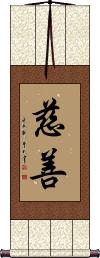
There are a few different words used to express charity in Chinese characters, Japanese Kanji and old Korean Hanja but 慈善 is the most common.
Some of the other words describe acts such as “giving alms” etc.
Note: Sometimes this is translated as benevolence or benevolent.
Also, this considered to be one of the Seven Heavenly Virtues.
If you need a different meaning, just contact me.
See Also: Benevolence | Altruism
Benevolence
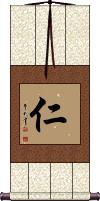
Beyond benevolence, 仁 can also be defined as “charity” or “mercy” depending on context.
The deeper meaning suggests that one should pay alms to the poor, care for those in trouble, and take care of his fellow man (or woman).
仁 is one of the five tenets of Confucius. In fact, it is a subject that Confucius spent a great deal of time explaining to his disciples.
I have also seen this benevolent-related word translated as perfect virtue, selflessness, love for humanity, humaneness, goodness, goodwill, or simply “love” in the non-romantic form.
This is also a virtue of the Samurai Warrior
See our page with just Code of the Samurai / Bushido here
Kindness / Benevolence
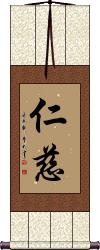
仁慈 word is used in Chinese, Korean, Japanese, and Asian Buddhism to relay the important idea of loving kindness.
仁慈 can also be defined as: benevolent; charitable; kind; merciful; kind-hearted; benevolence; kindness; humanity; mercy.
In Japanese, this can also be the given name Hitoji. This would also be a good Mandarin Chinese given name romanized as Jentzu (in Taiwan) or Renci (which sounds like ren-tsuh).
Love Binds Us Together
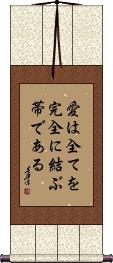
愛は全てを完全に結ぶ帯である is a Japanese phrase that suggests we (or a couple) are bound together by love.
I searched the web and found all of these English translation variations for this phrase:
Have love; The only way in which you may be completely joined together.
Love is the sash that perfectly binds us together.
Love is what binds us together
Love binds all things together in perfect unity.
This same Japanese phrase is used as part of Colossians 3:14 in at least one version of the Japanese Bible.
A few Biblical versions include:
...Charity, which is the bond of perfectness. (KJV)
...Love, which binds them all together in perfect unity. (NIV)
Note: Because this selection contains some special Japanese Hiragana characters, it should be written by a Japanese calligrapher.
Mercy / Compassion / Love
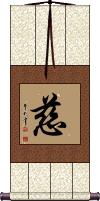
慈 is the simplest way to express the idea of compassion.
This can also mean love for your fellow humans, humanity, or living creatures. Sometimes this is extended to mean charity.
This term is often used in a Buddhist or Christian context. The concept was also spoken of by Laozi (Lao Tzu) in the Dao De Jing (Tao Te Ching).
慈 is considered the direct translation of the Sanskrit word मैत्री (maitrī) Pali word मेत्ता (mettā). In this context, it means benevolence, loving kindness, and goodwill.
This Chinese character is understood in Japanese but is usually used in compound words (not seen alone). Also used in old Korean Hanja, so it's very universal.
See Also: Mercy | Benevolence | Forgiveness | Kindness
The Five Tenets of Confucius
The Five Cardinal Rules / Virtues of Confucius
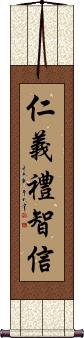
仁義禮智信 are the core of Confucius's philosophy.
Simply stated:
仁 = Benevolence / Charity
義 = Justice / Rectitude
禮 = Courtesy / Politeness / Tact
智 = Wisdom / Knowledge
信 = Fidelity / Trust / Sincerity
Many of these concepts can be found in various religious teachings. It should be clearly understood that Confucianism is not a religion but should instead be considered a moral code for a proper and civilized society.
This title is also labeled “5 Confucian virtues.”
 If you order this from the Japanese calligrapher, expect the middle Kanji to be written in a more simple form (as seen to the right). This can also be romanized as "jin gi rei satoshi shin" in Japanese. Not all Japanese will recognize this as Confucian tenets but they will know all the meanings of the characters.
See Also: Confucius Teachings | Ethics
Corinthians 13:4
All you need to know about LOVE
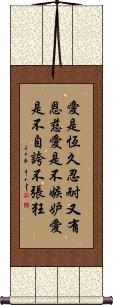
愛是恆久忍耐又有恩慈愛是不嫉妒愛是不自誇不張狂 is 1st Corinthians 13:4 in Chinese.
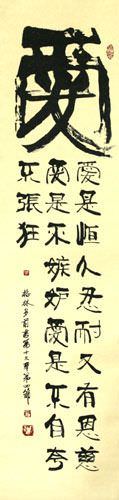
With large “love” character added.
In English, this reads:
1st Corinthians 13:4 (KJV) Charity suffereth long, and is kind; charity envieth not; charity vaunteth not itself, is not puffed up...
1st Corinthians 13:4 (NIV) Love is patient, love is kind. It does not envy, it does not boast, it is not proud.
1st Corinthians 13:4 (Basic English) Love is never tired of waiting; love is kind; love has no envy; love has no high opinion of itself, love has no pride.
The Chinese translation follows the love meaning, rather than the King James' use of “charity.” I was a little confused when writing this description with the significant differences between the NIV vs. KJV translations. After speaking to a Greek scholar about this, it would seem that the KJV has an almost errant translation with the use of “charity” in place of “love.”
We used the most popular Christian Chinese Bible, which is the Chinese Union Version (CUV). The CUV was first published in 1919. We use this so that the Chinese translation would be as accurate and standard as possible. Any Chinese Christian worth their salt will easily be able to identify this verse when they see these characters.
If you want a big “love” character written above the verse on your artwork, just make a note in the “special instructions” tab when you are customizing your artwork. There is no extra charge for that service on this special verse.
Corinthians 13:4

愛は忍耐強い。愛は情け深い。ねたまない。愛は自慢せず、高ぶらない。is 1st Corinthians 13:4 in Japanese.
In English, this reads:
1st Corinthians 13:4 (KJV) Charity suffereth long, and is kind; charity envieth not; charity vaunteth not itself, is not puffed up...
1st Corinthians 13:4 (NIV) Love is patient, love is kind. It does not envy, it does not boast, it is not proud.
1st Corinthians 13:4 (Basic English) Love is never tired of waiting; love is kind; love has no envy; love has no high opinion of itself, love has no pride.
If you want a big “love” character written above the verse on your artwork, just make a note in the “special instructions” tab when you are customizing your artwork. There is no extra charge for that service on this special verse.
Note: Because this selection contains some special Japanese Hiragana characters, it should be written by a Japanese calligrapher.
Dana: Almsgiving and Generosity
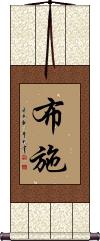
布施 is the Buddhist practice of giving known as Dāna or दान from Pali and Sanskrit.
Depending on the context, this can be alms-giving, acts of charity, or offerings (usually money) to a priest for reading sutras or teachings.
Some will put Dāna in these two categories:
1. The pure or unsullied charity, which looks for no reward here but only in the hereafter.
2. The sullied almsgiving whose object is personal benefit.
The first kind is, of course, the kind that a liberated or enlightened person will pursue.
Others will put Dāna in these categories:
1. Worldly or material gifts.
2. Unworldly or spiritual gifts.
You can also separate Dāna into these three kinds:
1. 財布施 Goods such as money, food, or material items.
2. 法布施 Dharma, as an act to teach or bestow the Buddhist doctrine onto others.
3. 無畏布施 Courage, as an act of facing fear to save someone or when standing up for someone or standing up for righteousness.
The philosophies and categorization of Dāna will vary among various monks, temples, and sects of Buddhism.
Breaking down the characters separately:
布 (sometimes written 佈) means to spread out or announce, but also means cloth. In ancient times, cloth or robs were given to the Buddhist monks annually as a gift of alms - I need to do more research, but I believe there is a relationship here.
施 means to grant, to give, to bestow, to act, to carry out, and by itself can mean Dāna as a single character.
Dāna can also be expressed as 檀那 (pronounced “tán nà” in Mandarin and dan-na or だんな in Japanese). 檀那 is a transliteration of Dāna. However, it has colloquially come to mean some unsavory or unrelated things in Japanese. So, I think 布施 is better for calligraphy on your wall to remind you to practice Dāna daily (or whenever possible).
Benevolent and Skilled Doctor
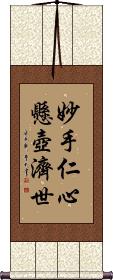
妙手仁心悬壶济世 is a phrase that celebrates the benevolence, skill, and service to his/her patients.
Here's a breakdown of the characters:
妙手 miào shǒu admirable skill in curing disease (when used in reference to doctors).
仁心 rén xīn kindheartedness, charity, benevolent heart.
悬壶济世 xuán hú jì shì practice medicine or pharmacy to help the people or the public.
Benevolent and Skilled Doctor
Short version

妙手仁心 is a phrase that celebrates the benevolence, skill, and service to his/her patients.
Here's a breakdown of the characters:
妙手 miào shǒu is an admirable skill in curing disease (when referring to doctors).
仁心 rén xīn kindheartedness, charity, benevolent heart.
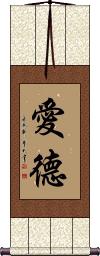
愛德 is a common transliteration to Mandarin Chinese for the name Ed.
愛德 mean “loving virtue” or charity.
Generosity
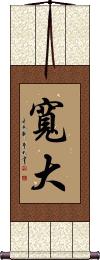
寬大 is a Chinese, Japanese, and Korean word that means Generosity.
Generosity is giving and sharing. You share freely, not with the idea of receiving something in return. You find ways to give others happiness and give just for the joy of giving. Generosity is one of the best ways to show love and friendship.
寬大 can also be translated as charitable, magnanimity, liberality, or in some contexts, broad-mindedness.
Note: There is a tiny deviation in the first character when written in Japanese. If you choose our Japanese master calligrapher, the little dot on the lower right of the first character will be omitted. With or without the dot, this can be read in Chinese, Japanese Kanji, and old Korean Hanja.
See Also: Benevolence | Altruism
Goddess of Mercy and Compassion
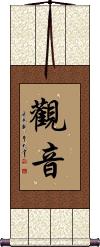
觀音/観音 is the Buddhist deity known as the Goddess of Mercy or Bodhisattva of Compassion.
In Chinese, the proper name of this being is Guan Yin. There is some debate as to whether Guan Yin is female. The argument comes from some scripture that suggests Buddhist deities take on the male form. Others say that Guan Yin has no sex. And still, others are okay with the female representation of Guan Yin.
This bodhisattva is also known or Romanized in the following ways:
Mandarin Chinese: Guan Yin, Kuan Yin, Kwan Yin.
Japanese: Kannon, Kwannon.
Sanskrit: Bodhisattva Avalokitesvara.
Korean: Gwan-eum.
Vietnamese: Quan Âm.
Thai: Kuan Eim.
English: Bodhisattva of Mercy and Salvation, Goddess of Compassion, Buddha of Mercy, et al.
Note: The first character has a slight variation in Japanese. If your audience is specifically Japanese, you may want to select that version.
See Also: Buddhism | Goddess | Namo Amitabha | Bodhisattva
Goddess of Mercy and Compassion
This is the long or more formal version of this title
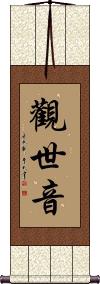
觀世音 is the longer and perhaps more formal title for the Buddhist deity known as the Goddess of Mercy or Bodhisattva of Compassion.
The longer title of this bodhisattva is Romanized in the following ways:
Mandarin Chinese: Guanshi Yin, Kuan-shih Yin.
Japanese: Kanzeon.
Sanskrit: Bodhisattva Avalokitesvara.
Korean: Gwan-se-eum.
Vietnamese: Quan Thế Âm.
Thai: Prah Mae Kuan Eim.
English: Bodhisattva of Mercy and Salvation, Goddess of Compassion, Buddha of Mercy, et al.
Please view our more common and shorter version, “Guan Yin” before you make a decision. Also, note that the first character has a slight variation in Japanese. If your audience is specifically Japanese, you may want to select that version.
Goddess of Compassion
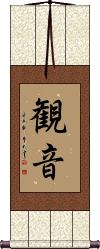
観音 is the specifically Japanese version of Bodhisattva of Compassion or Guan Yin.
In Japanese, this is pronounced Kannon and occasionally spelled Kwannon. The Chinese version is a bit more commonly seen in Asia. However, in Japanese, there is a slight variation with the first character.
Some time ago, a camera company in Japan named their company after this Buddhist deity. That camera company is still known as Canon (they chose a “C” instead of a “K” when they Romanized this name).
Goddess of Compassion
Long or more formal Japanese version of this title
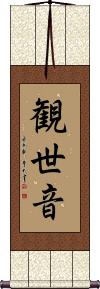
観世音 is the more extended and more formal Japanese version of Bodhisattva of Compassion or Guan Yin.
In Japanese, this is pronounced Kanzeon. The Chinese version is a bit more common in Asia, but in Japanese, they use a slight variation of the first character. Choose this version only if your intended audience is specifically Japanese.
Goodness / Good Deed
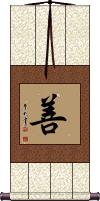
善 means goodness, virtue, good deed, charitable, benevolent, well-disposed, nice, pleasant, kind, or simply, “good.”
善 is the kind of good that applies to someone's good character, or a good person in general.
Referring to someone with this word means that they have a well-aimed moral compass, and are charitable, giving, wise, and honest. Basically, this is a blanket statement for every good trait a human can have or all the things that make someone good.
In another context, it can mean to improve or perfect something or refer to someone who is good at something.
Goodness / Kind-Hearted
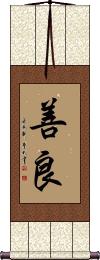
善良 is a word that means good and honest, kind-hearted, goodness, excellence, and/or virtue.
Helpfulness

樂於助人 is about helpfulness, being of service to others, and doing thoughtful things that make a difference in their lives.
Offer your help without waiting to be asked. Ask for help when you need it. When we help each other, we get more done. We make our lives easier.
See Also: Caring | Benevolence
Love for Humanity / Brotherly Love
benevolence, love
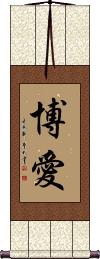
In Chinese and Korean, 博愛 means a universal fraternity, brotherhood, or universal love.
In Japanese, this means charity, benevolence, philanthropy, or love for humanity.
Please note these subtle differences and take that into account depending on your intended audience (Chinese, Korean or Japanese).
See Also: Benevolence | Altruism
Jin Shin Jyutsu
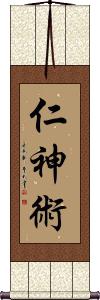
仁神術 is Jin Shin Jyutsu or Jin Shin Jutsu.
This is a practice of calming the mind and clearing the flow of Qi energy in the body. Jin Shin Jyutsu has some commonality with the practice of Reiki.
A good translation of 仁神術 would be “Benevolent Spirit Method.”
We can break that down into all of the possible meanings:
仁 = benevolence (esp. as a virtue of Confucianism), consideration, compassion, humanity, charity, kindness, or virtue.
神 = deity, soul, spirit, mysterious, psyche, god, divinity, spiritual powers, deva, divine, spiritual, or supernatural.
術 = way, method, means, art, trick, or plan. The correct romaji for this 術 Kanji should be “jutsu.” However, in martial arts, this is often written “jitsu” but in this case, “jyutsu” became common.
Benevolent Love
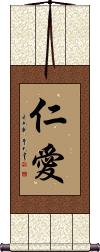
仁愛 is a word that means benevolence, charity, compassion, and/or love.
This can also be a Japanese female name that romanizes as Megumi.
Loving Heart / Compassion
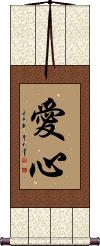
愛心 literally means “loving heart.” It can also be translated as “compassion.”
In Chinese, it carries more of a compassionate meaning.
愛心 is rarely used in Japanese anymore, so best if your audience is Chinese.
See Also: Compassion | Love
Loving Heart / One’s Love

戀心 literally means “loving heart.” It can also be translated as “one's love” or “awakening of love.”
戀心 is used exclusively for love between boyfriends and girlfriends or husband and wife.
Breaking down the meaning of each Kanji, the first means love, affection, or tender passion. The second Kanji means heart, mind, or soul (most will read it as the heart).
See Also: Compassion | Love
Mercy / Compassion / Buddhist Loving Kindness
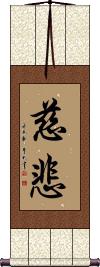
Besides the title above, 慈悲 can also be defined as clemency or lenience and sometimes the act of giving charity.
In the Buddhist context, it can be defined as “benevolence,” “loving-kindness and compassion,” or “mercy and compassion.”
This Buddhist virtue is perhaps the most important to employ in your life. All sentient beings that you encounter should be given your loving kindness. And trust me, however much you can give, it comes back. Make your life and the world a better place!
This Chinese/Japanese Buddhist term is the equivalent of Metta Karuna from Pali or Maitri Karuna from Sanskrit.
慈 can mean loving-kindness by itself.
悲 adds a component of sorrow, empathy, compassion, and sympathy for others.
See Also: Benevolence
Seven Heavenly Virtues
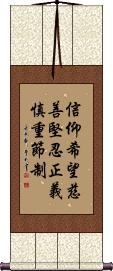
信仰希望慈善堅忍正義慎重節制 is a list in Chinese and Japanese Kanji of an interpretation of the Seven Heavenly Virtues.
1. Faith is belief in God, and the right virtues.
2. Hope is taking a positive future view that good will prevail.
3. Charity is a concern for, and active helping of, others.
4. Fortitude is never giving up.
5. Justice is being fair and equitable with others.
6. Prudence is care of and moderation with money.
7. Temperance is moderation of needed things and abstinence from things that are not needed.
The full list is here. 信仰希望慈善堅忍正義慎重節制 is a word list, not a common phrase. While all Chinese and Japanese people will recognize the words in the list, they may not understand what the list is about (unless they are familiar with the Seven Heavenly Virtues).
don’t get this as a tattoo or anything like that without first consulting a native translator in the target language. These are fine for a wall scroll but a long discussion is needed before you commit to this for a lifetime inking commitment.
Teach A Man To Fish
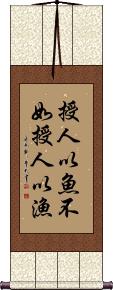
授人以魚不如授人以漁 is the Chinese version of the proverb, “Give a man a fish and you feed him for a day; teach a man to fish and you feed him for a lifetime.”
This implies that knowledge is the best charity.
The following table may be helpful for those studying Chinese or Japanese...
| Title | Characters | Romaji (Romanized Japanese) | Various forms of Romanized Chinese | |
| Charity | 慈善 | ji zen / jizen | cí shàn / ci2 shan4 / ci shan / cishan | tz`u shan / tzushan / tzu shan |
| Benevolence | 仁 | jin | rén / ren2 / ren | jen |
| Kindness Benevolence | 仁慈 | jin ji / jinji | rén cí / ren2 ci2 / ren ci / renci | jen tz`u / jentzu / jen tzu |
| Love Binds Us Together | 愛は全てを完全に結ぶ帯である | ai ha subete o kanzen ni musubu obi de aru | ||
| Mercy Compassion Love | 慈 | ji | cí / ci2 / ci | tz`u / tzu |
| The Five Tenets of Confucius | 仁義禮智信 仁义礼智信 | jin gi rei tomo nobu jingireitomonobu | rén yì lǐ zhì xìn ren2 yi4 li3 zhi4 xin4 ren yi li zhi xin renyilizhixin | jen i li chih hsin jenilichihhsin |
| Corinthians 13:4 | 愛是恆久忍耐又有恩慈愛是不嫉妒愛是不自誇不張狂 爱是恒久忍耐又有恩慈爱是不嫉妒爱是不自夸不张狂 | ài shì héng jiǔ rěn nài yòu yǒu én cí ài shì bú jì dù ài shì bú zì kuā bù zhāng kuáng ai4 shi4 heng2 jiu3 ren3 nai4 you4 you3 en2 ci2 ai4 shi4 bu2 ji4 du4 ai4 shi4 bu2 zi4 kua1 bu4 zhang1 kuang2 ai shi heng jiu ren nai you you en ci ai shi bu ji du ai shi bu zi kua bu zhang kuang | ai shih heng chiu jen nai yu yu en tz`u ai shih pu chi tu ai shih pu tzu k`ua pu chang k`uang ai shih heng chiu jen nai yu yu en tzu ai shih pu chi tu ai shih pu tzu kua pu chang kuang |
|
| Corinthians 13:4 | 愛は忍耐強い。愛は情け深い。ねたまない。愛は自慢せず、高ぶらない。 | ai ha nintai tsuyoi. ai ha nasakebukai. netama nai. ai ha jiman se zu, takabura nai. | ||
| Dana: Almsgiving and Generosity | 布施 | fuse | bù shī / bu4 shi1 / bu shi / bushi | pu shih / pushih |
| Benevolent and Skilled Doctor | 妙手仁心懸壺濟世 妙手仁心悬壶济世 | miào shǒu rén xīn xuán hú jì shì miao4 shou3 ren2 xin1 xuan2 hu2 ji4 shi4 miao shou ren xin xuan hu ji shi | miao shou jen hsin hsüan hu chi shih | |
| Benevolent and Skilled Doctor | 妙手仁心 | miào shǒu rén xīn miao4 shou3 ren2 xin1 miao shou ren xin miaoshourenxin | miao shou jen hsin miaoshoujenhsin |
|
| Ed | 愛德 爱德 | ài dé / ai4 de2 / ai de / aide | ai te / aite | |
| Generosity | 寬大 宽大 | kandai | kuān dà / kuan1 da4 / kuan da / kuanda | k`uan ta / kuanta / kuan ta |
| Goddess of Mercy and Compassion | 觀音 / 観音 观音 | kan non / kannon | guān yīn / guan1 yin1 / guan yin / guanyin | kuan yin / kuanyin |
| Goddess of Mercy and Compassion | 觀世音 观世音 | guān shì yīn guan1 shi4 yin1 guan shi yin guanshiyin | kuan shih yin kuanshihyin |
|
| Goddess of Compassion | 観音 | kan non / kannon | guān yīn / guan1 yin1 / guan yin / guanyin | kuan yin / kuanyin |
| Goddess of Compassion | 観世音 | kan ze on / kanzeon | guān shì yīn guan1 shi4 yin1 guan shi yin guanshiyin | kuan shih yin kuanshihyin |
| Goodness Good Deed | 善 | zen | shàn / shan4 / shan | |
| Goodness Kind-Hearted | 善良 | zen ryou / zenryou / zen ryo | shàn liáng shan4 liang2 shan liang shanliang | |
| Helpfulness | 樂於助人 乐于助人 | lè yú zhù rén le4 yu2 zhu4 ren2 le yu zhu ren leyuzhuren | le yü chu jen leyüchujen |
|
| Love for Humanity Brotherly Love | 博愛 博爱 | hakuai | bó ài / bo2 ai4 / bo ai / boai | po ai / poai |
| Jin Shin Jyutsu | 仁神術 | jin shin jutsu jinshinjutsu | rén shén shù ren2 shen2 shu4 ren shen shu renshenshu | jen shen shu jenshenshu |
| Benevolent Love | 仁愛 仁爱 | jinai | rén ài / ren2 ai4 / ren ai / renai | jen ai / jenai |
| Loving Heart Compassion | 愛心 爱心 | ài xīn / ai4 xin1 / ai xin / aixin | ai hsin / aihsin | |
| Loving Heart One’s Love | 戀心 恋心 | koi gokoro / koigokoro | ||
| Mercy Compassion Buddhist Loving Kindness | 慈悲 | ji hi / jihi | cí bēi / ci2 bei1 / ci bei / cibei | tz`u pei / tzupei / tzu pei |
| Seven Heavenly Virtues | 信仰希望慈善堅忍正義慎重節制 信仰希望慈善坚忍正义慎重节制 | shinkou kibou jizen kennin seigi shinchou sessei shinko kibo jizen kennin seigi shincho sesei | xìn yǎng xī wàng cí shàn jiān rěn zhèng yì shèn zhòng jié zhì xin4 yang3 xi1 wang4 ci2 shan4 jian1 ren3 zheng4 yi4 shen4 zhong4 jie2 zhi4 xin yang xi wang ci shan jian ren zheng yi shen zhong jie zhi | hsin yang hsi wang tz`u shan chien jen cheng i shen chung chieh chih hsin yang hsi wang tzu shan chien jen cheng i shen chung chieh chih |
| Teach A Man To Fish | 授人以魚不如授人以漁 授人以鱼不如授人以渔 | shòu rén yǐ yú bù rú shòu rén yǐ yú shou4 ren2 yi3 yu2 bu4 ru2 shou4 ren2 yi3 yu2 shou ren yi yu bu ru shou ren yi yu | shou jen i yü pu ju shou jen i yü | |
| In some entries above you will see that characters have different versions above and below a line. In these cases, the characters above the line are Traditional Chinese, while the ones below are Simplified Chinese. | ||||



