Many custom options...


And formats...



Sick in Chinese / Japanese...
Buy a Sick calligraphy wall scroll here!
Personalize your custom “Sick” project by clicking the button next to your favorite “Sick” title below...
Kill / Massacre / Mass Killing
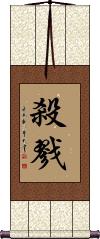
殺戮 is how to write “kill” or “massacre.”
殺戮 is an absolutely shocking word to have on a wall scroll. It will bewilder, scare, and perhaps offend any Chinese, Korean or Japanese person who sees it. I do not in any way recommend this for a piece of calligraphy artwork. This entry is only here because our calligraphy search engine received many requests for “kill” and “massacre.”
You are all a bunch of sick puppies!
Birth Old-Age Sickness Death
Born to Suffer
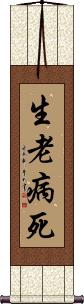
生老病死 means “to be born, to grow old, to get sick and to die” or “birth, aging, sickness, and death.”
This is an old somewhat-morbid Chinese proverb that is also used in Korean and Japanese. It figuratively means the fate of humankind (i.e. mortality) or suggests that we are all born to suffer.
In the Buddhist context, there are the “four inevitables in human life” or “four afflictions that are the lot of every human” known as “四苦” (literally “four afflictions”). Sometimes this proverb is written with that affliction character, 苦, at the end like 生老病死苦.
Reiki
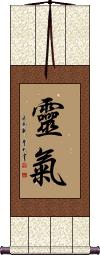
靈氣 is the title of a healing practice now found globally but with origins in Japan.
Special note: Outside of the context of the healing practice of Reiki, this means “aura” or “spiritual essence that surrounds all living things.” A Japanese person unfamiliar with the practice will take the “aura” meaning.
Reiki is a technique for stress reduction and relaxation that also heals. It can be compared to massage but is based on the idea that an unseen “life force energy” flows through us and is what causes us to be alive. If your life force energy is low, you'll be more likely to get sick or feel stressed. If your life force energy is abundant and flowing well, you become more capable of being happy and healthy.
There is a lot of information available if you want to Google this term - my job is to offer the calligraphy while you can decide if it is right for you.


Note: We are showing the ancient (traditional) form of the Reiki Kanji. I have seen Reiki written with the slightly simplified version and this more classic form. If you want the form of Reiki with the two strokes in the shape of an X on the second character and the modern first character, simply click on the Kanji characters to the right.
Note: 靈氣 is also a Chinese word, but in Chinese, these characters create a word that refers to a smart person or someone with high aspirations. It is not read as a healing method in Chinese.
In Korean Hanja, this can be read as a “mysterious atmosphere” by a Korean who is not familiar with the practice of Reiki (still has a cool meaning in Korean).
Not the results for sick that you were looking for?
Below are some entries from our dictionary that may match your sick search...
| Characters If shown, 2nd row is Simp. Chinese |
Pronunciation Romanization |
Simple Dictionary Definition |
布施 see styles |
bù shī bu4 shi1 pu shih fuho ふほ |
More info & calligraphy: Dana: Almsgiving and Generosity(n,vs,vi) (1) {Buddh} alms-giving; charity; (n,vs,vi) (2) {Buddh} offerings (usu. money) to a priest (for reading sutras, etc.); (surname) Fuho dāna 檀那; the sixth pāramitā, almsgiving, i. e. of goods, or the doctrine, with resultant benefits now and also hereafter in the forms of reincarnation, as neglect or refusal will produce the opposite consequences. The 二種布施 two kinds of dāna are the pure, or unsullied charity, which looks for no reward here but only hereafter; and the sullied almsgiving whose object is personal benefit. The three kinds of dāna are goods, the doctrine, and courage, or fearlessness. The four kinds are pens to write the sutras, ink, the sutras themselves, and preaching. The five kinds are giving to those who have come from a distance, those who are going to a distance, the sick, the hungry, those wise in the doctrine. The seven kinds are giving to visitors, travellers, the sick, their nurses, monasteries, endowments for the sustenance of monks or nuns, and clothing and food according to season. The eight kinds are giving to those who come for aid, giving for fear (of evil), return for kindness received, anticipating gifts in return, continuing the parental example of giving, giving in hope of rebirth in a particular heaven, in hope of an honoured name, for the adornment of the heart and life. 倶舍論 18. |
生老病死 see styles |
shēng lǎo bìng sǐ sheng1 lao3 bing4 si3 sheng lao ping ssu shouroubyoushi / shorobyoshi しょうろうびょうし |
More info & calligraphy: Birth Old-Age Sickness Death(yoji) {Buddh} the four inevitables in human life (birth, aging, sickness, and death) Birth, age, sickness, death, the 四苦 four afflictions that are the lot of every man. The five are the above four and 苦 misery, or suffering. |
疒 see styles |
ne ne4 ne |
sick; sickness; Kang Xi radical 104; also pr. [chuang2] |
病 see styles |
bìng bing4 ping yamai やまい |
illness; CL:場|场[chang2]; disease; to fall ill; defect (1) illness; disease; (2) bad habit; weakness; fault Illness, disease; to hurt. |
痡 see styles |
pū pu1 p`u pu |
sick; disabled |
瘁 see styles |
cuì cui4 ts`ui tsui |
care-worn; distressed; tired; overworked; sick; weary |
癠 see styles |
jì ji4 chi |
sick; diseased |
酸 see styles |
suān suan1 suan san さん |
sour; tart; sick at heart; grieved; sore; aching; pedantic; impractical; to make sarcastic remarks about sb; an acid (1) acid; (2) sourness; sour taste vinegar |
七子 see styles |
qī zǐ qi1 zi3 ch`i tzu chi tzu fumiko ふみこ |
(female given name) Fumiko The parable in the Nirvana Sutra of the sick son whose parents, though they love all their sons equally, devote themselves to him. So does the Buddha specially care for sinners. The seven sons are likened to mankind, devas, sravakas, pratyeka-buddhas, and the three kinds of bodhisattvas of the 藏, 通 and 別教. |
五德 see styles |
wǔ dé wu3 de2 wu te gotoku |
The five virtues, of which there are various definitions. The five virtues required in a confessor at the annual confessional ending the rainy retreat are: freedom from predilections, from anger, from fear, not easily deceived, discernment of shirkers of confession. Another group is the five virtues for a nurse of the sick, and there are others. |
作嘔 作呕 see styles |
zuò ǒu zuo4 ou3 tso ou |
to feel sick; to feel nauseous; to feel disgusted |
假別 假别 see styles |
jià bié jia4 bie2 chia pieh |
category of leave (maternity leave, sick leave etc) |
公假 see styles |
gōng jià gong1 jia4 kung chia |
official leave from work (e.g. maternity leave, sick leave or leave to attend to official business) |
加養 see styles |
kayou / kayo かよう |
(noun/participle) caring for the sick; taking care of oneself; (place-name, surname) Kayou |
厭煩 厌烦 see styles |
yàn fán yan4 fan2 yen fan enbon |
bored; fed up with something; sick of something to trouble |
吃傷 see styles |
chī shāng chi1 shang1 ch`ih shang chih shang |
to become sick of a food after eating it too much |
吃膩 吃腻 see styles |
chī nì chi1 ni4 ch`ih ni chih ni |
to be sick of eating (something); to be tired of eating (something) |
害病 see styles |
hài bìng hai4 bing4 hai ping |
to fall sick; to contract an illness |
帶病 带病 see styles |
dài bìng dai4 bing4 tai ping |
to be suffering from an illness (often implying "in spite of being sick"); to carry the causative agent of an infectious disease |
心塞 see styles |
xīn sāi xin1 sai1 hsin sai |
(coll.) to feel sick at heart; to feel stifled; to feel crushed |
恙む see styles |
tsutsumu つつむ |
(Godan verb with "mu" ending) (archaism) to become sick; to be struck by a disaster; to hinder; to be hindered; to run into problems; to have an accident |
慰問 慰问 see styles |
wèi wèn wei4 wen4 wei wen imon いもん |
to express sympathy, greetings, consolation etc (noun, transitive verb) visit to console someone; giving comfort (to the sick, injured, etc.); expressing condolences (sympathy, concern, etc.); sympathy call to greet |
探病 see styles |
tàn bìng tan4 bing4 t`an ping tan ping |
to visit a sick person or patient |
施浴 see styles |
seyoku せよく |
bath at a temple for the poor, sick and prisoners |
暈血 晕血 see styles |
yùn xuè yun4 xue4 yün hsüeh |
to feel sick when seeing blood |
有疾 see styles |
yǒu jí you3 ji2 yu chi u shitsu |
be sick |
湯取 see styles |
yutori ゆとり |
(irregular okurigana usage) (1) clothing to absorb dampness after bathing; yukata; (2) (abbreviation) twice-boiled rice (for sick persons); (3) (archaism) scoop for removing bilge water |
滅病 灭病 see styles |
miè bìng mie4 bing4 mieh ping metsubyō |
One of the 四病 four sick or faulty ways of seeking perfection, the Hīnayāna method of endeavouring to extinguish all perturbing passions so that nothing of them remains. |
焦炙 see styles |
jiāo zhì jiao1 zhi4 chiao chih |
to scorch; to burn to charcoal; sick with worry |
病人 see styles |
bìng rén bing4 ren2 ping jen byounin / byonin びょうにん |
sick person; patient; invalid; CL:個|个[ge4] sick person; patient; invalid sick person |
Click here for more sick results from our dictionary
The following table may be helpful for those studying Chinese or Japanese...
| Title | Characters | Romaji (Romanized Japanese) | Various forms of Romanized Chinese | |
| Kill Massacre Mass Killing | 殺戮 杀戮 | satsuriku | shā lù / sha1 lu4 / sha lu / shalu | |
| Birth Old-Age Sickness Death | 生老病死 | shou rou byou shi shouroubyoushi sho ro byo shi | shēng lǎo bìng sǐ sheng1 lao3 bing4 si3 sheng lao bing si shenglaobingsi | sheng lao ping ssu shenglaopingssu |
| Reiki | 靈氣 灵气 霊気 | reiki | líng qì / ling2 qi4 / ling qi / lingqi | ling ch`i / lingchi / ling chi |
| In some entries above you will see that characters have different versions above and below a line. In these cases, the characters above the line are Traditional Chinese, while the ones below are Simplified Chinese. | ||||

Successful Chinese Character and Japanese Kanji calligraphy searches within the last few hours...



