I am shipping orders on Thursday this week. News and More Info
Buy a Shin Jodo Shu calligraphy wall scroll here!
Personalize your custom “Shin Jodo Shu” project by clicking the button next to your favorite “Shin Jodo Shu” title below...
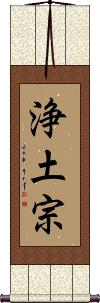
浄土 means “Pure Land.”
This term, “Pure Land” is often associated with the Western Pure Land paradise of Amitabha, also known as the “Buddhist paradise.”
浄土 can also be used as an abbreviation for “Pure Land Buddhism.”
You may see this romanized as Jodo, Joudo, or Jōdo. Some also combine Pure Land into Pureland in English.
This can also be a Japanese surname with the same Jodo or Joudo pronunciation.
See Also: Shin Buddhism
Also a sect of Buddhism
淨土 literally means “pure land” or “clean earth.”
淨土 is also the abbreviated title of a Buddhist sect that involves faith in the rebirth of Buddha Amitabha (Amitābha) in the Western Heaven. Sometimes this sect is translated as “Paradise of the West.” Other titles of this school of Buddhism include Amidism or Elysium.
See Also: Nirvana | Shin Buddhism
浄土宗 is the title of Japanese “Pure Land Buddhism.” This form is also romanized/known as “Jodo Shu” (jōdo shū).
Also known as Amidism for the fact that this is a branch of Mahayana (Mahāyāna) Buddhism which focuses on Amitabha (Amitābha) Buddha. This form of Buddhism, along with Chinese characters, came to Japan via China in the 5th century, according to most historians.
Notes:
Pure Land Buddhism is also known as ![]()
![]()
![]()
(jōdo bukkyō).
Some will just express it with just ![]()
(Pure Land).
See Also: Shin Buddhism
Below are some entries from our dictionary that may match your shin jodo shu search...
| Characters If shown, 2nd row is Simp. Chinese |
Pronunciation Romanization |
Simple Dictionary Definition |
淨土宗 净土宗 see styles |
jìng tǔ zōng jing4 tu3 zong1 ching t`u tsung ching tu tsung Jōdo Shū |
Pure Land Buddhism The Pure-land sect, whose chief tenet is salvation by faith in Amitābha; it is the popular cult in China, also in Japan, where it is the Jōdo sect; it is also called 蓮宗(蓮花宗) the Lotus sect. Established by Hui-yuan 慧遠 of the Chin dynasty (317— 419), it claims P'u-hsien 普賢 Samantabhadra as founder. Its seven chief textbooks are 無量淸淨平等覺經; 大阿彌陀經; 無量壽經; 觀無量壽經; 阿彌陀經; 稱讚淨土佛攝受經; and 鼓音聲三陀羅尼經. The淨土眞宗 is the Jōdo-Shin, or Shin sect of Japan. |
宗派 see styles |
zōng pài zong1 pai4 tsung p`ai tsung pai shuuha / shuha しゅうは |
sect (1) sect; denomination; (2) school (e.g. of poetry) Sects (of Buddhism). In India, according to Chinese accounts, the two schools of Hīnayāna became divided into twentysects. Mahāyāna had two main schools, the Mādhyamika, ascribed to Nāgārjunaand Āryadeva about the second century A. D., and the Yogācārya, ascribed toAsaṅga and Vasubandhu in the fourth century A. D. In China thirteen sectswere founded: (1) 倶舍宗 Abhidharma or Kośa sect, representing Hīnayāna,based upon the Abhidharma-kosa-śāstra or 倶舍論. (2) 成實宗 Satyasiddhi sect, based on the 成實論 Satyasiddhi-śāstra,tr. by Kumārajīva; no sect corresponds to it in India; in China and Japan itbecame incorporated in the 三論宗. (3) 律宗 Vinaya or Discipline sect, basedon 十誦律, 四分律, 僧祗律, etc. (4) 三論宗 The three śāstra sect, based on theMādhyamika-śāstra 中觀論 of Nāgārjuna, theSata-śāstra 百論 of Āryadeva, and theDvādasa-nikāya-śāstra 十二門論 of Nāgārjuna; this schooldates back to the translation of the three śāstras by Kumārajīva in A. D. 409. (5) 涅槃宗 Nirvāṇasect, based upon the Mahāparinirvāṇa-sūtra 涅槃經 tr. byDharmaraksa in 423; later incorporated in Tiantai, with which it had much incommon. (6) 地論宗 Daśabhūmikā sect, based on Vasubandhu's work on the tenstages of the bodhisattva's path to Buddhahood, tr. by Bodhiruci 508,absorbed by the Avataṃsaka school, infra. (7) 淨土宗 Pure-land or Sukhāvatīsect, founded in China by Bodhiruci; its doctrine was salvation throughfaith in Amitābha into the Western Paradise. (8) 禪宗 dhyāna, meditative or intuitional sect, attributed toBodhidharma about A. D. 527, but it existed before he came to China. (9) 攝論宗, based upon the 攝大乘論 Mahāyāna-saṃparigraha-śāstra byAsaṅga, tr. by Paramārtha in 563, subsequently absorbed by the Avataṃsakasect. (10) 天台宗 Tiantai, based on the 法華經 SaddharmapuṇḍarīkaSūtra, or the Lotus of the Good Law; it is aconsummation of the Mādhyamika tradition. (11) 華嚴宗 Avataṃsaka sect, basedon the Buddhāvataṃsaka-sūtra, or Gandha-vyūha 華嚴經 tr. in 418. (12) 法相宗 Dharmalakṣaṇa sect, established after thereturn of Xuanzang from India and his trans. of the important Yogācāryaworks. (13) 眞言宗 Mantra sect, A. D. 716. In Japan twelve sects are named:Sanron, Hossō, Kegon, Kusha, Jōjitsu, Ritsu, Tendai, Shingon; these areknown as the ancient sects, the two last being styled mediaeval; therefollow the Zen and Jōdo; the remaining two are Shin and Nichiren; at presentthere are the Hossō, Kegon, Tendai, Shingon, Zen, Jōdo, Shin, and Nichirensects. |
一向宗 see styles |
yī xiàng zōng yi1 xiang4 zong1 i hsiang tsung ikkoushuu / ikkoshu いっこうしゅう |
(See 浄土真宗) Ikkō sect (of Buddhism); Jōdo Shinshū; True Pure Land School The 眞宗 Shin or Pure-land Shin Sect founded by Shinran, in Japan, whose chief tenet is unwavering reflection on Amida (by repeating his name). |
不來迎 不来迎 see styles |
bù lái yíng bu4 lai2 ying2 pu lai ying fu raigō |
Without being called he comes to welcome; the Pure-land sect believes that Amitābha himself comes to welcome departing souls of his followers on their calling upon him, but the 淨土眞宗 (Jōdo Shin-shu sect) teaches that belief in him at any time ensures rebirth in the Pure Land, independently of calling on him at death. |
成道之辰 see styles |
chéng dào zhī chén cheng2 dao4 zhi1 chen2 ch`eng tao chih ch`en cheng tao chih chen jōdō no shin |
occasion of the attainment of the way |
The following table may be helpful for those studying Chinese or Japanese...
| Title | Characters | Romaji (Romanized Japanese) | Various forms of Romanized Chinese | |
| Pure Land Jodo | 浄土 | jou do / joudo / jo do | jìng tǔ / jing4 tu3 / jing tu / jingtu | ching t`u / chingtu / ching tu |
| Pure Land Jodo | 淨土 净土 | jou do / joudo / jo do | jìng tǔ / jing4 tu3 / jing tu / jingtu | ching t`u / chingtu / ching tu |
| Pure Land Buddhism Jodo Buddhism | 淨土宗 浄土宗 | jou do shuu joudoshuu jo do shu | jìng tǔ zōng jing4 tu3 zong1 jing tu zong jingtuzong | ching t`u tsung chingtutsung ching tu tsung |
| In some entries above you will see that characters have different versions above and below a line. In these cases, the characters above the line are Traditional Chinese, while the ones below are Simplified Chinese. | ||||
Successful Chinese Character and Japanese Kanji calligraphy searches within the last few hours...

All of our calligraphy wall scrolls are handmade.
When the calligrapher finishes creating your artwork, it is taken to my art mounting workshop in Beijing where a wall scroll is made by hand from a combination of silk, rice paper, and wood.
After we create your wall scroll, it takes at least two weeks for air mail delivery from Beijing to you.
Allow a few weeks for delivery. Rush service speeds it up by a week or two for $10!
When you select your calligraphy, you'll be taken to another page where you can choose various custom options.
The wall scroll that Sandy is holding in this picture is a "large size"
single-character wall scroll.
We also offer custom wall scrolls in small, medium, and an even-larger jumbo size.
Professional calligraphers are getting to be hard to find these days.
Instead of drawing characters by hand, the new generation in China merely type roman letters into their computer keyboards and pick the character that they want from a list that pops up.
There is some fear that true Chinese calligraphy may become a lost art in the coming years. Many art institutes in China are now promoting calligraphy programs in hopes of keeping this unique form
of art alive.
Even with the teachings of a top-ranked calligrapher in China, my calligraphy will never be good enough to sell. I will leave that to the experts.
The same calligrapher who gave me those lessons also attracted a crowd of thousands and a TV crew as he created characters over 6-feet high. He happens to be ranked as one of the top 100 calligraphers in all of China. He is also one of very few that would actually attempt such a feat.
Check out my lists of Japanese Kanji Calligraphy Wall Scrolls and Old Korean Hanja Calligraphy Wall Scrolls.
Some people may refer to this entry as Shin Jodo Shu Kanji, Shin Jodo Shu Characters, Shin Jodo Shu in Mandarin Chinese, Shin Jodo Shu Characters, Shin Jodo Shu in Chinese Writing, Shin Jodo Shu in Japanese Writing, Shin Jodo Shu in Asian Writing, Shin Jodo Shu Ideograms, Chinese Shin Jodo Shu symbols, Shin Jodo Shu Hieroglyphics, Shin Jodo Shu Glyphs, Shin Jodo Shu in Chinese Letters, Shin Jodo Shu Hanzi, Shin Jodo Shu in Japanese Kanji, Shin Jodo Shu Pictograms, Shin Jodo Shu in the Chinese Written-Language, or Shin Jodo Shu in the Japanese Written-Language.
104 people have searched for Shin Jodo Shu in Chinese or Japanese in the past year.
Shin Jodo Shu was last searched for by someone else on Oct 18th, 2025