Many custom options...


And formats...



Rational in Chinese / Japanese...
Buy a Rational calligraphy wall scroll here!
Harmony / Balance
Cho Wa
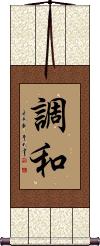
調和 is one of the several ways to express harmony in Chinese and Japanese.
Note: The first character means harmony but also suggests a musical meaning. It can also describe warriors marching in perfect cadence (in step) or to regulate something.
The second character carries the meaning of harmony and peace by itself.
Together, these characters create a word that can be defined as harmonious, to mediate, to reconcile, to compromise; mediation, temper, to mix, blend, blended, season, seasoning (getting the flavors of the food in balance), to placate, or be in harmonious proportion.
The meaning varies depending on the context. However, when hanging as a wall scroll, this will refer to the person (you) being balanced and in harmony while rational and under control simultaneously.
Not the results for rational that you were looking for?
Below are some entries from our dictionary that may match your rational search...
| Characters If shown, 2nd row is Simp. Chinese |
Pronunciation Romanization |
Simple Dictionary Definition |
摩 see styles |
mó mo2 mo ma |
to rub ? 沙 manuṣya,摩 ?奢; 摩 ?賖 man, any rational being, v. 末? 沙, 摩奴沙.; To feel, handle, rub; translit. m, ma, mu, ba; cf. 末, 磨. |
合理 see styles |
hé lǐ he2 li3 ho li gouri / gori ごうり |
rational; reasonable; sensible; fair rationality; (female given name) Auri in accord with reason |
愛行 爱行 see styles |
ài xíng ai4 xing2 ai hsing yoshiyuki よしゆき |
(given name) Yoshiyuki Emotional behavior, or the emotions of desire, as contrasted with 見行 rational behavior. |
愛見 爱见 see styles |
ài jiàn ai4 jian4 ai chien emi えみ |
(female given name) Emi Attachment or love growing from thinking of others. Also, attachment to things 愛 and attachment to false views 見; also emotional and rational. |
有意 see styles |
yǒu yì you3 yi4 yu i yuui / yui ゆうい |
to intend; intentionally; interested in (adj-na,adj-no,n) (1) significant; meaningful; (adj-no,adj-na,n) (2) intentional; volitional mati; matimant; possessing mind, intelligent; a tr. of manuṣya, man, a rational being. The name of the eldest son of Candra-sūrya-pradīpa. |
有理 see styles |
yǒu lǐ you3 li3 yu li yuri ゆり |
reasonable; justified; right; (math.) rational (can be adjective with の) (1) rational; (can be adjective with の) (2) {math} rational (number or function); (female given name) Yuri reasonable |
格物 see styles |
gé wù ge2 wu4 ko wu |
to study the underlying principles, esp. in neo-Confucian rational learning 理學|理学[li3 xue2]; word for Western natural sciences during late Qing |
理外 see styles |
rigai りがい |
supra-rational |
理性 see styles |
lǐ xìng li3 xing4 li hsing risei / rise りせい |
reason; rationality; rational reason; reasoning power; (one's) sense Absolute nature, immutable reality, fundamental principle or character. |
理智 see styles |
lǐ zhì li3 zhi4 li chih richi りち |
reason; intellect; rationality; rational intellect; intelligence; (female given name) Richi Principle and gnosis (or reason); the noumenal in essence and in knowledge; the truth in itself and in knowledge; li is also the fundamental principle of the phenomenon under observation, chih the observing wisdom; one is reality, the other the knower or knowing; one is the known object, the other the knower, the knowing, or what is known; each is dependent on the other, chih depends on lili is revealed by chih. Also knowledge or enlightenment in its essence or purity, free from incarnational influences. |
科學 科学 see styles |
kē xué ke1 xue2 k`o hsüeh ko hsüeh |
science; scientific knowledge; scientific; rational; CL:門|门[men2],個|个[ge4],種|种[zhong3] See: 科学 |
道學 道学 see styles |
dào xué dao4 xue2 tao hsüeh |
Confucian study of ethics; study of Daoism; school for Daoism in Tang and Song times; Daoist magic; another name for 理學|理学, rational learning of Song dynasty neo-Confucianism See: 道学 |
合理的 see styles |
gouriteki / goriteki ごうりてき |
(adjectival noun) rational; reasonable; logical |
循環節 循环节 see styles |
xún huán jié xun2 huan2 jie2 hsün huan chieh |
recurring section of a rational decimal |
摩奴沙 see styles |
mó nú shā mo2 nu2 sha1 mo nu sha manusha |
(or 摩奴闍), v. 末奴沙 manuṣya, mānuṣa, man, any rational being. |
有理式 see styles |
yǒu lǐ shì you3 li3 shi4 yu li shih yuurishiki / yurishiki ゆうりしき |
rational expression (math.) rational expression |
有理数 see styles |
yuurisuu / yurisu ゆうりすう |
{math} rational number |
有理數 有理数 see styles |
yǒu lǐ shù you3 li3 shu4 yu li shu |
rational number (i.e. fraction of two integers, math.) See: 有理数 |
理中客 see styles |
lǐ zhōng kè li3 zhong1 ke4 li chung k`o li chung ko |
rational, neutral, objective (abbr. for 理性、中立、客觀|理性、中立、客观[li3 xing4 , zhong1 li4 , ke4 guan1]) |
理性的 see styles |
riseiteki / riseteki りせいてき |
(adjectival noun) rational |
示性式 see styles |
shiseishiki / shiseshiki しせいしき |
{chem} rational formula |
緣慮心 缘虑心 see styles |
yuán lǜ xīn yuan2 lv4 xin1 yüan lü hsin enryo shin |
The rational cogitating mind; also 慮知心 the cogitating perceiving mind. |
道理義 道理义 see styles |
dào lǐ yì dao4 li3 yi4 tao li i dōri gi |
rational |
有理數域 有理数域 see styles |
yǒu lǐ shù yù you3 li3 shu4 yu4 yu li shu yü |
field of rational numbers (math.), usually denoted by Q |
有理數集 有理数集 see styles |
yǒu lǐ shù jí you3 li3 shu4 ji2 yu li shu chi |
set of rational numbers (math.) |
有理関数 see styles |
yuurikansuu / yurikansu ゆうりかんすう |
{math} rational function |
有道理義 有道理义 see styles |
yǒu dào lǐ yì you3 dao4 li3 yi4 yu tao li i u dōri gi |
rational |
理性知識 理性知识 see styles |
lǐ xìng zhī shi li3 xing4 zhi1 shi5 li hsing chih shih |
rational knowledge |
理性認識 理性认识 see styles |
lǐ xìng rèn shi li3 xing4 ren4 shi5 li hsing jen shih |
cognition; rational knowledge |
省エネ法 see styles |
shouenehou / shoeneho しょうエネほう |
(1) {law} (abbr. of エネルギーの使用の合理化等に関する法律) Law Concerning the Rational Use of Energy; (2) energy saving law |
Click here for more rational results from our dictionary
The following table may be helpful for those studying Chinese or Japanese...
| Title | Characters | Romaji (Romanized Japanese) | Various forms of Romanized Chinese | |
| Harmony Balance | 調和 调和 | chou wa / chouwa / cho wa | tiáo hé / tiao2 he2 / tiao he / tiaohe | t`iao ho / tiaoho / tiao ho |
| In some entries above you will see that characters have different versions above and below a line. In these cases, the characters above the line are Traditional Chinese, while the ones below are Simplified Chinese. | ||||

Successful Chinese Character and Japanese Kanji calligraphy searches within the last few hours...



