Many custom options


And formats



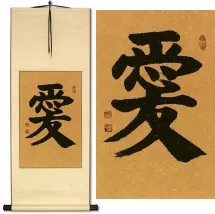
First Love in Chinese / Japanese
Buy a First Love calligraphy wall scroll here!
Personalize your custom “First Love” project by clicking the button next to your favorite “First Love” title below.
1. First Love
2. Best Love / Most Sincere Love
3. Eternal Love / Love Eternally
4. Eternal Love
5. Forever Love
6. Passionate Love / Ardent Love and Devotion
9. My True Love
10. Love Forever / Love Eternal
11. True Love
12. Love and Honor
13. Peace and Love
14. Love and Honor
15. Infinite Love
16. Live Laugh Love
18. Best
19. Love and Respect
20. Greatest Love
21. Love and Respect
22. Forbidden Love
23. Love and Hate
25. Love and Hate
27. Family Love / Domestic Bliss
28. The Karma/Fate/Destiny that Brings Lovers Together
29. Appreciation and Love for Your Parents
31. Soul Mates
33. Erin
35. Corinthians 13:4
37. Generosity
38. Eternal Friendship / Friends Forever
39. I Need You
41. I Need You
42. Kindheartedness / Benevolence / Humanity
43. Sushi
44. Lover / Spouse / Sweetheart
45. Daodejing / Tao Te Ching - Excerpt
46. Beauty / Beautiful / Handsome
47. The one who retreats 50 paces mocks the one to retreats 100
48. Daoism / Taoism
49. Islam
50. Art of War: 5 Points of Analysis
First Love
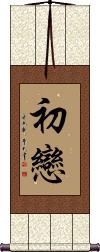
初戀 means “first love” in Chinese and Japanese.
You could also say that it means “first crush,” “first affection,” or “puppy love.”
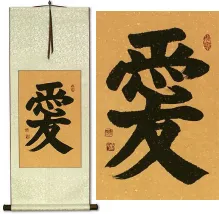
 In Japanese and Simplified Chinese, they write the second character as shown to the right. If you want this version, click on the characters to the right instead of the Select and Customize button above.
Best Love / Most Sincere Love
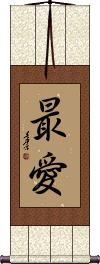
最愛 is a Japanese word that means the best love, beloved, or most sincere love of your life.
This could be a romantic love such as your love for your spouse or a boyfriend/girlfriend.
It can also apply to the extreme love you have for your children or a parent and maybe a really good friend.
See Also: I Love You
Best Love / Most Sincere Love
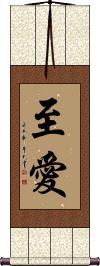
至愛 can mean the best love or most sincere love of your life.
This could be a romantic love such as your love for your spouse or a boyfriend/girlfriend.
It can also apply to the extreme love you have for your children or a parent and maybe a really good friend.
See Also: I Love You
Eternal Love / Love Eternally
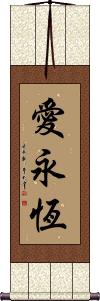
愛永恆 is the shortest way to express the idea of “love eternally” in Chinese.
The first character here means “love”
The last two mean eternal, eternally, everlasting, and/or perpetual.
See Also: Forever Love
Eternal Love
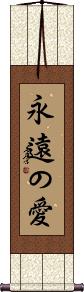
永遠の愛 is a great way to write “Eternal Love” in Japanese.
The first two characters mean eternal, eternity, perpetuity, forever, immortality, and permanence.
The third character is a possessive article which sort of makes this selection mean “Love, of the eternal kind.”
The last character is “love.”
Cultural note: Most of the time, it is taboo to use the word “love” in Japanese. For instance, a Japanese man will say, “I like you,” rather than, “I love you,” to his spouse/girlfriend. However, this entry for eternal love is acceptable because of the way it is composed.
This entry is only appropriate if your audience is Japanese. We also have a Chinese version of this eternal love.
See Also: Forever Love | Love
Eternal Love
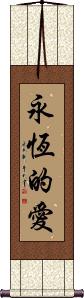
永恆的愛 is the best way to write “Eternal Love” in Chinese.
The first two characters mean eternal, eternally, everlasting, and/or perpetual.
The third character is a possessive article which sort of makes this selection mean “Love of the eternal kind.”
The last character is “love.”
This version is best if your audience is Chinese. We also have a Japanese version of eternal love.
See Also: Forever Love | Love
Forever Love
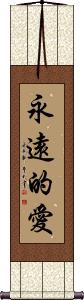
永遠的愛 refers to love that will last forever.
The first two characters mean forever, eternal, eternity, perpetuity, immortality, and/or permanence.
The third character is a possessive article which sort of makes this selection mean “The forever kind of love.”
The last character is “love.”
See Also: Love
Passionate Love / Ardent Love and Devotion
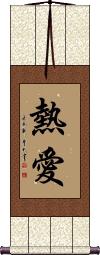
熱愛 means love passionately, ardent love, devotion, adoration.
The literal meaning is “hot love,” as the first character means heat, fervent, hot, and warm. Sometimes it can mean fever, restlessness, or zeal. The second character is, of course, love. If you adore and are devoted to someone with all your love, this is the title for you.
Love Myself First
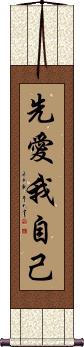
This directly translates as, “First, love myself.”
While you might be looking for “Love yourself first,” there's the problem with yourself versus myself. If this is on your wall or tattooed on your arm, should it not say “myself” since it's directed at you, and not others?
See Also: Love Yourself First
Love Yourself First
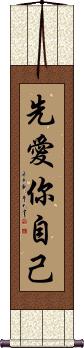
This directly translates as, “First, love yourself.”
Because this uses “yourself” instead of “myself,” this is a direction for those reading it. It could be the owner of the art or those who view it.
This would be weird as a tattoo, so please avoid it since for whom the tattoo is directed would be confusing.
See Also: Love Myself First
My True Love
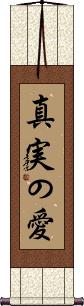
真実の愛 means “true love” or “genuine affection” in Japanese.
The first two Kanji mean true, real, genuine, or authentic.
The third Kanji is a connecting possessive article.
The last character is love or affection.
Love Forever / Love Eternal
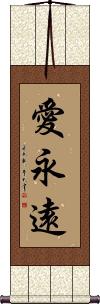
The first character here means “love.”
The last two mean forever, eternity, eternal, perpetuity, immortality, and/or permanence.
愛永遠 is the shortest and most universal way to express this idea in Chinese and Japanese.
Japanese note: This sound more like a title than a phrase in Japanese (if that makes any sense). 愛永遠 is a great title for a romantic book, the title of a movie, the name of a perfume, or even a name for a store.
See Also: Eternal Love | Forever Love
True Love
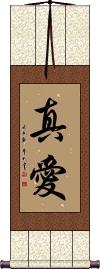
真愛 is literally “True Love” in Chinese.
The first character means “real,” “true,” and “genuine.” The second character means “love” and “affection.”
During the customization of your calligraphy wall scroll, there is a place to add an inscription. You might want that inscription to be your names in Chinese down the side of your wall scroll or perhaps just below these two main characters (just $9 extra). A nice gift to celebrate an anniversary or marriage!
Love and Honor
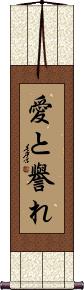
愛と譽れ means to love and honor in Japanese.
The first Kanji is literally “love.”
The second character just acts to connect the ideas like “and” or “with.”
The last two Kanji mean “honor” or “honour.” This is the kind of honor that suggests you are praising or admiring someone.
Note: Because this selection contains some special Japanese Hiragana characters, it should be written by a Japanese calligrapher.
See Also: Love and Honor
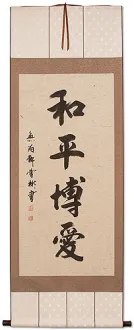
Peace and Love
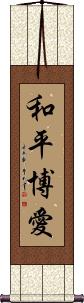
和平博愛 is the Chinese and Japanese way to express “Peace and Love.”
These are two separate words, so the calligrapher will put a slight space between the first two characters, which mean peace, and the last two, which represent universal love. This space is not shown on the sample character images for this phrase.
A special note: Word lists may seem okay in English but feel strange in Chinese and Japanese. We don't offer too many of them but this one is often-requested and feels okay in Chinese and Japanese, though a bit uncommon in Korean.
See Also: Worldwide Peace | Love
Love and Honor
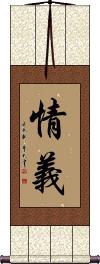
情義 means to love and honor in Chinese. 情義 is more or less the kind of thing you'd find in marriage vows.
The first character suggests emotions, passion, heart, humanity, sympathy, and feelings.
In this context, the second character means to honor your lover's wishes and treat them justly and righteously (fairly). That second character can also be translated as “obligation,” as in the obligation a husband and wife have to love each other even through difficult times.
In the context outside of a couple's relationship, this word can mean “comradeship.”
Japanese may see this more as “humanity and justice” than “love and honor.” It's probably best if your target is Chinese.
This is the short and sweet form, there is also a longer poetic form (you can find it here: Love and Honor if it’s not on the page you are currently viewing).
See Also: Love and Honor
Love and Honor
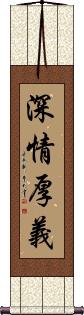
深情厚義 means to love and honor.
This is more or less the kind of thing you'd find in marriage vows.
The first two characters suggest deep love or deep emotions, passion, and feelings.
The last two characters mean generous justice or thick honor (the third character is an adjective that means generous or thick). It just means that you will honor your lover's wishes and treat them justly and righteously (fairly).
This is the longer four-character version, there is also a short and sweet two character version.
See Also: Love and Honor
Infinite Love
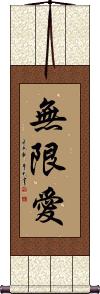
無限愛 is the Chinese and Japanese title meaning infinite love, unlimited love, or unbounded love.
The first character means never, not, or like the prefix “un-.”
The second means limited, restricted, or bound.
The third means love or affection.
Live Laugh Love
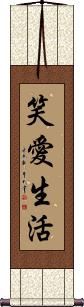
In English, the word order shown in the title is the most natural or popular. In Chinese, the natural order is a little different:
The first character means laugh (sometimes means smile).
The second character means love.
The last two characters mean “live” as in “to be alive” or “pursue life.”
Please note: 笑愛生活 is not a normal phrase in that it does not have a subject, verb, or object. It is a word list. Word lists are not common in Asian languages/grammar (at least not as normal as in English). We only added this entry because so many people requested it.
We put the characters in the order shown above, as it almost makes a single word with the meaning “A life of laughter and love.” It's a made-up word, but it sounds good in Chinese.
We removed the Japanese pronunciation guide from this entry, as the professional Japanese translator deemed it “near nonsense” from a Japanese perspective. Choose this only if your audience is Chinese and you want the fewest-possible characters to express this idea.
In Korean, this would be 소애생활 or “so ae saeng hwar” but I have not confirmed that this makes sense in Korean.
Loving Heart / One’s Love
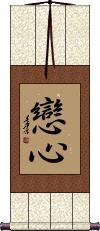
戀心 literally means “loving heart.” It can also be translated as “one's love” or “awakening of love.”
戀心 is used exclusively for love between boyfriends and girlfriends or husband and wife.
Breaking down the meaning of each Kanji, the first means love, affection, or tender passion. The second Kanji means heart, mind, or soul (most will read it as the heart).
See Also: Compassion | Love
Best
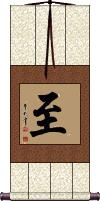
至 is a little strange as calligraphy, but 至 would be the character that means “best” or “extreme” in Chinese and Korean.
The problem is, this is seldom used alone. It's mostly used in combination with other characters to make words like “best friend,” “best food,” and “best love.”
I do not recommend this character for a wall scroll. It's better if you find a more specific term that fits your circumstances.
Note: This can be pronounced in Japanese and has a similar meaning but it is rarely if ever used in modern Japanese.
Love and Respect
Love and respect each other
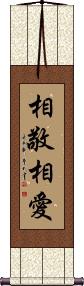
相敬相愛 is an old Chinese proverb that suggests love and respect go together and are to be exchanged between people (especially couples).
The first two characters mean “exchanging respect” or “mutual respect.”
The last two characters create a word that means “to love each other” or “mutual love.”
You'll notice that the first and third characters are the same. So you can read this literally as something like “Exchange respect, exchange love” or “Mutual respect, mutual love.” In English, we'd probably just say, “Mutual love and respect.” Grammar differs in every language - So while the literal translation might sound a bit awkward in English, this phrase is very natural in Chinese.
Greatest Love
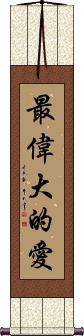
最偉大的愛 means “the greatest love” in Chinese.
Keeping in mind that Chinese is different than English, the first character is like “-est” or adding “the most” as a modifier to the next word.
The 2nd and 3rd characters mean great, mighty, and/or large.
The 4th is a possessive article.
The last is the character for love.
When you put it all together, you get a phrase that means the greatest love, enormous love, or the mightiest love.
Love and Respect
Love each other and show mutual respect
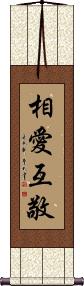
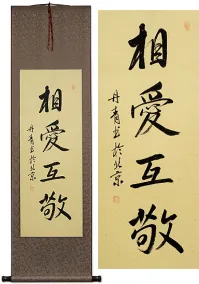
相愛互敬 is a nice way to say “Love and Respect” in Chinese.
This proverb is about the mutual exchange of love and respect within a good relationship.
The first two characters create a word that means “to love each other” or “mutual love.”
The third character means mutual, interlocking, or in some contexts, “to dovetail” (as in how joints are made in fine furniture).
The last character means “to respect,” “to venerate,” “to salute,” “reverence,” or simply “respect.”
Forbidden Love
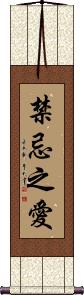
禁忌之愛 means “forbidden love” in Chinese.
The first two characters are a word that means forbidden, taboo, or “[something] to be avoided.”
The third character is a particle that connects forbidden to love.
The last character means love.
Love and Hate
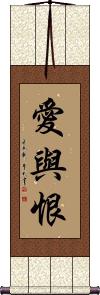
Whether you want to make a joke about what marriage really is or just feel that the world is full of love and hate, this selection is for you.
愛與恨 happens to literally translate. So the first character is love. The middle character is a connecting particle-like “and” in English. The last character is hate.
Upon request, we can omit the “and” character and just put a dot to separate love and hate if you prefer.
Love Faith Strength
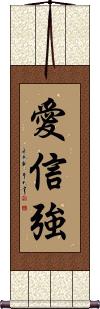
愛信強 is the shortest way to write the word list, “love faith strength.”
The first character is love, the second is faith or believe, and the third means strong or strength.
It should be noted that word lists like this are not as natural sounding in Chinese as word lists can be in English. it’s more common to have a full phrase (with subject, verb, and object) or single words on calligraphy wall scrolls in Asia.
Love and Hate
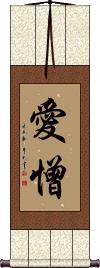
愛憎 is a weird selection for a calligraphy wall scroll. But if you really want it, we'll do it.
This version is most appropriate if your audience is Japanese or Korean (for Koreans who can read the ancient Korean Hanja).
The first character means love or affection.
The second character means hate, dislike, detest, or loathe.
Live for What You Love
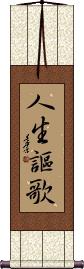
人生謳歌 means “live for what you love” in Japanese.
The first two characters mean “human life” or simply “living.” The last two characters mean “merit,” “prosperity,” or “what you enjoy.” This phrase can suggest working or staying busy for your own goals (in your career).
See Also: Prosperity
Family Love / Domestic Bliss
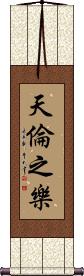
天倫之樂 means family love and joy, or domestic bliss.
The first two characters mean “the bonds of the family.”
The third character connects this to the fourth character which means happiness, joy, and cheerfulness.
The Karma/Fate/Destiny that Brings Lovers Together
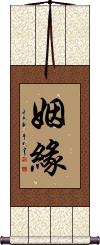
姻緣 means “Destiny that brings lovers together.” It can also be translated technically as “Predestined matrimonial affinity” (wow, talk about taking the romance out of this word - that was from the Oxford C-E dictionary).
This speaks to the fate (or karma) that brings a husband and wife together. I would translate this as “Together by fate” or “Joined by destiny” but in the context of marriage. You could use this for non-married lovers, but the first character has a suggestion that this refers to those that are married.
Appreciation and Love for Your Parents
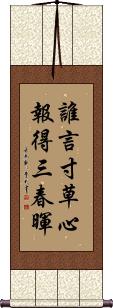
誰言寸草心報得三春暉 is the last line of a famous poem. It is perceived as a tribute or ode to your parents or mother from a child or children that have left home.
The poem was written by Meng Jiao during the Tang Dynasty (about 1200 years ago). The Chinese title is “You Zi Yin” which means “The Traveler's Recite.”
The last line as shown here speaks of the generous and warm spring sunlight which gives the grass far beyond what the little grass can could ever give back (except perhaps by showing its lovely green leaves and flourishing). The metaphor is that the sun is your mother or parents, and you are the grass. Your parents raise you and give you all the love and care you need to prepare you for the world. A debt that you can never repay, nor is repayment expected.
The first part of the poem (not written in the characters to the left) suggests that the thread in a loving mother's hands is the shirt of her traveling offspring. Vigorously sewing while wishing them to come back sooner than they left.
...This part is really hard to translate into English that makes any sense but maybe you get the idea. We are talking about a poem that is so old that many Chinese people would have trouble reading it (as if it was the King James Version of Chinese).
Spiritual Soul Mates
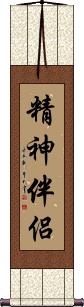
精神伴侶 means “Spiritual Soul Mates.” The first two characters mean “spiritual” or “soul.” The second two characters mean “mates,” “companions,” or “partners.”
This is more about the spiritual connection between partners rather than a “fate-brought-us-together” kind of soul mates.
Both halves of this title have meaning in Japanese but I've not yet confirmed that this is a commonly used title in Japan.
Soul Mates
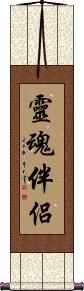
靈魂伴侶 is the literal translation of “Soul Mates.”
This is kind of the western way to express “soul mates” but translated into Chinese, Japanese Kanji, and old Korean Hanja.
The first two characters mean “soul” or “spirit.”
The second two characters mean “mate,” “companion” or “partner.”
Although not the most common title, these characters have good meaning and will be received well in Chinese, Japanese, and Korean. It's a universal title!
Sincere / True Sincerity
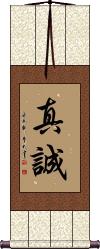
真誠 is the true essence of sincerity.
It takes strength of personality to be truly sincere without overdoing it. Speaking of strength, this is probably the strongest way to convey the idea of sincerity in the Chinese language.
The first character literally means true, real, and genuine. While the second character means sincere and honest.
Erin
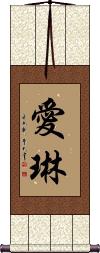
This is an alternate transliteration to Mandarin Chinese for the name Erin.
This version uses “love” as the first character. This is not the standard but popular, as the resulting meaning is “Love Gem.”
1 Corinthians 13:4-8
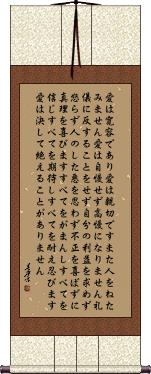
Here is 1st Corinthians 13:4-8 (just the first sentence of verse 8) in Japanese.
In the familiar NIV, this would read:
Love is patient, love is kind. It does not envy, it does not boast, it is not proud.
It does not dishonor others, it is not self-seeking, it is not easily angered, it keeps no record of wrongs.
Love does not delight in evil but rejoices with the truth.
It always protects, always trusts, always hopes, always perseveres.
Love never fails...
The Japanese text is from the 新改訳聖書 (Shinkaiyaku) or New Japanese Bible. Popular among most Protestant denominations in modern Japan.
Note: Because this selection contains some special Japanese Hiragana characters, it should be written by a Japanese calligrapher.
Corinthians 13:4
All you need to know about LOVE
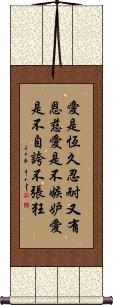
愛是恆久忍耐又有恩慈愛是不嫉妒愛是不自誇不張狂 is 1st Corinthians 13:4 in Chinese.
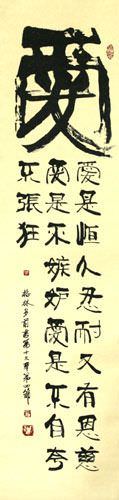
With large “love” character added.
In English, this reads:
1st Corinthians 13:4 (KJV) Charity suffereth long, and is kind; charity envieth not; charity vaunteth not itself, is not puffed up...
1st Corinthians 13:4 (NIV) Love is patient, love is kind. It does not envy, it does not boast, it is not proud.
1st Corinthians 13:4 (Basic English) Love is never tired of waiting; love is kind; love has no envy; love has no high opinion of itself, love has no pride.
The Chinese translation follows the love meaning, rather than the King James' use of “charity.” I was a little confused when writing this description with the significant differences between the NIV vs. KJV translations. After speaking to a Greek scholar about this, it would seem that the KJV has an almost errant translation with the use of “charity” in place of “love.”
We used the most popular Christian Chinese Bible, which is the Chinese Union Version (CUV). The CUV was first published in 1919. We use this so that the Chinese translation would be as accurate and standard as possible. Any Chinese Christian worth their salt will easily be able to identify this verse when they see these characters.
If you want a big “love” character written above the verse on your artwork, just make a note in the “special instructions” tab when you are customizing your artwork. There is no extra charge for that service on this special verse.
Compassion / Kindness
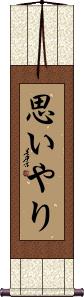
思いやり is compassion, kindness, or sympathy in Japanese.
The first part of this word suggests feelings, emotion, sentiment, love, affection, wish, and hope are connected with this idea of compassion and sympathy.
Note: Because this selection contains some special Japanese Hiragana characters, it should be written by a Japanese calligrapher.
Generosity
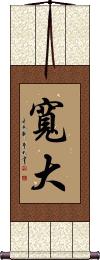
寬大 is a Chinese, Japanese, and Korean word that means Generosity.
Generosity is giving and sharing. You share freely, not with the idea of receiving something in return. You find ways to give others happiness and give just for the joy of giving. Generosity is one of the best ways to show love and friendship.
寬大 can also be translated as charitable, magnanimity, liberality, or in some contexts, broad-mindedness.
Note: There is a tiny deviation in the first character when written in Japanese. If you choose our Japanese master calligrapher, the little dot on the lower right of the first character will be omitted. With or without the dot, this can be read in Chinese, Japanese Kanji, and old Korean Hanja.
See Also: Benevolence | Lotus | Charity
Eternal Friendship / Friends Forever
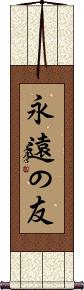
永遠の友 is a Japanese phrase about eternal friendship.
The first two characters mean eternal, eternity, perpetuity, forever, immortality, and permanence.
The third character is a possessive article which sort of makes this selection mean “Love, of the eternal kind.”
The last character is “friend” or “Friendship.”
See Also: Best Friends
I Need You
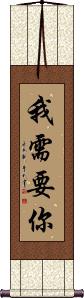
Some people like to say, “I love you” but others might want to say “I need you.” That is what this 我需要你 phrase is all about.
The first character means “I.” The second and third create a compound word that means “need” and “want” at the same time. The last character means “you.”
Lust / Desire / Passion
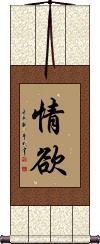
情欲 can mean lust, sexual desire, sensual desire, carnal desire, carnal passions, sexual desire, and passion.
The first character means feeling, emotions, passionate, sympathy, affection, love, compassion, tender feelings, and sometimes circumstances or facts.
The second character means desire, longing, appetite, wish, covetousness, greed, passion, desire, and craving.
This word is universal in Chinese, Japanese Kanji, and Korean Hanja.
I Need You
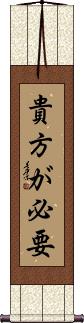
Some people like to say, “I love you” but others might want to say “I need you.” 貴方が必要 is “I need you” in Japanese.
The first two characters mean “You.”
The middle character is a connecting particle. In this case, it more or less means “are.”
The last two characters mean necessary, needed, essential, indispensable, or necessity.
The “I” in the title is implied. Effectively this means “I need you.”
Kindheartedness / Benevolence / Humanity
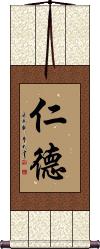
仁德 is a word that can mean love, kindheartedness, benevolence, and humanity.
The first character means benevolence by itself.
The second character means virtue or morality.
Japanese note: The second Kanji of this word has been slightly simplified (one tiny horizontal stroke removed). It is still readable for Japanese but if you select our Japanese calligrapher, expect that stroke to be missing on your wall scroll.
Sushi
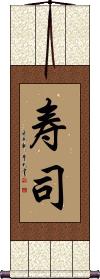
Got a 寿司/sushi restaurant and need an appropriate wall scroll? Or maybe you love sushi enough to have it on your wall. This sushi calligraphy scroll is for you.
Note that the written characters for sushi are the same in Chinese and Japanese. However, the first character is actually a modern Japanese / Simplified Chinese, so in some cases, it will be written differently in Taiwan, Hong Kong, and some older Japanese sushi restaurants where you might see 壽司 instead of 寿司.
Lover / Spouse / Sweetheart
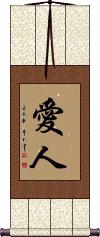
愛人 means lover, sweetheart, spouse, husband, wife, or beloved in Chinese, Japanese Kanji, and old Korean Hanja.
The first character means “love,” and the second means “person.”
This title can be used in many different ways, depending on the context. Husbands and wives may use this term for each other. But, if you change the context, this title could be used to mean “mistress.” It's pretty similar to the way we can use “lover” in many different ways in English.
In modern Japan, this lover title has slipped into the definition of mistress and is not good for a wall scroll.
Daodejing / Tao Te Ching - Excerpt
Excerpt from Chapter 67
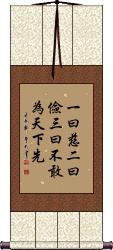
一曰慈二曰儉三曰不敢為天下先 is an excerpt from the 67th Chapter of Lao Tzu's (Lao Zi's) Te-Tao Ching (Dao De Jing).
This is the part where the three treasures are discussed. In English, we'd say these three treasures are compassion, frugality, and humility. Some may translate these as love, moderation, and lack of arrogance. I have also seen them translated as benevolence, modesty, and “Not presuming to be at the forefront in the world.” You can mix them up the way you want, as translation is not really a science but rather an art.
I should also explain that the first two treasures are single-character ideas, yet the third treasure was written out in six characters (there are also some auxiliary characters to number the treasures).
If Lao Tzu's words are important to you, then a wall scroll with this passage might make a great addition to your home.
Beauty / Beautiful / Handsome
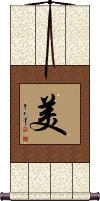
美 is often used to describe the beauty of a woman.
However, when applied to a man, it can mean handsome. It's also the first character in the word for “beauty salon” which you will see all over China and Japan.
美 can mean the given name for a girl (spell it or say it as “Mei” or “May”).
For a bit of trivia: The title for the “USA” in Chinese is “Mei Guo” which literally means “Beautiful Country.” This name was bestowed at a time before Chairman Mao came to power and decided that China didn't like the USA anymore (even though we fought together against the Japanese in WWII). But these days, Chinese people love Americans (but have a distaste for American politics and policy). But I digress...
美 is also how “Beautiful” is written in Japanese Kanji and Korean Hanja. 美 can also mean: very satisfactory; good; to be pleased with oneself; abbreviation for the USA; fine; handsome; admirable; madhura; sweet; and/or pleasant.
See Also: Beautiful Woman | Beautiful Girl
The one who retreats 50 paces mocks the one to retreats 100
The pot calls the kettle black
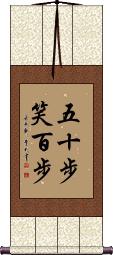
五十步笑百步 is a Chinese proverb that means the one who retreats 50 paces mocks the one who retreats 100 paces.
During the Warring States Period of what is now China (475 - 221 B.C.), the King of Wei was in love with war. He often fought with other kingdoms just for spite or fun.
One day, the King of Wei asked the philosopher Mencius, “I love my people, and all say I do the best for them. I move the people from famine-stricken areas to places of plenty and transport grains from rich areas to the poor. Nobody goes hungry in my kingdom, and I treat my people far better than other kings. But why does the population of my kingdom not increase, and why does the population of other kingdoms not decrease?”
Mencius answered, “Since you love war, I will make this example: When going to war, and the drums beat to start the attack, some soldiers flee for their lives in fear. Some run 100 paces in retreat, and others run 50 steps. Then the ones who retreated 50 paces laugh and taunt those who retreated 100 paces, calling them cowards mortally afraid of death. Do you think this is reasonable?
The King of Wei answered, “Of course not! Those who run 50 paces are just as timid as those who run 100 paces.”
Mencius then said, “You are a king who treats his subjects better than other kings treat their people, but you are so fond of war that your people suffer from great losses in battle. Therefore, your population does not grow. While other kings allow their people to starve to death, you send your people to die in war. Is there any difference?”
This famous conversation led to the six-character proverb shown here. It serves as a warning to avoid hypocrisy. It goes hand-in-hand with the western phrase, “The pot calls the kettle black,” or the Biblical phrase, “Before trying to remove a splinter from your neighbor's eye, first remove the plank from your own eye.”
Daoism / Taoism
Literally: The Way or Road
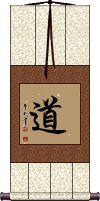
道 is the character “dao” which is sometimes written as “tao” but pronounced like “dow” in Mandarin.
道 is the base of what is known as “Taoism.” If you translate this literally, it can mean “the way” or “the path.”
Dao is believed to be that which flows through all things and keeps them in balance. It incorporates the ideas of yin and yang (e.g. there would be no love without hate, no light without dark, no male without female.)
The beginning of Taoism can be traced to a mystical man named
Lao Zi (604-531 BC), who followed, and added to the teachings of Confucius.
More about Taoism / Daoism here.
Note that this is pronounced “dou” and sometimes “michi” when written alone in Japanese but pronounced “do” in word compounds such as Karate-do and Bushido. It's also “do” in Korean.
Alternate translations and meanings: road, way, path; truth, principle province.
Important Japanese note: In Japanese, this will generally be read with the road, way, or path meaning. Taoism is not as popular or well-known in Japan so Daoist/Taoist philosophy is not the first thing a Japanese person will think of when they read this character.
See our Taoism Page
Islam
(phonetic version)
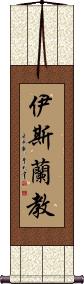
伊斯蘭教 both means and sounds like “Islam” in Mandarin Chinese.
The first three characters sound like the word “Islam,” and the last character means “religion” or “teaching.” It's the most general term for “Islam” in China. The highest concentration of Muslims in China is Xinjiang (the vast region in northwest China that was called The East Turkistan Republic until 1949 and is sometimes called Chinese Turkistan, Uyghuristan). Here you will find Uygurs, Kazakhs, Kyrgyz, and others that are descendants of Turkmen (possibly mixed with Persians and Arabs). Many of their ancestors were traders who traveled the silk road to buy and sell spices and silk and exchange other goods from the Orient and the Middle East.
I spent some time in Xinjiang and got to know this community. They are strong people who can endure much. They are friendly and love to have a good time. I was a stranger but was treated by villagers (near China's border with Afghanistan) as if I was a good friend.
However, I have heard that it's best not to cross them, as in this land, the law is the blade, and everything is “eye for an eye.” The Chinese government has little control in Xinjiang, with almost no police officers except in the capital of Urumqi (so it's a 60-hour roundtrip train ride to seek the aid of law enforcement in most cases).
While few seem devout, there are at least small mosques in every village. And you will never see a man or woman outside without a head covering.
It should be noted that these people are all citizens of China, but they are officially of the Caucasian race. A visit to Xinjiang will change your idea of what it means to be Chinese.
Art of War: 5 Points of Analysis
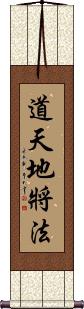
道天地將法 is a list of five key points to analyzing your situation from the first chapter of Sun Tzu's Art of War.
This reads like a 5-part military proverb. Sun Tzu says that to sharpen your skills, you must plan. To plan well, you must know your situation. Therefore, you must consider and discuss the following:
1. Philosophy and Politics: Make sure your way or your policy is agreeable among all of your troops (and the citizens of your kingdom as well). For when your soldiers believe in you and your way, they will follow you to their deaths without hesitation and will not question your orders.
2. Heaven/Sky: Consider climate / weather. This can also mean considering whether God is smiling upon you. In the modern military, this could be waiting for clear skies so that you can have air support for an amphibious landing.
3. Ground/Earth: Consider the terrain in which the battle will take place. This includes analyzing defensible positions, and exit routes, while using varying elevations to your advantage. When you plan an ambush, you must know your terrain and the best location from which to stage that ambush. This knowledge will also help you avoid being ambushed, as you will know where the likely places in which to expect an ambush from your enemy.
4. Leadership: This applies to you as the general and your lieutenants. A leader should be smart and be able to develop good strategies. Leaders should keep their word, and if they break a promise, they should punish themselves as harshly as they would punish subordinates. Leaders should be benevolent to their troops, with almost a fatherly love for them. Leaders must have the ability to make brave and fast decisions. Leaders must have steadfast principles.
5. [Military] Methods: This can also mean laws, rules, principles, models, or systems. You must have an efficient organization in place to manage both your troops and supplies. In the modern military, this would be a combination of how your unit is organized and your SOP (Standard Operating Procedure).
Notes: This is a simplistic translation and explanation. Much more is suggested in the actual text of the Art of War (Bing Fa). It would take many study to master all of these aspects. In fact, these five characters can be compared to the modern military acronyms such as BAMCIS or SMEAC.
CJK notes: I have included the Japanese and Korean pronunciations but in Chinese, Korean and Japanese, this does not make a typical phrase (with subject, verb, and object) it is a list that only someone familiar with Sun Tzu’s writings would understand.
Mountain Travels Poem by Dumu

This poem was written almost 1200 years ago during the Tang dynasty.
It depicts traveling up a place known as Cold Mountain, where some hearty people have built their homes. The traveler is overwhelmed by the beauty of the turning leaves of the maple forest that surrounds him just as night overtakes the day, and darkness prevails. His heart implores him to stop, and take in all of the beauty around him.
First, before you get to the full translation, I must tell you that Chinese poetry is a lot different than what we have in the west. Chinese words simply don't rhyme in the same way that English or other western languages do. Chinese poetry depends on rhythm and a certain beat of repeated numbers of characters.
I have done my best to translate this poem keeping a certain feel of the original poet. But some of the original beauty of the poem in its original Chinese will be lost in translation.
Far away on Cold Mountain, a stone path leads upwards.
Among white clouds, people's homes reside.
Stopping my carriage I must, as to admire the maple forest at nights fall.
In awe of autumn leaves showing more red than even flowers of early spring.
Hopefully, this poem will remind you to stop, and “take it all in” as you travel through life.
The poet's name is “Du Mu” in Chinese that is: 
 .
.
The title of the poem, “Mountain Travels” is: 

You can have the title, poet's name, and even “Tang Dynasty” written as an inscription on your custom wall scroll if you like.
More about the poet:
Dumu lived from 803-852 AD and was a leading Chinese poet during the later part of the Tang dynasty.
He was born in Chang'an, a city in central China and the former capital of the ancient Chinese empire in 221-206 BC. In present-day China, his birthplace is currently known as Xi'an, the home of the Terracotta Soldiers.
He was awarded his Jinshi degree (an exam administered by the emperor's court which leads to becoming an official of the court) at the age of 25 and went on to hold many official positions over the years. However, he never achieved a high rank, apparently because of some disputes between various factions, and his family's criticism of the government. His last post in the court was his appointment to the office of Secretariat Drafter.
During his life, he wrote scores of narrative poems, as well as a commentary on the Art of War and many letters of advice to high officials.
His poems were often very realistic and often depicted everyday life. He wrote poems about everything, from drinking beer in a tavern to weepy poems about lost love.
The thing that strikes you most is the fact even after 1200 years, not much has changed about the beauty of nature, toils, and troubles of love and beer drinking.
Broken Mirror Rejoined
Used in modern times for divorced couples that come back together
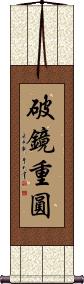
破鏡重圓 is about a husband and wife who were separated and reunited.
About 1500 years ago in China, there lived a beautiful princess named Le Chang. She and her husband Xu De Yan loved each other very much. But when the army of the Sui Dynasty was about to attack their kingdom, disposed of all of their worldly possessions and prepared to flee into exile.
They knew that in the chaos, they might lose track of each other, so the one possession they kept was a bronze mirror which is a symbol of unity for a husband and wife. They broke the mirror into two pieces, and each of them kept half of the mirror. They decided that if separated, they would try to meet at the fair during the 15th day of the first lunar month (which is the lantern festival). Unfortunately, the occupation was brutal, and the princess was forced to become the mistress of the new commissioner of the territory, Yang Su.
At the Lantern Festival the next year, the husband came to the fair to search for his wife. He carried with him his half of the mirror. As he walked through the fair, he saw the other half of the mirror for sale at a junk market by a servant of the commissioner. The husband recognized his wife's half of the mirror immediately, and tears rolled down his face as he was told by the servant about the bitter and loveless life that the princess had endured.
As his tears dripped onto the mirror, the husband scratched a poem into his wife's half of the mirror:
You left me with the severed mirror,
The mirror has returned, but absent are you,
As I gaze in the mirror, I seek your face,
I see the moon, but as for you, I see not a trace.
The servant brought the inscribed half of the mirror back to the princess. For many days, the princess could not stop crying when she found that her husband was alive and still loved her.
Commissioner Yang Su, becoming aware of this saga, realized that he could never obtain the princess's love. He sent for the husband and allowed them to reunite.
This proverb, 破鏡重圓, is now used to describe a couple who has been torn apart for some reason (usually divorce) but have come back together (or remarried).
It seems to be more common these days in America for divorced couples to reconcile and get married to each other again. This will be a great gift if you know someone who is about to remarry their ex.
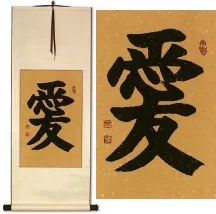
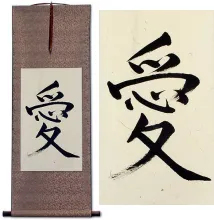
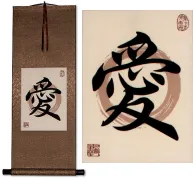
This in-stock artwork might be what you are looking for, and ships right away...




The following table may be helpful for those studying Chinese or Japanese:
| Title | Characters | Romaji (Romanized Japanese) | Various forms of Romanized Chinese | |
| First Love | 初戀 初恋 | hatsukohi / hatsukoi | chū liàn / chu1 lian4 / chu lian / chulian | ch`u lien / chulien / chu lien |
| Best Love Most Sincere Love | 最愛 | moai | ||
| Best Love Most Sincere Love | 至愛 至爱 | zhì ài / zhi4 ai4 / zhi ai / zhiai | chih ai / chihai | |
| Eternal Love Love Eternally | 愛永恆 爱永恒 | ài yǒng héng ai4 yong3 heng2 ai yong heng aiyongheng | ai yung heng aiyungheng |
|
| Eternal Love | 永遠の愛 | ei en no ai eiennoai | ||
| Eternal Love | 永恆的愛 永恒的爱 | yǒng héng de ài yong3 heng2 de ai4 yong heng de ai yonghengdeai | yung heng te ai yunghengteai |
|
| Forever Love | 永遠的愛 永远的爱 | yǒng yuǎn de ài yong3 yuan3 de ai4 yong yuan de ai yongyuandeai | yung yüan te ai yungyüanteai |
|
| Passionate Love Ardent Love and Devotion | 熱愛 热爱 | netsu ai / netsuai | rè ài / re4 ai4 / re ai / reai | je ai / jeai |
| Love Myself First | 先愛我自己 先爱我自己 | xiān ài wǒ zì jǐ xian1 ai4 wo3 zi4 ji3 xian ai wo zi ji xianaiwoziji | hsien ai wo tzu chi hsienaiwotzuchi |
|
| Love Yourself First | 先愛你自己 先爱你自己 | xiān ài nǐ zì jǐ xian1 ai4 ni3 zi4 ji3 xian ai ni zi ji xianainiziji | hsien ai ni tzu chi hsienainitzuchi |
|
| My True Love | 真実の愛 | shin jitsu no ai shinjitsunoai | ||
| Love Forever Love Eternal | 愛永遠 爱永远 | ai ei en / aieien | ài yǒng yuǎn ai4 yong3 yuan3 ai yong yuan aiyongyuan | ai yung yüan aiyungyüan |
| True Love | 真愛 真爱 | shinai | zhēn ài / zhen1 ai4 / zhen ai / zhenai | chen ai / chenai |
| Love and Honor | 愛と譽れ 愛と誉れ | ai to homa re aitohomare | ||
| Peace and Love | 和平博愛 和平博爱 | wahei hakuai waheihakuai | hé píng bó ài he2 ping2 bo2 ai4 he ping bo ai hepingboai | ho p`ing po ai hopingpoai ho ping po ai |
| Love and Honor | 情義 情义 | qíng yì / qing2 yi4 / qing yi / qingyi | ch`ing i / chingi / ching i | |
| Love and Honor | 深情厚義 深情厚义 | shēn qíng hòu yì shen1 qing2 hou4 yi4 shen qing hou yi shenqinghouyi | shen ch`ing hou i shenchinghoui shen ching hou i |
|
| Infinite Love | 無限愛 无限爱 | mu gen ai / mugenai | wú xiàn ài wu2 xian4 ai4 wu xian ai wuxianai | wu hsien ai wuhsienai |
| Live Laugh Love | 笑愛生活 笑爱生活 | xiào ài shēng huó xiao4 ai4 sheng1 huo2 xiao ai sheng huo xiaoaishenghuo | hsiao ai sheng huo hsiaoaishenghuo |
|
| Loving Heart One’s Love | 戀心 恋心 | koi gokoro / koigokoro | ||
| Best | 至 | shi | zhì / zhi4 / zhi | chih |
| Love and Respect | 相敬相愛 相亲相爱 | xiāng jìng xiāng ài xiang1 jing4 xiang1 ai4 xiang jing xiang ai xiangjingxiangai | hsiang ching hsiang ai hsiangchinghsiangai |
|
| Greatest Love | 最偉大的愛 最伟大的爱 | zuì wěi dà de ài zui4 wei3 da4 de ai4 zui wei da de ai zuiweidadeai | tsui wei ta te ai tsuiweitateai |
|
| Love and Respect | 相愛互敬 相爱互敬 | xiāng ài hù jìng xiang1 ai4 hu4 jing4 xiang ai hu jing xiangaihujing | hsiang ai hu ching hsiangaihuching |
|
| Forbidden Love | 禁忌之愛 禁忌之爱 | jīn jì zhī ài jin1 ji4 zhi1 ai4 jin ji zhi ai jinjizhiai | chin chi chih ai chinchichihai |
|
| Love and Hate | 愛與恨 爱与恨 | ài yǔ hèn ai4 yu3 hen4 ai yu hen aiyuhen | ai yü hen aiyühen |
|
| Love Faith Strength | 愛信強 爱信強 | ài xìn qiáng ai4 xin4 qiang2 ai xin qiang aixinqiang | ai hsin ch`iang aihsinchiang ai hsin chiang |
|
| Love and Hate | 愛憎 爱憎 | ai zou / aizou / ai zo | ài zèng / ai4 zeng4 / ai zeng / aizeng | ai tseng / aitseng |
| Live for What You Love | 人生謳歌 | jin sei ou ka jinseiouka jin sei o ka | ||
| Family Love Domestic Bliss | 天倫之樂 天伦之乐 | tiān lún zhī lè tian1 lun2 zhi1 le4 tian lun zhi le tianlunzhile | t`ien lun chih le tienlunchihle tien lun chih le |
|
| The Karma/Fate/Destiny that Brings Lovers Together | 姻緣 姻缘 | yīn yuán / yin1 yuan2 / yin yuan / yinyuan | yin yüan / yinyüan | |
| Appreciation and Love for Your Parents | 誰言寸草心報得三春暉 谁言寸草心报得三春晖 | shuí yán cùn cǎo xīn bào dé sān chūn huī shui2 yan2 cun4 cao3 xin1 bao4 de2 san1 chun1 hui1 shui yan cun cao xin bao de san chun hui | shui yen ts`un ts`ao hsin pao te san ch`un hui shui yen tsun tsao hsin pao te san chun hui |
|
| Spiritual Soul Mates | 精神伴侶 精神伴侣 | sei shin han ryo seishinhanryo | jīng shén bàn lǚ jing1 shen2 ban4 lv3 jing shen ban lv jingshenbanlv | ching shen pan lü chingshenpanlü |
| Soul Mates | 靈魂伴侶 灵魂伴侣 | reikon hanryo reikonhanryo | líng hún bàn lǚ ling2 hun2 ban4 lv3 ling hun ban lv linghunbanlv | ling hun pan lü linghunpanlü |
| Sincere True Sincerity | 真誠 真诚 | zhēn chéng zhen1 cheng2 zhen cheng zhencheng | chen ch`eng chencheng chen cheng |
|
| Erin | 愛琳 爱琳 | ài lín / ai4 lin2 / ai lin / ailin | ||
| 1 Corinthians 13:4-8 | 愛は寛容であり愛は親切ですまた人をねたみません愛は自慢せず高慢になりません礼儀に反することをせず自分の利益を求めず怒らず人のした悪を思わず不正を喜ばずに真理を喜びますすべてをがまんしすべてを信じすべてを期待しすべてを耐え忍びます愛は決して絶えることがありません | ai wa kan youdeari ai wa shinsetsudesu mata hito o netamimasen ai wa jiman sezu kouman ni narimasen reigi ni hansuru koto o sezu jibun no rieki o motomezu okorazu hito no shita aku o omowazu fusei o yorokobazu ni shinri o yorokobimasu subete o gaman shi s ai wa kan yodeari ai wa shinsetsudesu mata hito o netamimasen ai wa jiman sezu koman ni narimasen reigi ni hansuru koto o sezu jibun no rieki o motomezu okorazu hito no shita aku o omowazu fusei o yorokobazu ni shinri o yorokobimasu subete o gaman shi s | ||
| Corinthians 13:4 | 愛是恆久忍耐又有恩慈愛是不嫉妒愛是不自誇不張狂 爱是恒久忍耐又有恩慈爱是不嫉妒爱是不自夸不张狂 | ài shì héng jiǔ rěn nài yòu yǒu én cí ài shì bú jì dù ài shì bú zì kuā bù zhāng kuáng ai4 shi4 heng2 jiu3 ren3 nai4 you4 you3 en2 ci2 ai4 shi4 bu2 ji4 du4 ai4 shi4 bu2 zi4 kua1 bu4 zhang1 kuang2 ai shi heng jiu ren nai you you en ci ai shi bu ji du ai shi bu zi kua bu zhang kuang | ai shih heng chiu jen nai yu yu en tz`u ai shih pu chi tu ai shih pu tzu k`ua pu chang k`uang ai shih heng chiu jen nai yu yu en tzu ai shih pu chi tu ai shih pu tzu kua pu chang kuang |
|
| Compassion Kindness | 思いやり | omoi yari / omoiyari | ||
| Generosity | 寬大 宽大 | kandai | kuān dà / kuan1 da4 / kuan da / kuanda | k`uan ta / kuanta / kuan ta |
| Eternal Friendship Friends Forever | 永遠の友 | ei en no yuu eiennoyuu ei en no yu | ||
| I Need You | 我需要你 | wǒ xū yào nǐ wo3 xu1 yao4 ni3 wo xu yao ni woxuyaoni | wo hsü yao ni wohsüyaoni |
|
| Lust Desire Passion | 情欲 | jouyoku / joyoku | qíng yù / qing2 yu4 / qing yu / qingyu | ch`ing yü / chingyü / ching yü |
| I Need You | 貴方が必要 | ana ta ga hitsu you anatagahitsuyou ana ta ga hitsu yo | ||
| Kindheartedness Benevolence Humanity | 仁德 | jintoku | rén dé / ren2 de2 / ren de / rende | jen te / jente |
| Sushi | 壽司 寿司 | su shi / sushi | shòu sī / shou4 si1 / shou si / shousi | shou ssu / shoussu |
| Lover Spouse Sweetheart | 愛人 爱人 | ai jin / aijin | ài ren / ai4 ren / ai ren / airen | ai jen / aijen |
| Daodejing Tao Te Ching - Excerpt | 一曰慈二曰儉三曰不敢為天下先 一曰慈二曰俭三曰不敢为天下先 | yī yuē cí èr yuē jiǎn sān yuē bù gǎn wéi tiān xià xiān yi1 yue1 ci2 er4 yue1 jian3 san1 yue1 bu4 gan3 wei2 tian1 xia4 xian1 yi yue ci er yue jian san yue bu gan wei tian xia xian | i yüeh tz`u erh yüeh chien san yüeh pu kan wei t`ien hsia hsien i yüeh tzu erh yüeh chien san yüeh pu kan wei tien hsia hsien |
|
| Beauty Beautiful Handsome | 美 | bi | měi / mei3 / mei | |
| The one who retreats 50 paces mocks the one to retreats 100 | 五十步笑百步 | wù shí bù xiào bǎi bù wu4 shi2 bu4 xiao4 bai3 bu4 wu shi bu xiao bai bu wushibuxiaobaibu | wu shih pu hsiao pai pu wushihpuhsiaopaipu |
|
| Daoism Taoism | 道 | michi / -do | dào / dao4 / dao | tao |
| Islam | 伊斯蘭教 伊斯兰教 | yī sī lán jiào yi1 si1 lan2 jiao4 yi si lan jiao yisilanjiao | i ssu lan chiao issulanchiao |
|
| Art of War: 5 Points of Analysis | 道天地將法 道天地将法 | dou ten chi shou hou doutenchishouhou do ten chi sho ho | dào tiān dì jiàng fǎ dao4 tian1 di4 jiang4 fa3 dao tian di jiang fa daotiandijiangfa | tao t`ien ti chiang fa taotientichiangfa tao tien ti chiang fa |
| Mountain Travels Poem by Dumu | 遠上寒山石徑斜白雲生處有人家停車坐愛楓林晚霜葉紅於二月花 远上寒山石径斜白云生处有人家停车坐爱枫林晚霜叶红于二月花 | yuǎn shàng hán shān shí jìng xiá bái yún shēng chù yǒu rén jiā tíng chē zuò ài fēng lín wǎn shuàng yè hóng yú èr yuè huā yuan3 shang4 han2 shan1 shi2 jing4 xia2 bai2 yun2 sheng1 chu4 you3 ren2 jia1 ting2 che1 zuo4 ai4 feng1 lin2 wan3 shuang4 ye4 hong2 yu2 er4 yue4 hua1 yuan shang han shan shi jing xia bai yun sheng chu you ren jia ting che zuo ai feng lin wan shuang ye hong yu er yue hua | yüan shang han shan shih ching hsia pai yün sheng ch`u yu jen chia t`ing ch`e tso ai feng lin wan shuang yeh hung yü erh yüeh hua yüan shang han shan shih ching hsia pai yün sheng chu yu jen chia ting che tso ai feng lin wan shuang yeh hung yü erh yüeh hua |
|
| Broken Mirror Rejoined | 破鏡重圓 破镜重圆 | pò jìng chóng yuán po4 jing4 chong2 yuan2 po jing chong yuan pojingchongyuan | p`o ching ch`ung yüan pochingchungyüan po ching chung yüan |
|
| In some entries above you will see that characters have different versions above and below a line. In these cases, the characters above the line are Traditional Chinese, while the ones below are Simplified Chinese. | ||||

Successful Chinese Character and Japanese Kanji calligraphy searches within the last few hours...



