Many custom options...


And formats...



Background in Chinese / Japanese...
Buy a Background calligraphy wall scroll here!
Personalize your custom “Background” project by clicking the button next to your favorite “Background” title below...
1. Bodhicitta: Enlightened Mind
2. Impartial and Fair to the Brotherhood and Sisterhood of the World
3. Bamboo Moon
5. Earth
Bodhicitta: Enlightened Mind
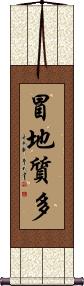
冒地質多 is a Chinese and Japanese way to write Bodhicitta.
冒地質多 is often translated as “the enlightened mind” or “enlightened heart.”
This title is strictly Buddhist and won't make sense to Chinese or Japanese people who do not have an expansive background in Buddhist terms, concepts, and scripture.
Impartial and Fair to the Brotherhood and Sisterhood of the World
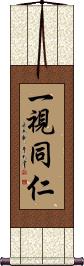
一視同仁 is how to write “universal benevolence.” This is also how to express the idea that you see all people the same.
If you are kind and charitable to everyone, this is the best way to state that virtue. It is the essence of being impartial to all mankind, regardless of social standing, background, race, sex, etc. You do not judge others, but instead, you see them eye to eye on the same level as you.
See Also: Benevolence | Compassion | Equality | Justice | Right Decision | Selflessness | Work Unselfishly for the Common
Bamboo Moon
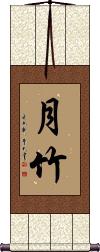
月竹 is the title, “Bamboo Moon” - Technically, it's in the order of “moon bamboo,” but that's the most natural order in Chinese and Japanese.
With a little research, I found this title has been used as the name of a linen company, a band, a song title, an actual person's name, the title for a piece of artwork featuring bamboo with a moon in the background, and a few other things. I added it here because many people searched for “bamboo moon” on my website, so here it is for you.
The typical Japanese pronunciation would probably be "tsu-ki ta-ke." However, this would not be the only possible pronunciation in Japanese (especially if used as a given name).
Buddha / Buddhism
Hotoke
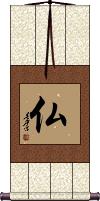
仏 is the single Japanese Kanji that can mean Buddha or Buddhism.
This Kanji was a shorthand way to write 佛 (Buddha) in Chinese (popular around the 13th century). Somehow, this became the version of this Chinese character that was absorbed into Japanese and thus became part of standard Kanji. Centuries later, this character is not recognized in China (except for those from China with a background in Chinese literature or language).
仏 is also a rare or derivative Korean Hanja form - but I doubt you will find any Korean that knows that.
Earth
(Used in Japanese version of five elements)
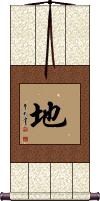
地 is the single-character element and title of the planet Earth in Chinese, old Korean Hanja, and Japanese Kanji.
Because this is a single character, the definition is a little ambiguous and can have many meanings depending on the context in which it is used. These meanings include: earth, ground, land, soil, dirt, place, territory, bottom (of a package, book, etc.), earth (one of the Japanese five elements), the region in question, the local area, skin, texture, fabric, material, weave, base, background, one's true nature, narrative (i.e. descriptive part of a story), real life, actuality, etc.
In Japanese, this Kanji can be pronounced several ways, including chi, ji, tsushi, or tsuchi.
地 is also an element of the Japanese version of the five elements (the original Chinese version uses a different version of earth).
Jujitsu / Jujutsu
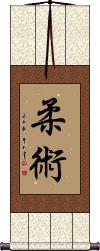
柔術 has been somewhat incorrectly spelled and pronounced “Jujitsu” for some time in the English-speaking world. The correct Japanese Romaji is Jujutsu or Juujutsu.
A little background on the word: By combining the Kanji pronounced “Ju” (which means flexible, pliable, gentle, yielding) with the Kanji pronounced “Jutsu” (which means art or technique), we get a meaning that can be translated as “flexible technique,” “gentle art” or “yielding technique.”
柔術 does make sense in Chinese as well, although pronounced “rou shu” in China.
The Jujutsu system has a history in Japan that started well before the 1600s. Some see this style as a variation of the “Empty Hand Method” (Karate-do). Even the samurai of old used some Jujutsu methods in defending themselves with their unarmed hands against weapons that could pierce their heavy armor.
There are convoluted relationships between various schools and systems of martial arts, but it's generally accepted that Jujutsu led to the development of Judo and a few other variations.
Work Unselfishly for the Common Good
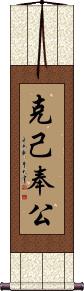
克己奉公 is a Chinese proverb that is often used to express how one should act as a government official. Most of us wish our public officials would hold themselves to higher standards. I wish I could send this scroll, along with the meaning to every member of Congress, and the President (or if I was from the UK, all the members of Parliament, and the PM)
This can also mean: “Place Strict Standards on Oneself in Public Service.”
The story behind this ancient Chinese idiom:
Cai Zun was born in China a little over 2000 years ago. In 24 AD, he joined an uprising led by Liu Xiu, who later became the emperor of the Eastern Han Dynasty.
Later, the new emperor put Cai Zun in charge of the military court. Cai Zun exercised his power in strict accordance with military law, regardless of the offender's rank or background. He even ordered the execution of one of the emperor's close servants after the servant committed a serious crime.
Cai Zun led a simple life but put great demands on himself to do all things honorably. The emperor rewarded him for his honest character and honorable nature by promoting him to the rank of General and granting him the title of Marquis.
Whenever Cai Zun would receive an award, he would give credit to his men and share the reward with them.
Cai Zun was always praised by historians who found many examples of his selfless acts that served the public interest.
Sometime long ago in history, people began to refer to Cai Zun as “ke ji feng gong.”
See Also: Unselfish | Selflessness | Altruism
This in-stock artwork might be what you are looking for, and ships right away...

Gallery Price: $126.00
Your Price: $69.88
Gallery Price: $63.00
Your Price: $35.00


Gallery Price: $126.00
Your Price: $69.88

Gallery Price: $63.00
Your Price: $34.88

Gallery Price: $120.00
Your Price: $49.88
These search terms might be related to Background:
Bad Experience, Caution Lingers
Confucius: Universal Education
Discipline / Training / Tempering Character
Each Time You Stumble and Fall, You Gain Experience and Wisdom
Education / Refinement
Experience is the Mother of Wisdom
Family / Home
Family / Household
Family / Members of a Family
Family and Friends
Family Bond / Family Ties
Family Love
Family Love / Domestic Bliss
Family Over Everything
Fierce and Courageous Training Defeats the Strong and Protects the Body.
Forever Family
Happy Family
Knowledge From Experience
Mark the Boat to Find the Lost Sword / Ignoring the Changing Circumstances of the World
One Family Under Heaven
Past Experience is the Teacher for the Future
Safety and Well-Being of the Family
Schooled by Experience and Hard Knocks
Set Your Heart Ablaze
Skill Acquired Through Hard Training
Teach / Education
The More We Sweat in Training, the Less We Bleed in Battle
To Know Hardship, One Must Experience It
Training / Drill
Training / Practice / Cultivation
Wisdom Comes From Experience
Not the results for background that you were looking for?
Below are some entries from our dictionary that may match your background search...
| Characters If shown, 2nd row is Simp. Chinese |
Pronunciation Romanization |
Simple Dictionary Definition |
出 see styles |
chū chu1 ch`u chu de で |
to go out; to come out; to arise; to occur; to produce; to yield; to go beyond; to exceed; (used after a verb to indicate an outward direction or a positive result); classifier for dramas, plays, operas etc (n,n-suf) (1) coming out; going out; outflow; efflux; rising (of the Sun or the Moon); (n,n-suf) (2) attending (work); appearing (on stage); one's turn to go on; (n,n-suf) (3) start; beginning; (n,n-suf) (4) origins; background; person (or item) originating from ...; graduate of ...; native of ...; member of ... (lineage); (n,n-suf) (5) architectural member that projects outward; (n,n-suf) (6) highest point of the stern of a ship; (n,n-suf) (7) (kana only) (usu. after the -masu stem of a verb as 〜出がある or 〜出がない, etc.) amount (comprising something); amount of time or effort required to do something; (surname) De To go out, come forth, put forth; exit; beyond. |
底 see styles |
dǐ di3 ti soko そこ |
bottom; base; background; foundation; copy (of a manuscript or receipt etc) kept as a record; (suffix) end of a year or month; (math.) radix; base (abbr. for 底數|底数[di3 shu4]) (1) {math} base (logarithmic, exponential, number system); radix; (2) {geom} base (triangle, cone, cylinder, etc.); (3) type; kind; extent; degree; (surname) Soko Bottom, basis; translit. t, d, dh. |
翳 see styles |
yì yi4 i ei さしば |
feather screen; to screen; to shade; cataract (kana only) dimness (of sight); (1) shade; shadow; (2) other side; back; background; large fan-shaped object held by an attendant and used to conceal the face of a noble, etc. A film; screen; fan; hide, invisible; translit. e, a. |
蔭 荫 see styles |
yìn yin4 yin kage かげ |
shade (1) shade; shadow; (2) other side; back; background; (surname) Kage |
借景 see styles |
shakkei / shakke しゃっけい |
making use of the surrounding landscape as a part of the design of a garden; natural scenery used as the background in the landscaping of a garden |
出身 see styles |
chū shēn chu1 shen1 ch`u shen chu shen shusshin しゅっしん |
to be born of; to come from; family background; class origin one's origin (e.g. city, country, parentage, school) |
劇伴 see styles |
gekiban げきばん |
background music (in a movie, television drama, etc.) |
去背 see styles |
qù bèi qu4 bei4 ch`ü pei chü pei |
(Tw) to remove the background from an image |
壁紙 壁纸 see styles |
bì zhǐ bi4 zhi3 pi chih kabegami かべがみ |
wallpaper (1) wallpaper; (2) {comp} wallpaper; background image; desktop image |
学歴 see styles |
gakureki がくれき |
academic background; academic credentials; academic record |
學歷 学历 see styles |
xué lì xue2 li4 hsüeh li |
educational background; academic qualifications |
家世 see styles |
jiā shì jia1 shi4 chia shih |
family background |
履歴 see styles |
rireki りれき |
(1) personal history; background; career; (2) log; record; history; (3) (abbreviation) (See 履歴現象・りれきげんしょう) hysteresis |
履歷 履历 see styles |
lǚ lì lu:3 li4 lü li |
background (academic and work); curriculum vitae; résumé |
後光 后光 see styles |
hòu guāng hou4 guang1 hou kuang gokou / goko ごこう |
(1) halo; aureole; aureola; nimbus; (2) halo (optical phenomenon); glory; (surname) Gokou The halo behind an image. |
後台 后台 see styles |
hòu tái hou4 tai2 hou t`ai hou tai godai ごだい |
backstage area; behind-the-scenes supporter; (computing) back-end; background (place-name) Godai |
後景 see styles |
koukei / koke こうけい |
background; setting |
摳圖 抠图 see styles |
kōu tú kou1 tu2 k`ou t`u kou tu |
(image processing) to extract a foreground object from its background; image matting |
文脈 see styles |
bunmyaku ぶんみゃく |
(1) context (of a passage); line of thought; (2) context (of a matter, event, etc.); circumstances; background |
旁白 see styles |
páng bái pang2 bai2 p`ang pai pang pai |
aside (theater); voice-over; background narration |
本底 see styles |
běn dǐ ben3 di3 pen ti motosoko もとそこ |
background (surname) Motosoko |
柴門 柴门 see styles |
chái mén chai2 men2 ch`ai men chai men shibakado しばかど |
lit. woodcutter's family; humble background; poor family background (surname) Shibakado |
根底 see styles |
gēn dǐ gen1 di3 ken ti kontei / konte こんてい |
foundation; grounding; background; what lies at the bottom of something; root; cause root; basis; foundation |
桌布 see styles |
zhuō bù zhuo1 bu4 cho pu |
tablecloth; (Tw) (computing) background; wallpaper (of a desktop, phone etc) |
泥絵 see styles |
doroe; deie / doroe; dee どろえ; でいえ |
(1) (esp. どろえ) (See 泥絵の具) distemper painting; (2) (esp. でいえ) (See 金銀泥絵) painting made with gold or silver paint (usu. on a dark background) |
烘托 see styles |
hōng tuō hong1 tuo1 hung t`o hung to |
background (of a painting); backdrop; a foil (to set off something to advantage); to offset (something to advantage) |
種姓 种姓 see styles |
zhǒng xìng zhong3 xing4 chung hsing shushō すじょう |
caste (traditional Indian social division) (out-dated or obsolete kana usage) birth; lineage; parentage; origin; identity; background; history family |
素姓 see styles |
suzou / suzo すぞう sujou / sujo すじょう |
birth; lineage; parentage; origin; identity; background; history |
素生 see styles |
motoki もとき |
birth; lineage; parentage; origin; identity; background; history; (given name) Motoki |
経歴 see styles |
keireki / kereki けいれき |
personal history; background; career |
Click here for more background results from our dictionary
The following table may be helpful for those studying Chinese or Japanese...
| Title | Characters | Romaji (Romanized Japanese) | Various forms of Romanized Chinese | |
| Bodhicitta: Enlightened Mind | 冒地質多 冒地质多 | boujiishitta bojishitta | mào dì zhì duō mao4 di4 zhi4 duo1 mao di zhi duo maodizhiduo | mao ti chih to maotichihto |
| Impartial and Fair to the Brotherhood and Sisterhood of the World | 一視同仁 一视同仁 | isshidoujin ishidojin | yí shì tóng rén yi2 shi4 tong2 ren2 yi shi tong ren yishitongren | i shih t`ung jen ishihtungjen i shih tung jen |
| Bamboo Moon | 月竹 | tsuki take / tsukitake | yuè zhú / yue4 zhu2 / yue zhu / yuezhu | yüeh chu / yüehchu |
| Buddha Buddhism | 佛 仏 | hotoke / butsu | ||
| Earth | 地 | chi / ji / tsushi / tsuchi | dì / di4 / di | ti |
| Jujitsu Jujutsu | 柔術 柔术 | juu jutsu / juujutsu / ju jutsu | róu shù / rou2 shu4 / rou shu / roushu | jou shu / joushu |
| Work Unselfishly for the Common Good | 克己奉公 | kè jǐ fèng gōng ke4 ji3 feng4 gong1 ke ji feng gong kejifenggong | k`o chi feng kung kochifengkung ko chi feng kung |
|
| In some entries above you will see that characters have different versions above and below a line. In these cases, the characters above the line are Traditional Chinese, while the ones below are Simplified Chinese. | ||||

Successful Chinese Character and Japanese Kanji calligraphy searches within the last few hours...



