Many custom options


And formats



Wear in Chinese / Japanese
Buy a Wear calligraphy wall scroll here!
Personalize your custom “Wear” project by clicking the button next to your favorite “Wear” title below.
Wear
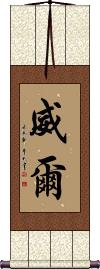
威爾 is the name Wear in Chinese (Mandarin).
Wear

ウェア is the name Wear in Japanese Katakana.
Note: Because this title is entirely Japanese Katakana, it should be written by a Japanese calligrapher.
Yellow
Yellow Color
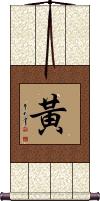
黃 is the single character for the color yellow in Chinese.
This can be a Chinese surname Huang or a Korean surname Hwang.
In China, yellow is traditionally the color of the emperor. In fact, there was a time when only the emperor could wear yellow clothing or own yellow pet fish.
Note: Goldfish were bred originally in China for the emperor. When the perfect yellow fish was bred, all but the emperor were banned from owning any. Thus a more orange-colored goldfish dominated the market.
Notes: 黃 is not a common selection for a wall scroll. In certain contexts in China, yellow can refer to pornography or vice.
 This character is written with a slight variation in Simplified Chinese and modern Japanese. Click on the image to the right if you want this alternate version.
Choose Life
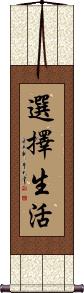
選擇生活 can mean to choose life instead of death (or suicide) or to choose to live life to the fullest.
I think of it as the key phrase used by Renton (Ewan McGregor) in the movie Trainspotting. While Chinese people will not think of Trainspotting when they see this phrase, for me, it will always be what comes near the end of this colorful rant:
Choose life. Choose a job. Choose a career. Choose a family. Choose a fucking big television. Choose washing machines, cars, compact disc players, and electrical tin can openers. Choose good health, low cholesterol, and dental insurance. Choose fixed-interest mortgage repayments. Choose a starter home. Choose your friends. Choose leisure wear and matching luggage. Choose a three-piece suite on-hire purchase in a range of fucking fabrics. Choose DIY and wondering who the fuck you are on a Sunday morning. Choose sitting on that couch watching mind-numbing, spirit-crushing game shows, stuffing fucking junk food into your mouth. Choose rotting away at the end of it all, pissing your last in a miserable home, nothing more than an embarrassment to the selfish, fucked-up brats you have spawned to replace yourself. Choose your future. Choose life.
This in-stock artwork might be what you are looking for, and ships right away...
These search terms might be related to Wear:
Bear
Carry On, Undaunted
Chop Wood, Carry Water
Hold Hands With You, Grow Old With You
If You Cannot Bite, Do Not Show Your Teeth
Panda Bear
Polar Bear
White Bear / Polar Bear
Not the results for Wear that you were looking for?
Below are some entries from our dictionary that may match your Wear search:
| Characters If shown, 2nd row is Simp. Chinese |
Pronunciation Romanization |
Simple Dictionary Definition |
戴 see styles |
dài dai4 tai dai だい |
More info & calligraphy: Dye(personal name) Dai To wear (on the head); to bear, sustain. |
累 see styles |
lèi lei4 lei rui るい |
tired; weary; to strain; to wear out; to work hard trouble; harmful effect; evil influence; implication; involvement; (female given name) Rui To tie; accumulate; repeatedly; to implicate, involve. |
ウェア see styles |
uea ウエア |
More info & calligraphy: Wear |
佩 see styles |
pèi pei4 p`ei pei hai はい |
to respect; to wear (belt etc) (1) ancient oriental belt decoration; (suf,ctr) (2) counter for swords to wear; put on; wrap around |
圍 围 see styles |
wéi wei2 wei kakoi かこい |
to encircle; to surround; all around; to wear by wrapping around (scarf, shawl) (surname) Kakoi Surround, enclose, encircle, go round. |
帶 带 see styles |
dài dai4 tai tai たらし |
band; belt; girdle; ribbon; tire; area; zone; region; CL:條|条[tiao2]; to wear; to carry; to take along; to bear (i.e. to have); to lead; to bring; to look after; to raise (out-dated kanji) (out-dated or obsolete kana usage) obi; kimono sash; (out-dated kanji) (1) obi; kimono sash; (2) paper wrapper on books, CDs, etc. A girdle, belt, bandage, tape, appendage; connect; implicate; take along. |
披 see styles |
pī pi1 p`i pi hiraki ひらき |
to drape over one's shoulders; to open; to unroll; to split open; to spread out (place-name) Hiraki To spread open, unroll, thrown on (as a cloak). 披 is to wear the garment over both shoulders; 袒 is to throw it over one shoulder. |
摜 掼 see styles |
guàn guan4 kuan |
to fling; to fall; to wear |
服 see styles |
fù fu4 fu fukusaki ふくさき |
classifier for medicine: dose; Taiwan pr. [fu2] (1) (archaism) mourning clothes; (2) (archaism) mourning; period of mourning; (surname) Fukusaki Submit, serve; clothing, to wear; mourning; to swallow; a dose. |
着 see styles |
zhuó zhuo2 cho tsukizaki つきざき |
variant of 著|着[zhuo2] (suffix noun) (1) (See 発・1) arrival; arriving at ...; (counter) (2) counter for items or suits of clothing; (counter) (3) nth place (in a race); (counter) (4) {go} counter for moves; (surname) Tsukizaki to wear |
穿 see styles |
chuān chuan1 ch`uan chuan haku はく |
to wear; to put on; to dress; to bore through; to pierce; to perforate; to penetrate; to pass through; to thread (female given name) Haku To bore, pierce; to thread; to don, put on. To bore a well and gradually discover water, likened to the gradual discovery of the Buddha-nature. |
衣 see styles |
yì yi4 i matoi まとい |
to dress; to wear; to put on (clothes) (1) clothes; garment; (2) gown; robe; (3) coating (e.g. glaze, batter, icing); (female given name) Matoi Clothes, especially a monk's robes which are of two kinds, the compulsory three garments of five, seven, or nine pieces; and the permissive clothing for the manual work of the monastery, etc. The 三衣 or three garments are (1) 安陀會衣 antarvāsas, an inner garment; the five-piece 袈裟 cassock; (2) 鬱多羅僧衣 uttarāsaṇga, outer garment, the seven-piece cassock; (3) 僧伽梨衣 saṁghāti, assembly cassock of from nine to twenty-five pieces. The permissive clothing is of ten kinds. |
靠 see styles |
kào kao4 k`ao kao kō |
to lean against or on; to stand by the side of; to come near to; to depend on; to trust; to fuck (vulgar); traditional military costume drama where the performers wear armor (old) resting on or in |
靸 see styles |
sǎ sa3 sa |
children's shoe (old); to wear one's shoes babouche style |
下す see styles |
kudasu くだす orosu おろす |
(transitive verb) (1) to make a decision; to draw a conclusion; (2) to judge; to hand down a verdict; to pass sentence; (3) to let go down; to lower; (4) to do oneself; to do by oneself; (5) to beat; to defeat; (6) to have loose bowels; to have diarrhea; to pass excrement; (irregular okurigana usage) (transitive verb) (1) to take down (e.g. flag); to launch (e.g. boat); to drop; to lower (e.g. ladder); to let (a person) off; to unload; to discharge; (2) to drop off (a passenger from a vehicle); to let (a person) off; (3) to withdraw money from an account; (4) to wear (clothing) for the first time; (5) to fillet (e.g. a fish) |
五法 see styles |
wǔ fǎ wu3 fa3 wu fa gohō |
pañcadharma. The five laws or categories, of which four groups are as follows: I. 相名五法 The five categories of form and name: (1) 相 appearances, or phenomena; (2) 名 their names; (3) 分別 sometimes called 妄想 ordinary mental discrimination of them— (1) and (2) are objective, (3) subjective; (4) 正智 corrective wisdom, which corrects the deficiencies and errors of the last: (5) 如如 the 眞如 Bhutatathata or absolute wisdom, reached through the 如理智 understanding of the law of the absolute, or ultimate truth. II. 事理五法 The five categories into which things and their principles are divided: (1) 心法 mind; (2) 心所法 mental conditions or activities; (3) 色法 the actual states or categories as conceived; (4) 不相應法 hypothetic categories, 唯識 has twenty-four, the Abhidharma fourteen; (5) 無爲法 the state of rest, or the inactive principle pervading all things; the first four are the 事 and the last the 理. III. 理智五法 cf. 五智; the five categories of essential wisdom: (1) 眞如 the absolute; (2) 大圓鏡智 wisdom as the great perfect mirror reflecting all things; (3) 平等性智 wisdom of the equal Buddha nature of all beings; (4) 妙觀察智 wisdom of mystic insight into all things and removal of ignorance and doubt; (5) 成所作智 wisdom perfect in action and bringing blessing to self and others. IV. 提婆五法 The five obnoxious rules of Devadatta: not to take milk in any form, nor meat, nor salt; to wear unshaped garments, and to live apart. Another set is: to wear cast-off rags, beg food, have only one set meal a day, dwell in the open, and abstain from all kinds of flesh, milk, etc. |
佩く see styles |
haku はく |
(transitive verb) (1) to put on (or wear) lower-body clothing (i.e. pants, skirt, etc.); to put on (or wear) footwear; (2) to affix a sword to one's hip; (3) to affix a bowstring to a bow |
佩帶 佩带 see styles |
pèi dài pei4 dai4 p`ei tai pei tai |
to wear (as accessories); carry at the waist |
佩戴 see styles |
pèi dài pei4 dai4 p`ei tai pei tai |
to wear (as an accessory: jewelry, pedometer, ID card etc) |
便服 see styles |
biàn fú bian4 fu2 pien fu benpuku べんぷく |
everyday clothes; informal dress; civilian clothes (See 普段着) everyday clothes; ordinary clothes; casual wear |
保つ see styles |
tamotsu(p); motsu(ik) たもつ(P); もつ(ik) |
(transitive verb) (1) to keep; to preserve; to hold; to retain; to maintain; to sustain; (v5t,vi) (2) to last; to endure; to keep well (food term); to wear well; to be durable |
偏袒 see styles |
piān tǎn pian1 tan3 p`ien t`an pien tan hendan |
to bare one shoulder; (fig.) to side with; to discriminate in favor of Bare on one side, i. e. to wear the toga, or robe, over the right shoulder, baring the other as a mark of respect. |
傷み see styles |
itami いたみ |
(1) pain; ache; soreness; grief; distress; (2) damage; injury; wear; bruise; break |
冠る see styles |
kamuru かむる kaburu かぶる |
(transitive verb) (1) (kana only) to put on (one's head); to wear; to have on; to pull over (one's head); to crown (oneself); (2) (kana only) to be covered with (dust, snow, etc.); to pour (water, etc.) on oneself; to dash on oneself; to ship water; (3) (kana only) to bear (e.g. someone's debts, faults, etc.); to take (blame); to assume (responsibility); to shoulder (burden); (4) to overlap (e.g. sound or color); (5) to be similar; to be redundant; (v5r,vi) (6) to be fogged (due to overexposure, etc.); (7) to close; to come to an end; (8) to get a full house; to sell out; (9) (archaism) to blunder; to bungle; to fail; (10) (archaism) to be deceived |
冬物 see styles |
fuyumono ふゆもの |
(1) winter clothing; winter wear; (2) winter goods |
制服 see styles |
zhì fú zhi4 fu2 chih fu seifuku / sefuku せいふく |
to subdue; to check; to bring under control; (in former times) what one is allowed to wear depending on social status; uniform (army, party, school etc); livery (for company employees); CL:套[tao4] uniform |
古す see styles |
furusu ふるす |
(transitive verb) to wear out |
召す see styles |
mesu めす |
(transitive verb) (1) (honorific or respectful language) to call; to summon; to send for; to invite; (transitive verb) (2) (honorific or respectful language) to eat; to drink; (transitive verb) (3) (honorific or respectful language) to put on; to wear; (transitive verb) (4) (honorific or respectful language) to buy; to purchase; (transitive verb) (5) (honorific or respectful language) to take (a bath); (v5s,vi) (6) (honorific or respectful language) to ride; to get in (a vehicle); to take; (transitive verb) (7) (honorific or respectful language) to catch (a cold); (transitive verb) (8) (honorific or respectful language) (as お年を召す) to put on (years); to get old; (v5s,vi) (9) (honorific or respectful language) (as お気に召す) to strike one's fancy; to please one; (transitive verb) (10) (honorific or respectful language) (See 召される・1) to do; (transitive verb) (11) (honorific or respectful language) (as お腹を召す) to commit seppuku; (aux-v,v5s) (12) (honorific or respectful language) (after -masu stem of verb) indicates respect |
合い see styles |
ai あい |
(1) (abbreviation) between-season wear; spring and autumn clothing; spring and fall clothing; (suffix) (2) together; (3) condition; situation; state; (4) -ish |
合服 see styles |
aifuku あいふく |
between-season wear; spring and autumn clothing; spring and fall clothing |
Click here for more Wear results from our dictionary
The following table may be helpful for those studying Chinese or Japanese:
| Title | Characters | Romaji (Romanized Japanese) | Various forms of Romanized Chinese | |
| Wear | 威爾 威尔 | wēi ěr / wei1 er3 / wei er / weier | wei erh / weierh | |
| Wear | ウェア | wea | ||
| Yellow | 黃 黄 | hon / kou / hon / ko | huáng / huang2 / huang | |
| Choose Life | 選擇生活 选择生活 | xuǎn zé shēng huó xuan3 ze2 sheng1 huo2 xuan ze sheng huo xuanzeshenghuo | hsüan tse sheng huo hsüantseshenghuo |
|
| In some entries above you will see that characters have different versions above and below a line. In these cases, the characters above the line are Traditional Chinese, while the ones below are Simplified Chinese. | ||||

Successful Chinese Character and Japanese Kanji calligraphy searches within the last few hours...



