Many custom options...


And formats...



Value in Chinese / Japanese...
Buy a Value calligraphy wall scroll here!
Personalize your custom “Value” project by clicking the button next to your favorite “Value” title below...
1. The Value of Warriors Lies in Their Quality
3. Bright Pearl
4. Shang
5. Time is as Precious as Gold
6. The Warrior’s Word, Dependable as Gold and Steel
7. Godzilla
9. Treasure
10. Warriors: Quality Over Quantity
11. Brevity: Fewer Words are Best
12. Dignity / Honor / Sanctity / Integrity
13. Ox / Bull / Cow
15. Sword
16. Tea Fate
The Value of Warriors Lies in Their Quality
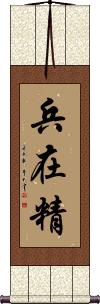
This literally means: [The value of] soldiers/warriors lies in [their] quality.
兵在精 is part of a longer phrase that ends with “not [just] in [their] quantity.”
兵在精 is a well-known phrase in military circles, so the second part is suggested when one hears or reads these three characters.
See Also: 兵在精而不在多
Value of Warrior Generals
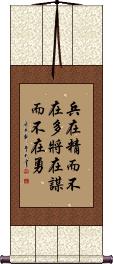
兵在精而不在多將在謀而不在勇 is a proverb that informs how it is better to have warriors of quality, rather than just a large quantity of warriors in your army/force.
This literally means: [Just as] warriors [are valued for their] quality and not [just] for quantity, [so] generals [are valued] for their tactics, not [just] for [their] bravery.
See Also: 兵在精而不在多
Bright Pearl
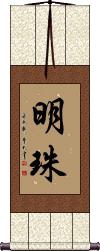
This means bright pearl or jewel of great value.
明珠 is a female given name Mingzhu in Chinese or Meishu in Japanese.
Shang
Surname
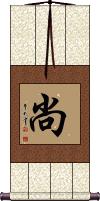
This is the most common character for the Chinese surname that romanizes as Shang. This is also a name, “Makato” in Japanese and “Sang” in Korean.
尚 is also a word meaning: still; yet; to value; to esteem; furthermore; in addition; greater; further.
Time is as Precious as Gold
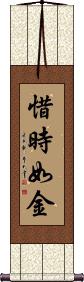
This proverb can be translated as “Cherish Time as if it was Gold” or “Time is as Valuable as Gold.”
This basically suggests that time is gold, and you should value the time you have (and use it well).
The Warrior’s Word, Dependable as Gold and Steel
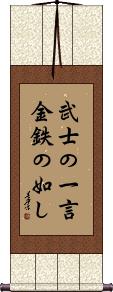
武士の一言金鉄の如し is an old Japanese proverb about the value of the word of a warrior.
Here are a couple of versions of how this can be translated:
A warrior's single word is as unchanging and reliable as gold and steel.
A warrior's promise is as dependable as gold, and his [scabbard contains] untarnished steel (a sword).
Note: Sometimes this phrase is written as 男子の一言、金鉄の如し (danshi no ichigon kintetsu no gotoshi)
Note: Because this selection contains some special Japanese Hiragana characters, it should be written by a Japanese calligrapher.
Godzilla
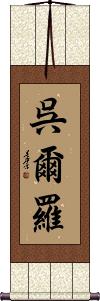
呉爾羅 was one of the original ways that Godzilla was written in Japanese Kanji.
However, the characters are used for their phonetic value rather than meaning. Later, Godzilla was written in Katakana (a specifically-phonetic character set in Japan) as ゴジラ. Either way that romanizes as Gojira. The name or title Godzilla is really the English version.
Mutual Respect
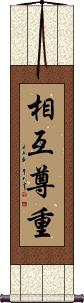
相互尊重 means mutual respect in Chinese, Japanese Kanji, and old Korean Hanja.
The first two characters are a word that means each other, mutual or reciprocal.
The last two characters are a word that means to respect, honor, value, eminent, or hold in high esteem.
Treasure
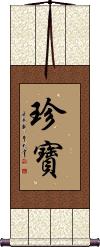
In Chinese, 珍寶 means treasure, something you value highly, or something very precious to you.
In Japanese, 珍寶 has a meaning like “rare treasure.”
珍 can mean a precious thing or treasure. 寶 can mean a jewel or gem, a treasure, or simply precious. Together these two characters reinforce each other into a word that clearly means treasure.
Warriors: Quality Over Quantity
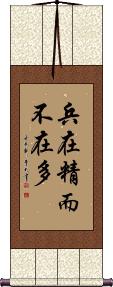
兵在精而不在多 is a Chinese proverb that means: [The value of] soldiers/warriors lies in [their] quality, not [just] in [their] quantity.
In simple terms, this says that regarding warriors, quality is better than quantity.
Most tacticians will agree that this can aid in the factor known as “force multiplication.” Having good troops of high morale, excellent training, and good discipline is like having a force that is three times larger.
See Also: 兵在精
Brevity: Fewer Words are Best
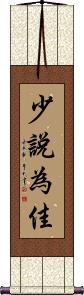
Getting to the point quickly with the fewest words possible is the suggestion of this 少說為佳 Chinese proverb.
But taking it more profound, there is a warning that using too many words may act to “tip your hat” or “show your hand” (to use two American idioms).
It can also be said that using many words does not make the message have more value.
This is really about the art of brevity.
My only hope is that I did not use too many words to explain this proverb.
Dignity / Honor / Sanctity / Integrity
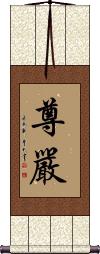
尊嚴 is a form of honor that means showing great respect for yourself, other people, and the rules you live by.
When you are honorable, you keep your word. You do the right thing regardless of what others are doing.
尊嚴 is the kind of personal honor or dignity that is of great value. If you lose this, you have lost yourself and perhaps the reputation of your family as well.
While this is not directly the same thing as “face” or “saving face” in Asian culture, it is associated with the same concept in China.
 In Japan, they currently use a more simplified second character for this word. The ancient Japanese form is the same as China but after WWII some Kanji were changed. If you want the modern Japanese version, just click on the Kanji image shown to the right, instead of the button above.
Ox / Bull / Cow
Year of the Ox / Bull - Zodiac Sign
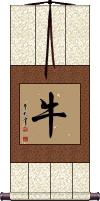
牛 is the character for bull, cow, ox, or bovine creature in Chinese, old Korean, and Japanese.
If you were born in the year of the ox/bull/cow, you . . .
Are dedicated to your work.
Are discrete, careful and conscientious.
Value work and family.
Note that in this Chinese character, there is no distinction between bull and cow. All bovine creatures fit into the definition of this character. To distinguish between male and female, another sex-designating character is added in front of this character. Therefore, in China, the energy drink “Red Bull” (Hong Niu) is often translated in the minds of Chinese people as “Red Cow” or even “Red Ox.”
See also our Chinese Zodiac page.
Death Before Dishonor
Better to be broken jade than unbroken pottery
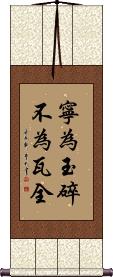
寧為玉碎不為瓦全 is the long version of a Chinese proverb that means “rather be shattered piece of jade than an unbroken piece of pottery.”
A little more explanation:
Death is implied with the “broken” meaning. Jade is one of the most precious materials in Chinese history, and in this case, is compared with one's honor and self-worth. Pottery is just something you eat off of, it has no deep value, just as a person who has lost their honor, or had none to begin with.
Thus, this means “better to die with honor than to live in shame” or words to that effect.
寧為玉碎不為瓦全 is often translated in English as “Death Before Dishonor,” the famous military slogan.
I would also compare this to the English proverb, “Better to die on your feet than to live on your knees.”
This is an idiom. It therefore doesn’t directly say exactly what it means. If you think about the English idiom, "The grass is always greener," it does not directly say "jealousy" or "envy" but everyone knows that it is implied.
Death Before Dishonor
Better to be broken jade than unbroken pottery
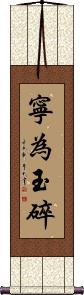
寧為玉碎 is the short version of a longer Chinese proverb which means “rather be shattered piece of jade than an unbroken piece of pottery.”
寧為玉碎 says the “rather be a broken piece of jade” part (the second half is implied - everyone in China knows this idiom).
A little more explanation:
Death is implied with the “broken” meaning. Jade is one of the most precious materials in Chinese history, and in this case, is compared with one's honor and self-worth. Pottery is just something you eat off of; it has no deep value, just as a person who has lost their honor or had none to begin with.
Thus, this means “better to die with honor than to live in shame” or words to that effect.
This is often translated in English as “Death Before Dishonor,” the famous military slogan.
I would also compare this to the English proverb, “Better to die on your feet than to live on your knees.”
Sword
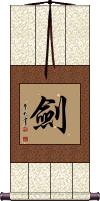
劍 is pronounced “jian” in Chinese. When you say it, imagine that you are making the sound of a sword as it clashes with a metal shield. This might get you closer to the correct pronunciation in Chinese.
I actually wonder if this word came from the metallic ringing sounds of a sword in battle - but such knowledge is lost in history.
The sword is a symbol of a warrior. The one thing that a soldier in ancient China lived and died by. A warrior with his skills and sword proves himself of great value. A warrior who losses his sword instantly becomes worthless.
劍 is an excellent scroll for someone in the military (especially officers of all services - as well as enlisted NCO Marines since they still carry swords even if mainly for ceremonial purposes). Or perhaps someone who practices variations of kung fu or tai chi that involve weapons.
Please note that while this character is understood with the sword meaning in Japanese, you might be looking for the word “katana” which also means sword in Japanese but means “knife” in Chinese.
There are other ways to write sword, and here are a few...


If you are particular about the version you receive, please let me know when you place your order (Note: Special styles are only available from one of our master calligraphers).
Tea Fate
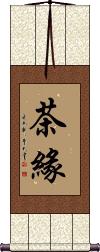
茶緣 is a special title for the tea lover. This kind of means “tea fate,” but it's more spiritual and hard to define. Perhaps the tea brought you in to drink it. Perhaps the tea will bring you and another tea-lover together. Perhaps you were already there, and the tea came to you. Perhaps it's the ah-ha moment you will have when drinking the tea.
I've been told not to explain this further, as it will either dilute or confuse the purposefully-ambiguous idea embedded in this enigma.
I happen to be the owner of a piece of calligraphy written by either the son or nephew of the last emperor of China, which is the title he wrote. It was given to me at a Beijing tea house in 2001. 茶緣 is where I learned to love tea after literally spending weeks tasting and studying everything I could about Chinese tea. I did not understand the significance of the authorship or the meaning of the title at all. Some 10 years later, I realized the gift was so profound and had such providence. Only now do I realize the value of a gift that it is too late to give proper thanks for. It was also years later that I ended up in this business and could have the artwork properly mounted as a wall scroll. It has been borrowed for many exhibitions and shows and always amazes native Chinese and Taiwanese who read the signature. This piece of calligraphy I once thought was just a bit of ink on a thin and wrinkled piece of paper, is now one of my most valued possessions. And fate has taught me to be more thankful for seemingly simple gifts.
Daodejing / Tao Te Ching - Chapter 27
The Mastery of Effortless Skill

Chapter 27 of the Daodejing reveals a profound truth about mastery: the highest skill leaves no trace, requires no force, and appears almost invisible.
善行無轍跡,
善言無瑕謫,
善數不用籌策,
善閉無關鍵而不可開,
善結無繩約而不可解。
是以聖人常善救人,
故無棄人;
常善救物,
故無棄物。
是謂襲明。
故善人者,不善人之師;
不善人者,善人之資。
不貴其師,不愛其資,
雖智大迷,
是謂要妙。
The sage moves through life with such natural harmony that nothing seems imposed; doors need no locks, knots require no rope, and actions leave no mark behind.
This is the essence of wúwéi (effortless action), where true ability arises from deep alignment with the Tao rather than deliberate effort.
At its heart, this chapter teaches compassion without exception. The sage “abandons no one and nothing,” recognizing value in all people and all things. Even those who seem flawed or unrefined are not rejected, but understood as part of a greater whole with each person both a student and a teacher in the unfolding of life.
Laozi reminds us that wisdom is not about perfection or control, but about subtle awareness. The truly skilled individual does not rely on tools, rules, or rigid structures; instead, they embody an intuitive understanding that makes their actions naturally complete.
In this way, excellence becomes quiet, effortless, and beyond imitation.
This teaching also reflects a deeper philosophical insight: Opposites are interdependent. The “good” person learns from the “not good,” and the “not good” provides the material for growth. To reject either is to misunderstand the balance of existence itself.
As calligraphy, Daodejing Chapter 27 serves as a reminder to cultivate inner mastery rather than outward display. It is a meditation on refinement, humility, and the quiet power of skill perfected through harmony with the natural order.
Note: The Chinese text used here is based on the early Mawangdui silk manuscript tradition (2nd century BCE). The Guodian manuscripts do NOT preserve Chapter 27 in full form.
This in-stock artwork might be what you are looking for, and ships right away...
Gallery Price: $108.00
Your Price: $59.88

Gallery Price: $61.00
Your Price: $33.88
These search terms might be related to Value:
A House Might Be Worth 1 Million Dollars, but Good Neighbors Are Worth 10 Million
Cherish
Guide / Help / Cooperate
Idea / Thought / Meaning
Live Together and Help Each Other
Love and Respect
Love and Respect / Kindness and Respect
Love Loyalty Respect
Loyalty and Respect
Maintain an Army for 1000 Days, Use It for an Hour
Mutual Respect
Precious / Treasure
Price
Protect Guard Treasure Cherish
Respect
Respect / Honor / Esteem
Respect and Loyalty
Respect Out of Fear is Never Genuine; Reverence Out of Respect is Never False
Respect, Honor, Truth
Self-Respect / Self-Esteem
Sun Tzu: Regard Your Soldiers as Children
The Key to Immortality is First Living a Life Worth Remembering
Treasure
Use Hard Work to Overcome Adversity
Warriors: Quality Over Quantity
Words Have Enormous Weight: One Word Worth Nine Caldrons
Worth
You Must Endure a Harsh Winter to Appreciate the Warmth of Springtime
The following table may be helpful for those studying Chinese or Japanese...
| Title | Characters | Romaji (Romanized Japanese) | Various forms of Romanized Chinese | |
| The Value of Warriors Lies in Their Quality | 兵在精 | bīng zài jīng bing1 zai4 jing1 bing zai jing bingzaijing | ping tsai ching pingtsaiching |
|
| Value of Warrior Generals | 兵在精而不在多將在謀而不在勇 兵在精而不在多将在谋而不在勇 | bīng zài jīng ér bú zài duō jiàng zài móu ér bú zài yǒng bing1 zai4 jing1 er2 bu2 zai4 duo1 jiang4 zai4 mou2 er2 bu2 zai4 yong3 bing zai jing er bu zai duo jiang zai mou er bu zai yong | ping tsai ching erh pu tsai to chiang tsai mou erh pu tsai yung | |
| Bright Pearl | 明珠 | mei shu / meishu | míng zhū / ming2 zhu1 / ming zhu / mingzhu | ming chu / mingchu |
| Shang | 尚 | nao | shàng / shang4 / shang | |
| Time is as Precious as Gold | 惜時如金 惜时如金 | xī shí rú jīn xi1 shi2 ru2 jin1 xi shi ru jin xishirujin | hsi shih ju chin hsishihjuchin |
|
| The Warrior’s Word, Dependable as Gold and Steel | 武士の一言、金鉄の如し | bushi no ichigon kintetsu no gotoshi | ||
| Godzilla | 呉爾羅 | go ji ra / gojira | ||
| Mutual Respect | 相互尊重 | sougo sonchou sougosonchou sogo soncho | xiāng hù zūn zhòng xiang1 hu4 zun1 zhong4 xiang hu zun zhong xianghuzunzhong | hsiang hu tsun chung hsianghutsunchung |
| Treasure | 珍寶 珍宝 | chin hou / chinhou / chin ho | zhēn bǎo / zhen1 bao3 / zhen bao / zhenbao | chen pao / chenpao |
| Warriors: Quality Over Quantity | 兵在精而不在多 | bīng zài jīng ér bú zài duō bing1 zai4 jing1 er2 bu2 zai4 duo1 bing zai jing er bu zai duo bingzaijingerbuzaiduo | ping tsai ching erh pu tsai to pingtsaichingerhputsaito |
|
| Brevity: Fewer Words are Best | 少說為佳 少说为佳 | shǎo shuō wéi jiā shao3 shuo1 wei2 jia1 shao shuo wei jia shaoshuoweijia | shao shuo wei chia shaoshuoweichia |
|
| Dignity Honor Sanctity Integrity | 尊嚴 尊严 / 尊厳 | son gen / songen | zūn yán / zun1 yan2 / zun yan / zunyan | tsun yen / tsunyen |
| Ox Bull Cow | 牛 | ushi | niú / niu2 / niu | |
| Death Before Dishonor | 寧為玉碎不為瓦全 宁为玉碎不为瓦全 | níng wéi yù suì bù wéi wǎ quán ning2 wei2 yu4 sui4 bu4 wei2 wa3 quan2 ning wei yu sui bu wei wa quan ningweiyusuibuweiwaquan | ning wei yü sui pu wei wa ch`üan ning wei yü sui pu wei wa chüan |
|
| Death Before Dishonor | 寧為玉碎 宁为玉碎 | níng wéi yù suì ning2 wei2 yu4 sui4 ning wei yu sui ningweiyusui | ning wei yü sui ningweiyüsui |
|
| Sword | 劍 剑 | ken / tsurugi | jiàn / jian4 / jian | chien |
| Tea Fate | 茶緣 茶缘 | chá yuán / cha2 yuan2 / cha yuan / chayuan | ch`a yüan / chayüan / cha yüan | |
| Daodejing Tao Te Ching - Chapter 27 | 善行無轍跡善言無瑕謫善數不用籌策善閉無關鍵而不可開善結無繩約而不可解是以聖人常善救人故無棄人常善救物故無棄物是謂襲明故善人者不善人之師不善人者善人之資不貴其師不愛其資雖智大迷是謂要妙 善行无辙迹善言无瑕谪善数不用筹策善闭无关键而不可开善结无绳约而不可解是以圣人常善救人故无弃人常善救物故无弃物是谓袭明故善人者不善人之师不善人者善人之资不贵其师不爱其资虽智大迷是谓要妙 | shàn xíng wú zhé jì shàn yán wú xiá zhé shàn shù bù yòng chóu cè shàn bì wú guān jiàn ér bù kě kāi shàn jié wú shéng yuē ér bù kě jiě shì yǐ shèng rén cháng shàn jiù rén gù wú qì rén cháng shàn jiù wù gù wú qì wù shì wèi xí míng gù shàn rén zhě bù shàn rén zhī shī bù shàn rén zhě shàn rén zhī zī bù guì qí shī bù ài qí zī suī zhì dà mí shì wèi yào miào shan4 xing2 wu2 zhe2 ji4 shan4 yan2 wu2 xia2 zhe2 shan4 shu4 bu4 yong4 chou2 ce4 shan4 bi4 wu2 guan1 jian4 er2 bu4 ke3 kai1 shan4 jie2 wu2 sheng2 yue1 er2 bu4 ke3 jie3 shi4 yi3 sheng4 ren2 chang2 shan4 jiu4 ren2 gu4 wu2 qi4 ren2 chang2 shan4 jiu4 wu4 gu4 wu2 qi4 wu4 shi4 wei4 xi2 ming2 gu4 shan4 ren2 zhe3 bu4 shan4 ren2 zhi1 shi1 bu4 shan4 ren2 zhe3 shan4 ren2 zhi1 zi1 bu4 gui4 qi2 shi1 bu4 ai4 qi2 zi1 sui1 zhi4 da4 mi2 shi4 wei4 yao4 miao4 shan xing wu zhe ji shan yan wu xia zhe shan shu bu yong chou ce shan bi wu guan jian er bu ke kai shan jie wu sheng yue er bu ke jie shi yi sheng ren chang shan jiu ren gu wu qi ren chang shan jiu wu gu wu qi wu shi wei xi ming gu shan ren zhe bu shan ren zhi shi bu shan ren zhe shan ren zhi zi bu gui qi shi bu ai qi zi sui zhi da mi shi wei yao miao | shan hsing wu che chi shan yen wu hsia che shan shu pu yung ch`ou ts`e shan pi wu kuan chien erh pu k`o k`ai shan chieh wu sheng yüeh erh pu k`o chieh shih i sheng jen ch`ang shan chiu jen ku wu ch`i jen ch`ang shan chiu wu ku wu ch`i wu shih wei hsi ming ku shan jen che pu shan jen chih shih pu shan jen che shan jen chih tzu pu kuei ch`i shih pu ai ch`i tzu sui chih ta mi shih wei yao miao shan hsing wu che chi shan yen wu hsia che shan shu pu yung chou tse shan pi wu kuan chien erh pu ko kai shan chieh wu sheng yüeh erh pu ko chieh shih i sheng jen chang shan chiu jen ku wu chi jen chang shan chiu wu ku wu chi wu shih wei hsi ming ku shan jen che pu shan jen chih shih pu shan jen che shan jen chih tzu pu kuei chi shih pu ai chi tzu sui chih ta mi shih wei yao miao |
|
| In some entries above you will see that characters have different versions above and below a line. In these cases, the characters above the line are Traditional Chinese, while the ones below are Simplified Chinese. | ||||

Successful Chinese Character and Japanese Kanji calligraphy searches within the last few hours...



