Many custom options...


And formats...



Universal in Chinese / Japanese...
Buy an Universal calligraphy wall scroll here!
Personalize your custom “Universal” project by clicking the button next to your favorite “Universal” title below...
Universal Love
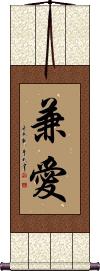
兼愛 is a Chinese word that means “universal love,” a principle advocated by philosopher Mozi (墨子), stressing that people should care for everyone equally.
Science / Universal Law
The rules of life, the universe, and everything.
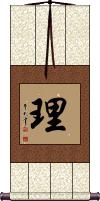
At its essence, 理 means science.
理 is a very ambiguous and open term; it speaks to the reason that all things exist, and how things work from the microscopic to the cosmic level.
In the Buddhist context, this character represents the “Universal Law.”
There are many translations for this word, including inner essence, intrinsic order, reason, logic, truth, natural science (esp. physics), principle, the underlying principles of the cosmos, the way of things, ruling principle, fundamental law, intrinsicality, universal basis, or essential element(s).
If you are a scientist, or just searching for “the answer to life, the universe, and everything,” this could be the character for you.
Confucius: Universal Education
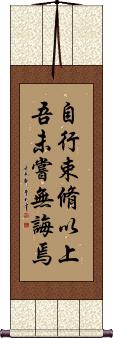
自行束脩以上吾未尝无诲焉 means, for anyone who brings even the smallest token of appreciation, I have yet to refuse instruction.
Another way to put it is: If a student (or potential student) shows just an ounce of interest, desire, or appreciation for the opportunity to learn, a teacher should offer a pound of knowledge.
This quote is from the Analects of Confucius.
This was written over 2500 years ago. The composition is in ancient Chinese grammar and phrasing. A modern Chinese person would need a background in Chinese literature to understand this without the aid of a reference.
This in-stock artwork might be what you are looking for, and ships right away...


These search terms might be related to Universal:
Chinese or Korean Army General
My Life is Complete Because of You
Shogun / Japanese General
The True and Complete Enlightenment
Uniform / Complete / Perfect / Order
Work Unselfishly for the Common Good
Worldwide Peace
Worldwide Wish for Peace and Prosperity
Not the results for Universal that you were looking for?
Below are some entries from our dictionary that may match your Universal search...
| Characters If shown, 2nd row is Simp. Chinese |
Pronunciation Romanization |
Simple Dictionary Definition |
博 see styles |
bó bo2 po hiromu ひろむ |
More info & calligraphy: Boe(suffix noun) (1) doctor; PhD; (suffix noun) (2) exposition; fair; exhibition; (given name) Hiromu Wide, universal; widely read, versed in; to cause; gamble; barter. |
理 see styles |
lǐ li3 li wataru わたる |
More info & calligraphy: Science / Universal Law(1) reason; principle; logic; (2) {Buddh} (See 事・じ) general principle (as opposed to individual concrete phenomenon); (3) the underlying principles of the cosmos (in neo-Confucianism); (given name) Wataru siddhānta; hetu. Ruling principle, fundamental law, intrinsicality, universal basis, essential element; nidāna, reason; pramāṇa, to arrange, regulate, rule, rectify. |
空 see styles |
kòng kong4 k`ung kung ron ろん |
More info & calligraphy: Sky / Ether / Void / Emptiness / Unreality(1) empty air; sky; (2) {Buddh} shunyata (the lack of an immutable intrinsic nature within any phenomenon); emptiness; (3) (abbreviation) (See 空軍) air force; (noun or adjectival noun) (4) fruitlessness; meaninglessness; (noun or adjectival noun) (5) (See 五大・1) void (one of the five elements); (can be adjective with の) (6) {math} empty (e.g. set); (female given name) Ron śūnya, empty, void, hollow, vacant, nonexistent. śūnyatā, 舜若多, vacuity, voidness, emptiness, non-existence, immateriality, perhaps spirituality, unreality, the false or illusory nature of all existence, the seeming 假 being unreal. The doctrine that all phenomena and the ego have no reality, but are composed of a certain number of skandhas or elements, which disintegrate. The void, the sky, space. The universal, the absolute, complete abstraction without relativity. There are classifications into 2, 3, 4, 6, 7, 11, 13, 16, and 18 categories. The doctrine is that all things are compounds, or unstable organisms, possessing no self-essence, i.e. are dependent, or caused, come into existence only to perish. The underlying reality, the principle of eternal relativity, or non-infinity, i.e. śūnya, permeates all phenomena making possible their evolution. From this doctrine the Yogācārya school developed the idea of the permanent reality, which is Essence of Mind, the unknowable noumenon behind all phenomena, the entity void of ideas and phenomena, neither matter nor mind, but the root of both. |
兼愛 兼爱 see styles |
jiān ài jian1 ai4 chien ai |
More info & calligraphy: Universal Love |
平等 see styles |
píng děng ping2 deng3 p`ing teng ping teng byoudou / byodo びょうどう |
More info & calligraphy: Equality(n,adj-na,adj-no) equality; impartiality; evenness; (place-name) Byōdō sama; samatā. Level, even, everywhere the same, universal, without partiality; it especially refers to the Buddha in his universal; impartial, and equal attitude towards all beings. |
海德 see styles |
hǎi dé hai3 de2 hai te kaitoku |
More info & calligraphy: HeidThe eight virtues, or powers of the ocean, i.e. vastness, tidal regularity, throwing out of the dead, containing the seven kinds of pearls, absorption of all rivers, of all rain without increase, holding the most mighty fish, universal unvarying saltness. |
瑜伽 see styles |
yú jiā yu2 jia1 yü chia yuga ゆが |
More info & calligraphy: Yoga{Buddh} (See ヨーガ) yoga; (surname) Yuga yoga; also 瑜誐; 遊迦; a yoke, yoking, union, especially an ecstatic union of the individual soul with a divine being, or spirit, also of the individual soul with the universal soul. The method requires the mutual response or relation of 境, 行, 理, 果 and 機; i.e. (1) state, or environment, referred to mind; (2) action, or mode of practice; (3) right principle; (4) results in enlightenment; (5) motivity, i.e. practical application in saving others. Also the mutual relation of hand, mouth, and mind referring to manifestation, incantation, and mental operation; these are known as 瑜伽三密, the three esoteric (means) of Yoga. The older practice of meditation as a means of obtaining spiritual or magical power was distorted in Tantrism to exorcism, sorcery, and juggling in general. |
一視同仁 一视同仁 see styles |
yī shì tóng rén yi1 shi4 tong2 ren2 i shih t`ung jen i shih tung jen isshidoujin / isshidojin いっしどうじん |
More info & calligraphy: Impartial and Fair to the Brotherhood and Sisterhood of the World(yoji) loving every human being with impartiality; universal brotherhood; universal benevolence |
アートマン see styles |
aadoman / adoman アードマン |
(See ブラフマン) atman (san: ātman); one's true self, which transcends death and is part of the universal Brahman (in Hinduism); (surname) Erdman |
大 see styles |
dài dai4 tai yutaka ゆたか |
see 大夫[dai4 fu5] (pref,adj-na,n) (1) large; big; great; huge; vast; major; important; serious; severe; (prefix) (2) great; prominent; eminent; distinguished; (suffix) (3) -sized; as big as; the size of; (suffix noun) (4) (abbreviation) (See 大学・1) university; (5) large (e.g. serving size); large option; (6) (abbreviation) (See 大の月) long month (i.e. having 31 days); (given name) Yutaka Maha. 摩訶; 麼賀. Great, large, big; all pervading, all-embracing; numerous 多; surpassing ; mysterious 妙; beyond comprehension 不可思議; omnipresent 體無不在. The elements, or essential things, i.e. (a) 三大 The three all-pervasive qualities of the 眞如 q.v. : its 體, 相 , 用 substance, form, and functions, v. 起信論 . (b) 四大 The four tanmātra or elements, earth, water, fire, air (or wind) of the 倶舍論. (c)五大 The five, i.e. the last four and space 空, v. 大日經. (d) 六大 The six elements, earth, water, fire, wind, space (or ether), mind 識. Hīnayāna, emphasizing impersonality 人空, considers these six as the elements of all sentient beings; Mahāyāna, emphasizing the unreality of all things 法空, counts them as elements, but fluid in a flowing stream of life, with mind 識 dominant; the esoteric sect emphasizing nonproduction, or non-creation, regards them as universal and as the Absolute in differentiation. (e) 七大 The 楞嚴經 adds 見 perception, to the six above named to cover the perceptions of the six organs 根. |
如 see styles |
rú ru2 ju yuki ゆき |
as; as if; such as {Buddh} (See 真如) tathata (the ultimate nature of all things); (female given name) Yuki tathā 多陀; 但他 (or 怛他), so, thus, in such manner, like, as. It is used in the sense of the absolute, the 空 śūnya, which is 諸佛之實相 the reality of all Buddhas; hence 如 ru is 賃相 the undifferentiated whole of things, the ultimate reality; it is 諸法之性 the nature of all things, hence it connotes 法性 faxing which is 眞實之際極 the ultimate of reality, or the absolute, and therefore connotes 實際 ultimate reality. The ultimate nature of all things being 如 ru, the one undivided same, it also connotes 理 li, the principle or theory behind all things, and this 理 li universal law, being the 眞實 truth or ultimate reality; 如 ru is termed 眞如 bhūtatathatā, the real so, or suchness, or reality, the ultimate or the all, i. e. the 一如 yiru. In regard to 如 ju as 理 li the Prajñā-pāramitā puṇḍarīka makes it the 中 zhong, neither matter nor nothingness. It is also used in the ordinary sense of so, like, as (cf yathā). |
彌 弥 see styles |
mí mi2 mi wataru わたる |
full; to fill; completely; more (given name) Wataru To shoot, reach everywhere, pervade; complete, universal; prevent, stop; more; long. |
徧 遍 see styles |
biàn bian4 pien hen |
variant of 遍[bian4] sarvatraga. On every side, ambit, everywhere, universal, pervade, all, the whole. |
普 see styles |
pǔ pu3 p`u pu fukatsu ふかつ |
general; popular; everywhere; universal (abbreviation) (See 普通預金・2) ordinary bank account; (personal name) Fukatsu viśva; universal, all; pervasive, ubiquitous; translit. po, pa, pu. |
溥 see styles |
pǔ pu3 p`u pu hiroshi ひろし |
extensive; pervading (given name) Hiroshi Universal. |
等 see styles |
děng deng3 teng hitoshi ひとし |
to wait for; to await; by the time; when; till; and so on; etc.; et al.; (bound form) class; rank; grade; (bound form) equal to; same as; (used to end an enumeration); (literary) (plural suffix attached to a personal pronoun or noun) (suffix) (1) (kana only) pluralizing suffix; (suffix) (2) (kana only) (See あちら・1,いくら・1) or so; rough indicator of direction, location, amount, etc.; (suffix) (3) (kana only) (after the stem of an adjective) (See 清ら) nominalizing suffix; (s,m,f) Hitoshi To pair; parallel, equal, of like order; a class, grade, rank; common; to wait; sign of plural. In Buddhist writings it is also used for 'equal everywhere', 'equally everywhere', 'universal'. |
通 see styles |
tòng tong4 t`ung tung michiaki みちあき |
classifier for an activity, taken in its entirety (tirade of abuse, stint of music playing, bout of drinking etc) (n,n-suf,adj-na) (1) authority; expert; connoisseur; well-informed person; (counter) (2) counter for messages, letters, notes, documents, etc.; (noun or adjectival noun) (3) understanding (esp. of male-female relations); tact; insight; (4) supernatural powers; magical powers; (given name) Michiaki Permeate, pass through, pervade; perceive, know thoroughly; communicate; current; free, without hindrance, unimpeded universal; e.g. 神通 supernatural, ubiquitous powers. There are categories of 五通, 六通, and 十通, all referring to supernatural powers; the five are (1) knowledge of the supernatural world; (2) deva vision; (3) deva hearing; (4) knowledge of the minds of all others; (5) knowledge of all the transmigrations of self and all others. The six are the above together with perfect wisdom for ending moral hindrance and delusion. The ten are knowing all previous transmigrations, having deva hearing, knowing the minds of others, having deva vision, showing deva powers, manifesting many bodies or forms, being anywhere instantly, power of bringing glory to one's domain, manifesting a body of transformation, and power to end evil and transmigration. |
UD see styles |
yuu dii; yuudii(sk) / yu di; yudi(sk) ユー・ディー; ユーディー(sk) |
(See ユニバーサルデザイン) universal design |
一般 see styles |
yī bān yi1 ban1 i pan ippan いっぱん |
same; ordinary; so-so; common; general; generally; in general (adj-no,n) (1) general; universal; (adj-no,n) (2) (ant: 特殊) ordinary; average; common; non-celebrity; (adj-no,n) (3) (archaism) the same; no different; (just) as if same |
万国 see styles |
mankoku まんこく |
(noun - becomes adjective with の) all countries; the whole world; universal; all nations; (surname) Mankoku |
万有 see styles |
manyu まんゆ |
all things; all creation; universal; (given name) Man'yu |
万能 see styles |
mannou / manno まんのう |
(adj-no,n) (1) all-purpose; utility; universal; (adj-no,n) (2) all-powerful; almighty; omnipotent; all-round (e.g. athlete); (place-name) Mannou |
三大 see styles |
sān dà san1 da4 san ta miou / mio みおう |
(prefix) (See 三大疾病) the big three ...; (surname) Miou The three great characteristics of the 眞如 in the 起信論 Awakening of Faith: (1) 體大 The greatness of the bhūtatathatā in its essence or substance; it is 衆生心之體性 the embodied nature of the mind of all the living, universal, immortal, immutable, eternal; (2) 相大 the greatness of its attributes or manifestations, perfect in wisdom and mercy, and every achievement; (3) 用大 the greatness of its functions and operations within and without, perfectly transforming all the living to good works and good karma now and hereafter. There are other groups, e.g. 體, 宗, and 用. |
三密 see styles |
sān mì san1 mi4 san mi sanmitsu さんみつ |
{Buddh} three mysteries (Buddha's body, speech and mind) The three mystic things: the body, mouth (i.e. voice), and mind of the Tathāgata, which are universal, all things being this mystic body, all sound this mystic voice, and all thought this mystic mind. All creatures in body, voice, and mind are only individualized parts of the Tathāgata, but illusion hides their Tathāgata nature from them. The esoterics seek to realize their Tathāgata nature by physical signs and postures, by voicing of 眞言 dhāraṇī and by meditations, so that 入我我入 He may enter me and I Him, which is the perfection of siddhi 悉地; v. 大日經疏 1. 菩提心論. |
三德 see styles |
sān dé san1 de2 san te santoku |
The three virtues or powers, of which three groups are given below. (1) (a) 法身德 The virtue or potency of the Buddha's eternal, spiritual body, the dharmakāya; (b) 般若德 of his prājñā, or wisdom, knowing all things in their reality; (c) 解脫德 of his freedom from all bonds and his sovereign Iiberty. Each of these has the four qualities of 常, 樂我, 淨eternity, joy, personality, and purity; v. 漫涅槃經 (2) (a) 智德 The potency of his perfect knowledge; (b) 斷德 of his cutting off all illusion and perfecting of supreme nirvāṇa; the above two are 自利 for his own advantage; (c) 恩德 of his universal grace and salvation, which 利他 bestows the benefits he has acquired on others. (3) (a) 因圓德 The perfection of his causative or karmic works during his three great kalpas of preparation; (b) 果圓德 the perfection of the fruit, or results in his own character and wisdom; (c) 恩圓德 the perfection of his grace in the salvation of others. |
三等 see styles |
sān děng san1 deng3 san teng santō さんとう |
third class The three equal and universal characteristics of the one Tathāgata, an esoteric definition: (1) (a) his 身 body, (b) 語 discourse, (c) 意 mind. (2) (a) his life or works 修行; (b) spiritual body 法身; (c) salvation 度生; in their equal values and universality. |
三身 see styles |
sān shēn san1 shen1 san shen sanmi さんみ |
{Buddh} trikaya (three bodies of the Buddha); (surname) Sanmi trikāya. 三寶身 The threefold body or nature of a Buddha, i.e. the 法, 報, and 化身, or dharmakāya, sambhogakāya, and nirmāṇakāya. The three are defined as 自性, 受用, and 變化, the Buddha-body per se, or in its essential nature; his body of bliss, which he "receives" for his own "use" and enjoyment; and his body of transformation, by which he can appear in any form; i.e. spiritual, or essential; glorified; revealed. While the doctrine of the trikāya is a Mahāyāna concept, it partly results from the Hīnayāna idealization of the earthly Buddha with his thirty-two signs, eighty physical marks, clairvoyance, clairaudience, holiness, purity, wisdom, pity, etc. Mahāyāna, however, proceeded to conceive of Buddha as the Universal, the All, with infinity of forms, yet above all our concepts of unity or diversity. To every Buddha Mahāyāna attributed a three-fold body: that of essential Buddha; that of joy or enjoyment of the fruits of his past saving labours; that of power to transform himself at will to any shape for omnipresent salvation of those who need him. The trinity finds different methods of expression, e.g. Vairocana is entitled 法身, the embodiment of the Law, shining everywhere, enlightening all; Locana is 報身; c.f. 三賓, the embodiment of purity and bliss; Śākyamuni is 化身 or Buddha revealed. In the esoteric sect they are 法 Vairocana, 報 Amitābha, and 化 Śākyamuni. The 三賓 are also 法 dharma, 報 saṅgha, 化 buddha. Nevertheless, the three are considered as a trinity, the three being essentially one, each in the other. (1) 法身 Dharmakāya in its earliest conception was that of the body of the dharma, or truth, as preached by Śākyamuni; later it became his mind or soul in contrast with his material body. In Mādhyamika, the dharmakāya was the only reality, i.e. the void, or the immateria1, the ground of all phenomena; in other words, the 眞如 the tathāgatagarbha, the bhūtatathatā. According to the Huayan (Kegon) School it is the 理or noumenon, while the other two are氣or phenomenal aspects. "For the Vijñānavāda... the body of the law as highest reality is the void intelligence, whose infection (saṃkleҫa) results in the process of birth and death, whilst its purification brings about Nirvāṇa, or its restoration to its primitive transparence" (Keith). The "body of the law is the true reality of everything". Nevertheless, in Mahāyāna every Buddha has his own 法身; e.g. in the dharmakāya aspect we have the designation Amitābha, who in his saṃbhogakāya aspect is styled Amitāyus. (2) 報身Sambhogakāya, a Buddha's reward body, or body of enjoyment of the merits he attained as a bodhisattva; in other words, a Buddha in glory in his heaven. This is the form of Buddha as an object of worship. It is defined in two aspects, (a) 自受用身 for his own bliss, and (b) 他受用身 for the sake of others, revealing himself in his glory to bodhisattvas, enlightening and inspiring them. By wisdom a Buddha's dharmakāya is attained, by bodhisattva-merits his saṃbhogakāya. Not only has every Buddha all the three bodies or aspects, but as all men are of the same essence, or nature, as Buddhas, they are therefore potential Buddhas and are in and of the trikāya. Moreover, trikāya is not divided, for a Buddha in his 化身 is still one with his 法身 and 報身, all three bodies being co-existent. (3) 化身; 應身; 應化身 nirmāṇakāya, a Buddha's transformation, or miraculous body, in which he appears at will and in any form outside his heaven, e.g. as Śākyamuni among men. |
不二 see styles |
bù èr bu4 er4 pu erh fuji ふじ |
the only (choice, way etc); undivided (loyalty) {Buddh} advaitam (non-duality); (surname, female given name) Fuji advaya. No second, non-duality, the one and undivided, the unity of all things, the one reality、 the universal Buddha-nature. There are numerous combinations, e. g. 善惡不二 good and evil are not a dualism: nor are 有 and 空 the material and immaterial, nor are 迷 and 悟 delusion and awareness— all these are of the one Buddha-nature. |
二圓 二圆 see styles |
èr yuán er4 yuan2 erh yüan nien |
The two perfect doctrines, a term of the Tiantai School, called 今圓 (also 開顯圓 and 絶待圓) and 昔圓 (also 相待圓 ). 今圓 is the present really perfect 一實 doctrine arising from the Lotus Sūtra; 昔圓 is the older, or 相待 comparatively speaking perfect doctrine of the pre-Lotus teaching, that of the 藏, 通, and 別 schools; but the older was for limited salvation and not universal like the 今圓; these two are also termed 部圓 and 教圓 . The Huayan school has a division of the two perfections into 漸圓 gradual perfection and 頓圓 immediate perfection. |
二相 see styles |
èr xiàng er4 xiang4 erh hsiang nisou / niso にそう |
(noun - becomes adjective with の) two-phase The two forms, or characteristics, of the bhutatathata, universal and particular. The 起信論 gives (a) 淨智相 pure wisdom, cf. ālaya-vijñāna, out of whose primary condition arise (b) 不思議用相 inconceivable, beneficial functions and uses. The same śāstra gives also a definition of the 眞如 as (a) 同相 that all things, pure or impure, are fundamentally of the same universal, e.g. clay which is made into tiles; (b) 異相 but display particular qualities, as affected by pure or impure causes, e.g. the tiles. Another definition, of the 智度論 31, is (a) 總相 universals, as impermanence; (b) 別相 particulars, for though all things have the universal basis of impermanence they have particular qualities, e.g. earth-solidity, heat of fire, etc. |
Click here for more Universal results from our dictionary
The following table may be helpful for those studying Chinese or Japanese...
| Title | Characters | Romaji (Romanized Japanese) | Various forms of Romanized Chinese | |
| Universal Love | 兼愛 兼爱 | jiān ài / jian1 ai4 / jian ai / jianai | chien ai / chienai | |
| Science Universal Law | 理 | kotowari | lǐ / li3 / li | |
| Confucius: Universal Education | 自行束脩以上吾未嘗無誨焉 (note 嘗 = 嚐) 自行束脩以上吾未尝无诲焉 | zì xíng shù xiū yǐ shàng wú wèi cháng wú huì yān zi4 xing2 shu4 xiu1 yi3 shang4 wu2 wei4 chang2 wu2 hui4 yan1 zi xing shu xiu yi shang wu wei chang wu hui yan | tzu hsing shu hsiu i shang wu wei ch`ang wu hui yen tzu hsing shu hsiu i shang wu wei chang wu hui yen |
|
| In some entries above you will see that characters have different versions above and below a line. In these cases, the characters above the line are Traditional Chinese, while the ones below are Simplified Chinese. | ||||

Successful Chinese Character and Japanese Kanji calligraphy searches within the last few hours...



