I am shipping orders on Thursday this week. News and More Info

Many custom options...

Tan Paper and Copper Silk Love Wall Scroll
Red Paper and Ivory Silk Love Wall Scroll
Orange Paper Love Scroll
Crazy Blue and Gold Silk Love Scroll


And formats...

Love Vertical Portrait
Love Horizontal Wall Scroll
Love Vertical Portrait

Ung in Chinese / Japanese...

Buy an Ung calligraphy wall scroll here!

Personalize your custom “Ung” project by clicking the button next to your favorite “Ung” title below...

Switched to secondary search mode due to lack of results using primary.
These secondary results may not be very accurate. Try a different but similar meaning word or phrase for better results. Or...

Look up Ung in my Japanese Kanji & Chinese Character Dictionary(My dictionary is a different system then the calligraphy search you just tried)

If you want a special phrase, word, title, name, or proverb, feel free to contact me, and I will translate your custom calligraphy idea for you.


  1. Adonis / Handsome Young Man

  2. Amelung

  3. Aung

  4. Chong / Sung / Su

  5. Chung Do Kwan

  6. Drunken Monkey Kung Fu

  7. Five Families / Tsoi Li Hoi Fut Hung

  8. Forever Young

  9. Forever Young / Eternal Youth

10. Forever Young / Long Life

11. Kung / Gong / Mitsugi

12. Gung Ho

13. Gurung

14. Hung Gar

15. Hung Ga Kuen

16. Hung Kuen

17. Hungary

18. Hyo-Jung

19. Jung Sim Do

20. Kitten / Young Cat / Little Cat

21. Kung / Gong

22. Kung Fu Panda

23. Kunga

24. Kung Fu / Gong Fu

25. Kung Fu San Soo / San Shou

26. Lau Gar Kung Fu

27. Laughing Dragon Kung Fu

28. Leung

29. Wise Younger Brother

30. Mungala

31. Qi Gong / Chi Kung

32. San Soo Kung Fu

33. Shaolin Kung Fu

34. Shit / Manure / Dung / Feces / Excrement / Poop

35. Si Gung

36. Tai Chi Wing Chun Kung Fu

37. Tung

38. Ung

39. Unger

40. Wing Chun Kung Fu

41. Youngblood

42. Younger

43. Younger Sister

44. Youngs

45. Yung

46. Zhang / Cheung


Adonis / Handsome Young Man

 bi sei nen
Adonis / Handsome Young Man Scroll

美青年 means handsome young man, or figuratively, Adonis, in Japanese.

 ā méi lóng
Amelung Scroll

阿梅隆 is the name Amelung in Chinese (Mandarin).

 amerungu
Amelung Scroll

アメルング is the name Amelung in Japanese Katakana.


Note: Because this title is entirely Japanese Katakana, it should be written by a Japanese calligrapher.

Aung

Burmese Surname

 áng
 hisashi
 
Aung Scroll

昂 is often used to represent the Burmese surname Aung.

The actual meaning is to lift, raise, high, high spirits, soar, or soaring.

In Japanese, this can be the given name Hisashi.

Chong / Sung / Su

Surname

 chóng
 sung
 sū
 
Chong / Sung / Su Scroll

This is the surname “Chong” or “Zhong” in Mandarin Chinese, “Sung” in Cantonese and Korean, and Su in Japanese.

崇 is used in other Chinese words and other Asian languages with the following meanings:
high; sublime; lofty; to esteem; to worship; eminent; honorable; honourable; reverence; adore/adoration.

Chung Do Kwan

 qīng tāo quǎn
Chung Do Kwan Scroll

靑濤館 is the Korean martial arts style, Chung Do Kwan, meaning “Blue Wave School.”

If you want this in modern Korean Hangul characters, click on the Hangul next to the Korean flag above instead of the button above.

Also Romanized as “Cheong Do Gwan” or “Ch'ŏng Do Kwan.”

Drunken Monkey Kung Fu

 zuì hóu gōng fu
Drunken Monkey Kung Fu Scroll

醉猴功夫 is the title for Drunken Monkey Kung Fu (Gong Fu).

The martial arts style was inspired by the novel, “Journey to the West.”


See Also:  Monkey Fist

Five Families / Tsoi Li Hoi Fut Hung

 cài lǐ hé fú xióng
 tsoi lee ho fat hung
Five Families / Tsoi Li Hoi Fut Hung Scroll

蔡李何佛雄 is the five families associated with San Soo Kung Fu.

The characters are always the same, but there are several ways these are romanized from Cantonese, Mandarin, and other dialects. Some common ones include Tsoi Li Hoi Fut Hung and Choi Li Ho Fut Hung.

If you are using a different romanization, that does not mean it's wrong. It might just be that your school is using a different dialect or romanization scheme.

Forever Young

 yǒng yuǎn nián qīng
Forever Young Scroll

永遠年輕 is “forever young” in Chinese characters.

Forever Young / Eternal Youth

 fu rou
Forever Young / Eternal Youth Scroll

不老 is a Japanese word that means “perpetual youth” or “forever young.”

It contains the idea of never getting old. It literally means “never aging,” or “not [getting] old.”

Forever Young / Long Life

 fu rou chou ju
Forever Young / Long Life Scroll

This Japanese phrase means “perpetual youth and longevity.”

It contains the ideas of never getting old and eternal life.

Kung / Gong / Mitsugi

Surname

 gòng
 mitsugi
 
Kung / Gong / Mitsugi Scroll

貢 is a Chinese surname that can romanize as Gong from Mandarin or Kung from Cantonese.

In Japan, this can be the surname or given name Mitsugi. The meaning of this is tribute or gifts.

Gung Ho

Working Together

 gōng hé
 guai
Gung Ho Scroll

工合 is one of those Asian words that is used more in English than in the original Chinese.

Gung Ho was originally used to speak of Carlson's Raiders, a group of “Gung Ho” U.S. Marines who went on an island-hopping campaign of death during WWII.

A movie called Gung Ho came out in the mid-1940s and was later re-released in the 1950s depicting the 2nd Marine Raider Battalion, and brought this word to the mainstream.

It is still sometimes used today within the U.S. Marine Corps brotherhood to refer to a unit or group that works well together or is otherwise efficient and motivated (has good morals).

In 1986, there was a movie called Gung Ho about a Japanese company taking over an American automotive factory. They completely ignored the fact that this was a Chinese title.

It should be noted that this title actually means a condition, state, manner, or the health of something in Japanese.

Language and pronunciation notes:
Like many Asian words absorbed into common use in English, this one is drastically mispronounced. The official Romanization is “gong he” but that doesn't tell you enough. The vowel sound on the first character is like the English word “own,” now just add the g-sounds to the beginning and end. The second character is misleading, as you might think it is like the English word “he.” In reality, the vowel sound is more like the “u” in “up.”

It should also be noted that the current generation in China no longer uses or recognizes this as a common word or slogan.


Note: This can be pronounced and is a word in Japanese, though seldom used. Japanese will use a variation of "具合" instead. But still, not common.

 gǔ lóng
Gurung Scroll

古隆 is the name Gurung in Chinese (Mandarin).

 gurun
Gurung Scroll

グルン is the name Gurung in Japanese Katakana.


Note: Because this title is entirely Japanese Katakana, it should be written by a Japanese calligrapher.

 hóng jiā
 hung gaa
Hung Gar Scroll

洪家 is the martial arts title Hung Ga or Hung Gar.

The first character means flood, big, immense, or great but it can also be the surname, Hong or Hung.

The last character means family or home.

This can also be read as “The Hung Family” or “The Hung Household.” This title is mostly associated with a style of Kung Fu.

Hung Ga Kuen

 hóng jiā quán
 hung gaa kyun
Hung Ga Kuen Scroll

洪家拳 is the martial arts title Hung Ga Kuen.

The first character means flood, big, immense, or great but it can also be the surname, Hong or Hung.

The second character means family or home.

The last character is a fist.

 hóng quán
 hung kyun
Hung Kuen Scroll

洪拳 is the martial arts title Hung Kuen.

The first character means flood, big, immense, or great but it can also be the surname, Hong or Hung.

The last character means fist.

 xiōng yá lì
Hungary Scroll

This is the Chinese name for the country of Hungary.


See Also:  Europe

 han ga rii
Hungary Scroll

This is Hungary in Japanese Katakana.


Note: Because this title is entirely Japanese Katakana, it should be written by a Japanese calligrapher.

 xiào jìng
Hyo-Jung Scroll

孝靜 or 효정 is the Korean given name Hyo-Jung or Hyojung.

If you want this name written in Hangul, click the Hangul characters next to the Korean flag above (instead of the big button).

 zhèng xīn dào
Jung Sim Do Scroll

This is the Korean martial arts title Jung Sim Do.

The official romanization should be Jeong Sim Do (thought in Korean, the J is almost a "Ch" sound) and other will romanize as Jung Shin Do.

The meaning is straight/right heart way. If you want this written in Hangul (정심도) in stead of Hanja (正心道), please click on the Hangul characters next to the Korean flag above.

Kitten / Young Cat / Little Cat

 xiǎo māo
 koneko
Kitten / Young Cat / Little Cat Scroll

小猫/小貓 means kitten (literally: little cat) in Chinese and Japanese Kanji.

 gōng
 
Kung / Gong Scroll

龔 is a Chinese surname that can be romanized as Gong or Kung.

From most of China, it would be Gong, but from Cantonese, it is often romanized as Kung.

In Korean, this could be a surname that romanizes as Gong or Kong and is now written as 공.

The original meaning of the character was something like, “to provide.”

Kung Fu Panda

 gōng fú xióng māo
Kung Fu Panda Scroll

This is the title Kung Fu Panda in Chinese.

 gēn gā
Kunga Scroll

根呷 is the name Kunga in Chinese (Mandarin).

Kunga is often a Tibetan name, ཀུན་དགའ།, so this would be the transliteration of that name into Chinese. This is also the Chinese name of the famous Tibetan singer, Kunga.

 kungaa
Kunga Scroll

クンガー is the name Kunga in Japanese (Katakana).


Note: Because this title is entirely Japanese Katakana, it should be written by a Japanese calligrapher.

Kung Fu / Gong Fu

 gōng fu
 gung fu
 kan fu / ku fu
Kung Fu / Gong Fu Scroll

功夫 or Kung Fu is one of the most famous types of martial arts in the world - and not just because of Bruce Lee.

Some translate the meaning as “Accomplishment by Great Effort.” I think this is partially true, but directly translated, it literally means “Merit/Achievement/Accomplishment Man.” The word “fu” can sometimes mean “husband” or “porter,” but in this case, it can only mean “man.” However, few in China will think “man” when they hear the word “Gong Fu” spoken.

This term is also used for things other than martial arts. In fact, it's used to refer to a person with excellent skills in crafts that require a lot of effort to master, such as cooking, tea ceremonies, and calligraphy.

What a lot of people don't know is that the spelling of “Kung Fu” was actually taken from the old Wade Giles form of Romanization. Using this method, the sounds of the English “G” and “K” were both written as “K” and an apostrophe after the “K” told you it was supposed to sound like a “G.” Nobody in the west knew this rule, so most people pronounce it with a “K-sound.” And so, Gong Fu will always be Kung Fu for most westerners.

Also, just to educate you a little more, the “O” in “Gong” has a sound like the English word “oh.”

The popular Chinese dish “Kung Pao Chicken” suffers from the same problem. It should actually be “Gong Bao Chicken.”

Historical note: Many will claim that Kung Fu was invented by the monks of the Shaolin monastery. This fact is argued in both directions by scholars of Chinese history. Perhaps it is more accurate to say that the Shaolin Monks brought the original fame to Kung Fu many generations ago.


Japanese note: While most Japanese martial artists will recognize these characters, Katakana is more often used to approximate the pronunciation of "Kung Fu" with "カンフー." Some will argue as to whether this should be considered a Japanese word at all.


See Also:  Bruce Lee

Kung Fu San Soo / San Shou

 gōng fu sǎn shǒu
 gung fu saan sau
Kung Fu San Soo / San Shou Scroll

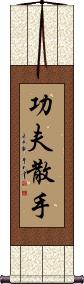
功夫散手 is a martial arts title.

Oddly, there are multiple ways two spell/romanize this in English, but in Chinese, it's written exactly the same.

Technically, the Mandarin romanizes as “gong fu san shou,” for which you'll sometimes see it written “kung fu san shou” (k'ung is an old romanization for a word that sounds like gong with a vowel sound like “oh”).

There is another martial arts style that spells this “Kung Fu San Soo.” I guess this was supposed to approximate Cantonese pronunciation for which the scholarly romanization is generally agreed to be “gung fu saan sau.”

Lau Gar Kung Fu

 liú jiā gōng fu
 lau gar gung fu
Lau Gar Kung Fu Scroll

劉家功夫 are the characters for the Lau Gar Kung Fu style of martial arts.

The romanization of “Lau Gar” comes from Cantonese. “Kung Fu” is the common romanization for English from the Mandarin “Gōng Fu” or Cantonese “Gung Fu” pronunciations.

Lau gar = Lau family.

Laughing Dragon Kung Fu

 xiào lóng gōng fu
Laughing Dragon Kung Fu Scroll

笑龍功夫 is the title for a Martial Arts studio (custom-made at by request of the owner of the studio).

Leung

Surname

 liáng
 reon / ryou
 
Leung Scroll

梁 is the most common character that can represent a surname romanized as Leung (from Cantonese) or Liang (from Mandarin).

The actual meaning is roof beam, structural beam, pillar and sometimes bridge.

This can refer to the Liang dynasty of China (502-557 AD).

This can also be the rare surname Reon in Japanese.

Wise Younger Brother

 xián dì
 ken tei
Wise Younger Brother Scroll

賢弟 is an honorific title for a little brother.

This can be translated as a worthy little brother or wise younger brother. This can also be a polite reference to another person's younger brother, your junior, or your subordinate.

 méng jiā lā
Mungala Scroll

蒙加拉 is the name Mungala in Chinese (Mandarin).

 mungara
Mungala Scroll

ムンガラ is the name Mungala in Japanese Katakana.


Note: Because this title is entirely Japanese Katakana, it should be written by a Japanese calligrapher.

Qi Gong / Chi Kung

 qì gōng
 ki kou
Qi Gong / Chi Kung Scroll

氣功 or Qigong is the title of a technique that is somewhere between medical practice, meditation, and in some cases, religion.

The definition is blurred depending on which school of Qigong you are following. In some cases, it is even incorporated with martial arts.

Some people (even Chinese people) mix this title with Tai Chi (Tai Qi) exercises.

Lately, in China, people will claim to practice Tai Chi rather than Qigong because the Qigong title was recently used as a cover for an illegal pseudo-religious movement in China with the initials F.G. or F.D. (I can not write those names here for fear of our website being banned in China).

You can learn those names and more here: Further info about Qigong

If you are wondering why I wrote “Qi Gong” and “Chi Kung” as the title of this calligraphy entry, I should teach you a little about the various ways in which Chinese can be Romanized. One form writes this as “Chi Kung” or “Chikung” (Taiwan). In the mainland and elsewhere, it is Romanized as “Qi Gong” or “Qigong.” The pronunciation is the same in Taiwan, mainland, and Singapore Mandarin. Neither Romanization is exactly like English. If you want to know how to say this with English rules, it would be something like “Chee Gong” (but the “gong” has a vowel sound like the “O” in “go”).

Romanization is a really confusing topic and has caused many Chinese words to be mispronounced in the west. One example is “Kung Pao Chicken,” which should actually be more like “Gong Bao” with the “O” sounding like “oh” for both characters. Neither the Romanization system in Taiwan nor the Mainland is perfect, in my opinion, and leads to many misunderstandings.


In modern Japan, you may see this written as 気功, but the original 氣功 is still recognized. If you need the Japanese version, please contact me.

San Soo Kung Fu

 sǎn shǒu gōng fu
 saan sau gung fu
San Soo Kung Fu Scroll

散手功夫 is San Soo Kung Fu.

Sometimes you will see this in the order 功夫散手 (Kung Fu San Soo). Either version is OK.

It's like “Kung Fu of San Soo” vs. “San Soo Kung Fu” if you put it in English terms. San Soo is the adjective either way in Chinese.

Shaolin Kung Fu

 shǎo lín gōng fu
 sho rin kan fu
Shaolin Kung Fu Scroll

The Shaolin monks of China have been practicing the art of Kung Fu for thousands of years.

少林功夫 is the full title, “Shao Lin Kung Fu.”

Shit / Manure / Dung / Feces / Excrement / Poop

NOT APPROPRIATE FOR
CUSTOM CALLIGRAPHY

 fèn
 kuso
 
Shit / Manure / Dung / Feces / Excrement / Poop Scroll

Seems a lot of you want to know how to write “shit” in Chinese, Japanese Kanji, and old Korean Hanja. 糞 is the single-character version of shit, which is used to express the ideas of manure, dung, and bullshit. Yes, at least in Chinese, they use this in much the same way as shit or bullshit is used in English.

Please don't try to order this, it's here only for reference. 糞 is not appropriate for custom calligraphy!

 shī gōng
 shi kou
Si Gung Scroll

This is a term for “teacher” that is primarily used in Wing Chun martial arts schools.

In very old Buddhist context this can be “thaumaturge” meaning a worker of wonders and/or performer of miracles.

Tai Chi Wing Chun Kung Fu

 tài jí yǒng chūn gōng fu
Tai Chi Wing Chun Kung Fu Scroll

太極詠春功夫 is the title Tai Chi Wing Chun Kung Fu.

Please note that it can be romanized in a variety of ways such as:
Tai Chi Ving Tsun Kung Fu
Tai Qi Yong Chun Gong Fu
Taai Gik Wing Ceon Gung Fu

Be sure this is the right title for what you are looking for before you order.

 dǒng
Tung Scroll

董 is the name Tung in Chinese (Mandarin).

 tan
Tung Scroll

タン is the name Tung in Japanese Katakana.


Note: Because this title is entirely Japanese Katakana, it should be written by a Japanese calligrapher.

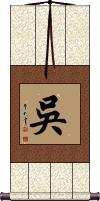
 wēng
Ung Scroll

翁 is the name Ung in Chinese (Mandarin).

 un
Ung Scroll

ウン is the name Ung in Japanese Katakana.


Note: Because this title is entirely Japanese Katakana, it should be written by a Japanese calligrapher.
 áng gé ěr
Unger Scroll

昂格爾 is the name Unger in Chinese (Mandarin).

 angaa
Unger Scroll

アンガー is the name Unger in Japanese Katakana.


Note: Because this title is entirely Japanese Katakana, it should be written by a Japanese calligrapher.

Wing Chun Kung Fu

 yǒng chūn gōng fu
 wing cheun gung fu
Wing Chun Kung Fu Scroll

詠春功夫 is Wing Chun Kung Fu.

The first two characters literally mean “Singing Spring” (as in springtime).

The last two are “Kung Fu” (high skill).

 yáng bù lā dé
Youngblood Scroll

楊布拉德 is the name Youngblood in Chinese (Mandarin).

 yanguburaddo
Youngblood Scroll

ヤングブラッド is the name Youngblood in Japanese Katakana.


Note: Because this title is entirely Japanese Katakana, it should be written by a Japanese calligrapher.

 yáng gé
Younger Scroll

揚格 is the name Younger in Chinese (Mandarin).

 yangaa
Younger Scroll

ヤンガー is the name Younger in Japanese Katakana.


Note: Because this title is entirely Japanese Katakana, it should be written by a Japanese calligrapher.

Younger Sister

 mèi
 mai / imouto
 
Younger Sister Scroll

妹 is the single character title for a younger sister.

In colloquial Japanese speech, this can be a way to say, darling, dear, honey, or my betrothed (only used when referring to a woman).

In Japanese, this can be the female given name Mai.

In Chinese, you will generally see this used in double form, “妹妹” or “mei mei” when referring to a younger sister.

 yangusu
Youngs Scroll

ヤングス is the name Youngs in Japanese Katakana.


Note: Because this title is entirely Japanese Katakana, it should be written by a Japanese calligrapher.

 yangu
Yung Scroll

ヤング is the name Yung in Japanese Katakana.


Note: Because this title is entirely Japanese Katakana, it should be written by a Japanese calligrapher.

Zhang / Cheung

 zhāng
 chou
 
Zhang / Cheung Scroll

This is a Chinese surname that romanizes as Zhang, but in Taiwan or old romanization can be Cheung.

This can also be the Japanese surnames Harisaki, Hari, Hara, Tsuan, Chou, Cho, Chiyan, Chiyau, Chan, Chian, Sun, Jin, Jiyon, Jiyan, Zan, San, or Kin.

The meaning of this character can be: to open up; to spread; sheet of paper; classifier for flat objects; sheet; classifier for votes.


The following table may be helpful for those studying Chinese or Japanese...

Title CharactersRomaji (Romanized Japanese)Various forms of Romanized Chinese
Adonis
Handsome Young Man
美青年bi sei nen / biseinen
Amelung阿梅隆ā méi lóng
a1 mei2 long2
a mei long
ameilong
a mei lung
ameilung
Amelungアメルングamerungu
Aunghisashiáng / ang2 / ang
Chong
Sung
Su
chóng / chong2 / chongch`ung / chung
Chung Do Kwan靑濤館qīng tāo quǎn
qing1 tao1 quan3
qing tao quan
qingtaoquan
ch`ing t`ao ch`üan
chingtaochüan
ching tao chüan
Drunken Monkey Kung Fu醉猴功夫 / 醉猴功伕
醉猴功夫
zuì hóu gōng fu
zui4 hou2 gong1 fu
zui hou gong fu
zuihougongfu
tsui hou kung fu
tsuihoukungfu
Five Families
Tsoi Li Hoi Fut Hung
蔡李何佛雄cài lǐ hé fú xióng
cai4 li3 he2 fu2 xiong2
cai li he fu xiong
cailihefuxiong
ts`ai li ho fu hsiung
tsailihofuhsiung
tsai li ho fu hsiung
Forever Young永遠年輕
永远年轻
yǒng yuǎn nián qīng
yong3 yuan3 nian2 qing1
yong yuan nian qing
yongyuannianqing
yung yüan nien ch`ing
yungyüannienching
yung yüan nien ching
Forever Young
Eternal Youth
不老fu rou / furou / fu ro
Forever Young
Long Life
不老長壽
不老長寿
fu rou chou ju
furouchouju
fu ro cho ju
Kung
Gong
Mitsugi

mitsugigòng / gong4 / gongkung
Gung Ho工合guaigōng hé / gong1 he2 / gong he / gonghekung ho / kungho
Gurung古隆gǔ lóng / gu3 long2 / gu long / gulongku lung / kulung
Gurungグルンgurun
Hung Gar洪家hóng jiā / hong2 jia1 / hong jia / hongjiahung chia / hungchia
Hung Ga Kuen洪家拳hóng jiā quán
hong2 jia1 quan2
hong jia quan
hongjiaquan
hung chia ch`üan
hungchiachüan
hung chia chüan
Hung Kuen洪拳hóng quán
hong2 quan2
hong quan
hongquan
hung ch`üan
hungchüan
hung chüan
Hungary匈牙利xiōng yá lì
xiong1 ya2 li4
xiong ya li
xiongyali
hsiung ya li
hsiungyali
Hungaryハンガリーhan ga rii / hangarii / han ga ri
Hyo-Jung孝靜xiào jìng
xiao4 jing4
xiao jing
xiaojing
hsiao ching
hsiaoching
Jung Sim Do正心道zhèng xīn dào
zheng4 xin1 dao4
zheng xin dao
zhengxindao
cheng hsin tao
chenghsintao
Kitten
Young Cat
Little Cat
小猫 / 小貓
小猫
konekoxiǎo māo / xiao3 mao1 / xiao mao / xiaomaohsiao mao / hsiaomao
Kung
Gong

gōng / gong1 / gongkung
Kung Fu Panda功夫熊貓
功夫熊猫
gōng fú xióng māo
gong1 fu2 xiong2 mao1
gong fu xiong mao
gongfuxiongmao
kung fu hsiung mao
kungfuhsiungmao
Kunga根呷gēn gā / gen1 ga1 / gen ga / gengaken ka / kenka
Kungaクンガーkungaa / kunga
Kung Fu
Gong Fu
功夫kan fu / ku fu
kanfu / kufu
gōng fu / gong1 fu / gong fu / gongfukung fu / kungfu
Kung Fu San Soo
San Shou
功夫散手gōng fu sǎn shǒu
gong1 fu san3 shou3
gong fu san shou
gongfusanshou
kung fu san shou
kungfusanshou
Lau Gar Kung Fu劉家功夫
刘家功夫
liú jiā gōng fu
liu2 jia1 gong1 fu
liu jia gong fu
liujiagongfu
liu chia kung fu
liuchiakungfu
Laughing Dragon Kung Fu笑龍功夫
笑龙功夫
xiào lóng gōng fu
xiao4 long2 gong1 fu
xiao long gong fu
xiaolonggongfu
hsiao lung kung fu
hsiaolungkungfu
Leungreon / ryou
reon / ryo
liáng / liang2 / liang
Wise Younger Brother賢弟
贤弟
ken tei / kenteixián dì / xian2 di4 / xian di / xiandihsien ti / hsienti
Mungala蒙加拉méng jiā lā
meng2 jia1 la1
meng jia la
mengjiala
meng chia la
mengchiala
Mungalaムンガラmungara
Qi Gong
Chi Kung
氣功
气功
ki kou / kikou / ki koqì gōng / qi4 gong1 / qi gong / qigongch`i kung / chikung / chi kung
San Soo Kung Fu散手功夫sǎn shǒu gōng fu
san3 shou3 gong1 fu
san shou gong fu
sanshougongfu
san shou kung fu
sanshoukungfu
Shaolin Kung Fu少林功夫sho rin kan fu
shorinkanfu
shǎo lín gōng fu
shao3 lin2 gong1 fu
shao lin gong fu
shaolingongfu
shao lin kung fu
shaolinkungfu
Shit
Manure
Dung
Feces
Excrement
Poop

kusofèn / fen4 / fen
Si Gung師公
师公
shi kou / shikou / shi koshī gōng / shi1 gong1 / shi gong / shigongshih kung / shihkung
Tai Chi Wing Chun Kung Fu太極詠春功夫
太极咏春功夫
tài jí yǒng chūn gōng fu
tai4 ji2 yong3 chun1 gong1 fu
tai ji yong chun gong fu
taijiyongchungongfu
t`ai chi yung ch`un kung fu
taichiyungchunkungfu
tai chi yung chun kung fu
Tungdǒng / dong3 / dongtung
Tungタンtan
Ungwēng / weng1 / weng
Ungウンun
Unger昂格爾
昂格尔
áng gé ěr
ang2 ge2 er3
ang ge er
anggeer
ang ko erh
angkoerh
Ungerアンガーangaa / anga
Wing Chun Kung Fu詠春功夫
咏春功夫
yǒng chūn gōng fu
yong3 chun1 gong1 fu
yong chun gong fu
yongchungongfu
yung ch`un kung fu
yungchunkungfu
yung chun kung fu
Youngblood楊布拉德
杨布拉德
yáng bù lā dé
yang2 bu4 la1 de2
yang bu la de
yangbulade
yang pu la te
yangpulate
Youngbloodヤングブラッドyanguburaddo
Younger揚格
扬格
yáng gé / yang2 ge2 / yang ge / yanggeyang ko / yangko
Youngerヤンガーyangaa / yanga
Younger Sistermai / imouto
mai / imoto
mèi / mei4 / mei
Youngsヤングスyangusu
Yungヤングyangu
Zhang
Cheung

chou / chozhāng / zhang1 / zhangchang
In some entries above you will see that characters have different versions above and below a line.
In these cases, the characters above the line are Traditional Chinese, while the ones below are Simplified Chinese.


Dictionary

Lookup Ung in my Japanese & Chinese Dictionary


Successful Chinese Character and Japanese Kanji calligraphy searches within the last few hours...


17 SeventeenAartiAbhijeetAbigailAdaleighAddieAdejahAdeliaAdityaAdynAeriAfnanAhoraAidynAilaAilinaAimanAimiAireenAjnaAkakaAkashaAkumaAlayaAldrinAleeshaAlephAlistairAlivinAliyaAliyahAlizaAllysonAlvinAlyaAmadiAmaliaAmandaAmeliaAmida BuddhaAmirAmnaAnarchyAnayeliAndreiAndryAngelinaAngeliqueAngeluAniketAnilAnisaAnishAnnetteAnnyaAnoopAnshulAntoinetteAnyaArabellaAreebaArgenyArgieArloArlynArmandoArmaniArshadArslanArt of WarArunArvidArwinAshrafAsyrafAthenaAuraAvengerAvitalAyannaAylaAzharAzzyBa Gua ZhangBalanceBarbaraBayuBe Like WaterBeauBeautiful SoulBeiliBellaBerthaBetelgeuseBetter to Be Happy Than RichBeverleyBijoyBishalBlack DragonBlack Tiger FistBlacksmithBlessed by GodBobbyBorjeBoxingBreeannaBrendaBrennaBridgetteBrinaBuddha Dharma SanghaBuddha ShakyamuniBuddhismBujutsuButterflyBuzzCallumCamiCamillaCandiceCaoimheCarolineCarstenCassiaCassyCaydenCedricCeireChaosCharanChastity Pure HeartChelleChelseaCheoChesleyChloeChristaChung Shin Tong IlCindiCinthiaClarityClaudiaClintCode of SilenceCodiCodieCompassionCompassionate HeartCoolioCoralineCoriCosta RicaCristianCrystalCyanCyrineDaisyDamarisDanetteDaniDanialDanielaDanielleDaodejingDarcieDark AngelDavenDaviDavianDavinderDayanDeath Before DishonorDebbieDeclanDeepakDeepikaDejuanDela-CruzDeniseDennizDeonDeronDevinDevonDevotionDianaDilaDinaraDivinaDoreenDove PigeonDragon WarriorDurellEduardoElaineEleanorElenaElielEliezer

All of our calligraphy wall scrolls are handmade.

When the calligrapher finishes creating your artwork, it is taken to my art mounting workshop in Beijing where a wall scroll is made by hand from a combination of silk, rice paper, and wood.
After we create your wall scroll, it takes at least two weeks for air mail delivery from Beijing to you.

Allow a few weeks for delivery. Rush service speeds it up by a week or two for $10!

When you select your calligraphy, you'll be taken to another page where you can choose various custom options.


A nice Chinese calligraphy wall scroll

The wall scroll that Sandy is holding in this picture is a "large size"
single-character wall scroll.
We also offer custom wall scrolls in small, medium, and an even-larger jumbo size.

A professional Chinese Calligrapher

Professional calligraphers are getting to be hard to find these days.
Instead of drawing characters by hand, the new generation in China merely type roman letters into their computer keyboards and pick the character that they want from a list that pops up.

There is some fear that true Chinese calligraphy may become a lost art in the coming years. Many art institutes in China are now promoting calligraphy programs in hopes of keeping this unique form of art alive.

Trying to learn Chinese calligrapher - a futile effort

Even with the teachings of a top-ranked calligrapher in China, my calligraphy will never be good enough to sell. I will leave that to the experts.

A high-ranked Chinese master calligrapher that I met in Zhongwei

The same calligrapher who gave me those lessons also attracted a crowd of thousands and a TV crew as he created characters over 6-feet high. He happens to be ranked as one of the top 100 calligraphers in all of China. He is also one of very few that would actually attempt such a feat.


Check out my lists of Japanese Kanji Calligraphy Wall Scrolls and Old Korean Hanja Calligraphy Wall Scrolls.

Some people may refer to this entry as Ung Kanji, Ung Characters, Ung in Mandarin Chinese, Ung Characters, Ung in Chinese Writing, Ung in Japanese Writing, Ung in Asian Writing, Ung Ideograms, Chinese Ung symbols, Ung Hieroglyphics, Ung Glyphs, Ung in Chinese Letters, Ung Hanzi, Ung in Japanese Kanji, Ung Pictograms, Ung in the Chinese Written-Language, or Ung in the Japanese Written-Language.

0 people have searched for Ung in Chinese or Japanese in the past year.
Ung was last searched for by someone else on Dec 8th, 2025