Many custom options...


And formats...



The Lord is My God in Chinese / Japanese...
Buy a The Lord is My God calligraphy wall scroll here!
Personalize your custom “The Lord is My God” project by clicking the button next to your favorite “The Lord is My God” title below...
God of Zion / God of Abraham
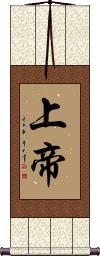
上帝 is how Chinese Christians and Jews refer to God, AKA The Judeo-Christian God.
There are Chinese Jews whose ancestry dates back to Jewish traders on the silk road. They are known as the Kaifeng Jews. Most have left China for Israel now.
There are also plenty of Christians in China of the Protestant and Catholic varieties. However, the churches are basically run by the government, and the Chinese Catholic church does not recognize the Pope.
Oddly, in my experience, I found the Chinese Protestant church to be much less political compared to Baptist and other Protestant churches that I have visited in America.
上帝 is also the typically-used title for God in Japanese.
While you may find this term in old Korean dictionaries, it is an obscure and rarely-used title for God in modern Korean.
See Also: Christianity | Jesus Christ
Joshua 1:9
Do not be afraid, God is always with you
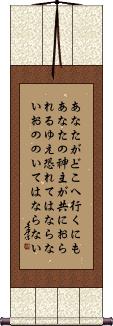
あなたがどこへ行くにもあなたの神主が共におられるゆえ恐れてはならないおののいてはならない is a Japanese translation of a large portion of Joshua 1:9.
The Japanese passage includes, “The Lord God is with you wherever you are; Therefore do not fear or be discouraged.”
Note: Because this selection contains some special Japanese Hiragana characters, it should be written by a Japanese calligrapher.
The LORD is my Shepherd
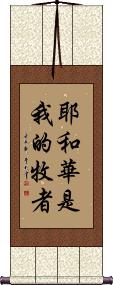
耶和華是我的牧者 is the first line from Psalms 23 straight out of the Chinese Union Bible.
This reads, “The LORD is my shepherd,” or “Jehovah is my shepherd.”
The character breakdown:
耶和華 = Jehovah (most English Bibles translate as LORD or God). This Chinese title is meant to sound a bit like the original Hebrew YHWH or Yahweh.
是 = is.
我的 = my.
牧者 = shepherd.
Christianity / Christian
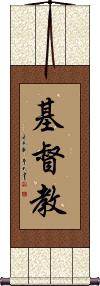
基督教 is the Chinese, Japanese and Korean word for “Christianity.”
Just as in English, this word is often used to mean “Protestant” but includes Catholics in the true definition.
It is the word used to refer to the whole “Christian religion” or “Christian Faith,” and therefore, it can be translated as “Christianity.” However, used as an adjective in regard to a person, it would translate as “Christian.” But more like saying, “His religion is Christianity,” rather than a noun form.
If you break it apart, the characters mean Base/Foundation Leading/Supervising Religion/Teaching. It makes more sense in Japanese, Chinese, and Korean. The first two characters together are translated as “Christ.” So you can also say this means “Christ's Religion” or “Christ's Teachings” when directly translated, or in reverse, “The Religion of Christ” or “The Teaching of Christ.”
Notes: The last character has a slight difference in one stroke - however, in calligraphic form, this will not be apparent. This entry can easily be read by any Korean person who knows Hanja characters (Chinese characters used in Korean).
See Also: Jesus Christ | God of Abraham
Joshua 1:9
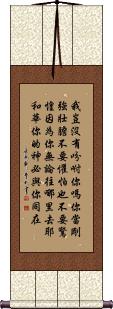
Here is the full translation of Joshua 1:9 into Chinese.
The text with punctuation:
我岂没有吩咐你吗?你当刚强壮胆。不要惧怕,也不要惊惶。因为你无论往哪里去,耶和华你的神必与你同在。
Hand-painted calligraphy does not retain punctuation.
This translation comes from the 1919 Chinese Union Bible.
For reference, from the KJV, this reads, “Have not I commanded thee? Be strong and of a good courage; be not afraid, neither be thou dismayed: for the LORD thy God is with thee whithersoever thou goest.”
Where There is a Will, There is a Way
A determined effort can move a mountain
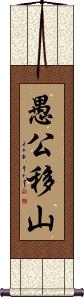
愚公移山 is the Chinese proverb (also somewhat known in Japan and Korea) for “the silly old man moves a mountain.”
Figuratively, this means “where there's a will, there's a way.”
Based on a fable of Lord Yu (愚公). He moved the soil of the mountain in front of his house. After years of effort, he finally moved the entire mountain (some versions of the story have God seeing how determined the man was, and sending two angels to whisk the mountains away).
The moral of the story: Anything can be accomplished if one works at it ceaselessly.
The Japanese version of this is 愚公山を移す (gu kou yama wo utsu su). But better to get the Chinese version, since this is originally a Chinese proverb.
See Also: Nothing is Impossible
I've noticed you are searching for "The Lord is My God". If you are interested, I can have your favorite verse from the Torah or Bible translated into Chinese and written on a wall scroll for you. Please contact me siting the verse or verses you want. Here is an example: Joshua 24:15.
If you are looking for a Jewish or Christian title, phrase, or word, I have a great selection here: Christian Words in Chinese
This in-stock artwork might be what you are looking for, and ships right away...
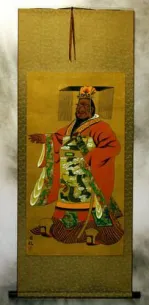
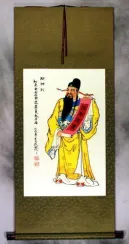
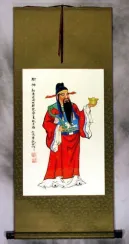
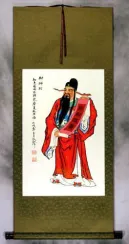
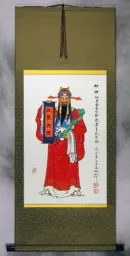
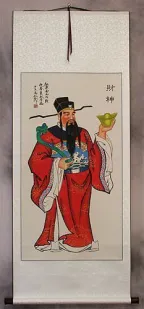
Gallery Price: $108.00
Your Price: $59.88
Gallery Price: $71.00
Your Price: $39.00
Not the results for The Lord is My God that you were looking for?
Below are some entries from our dictionary that may match your The Lord is My God search...
| Characters If shown, 2nd row is Simp. Chinese |
Pronunciation Romanization |
Simple Dictionary Definition |
因陀羅 因陀罗 see styles |
yīn tuó luó yin1 tuo2 luo2 yin t`o lo yin to lo Indara |
More info & calligraphy: IndraIndra, 因坻; 因提; 因提梨; 因達羅; 天帝; 天主帝; 帝釋天; originally a god of the atmosphere, i. e. of thunder and rain; idem Śakra; his symbol is the vajra, or thunderbolt, hence he is the 金剛手; he became 'lord of the gods of the sky', 'regent of the east quarter', 'popularly chief after Brahmā, Viṣṇu, and Śiva, '(M.W.); in Buddhism he represents the secular power, and is inferior to a Buddhist saint. Cf. 忉利 and 印. |
主 see styles |
zhǔ zhu3 chu mamoru まもる |
owner; master; host; individual or party concerned; God; Lord; main; to indicate or signify; trump card (in card games) (1) head (of a household, etc.); leader; master; (2) owner; proprietor; proprietress; (3) subject (of a rumour, etc.); doer (of a deed); (4) guardian spirit (e.g. long-resident beast, usu. with mystical powers); long-time resident (or employee, etc.); (5) husband; (pronoun) (6) (familiar language) (See おぬし) you; (given name) Mamoru Chief, lord, master; to control. |
貴 贵 see styles |
guì gui4 kuei motomu もとむ |
expensive; (bound form) highly valued; precious; (bound form) noble; of high rank; (prefix) (honorific) your (n,n-suf) (honorific or respectful language) (archaism) lord; god; goddess; honorific title for deities (and high-ranking people); (given name) Motomu Honourable, dear, precious. |
上天 see styles |
shàng tiān shang4 tian1 shang t`ien shang tien jouten / joten じょうてん |
Heaven; Providence; God; the sky above; to fly skywards; (euphemism) to die; to pass away; the previous day (or days) (1) (See 下土) sky; the heavens; (2) God; the Lord; the Creator; the Supreme Being; (3) ascension (into heaven); (surname) Jōten to ascend to heaven |
主宰 see styles |
zhǔ zǎi zhu3 zai3 chu tsai shusai しゅさい |
to dominate; to rule; to dictate; master (noun, transitive verb) (1) chairmanship; presidency; management; (2) (See 主宰者) president; chairman Lord, master; to dominate, control; the lord within, the soul; the lord of the universe, God. |
天主 see styles |
tiān zhǔ tian1 zhu3 t`ien chu tien chu tenshu てんしゅ |
God (in Catholicism); abbr. for 天主教[Tian1 zhu3 jiao4], Catholicism Lord of Heaven; God Devapati. The Lord of devas, a title of Indra. |
御心 see styles |
mikokoro みこころ |
(1) (honorific or respectful language) (another's) spirit; (2) {Christn} God's heart or spirit; Lord's will |
文殊 see styles |
wén shū wen2 shu1 wen shu monju もんじゅ |
Manjushri, the Bodhisattva of keen awareness (Buddhist term) Manjushri; Manjusri; Bodhisattva that represents transcendent wisdom; (p,s,f) Monju (文殊師利) Mañjuśrī 滿殊尸利 -later 曼殊室利. 文殊 is also used for Mañjunātha, Mañjudeva, Mañjughoṣa, Mañjuṣvara, et al. T., hjamdpal; J., Monju. Origin unknown; presumably, like most Buddhas and bodhisattvas, an idealization of a particular quality, in his case of Wisdom. Mañju is beautiful, Śrī; good fortune, virtue, majesty, lord, an epithet of a god. Six definitions are obtained from various scriptures: 妙首 (or 頭 ) wonderful or beautiful) head; 普首 universal head; 濡首 glossy head (probably a transliteration); 敬首 revered head; 妙德 wonderful virtue (or power); 妙吉祥 wonderfully auspicious; the last is a later translation in the 西域記. As guardian of wisdom 智慧 he is often placed on Śākyamuni's left, with 普顯 on the right as guardian of law 理, the latter holding the Law, the former the wisdom or exposition of it; formerly they held the reverse positions. He is often represented with five curls or waves to his hair indicating the 五智 q. v. or the five peaks; his hand holds the sword of wisdom and he sits on a lion emblematic of its stern majesty: but he has other forms. He is represented as a youth, i. e. eternal youth. His present abode is given as east of the universe, known as 淸涼山 clear and cool mountain, or a region 寶住 precious abode, or Abode of Treasures, or 寶氏 from which he derives one of his titles, 寶相如來. One of his dhāraṇīs prophesies China as his post-nirvāṇa realm. In past incarnations he is described as being the parent of many Buddhas and as having assisted the Buddha into existence; his title was 龍種上佛 the supreme Buddha of the nāgas, also 大身佛 or 神仙佛; now his title is 歡喜藏摩尼寶精佛 The spiritual Buddha who joyfully cares for the jewel: and his future title is to be 普現佛 Buddha universally revealed. In the 序品 Introductory Chapter of the Lotus Sutra he is also described as the ninth predecessor or Buddha-ancestor of Śākyamuni. He is looked on as the chief of the Bodhisattvas and represents them, as the chief disciple of the Buddha, or as his son 法王子. Hīnayāna counts Śāriputra as the wisest of the disciples, Mahāyāna gives Mañjuśrī the chief place, hence he is also styled 覺母 mother, or begetter of understanding. He is shown riding on either a lion or a peacock, or sitting on a white lotus; often he holds a book, emblem of wisdom, or a blue lotus; in certain rooms of a monastery he is shown as a monk; and he appears in military array as defender of the faith. His signs, magic words, and so on, are found in various sutras. His most famous centre in China is Wu-tai shan in Shansi. where he is the object of pilgrimages, especially of Mongols. The legends about him are many. He takes the place in Buddhism of Viśvakarman as Vulcan, or architect, of the universe. He is one of the eight Dhyāni-bodhisattvas, and sometimes has the image of Akṣobhya in his crown. He was mentioned in China as early as the fourth century and in the Lotus Sutra he frequently appears, especially as the converter of the daughter of the Dragon-king of the Ocean. He has five messengers 五使者 and eight youths 八童子 attending on him. His hall in the Garbhadhātu maṇḍala is the seventh, in which his group numbers twenty-five. His position is northeast. There are numerous sutras and other works with his name as title, e. g. 文殊師利問菩提經 Gayaśīrṣa sūtra, tr. by Kumārajīva 384-417: and its 論 or .Tīkā of Vasubandhu, tr. by Bodhiruci 535. see list in B. N. |
東君 东君 see styles |
dōng jun dong1 jun1 tung chün |
Lord of the East, the sun God of Chinese mythology |
梵天 see styles |
fàn tiān fan4 tian1 fan t`ien fan tien bonten ぼんてん |
Nirvana (in Buddhist scripture); Lord Brahma (the Hindu Creator) (1) Brahma (Hindu creator god); (2) (See 御幣) large staff with plaited paper streamers (used at religious festivals or as a sign); (3) buoy (used in longline fishing, gillnetting, etc.); (4) down puff (on the end of an ear pick); (given name) Bonten Brahmadeva. Brahmā, the ruler of this world. India. brahmaloka, the eighteen heavens of the realm of form, divided into four dhyāna regions (sixteen heavens in Southern Buddhism). The first three contain the 梵衆天 assembly of brahmadevas, i.e. the brahmakāyika; the 梵輔天 brahmspurohitas, retinue of Brahmā; and 大梵天 Mahābrahman, Brahman himself. |
Variations: |
mikoto みこと |
(n-suf,n) (1) (after the name of a god or a noble) Lord; Highness; (pronoun) (2) (archaism) (derogatory term) you |
七十二天 see styles |
qī shí èr tiān qi1 shi2 er4 tian1 ch`i shih erh t`ien chi shih erh tien shichijūni ten |
The seventy-two devas, namely, sixty-nine devas, the lord of Tai Shan, the god of the five roads, and 大吉祥天 Mahāśrī . |
以利亞敬 以利亚敬 see styles |
yǐ lì yà jìng yi3 li4 ya4 jing4 i li ya ching |
Eliakim (name, Hebrew: God will raise up); Eliakim, servant of the Lord in Isaiah 22:20; Eliakim, son of Abiud and father of Azor in Matthew 1:13 |
婆舍跋提 see styles |
pó shè bá tí po2 she4 ba2 ti2 p`o she pa t`i po she pa ti Bashabadai |
Vaśavartin, the sixth desire-heaven, the abode of Māra, the god of lust, sin, and death; its occupants avail themselves of the merits of others for their own pleasure; it is also called the abode of Śikhin (Brahma) as lord of fire; also 他化自在天 and 婆羅尼密婆舍跋提 Paranirmitavaśavartin. |
The following table may be helpful for those studying Chinese or Japanese...
| Title | Characters | Romaji (Romanized Japanese) | Various forms of Romanized Chinese | |
| God of Zion God of Abraham | 上帝 | joutei / jotei | shàng dì / shang4 di4 / shang di / shangdi | shang ti / shangti |
| Joshua 1:9 | あなたがどこへ行くにもあなたの神主が共におられるゆえ恐れてはならないおののいてはならない | anata ga doko e iku ni mo anata no kami omo ga tomoni ora reru yue osorete wa naranai ononoite wa naranai | ||
| The LORD is my Shepherd | 耶和華是我的牧者 耶和华是我的牧者 | yē hé huá shì wǒ de mù zhě ye1 he2 hua2 shi4 wo3 de mu4 zhe3 ye he hua shi wo de mu zhe yehehuashiwodemuzhe | yeh ho hua shih wo te mu che yehhohuashihwotemuche |
|
| Christianity Christian | 基督教 | kirisutokyou kirisutokyo | jī dū jiào ji1 du1 jiao4 ji du jiao jidujiao | chi tu chiao chituchiao |
| Joshua 1:9 | 我豈沒有吩咐你嗎你當剛強壯膽不要懼怕也不要驚惶因為你無論往哪里去耶和華你的神必與你同在 我岂没有吩咐你吗你当刚强壮胆不要惧怕也不要惊惶因为你无论往哪里去耶和华你的神必与你同在 | wǒ qǐ méi yǒu fēn fù nǐ ma nǐ dāng gāng qiáng zhuàng dǎn bù yào jù pà yě bù yào jīng huáng yīn wèi nǐ wú lùn wǎng nǎ lǐ qù yē hé huá nǐ de shén bì yǔ nǐ tóng zài wo3 qi3 mei2 you3 fen1 fu4 ni3 ma ni3 dang1 gang1 qiang2 zhuang4 dan3 bu4 yao4 ju4 pa4 ye3 bu4 yao4 jing1 huang2 yin1 wei4 ni3 wu2 lun4 wang3 na3 li3 qu4 ye1 he2 hua2 ni3 de shen2 bi4 yu3 ni3 tong2 zai4 wo qi mei you fen fu ni ma ni dang gang qiang zhuang dan bu yao ju pa ye bu yao jing huang yin wei ni wu lun wang na li qu ye he hua ni de shen bi yu ni tong zai | wo ch`i mei yu fen fu ni ma ni tang kang ch`iang chuang tan pu yao chü p`a yeh pu yao ching huang yin wei ni wu lun wang na li ch`ü yeh ho hua ni te shen pi yü ni t`ung tsai wo chi mei yu fen fu ni ma ni tang kang chiang chuang tan pu yao chü pa yeh pu yao ching huang yin wei ni wu lun wang na li chü yeh ho hua ni te shen pi yü ni tung tsai |
|
| Where There is a Will, There is a Way | 愚公移山 | yū gōng yí shān yu1 gong1 yi2 shan1 yu gong yi shan yugongyishan | yü kung i shan yükungishan |
|
| In some entries above you will see that characters have different versions above and below a line. In these cases, the characters above the line are Traditional Chinese, while the ones below are Simplified Chinese. | ||||

Successful Chinese Character and Japanese Kanji calligraphy searches within the last few hours...



