I am shipping orders on Thursday this week. News and More Info
Buy a Sun Always Rises calligraphy wall scroll here!
Personalize your custom “Sun Always Rises” project by clicking the button next to your favorite “Sun Always Rises” title below...
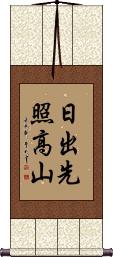
This old Buddhist phrase means, “When the sun rises it always shines first on the highest mountain,” or “When the sun appears, it first casts its light upon the highest mountain.”
This comes from the Avatamsaka Sutra and has been used as the name or portion of the name for temples in Japan and sites in China.
The Buddha's first round of teaching (Avatamsaka period) is likened to the time when the sun rises from the east horizon. When the sun first rises it illuminates the high mountains. In this analogy, the high mountains represent the great Bodhisattvas and/or those most ready to receive enlightenment and liberation.
This can be romanized from Japanese as “Nichi shutsu sen shō kō san,” “Nisshutsu saki teru takayama,” or “Hide temazu kōzan wo terasu yama.” The last one is probably the most common. Ask three Japanese people what they think the pronunciation is, and you will get three different opinions.
水漲船高 means “A rising tide lifts all boats/ships” in Chinese.
This idiom first appeared in the “Wudeng Huiyuan” (五燈會元) by the Song Dynasty monk Puji (普濟).
There is also a version that says “The longer the water flows, the higher the boat rises” or “水長船高”.
Acknowledgments: Thanks to Mac Lee for a factual correction to this entry.
鳳凰涅磐 is a proverb that suggests “Legendary Phoenix rises from the ashes.” It means “Legendary Phoenix [reaches] Nirvana.”
There is a legend in China of a great bird reborn once every 500 years. This bird gathers all the ill will, suffering, desire, and other negative things of the world. The bird then plunges into the fire to burn away all negative things, sacrificing itself in the process (achieving Nirvana, or perhaps allowing others the opportunity to reach Nirvana).
500 years later, the phoenix is reborn from the ashes again, and the cycle repeats.
Below are some entries from our dictionary that may match your Sun Always Rises search...
| Characters If shown, 2nd row is Simp. Chinese |
Pronunciation Romanization |
Simple Dictionary Definition |
水漲船高 水涨船高 see styles |
shuǐ zhǎng chuán gāo shui3 zhang3 chuan2 gao1 shui chang ch`uan kao shui chang chuan kao |
More info & calligraphy: A Rising Tide Lifts All Boats |
日出先照高山 see styles |
rì chū xiān zhào gāo shān ri4 chu1 xian1 zhao4 gao1 shan1 jih ch`u hsien chao kao shan jih chu hsien chao kao shan nichi shutsu sen shō kō san |
More info & calligraphy: When the sun rises it first shines on the highest mountain |
枳吒 枳咤 see styles |
zhǐ zhà zhi3 zha4 chih cha shita |
枳擔 (枳擔那) An island which rises out of the sea. |
私多 see styles |
sī duō si1 duo1 ssu to shita |
私陀; 悉陀; 徒多; 枲多 Sītā. Described as the 'cold' river; one of the four great rivers flowing from the Anavatpta or Anavadata Lake 阿耨達池 in Tibet. One account makes it 'an eastern outflux' which subsequently becomes the Yellow River. It is also said to issue from the west. Again, 'the Ganges flows eastward, the Indus south, Vatsch (Oxus) west, Sītā north.' Vatsch = Vākṣu. 'According to Xuanzang, however, it is the northern outflux of the Sirikol [Sarikkol] Lake (Lat. 38°20′N., Long. 74°E.) now called Yarkand daria, which flows into Lake Lop, thence underneath the desert of Gobi, and reappears as the source of the Huanghe.' Eitel. According to Richard, the Huanghe 'rises a little above two neighbouring lakes of Khchara (Charingnor) and Khnora (Oring-nor). Both are connected by a channel and are situated at an elevation of 14,000 feet. It may perhaps be at first confounded with Djaghing-gol, a river 110 miles long, which flows from the south and empties into the channel joining the two lakes'. |
踏空 see styles |
tà kōng ta4 kong1 t`a k`ung ta kung |
to miss one's step; (of an investor) to fail to invest before the price rises |
震旦 see styles |
zhèn dàn zhen4 dan4 chen tan Shindan しんだん |
ancient Indian name for China (ancient) China Cīna, name of China in ancient India; also 振旦; 眞旦; 神旦 intp. as the place where the sun rises, but a translit. of Cīnaṣṭhāna. |
呾羅斯 呾罗斯 see styles |
dá luó sī da2 luo2 si1 ta lo ssu Tarashi |
Talas, or Taras; '(1) an ancient city in Turkestan 150 li west of Ming bulak (according to Xuanzang). (2) A river which rises on the mountains west of Lake Issikoul and flows into a large lake to the north-west.' Eitel. |
猛暑日 see styles |
moushobi / moshobi もうしょび |
(See 夏日・2,真夏日) day on which the temperature rises above 35°C; extremely hot day |
真夏日 see styles |
manatsubi まなつび |
(See 夏日・2,猛暑日) day on which the temperature rises above 30°C |
連れ高 see styles |
tsuredaka つれだか |
{finc} rise in stock price in response to rises of other stocks |
酷暑日 see styles |
kokushobi こくしょび |
(1) (colloquialism) (See 猛暑日) day on which the temperature rises above 35°C; extremely hot day; (2) (used by the Japanese Weather Association) day on which the temperature rises above 40°C |
嚢中の錐 see styles |
nouchuunokiri / nochunokiri のうちゅうのきり |
(expression) (proverb) cream rises to the top; a drill in a bag (will always poke through) |
芙蓉出水 see styles |
fú róng chū shuǐ fu2 rong2 chu1 shui3 fu jung ch`u shui fu jung chu shui |
lit. lotus rises from the water (idiom); fig. to blossom (of poem or art) |
阿賴耶識 阿赖耶识 see styles |
ā lài yé shì a1 lai4 ye2 shi4 a lai yeh shih araya shiki |
ālaya-vijñāna. 'The receptacle intellect or consciousness;' 'the orginating or receptacle intelligence;' 'basic consciousness' (Keith). It is the store or totality of consciousness, both absolute and relative, impersonal in the whole, temporally personal or individual in its separated parts, always reproductive. It is described as 有情根本之心識 the fundamental mind-consciousness of conscious beings, which lays hold of all the experiences of the individual life: and which as storehouse holds the germs 種子 of all affairs; it is at the root of all experience, of the skandhas, and of all things on which sentient beings depend for existence. Mind is another term for it, as it both stores and gives rise to all seeds of phenomena and knowledge. It is called 本識 original mind, because it is the root of all things; 無沒識 inexhaustible mind, because none of its seeds (or products) is lost; 現識 manifested mind, because all things are revealed in or by it; 種子識 seeds mind, because from it spring all individualities, or particulars; 所知依識 because it is the basis of all knowledge; 異熟識 because it produces the rounds of morality, good and evil karma, etc.; 執持識 or 阿陀那 q.v., that which holds together, or is the seed of another rebirh, or phenomena, the causal nexus; 第一識 the prime or supreme mind or consciousness; 宅識 abode (of) consciousness; 無垢識 unsullied consciousness when considered in the absolute, i.e. the Tathāgata; and 第八識, as the last of the eight vijñānas. There has been much discussion as to the meaning and implications of the ālaya-vijñāna. It may also be termed the unconscious, or unconscious absolute, out of whose ignorance or unconsciousness rises all consciousness. |
風立ちぬ see styles |
kazetachinu かぜたちぬ |
(1) (work) The Wind Rises (2013 animated film); (2) (work) The Wind Has Risen (novel by Tatsuo Hori); (3) (work) Ride Like the Wind (1980 song); (wk) The Wind Rises (2013 animated film); (wk) The Wind Has Risen (novel by Tatsuo Hori); (wk) Ride Like the Wind (1980 song) |
風起潮湧 风起潮涌 see styles |
fēng qǐ cháo yǒng feng1 qi3 chao2 yong3 feng ch`i ch`ao yung feng chi chao yung |
lit. wind rises, tide bubbles up; turbulent times; violent development (idiom) |
光は東から see styles |
hikarihahigashikara ひかりはひがしから |
(expression) (proverb) (from the Roman saying, in reference to Constantinople) the light comes from the East; the light rises from the East; ex oriente lux |
太陽從西邊出來 太阳从西边出来 see styles |
tài yáng cóng xī biān chū lái tai4 yang2 cong2 xi1 bian1 chu1 lai2 t`ai yang ts`ung hsi pien ch`u lai tai yang tsung hsi pien chu lai |
lit. the sun rises in the west (idiom); fig. hell freezes over; pigs can fly |
一波未平,一波又起 |
yī bō wèi píng , yī bō yòu qǐ yi1 bo1 wei4 ping2 , yi1 bo1 you4 qi3 i po wei p`ing , i po yu ch`i i po wei ping , i po yu chi |
before the first wave subsides, a new wave rises (idiom); a new problem arises before the old is solved; many twists and turns to a story; one thing after another |
金烏西墜,玉兔東昇 金乌西坠,玉兔东升 |
jīn wū xī zhuì , yù tù dōng shēng jin1 wu1 xi1 zhui4 , yu4 tu4 dong1 sheng1 chin wu hsi chui , yü t`u tung sheng chin wu hsi chui , yü tu tung sheng |
lit. the golden bird of the sun sets in the west, the jade hare of the moon rises in the east; fig. at sunset |
瑠璃も玻璃も照らせば光る see styles |
rurimoharimoterasebahikaru るりもはりもてらせばひかる |
(exp,v5r) (proverb) cream rises to the top; great talent will stand out anywhere; lapis lazuli and crystals shine when lit up |
Variations: |
makugaaku / makugaku まくがあく |
(exp,v5k) (1) the curtain opens (for the start of a play, act, etc.); the curtain rises; to start (of a play); (exp,v5k) (2) to start (of an event, campaign, etc.); to begin |
瑠璃も玻璃も照らせば分かる see styles |
rurimoharimoterasebawakaru るりもはりもてらせばわかる |
(exp,v5r) (proverb) cream rises to the top; great talent will stand out anywhere; you realize what things are lapis lazuli and crystal when they are lit up |
Variations: |
hiryuujouun; hiryoujouun / hiryujoun; hiryojoun ひりゅうじょううん; ひりょうじょううん |
(yoji) hero that seizes the moment and rises; a dragon soaring through the clouds |
The following table may be helpful for those studying Chinese or Japanese...
| Title | Characters | Romaji (Romanized Japanese) | Various forms of Romanized Chinese | |
| When the sun rises it first shines on the highest mountain | 日出先照高山 | hiide temazu kousan wo terasu yama hide temazu kosan wo terasu yama | rì chū xiān zhào gāo shān ri4 chu1 xian1 zhao4 gao1 shan1 ri chu xian zhao gao shan richuxianzhaogaoshan | jih ch`u hsien chao kao shan jihchuhsienchaokaoshan jih chu hsien chao kao shan |
| A Rising Tide Lifts All Boats | 水漲船高 水涨船高 | shuǐ zhǎng chuán gāo shui3 zhang3 chuan2 gao1 shui zhang chuan gao shuizhangchuangao | shui chang ch`uan kao shuichangchuankao shui chang chuan kao |
|
| Phoenix Rise from the Ashes | 鳳凰涅磐 凤凰涅磐 | fèng huáng niè pán feng4 huang2 nie4 pan2 feng huang nie pan fenghuangniepan | feng huang nieh p`an fenghuangniehpan feng huang nieh pan |
|
| In some entries above you will see that characters have different versions above and below a line. In these cases, the characters above the line are Traditional Chinese, while the ones below are Simplified Chinese. | ||||
Successful Chinese Character and Japanese Kanji calligraphy searches within the last few hours...

All of our calligraphy wall scrolls are handmade.
When the calligrapher finishes creating your artwork, it is taken to my art mounting workshop in Beijing where a wall scroll is made by hand from a combination of silk, rice paper, and wood.
After we create your wall scroll, it takes at least two weeks for air mail delivery from Beijing to you.
Allow a few weeks for delivery. Rush service speeds it up by a week or two for $10!
When you select your calligraphy, you'll be taken to another page where you can choose various custom options.
The wall scroll that Sandy is holding in this picture is a "large size"
single-character wall scroll.
We also offer custom wall scrolls in small, medium, and an even-larger jumbo size.
Professional calligraphers are getting to be hard to find these days.
Instead of drawing characters by hand, the new generation in China merely type roman letters into their computer keyboards and pick the character that they want from a list that pops up.
There is some fear that true Chinese calligraphy may become a lost art in the coming years. Many art institutes in China are now promoting calligraphy programs in hopes of keeping this unique form
of art alive.
Even with the teachings of a top-ranked calligrapher in China, my calligraphy will never be good enough to sell. I will leave that to the experts.
The same calligrapher who gave me those lessons also attracted a crowd of thousands and a TV crew as he created characters over 6-feet high. He happens to be ranked as one of the top 100 calligraphers in all of China. He is also one of very few that would actually attempt such a feat.
Check out my lists of Japanese Kanji Calligraphy Wall Scrolls and Old Korean Hanja Calligraphy Wall Scrolls.
Some people may refer to this entry as Sun Always Rises Kanji, Sun Always Rises Characters, Sun Always Rises in Mandarin Chinese, Sun Always Rises Characters, Sun Always Rises in Chinese Writing, Sun Always Rises in Japanese Writing, Sun Always Rises in Asian Writing, Sun Always Rises Ideograms, Chinese Sun Always Rises symbols, Sun Always Rises Hieroglyphics, Sun Always Rises Glyphs, Sun Always Rises in Chinese Letters, Sun Always Rises Hanzi, Sun Always Rises in Japanese Kanji, Sun Always Rises Pictograms, Sun Always Rises in the Chinese Written-Language, or Sun Always Rises in the Japanese Written-Language.
104 people have searched for Sun Always Rises in Chinese or Japanese in the past year.
Sun Always Rises was last searched for by someone else on Oct 18th, 2025