Flying Crane, Rising Sun
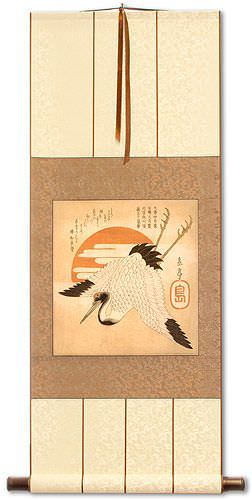
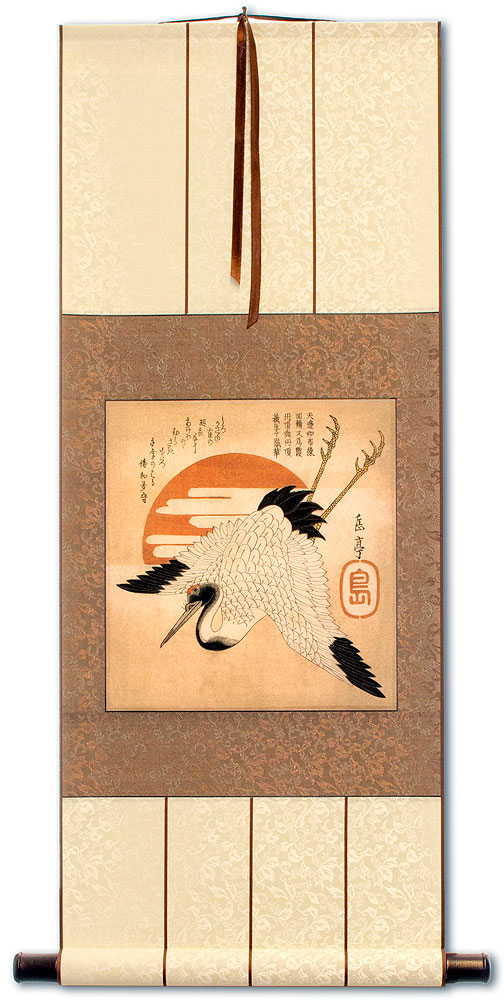
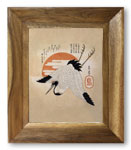
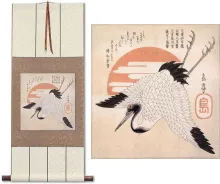
This features an Asian crane flying across the red disc of the rising sun at the horizon.
I loved this image when I first saw it on the Metropolitan Museum of Art's website. This was a woodblock print created by 八島岳亭 (Yashima Gakutei) back in about 1835. All of the prints were created so long ago that they all show a loss of detail, and portions were clipped. I spent many hours working on the restoration of the image. You can now enjoy what this would have looked like 188 years ago, for a price you can afford. I also cheated a little, as the original was a little over 8" (20cm) wide. Mine is almost 30% wider, so it makes a better presentation on your wall.
On the right, you will see the artist's given name, 岳亭, written vertically, in black characters. Below, a red stamp appears to be a circle around a 島 character. But the circle is actually a stylized 八 character (see the breaks at the top and bottom of that oval/circle? Those make it two strokes, hence 八). This is 八島 (Yashima), the artist's surname portion of his signature for this piece. Upon first glance, some may think it's just a circle around 島 (Note: 島 means island by itself).
At the top are two poems celebrating the crane, the rising sun, longevity, and the renewal of spring.
The unsigned poem on the right is written in classical Chinese style. It is written in traditional vertical columns, read from top to bottom and proceeding from right to left. Below, I typed it left-to-right to match the orientation of this text:
天邊如布練
回轉又為霞
丹頂與丹頂
蘇生千歲華
This is a kanshi-style Chinese poem, which is Chinese-language poetry composed in the Japanese literary tradition.
It compares the horizon to a band of white silk and evokes the glowing haze or rosy clouds of dawn (霞), while the red crown of the crane visually echoes the red disc of the rising sun. Its final line, 蘇生千歲華, evokes renewed splendor and the crane's traditional association with a thousand years of life.
A literal translation would be:
At heaven's edge, like a length of white silk,
Wheeling about, it becomes rosy cloud.
Red crown meets red crown;
Reviving the splendor of a thousand years.
A more poetic English translation:
At the edge of heaven, like a band of white silk,
the crane wheels through the crimson clouds.
Its vermilion crown meets the vermilion sun,
renewing the splendor of a thousand years.
The poem at the upper left is a Japanese kyōka poem signed 倭和夛守 (Yamato Watamori), indicating that it is not by 岳亭 (Gakutei) himself. Here is the text:
しろたへの
鶴の羽衣
あけ方の
むらさきめくる
千金の春
Reading the cursive kuzushiji, the text resolves into the standard 5–7–5–7–7 structure. In modern Japanese orthography, the poem can be transcribed as:
白妙の
鶴の羽衣
明け方の
紫めくる
千金の春
The pronunciation (romaji) is: Shirotae no / tsuru no hagoromo / akegata no / murasaki-mekuru / senkin no haru
The literal translation:
The pure-white
feather robe of the crane,
at break of dawn,
becomes tinged with violet—
spring worth a thousand pieces of gold.
A slightly more poetic translation:
The crane's robe of pure white feathers,
at the break of dawn
takes on a violet glow—
the priceless beauty
of spring.
The artist is believed to have been born around 1786, the illegitimate son of a samurai named Hirata who served the 徳川幕府 (Tokugawa shogunate). His mother later married into the 八島 (Yashima) family, from which the artist took the surname 八島 (Yashima).
This subject may be described in Japanese as 旭日飛鶴 (Kyokujitsu Hikaku), literally "Rising Sun and Flying Crane." This is a descriptive title rather than a unique historical title for this particular print, and similar wording is used for other Japanese artworks depicting a crane with the rising sun.
Surviving impressions show varying degrees of fading, wear, loss of detail, and trimming. I spent many hours working on the restoration of the image. You can now enjoy something much closer to what this remarkable print would have looked like nearly two centuries ago, for a price you can afford.
This features an Asian crane flying across the red disc of the rising sun at the horizon.
I loved this image when I first saw it on the Metropolitan Museum of Art's website. This was a woodblock print created by 八島岳亭 (Yoshima Gakutei) back in about 1835. All of the prints were created so long ago that they all show a loss of detail and portions were clipped. I spent many hours working on the restoration of the image. You can now enjoy how this would have looked 183 years ago, but for a price you can afford. I also cheated a little, as the original was a little over 8" (20cm) wide. Mine is almost 30% wider, so it makes a better presentation on your wall.
On the right, you will see the artist's given name, 岳亭, written vertically, in black characters. Below, a red stamp appears to be a circle around a 島 character. But the circle is actually a stylized 八 character (see the breaks at the top and bottom of that oval/circle? Those make it two strokes, hence 八). This is 八島 (Yoshima), the artist's surname portion of his signature for this piece. Upon first glance, some may think it's just a circle around 島 (Note: 島 means island by itself).
At the top, there are some poems. While this is Japanese artwork, on the right is an ancient Chinese ode or poem that speaks of the horizon meeting the red-crowned crane over and over for rebirths that expand 1000 years of history in China. The text on this artwork is written in vertical columns, starting from the right, as all old Chinese writing does. Below are the characters. I typed them left-to-right like English:
天邊如布練
回轉又為霞
丹頂與丹頂
蘇生千歲華
I have not found anyone who can translate the ancient Japanese poem on the upper left. The last characters on the far right are 倭和夛守. However, I am not sure of the third character. It seems to be a variant that is no longer used. It might be a variant of 多 or 尋, but nobody that looked at this was sure. Also not sure of the meaning, maybe a personal name.
The artist is believed to be the illegitimate son of Samura Hirata under the Totugawa Shogunate. His mother later married into the Yashima Clan, thus the artist taking the surname Yashima.
The unofficial Japanese title of this piece is 旭日飛鶴 (Kyokujitsu Hikaku) which means, "Sun Rising, Flying Cranes." However, this same title is given to many images of cranes flying by a sunrise.
I printed this on handmade kozo (mulberry) paper, the same kind of paper used to make Japanese woodblock prints for centuries. It was then sent to my workshop in Beijing where this handmade wall scroll was constructed. Just put a hook or nail in your wall and you have a classic piece of Japanese artwork.
Between the many hours I spent restoring the image quality, printer cost, ink, other labor, and other materials, I will never make any profit on these, but it's a labor of love. I really like this image of a crane and wanted to bring it to the world.
About My Giclée Prints
This is more than a business for me — it’s a passion. I create fine art prints because I love the process of pairing sacred and historic designs with the perfect paper and printing technique. I experiment until everything feels just right. For me, quality will always matter more than profit. (In fact, there’s a fine art print shop down the street charging twice as much as I do — so maybe I’m doing it wrong, but you get to benefit from my folly!)
Dedication to Quality
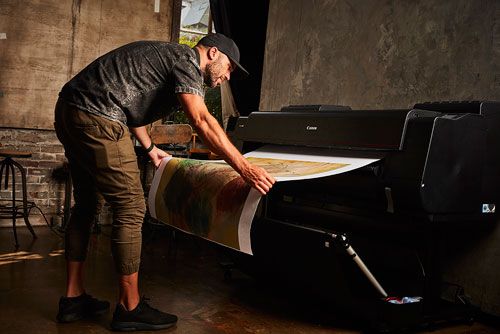
It took years — and a few costly missteps — to find the right printer. My first one worked well with delicate handmade papers, but the dye inks faded too quickly. My second was a massive HP DesignJet that constantly jammed on the specialty papers I love. After thousands of dollars lost, I finally invested in the Canon imagePROGRAF PRO Series — and it was worth every penny.
This remarkable printer has over 18,000 nozzles and can fire more than 32 million ink droplets per second. Combined with 12-color Canon Lucia Pro pigment inks, it produces an incredibly wide color gamut, velvety gradients, and museum-quality precision that ordinary printers simply can’t achieve.
Archival Excellence
I print exclusively with authentic Canon Lucia Pro pigment inks, which are both archival and UV-resistant. Independent tests rate them at 95+ years without noticeable fading — meaning your print will last a lifetime if properly cared for. Of course, like any fine art, it’s best to keep it out of direct sunlight.
Want a customized wall scroll or custom-sized print? Just contact me!
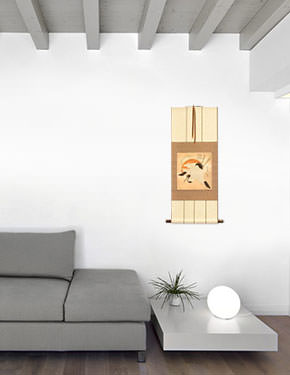
I can print this larger, on the paper texture of your choice, and give you whatever silk brocade colors you want. Ready-to-frame prints can be delivered in a few days. However, it does take several weeks for custom wall scrolls. Either way, it's worth the wait if you want something really custom and unique.