Many custom options...


And formats...



One Life Hanja in Chinese / Japanese...
Buy an One Life Hanja calligraphy wall scroll here!
Personalize your custom “One Life Hanja” project by clicking the button next to your favorite “One Life Hanja” title below...
1. Birth / Life
2. New Life
4. Soul Mates
5. Student
7. Karma
9. Passions / Feelings / Emotions
10. Peach / Peaches
11. Heaven and Earth
12. Smooth Sailing
13. Clarity
14. Sacrifice
15. Simplicity
16. Overcome
17. Body
19. Earth
20. Reiki
21. Impermanence
22. Empress
Birth / Life
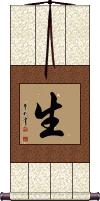
生 is a Chinese word that means “to be born” and “to give birth.”
Also, it's often used to refer to life itself, and sometimes “to grow.”
生 is used in a lot of compound words such as “yi sheng,” which means “doctor” (literally “healer of life”), “sheng ri” which means “birthday” (literally “birth-day”), and “xue sheng” which means student (literally “studying life” or “learner [about] life”). Few Chinese people will think of the literal meaning when this uses words like doctor and student - but it is interesting to note.
生 has the same root meaning in Korean Hanja and Japanese. However, in Japanese, there are many possible pronunciations, and this can be used to mean “raw” or “unprocessed” (as in draft beer). Therefore, not be the best if your audience is Japanese.
See Also: Vitality
New Life
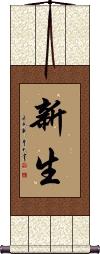
新生 literally means “new life” or “new birth” in Chinese, Japanese Kanji, and old Korean Hanja.
Depending on the context, this word can also mean newborn, new student, rebirth, new birth, or nascent.
In Japanese, this can be the given name Wakaki.
Note: This is not the most common word selection for a calligraphy wall scroll. But if you’re a westerner, you can bend the rules a bit.
Eternal Wheel of Life
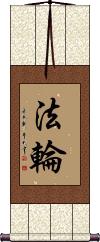
法輪 is the Chinese, Japanese Kanji, and old Korean Hanja title, “The Eternal Wheel of Life,” in Buddhism.
Also known as the wheel of the law, or Buddha-truth, which can crush all evil and all opposition. It is likened to Indra's wheel, which rolls on from man-to-man, place-to-place, age-to-age.
Colloquially used in some sects to mean preaching or spreading Buddha-truth.
Soul Mates
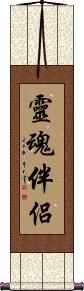
靈魂伴侶 is the literal translation of “Soul Mates.”
This is kind of the western way to express “soul mates” but translated into Chinese, Japanese Kanji, and old Korean Hanja.
The first two characters mean “soul” or “spirit.”
The second two characters mean “mate,” “companion” or “partner.”
Although not the most common title, these characters have good meaning and will be received well in Chinese, Japanese, and Korean. It's a universal title!
Student
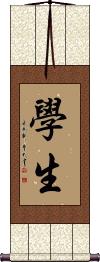
學生 is how to write “student” in Chinese, pre-WWII Japanese Kanji, and old Korean Hanja.
If you are a “student of life,” this might be an interesting wall scroll to hang in your reading room.
The first character means “study” or “learning.”
The second character means “life” or “birth.” Don't read too much into that second character unless you decide that this means “the birth of studies” or “the life of learning.” Everyone in China, Japan (and those who can read Hanja in Korea) will just read this word with the meaning of “student.”
If you put the character for “little” in front of this word, it becomes “elementary school student.” Prefixed with “middle,” it becomes “middle school student.” Prefixed with “big,” it becomes “university student” (though when these two characters for student are seen alone, it often suggests “university student”). The term “high school student” is written differently.
 There is a very common simplified version of the first character for this word. You will see this form in modern Japan and mainland China, Singapore, and other places. If you want this simplified version, please click on the character shown to the right instead of the "select and customize" button above.
Wind and Rain
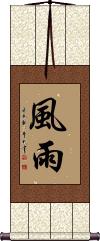
風雨 is wind and rain in Chinese, Japanese Kanji, and old Korean Hanja.
This can also refer to the elements of trials and hardships (in life).
Karma
Single character for Buddhist Karma
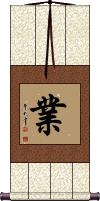
This is the simplest way to express the idea of Karma. This is the Buddhist concept of actions committed in a former life affecting the present and future.
Out of the context of Buddhism, this Karma character means one's profession in life, trade, occupation, business, study, or career.
The Karma definition applies to both Chinese and Japanese for this character. This also works as Korean Hanja as Karma; although the meaning can vary depending on context (my Korean dictionary gives the definition of profession/occupation).
See Also: Buddhism
Moderation / Temperance
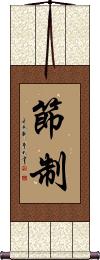
節制 means moderation or temperance in Chinese, Japanese Kanji, and old Korean Hanja.
Moderation is creating a healthy balance in your life between work and play, rest and exercise. You don't overdo or get swept away by the things you like. You use your self-discipline to take charge of your life and your time.
節制 can also be translated as sobriety or self-restraint.
This is often used as part of the Seven Heavenly Virtues to represent sobriety and/or temperance.
Passions / Feelings / Emotions
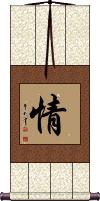
情 means feelings, emotions, passions, and sometimes refers to the situation you are in (with your emotions).
At least, this is the definition in Chinese and Japanese. This word is a bit stronger in Korean Hanja, where it means affection, love, compassion, sympathy, tender feelings, and emotions. Just as in Chinese and Japanese, this can also refer to your circumstances or your facts of life in Korean.
情 is also the original Korean Hanja for the surname Jeong (정).
In Japanese, this can be the surname Sei.
Peach / Peaches
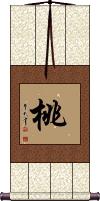
桃 means peach or peaches (Prunus persica) in Chinese, old Korean Hanja, and Japanese Kanji.
In Chinese culture, the peach represents longevity or long life.
This can also be the Japanese surname, Momosaki.
Heaven and Earth
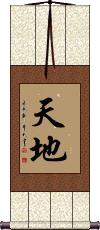
天地 is “Heaven and Earth” in Chinese, Japanese Kanji, and old Korean Hanja.
This title is used in many different contexts. It can be a general term but is also used by Buddhists and in other religions.
This can also be used to refer to all of nature, the universe, the top and bottom, the realm of life, or the sphere of existence.
Smooth Sailing
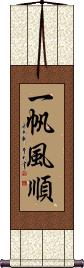
一帆風順 is just what you think it means. It suggests that you are on a trouble-free voyage through life, or literally on a sailing ship or sailboat. It is often used in China as a wish for good luck on a voyage or as you set out on a new quest or career in your life. Some may use this in place of “bon voyage.”
The literal meaning is “Once you raise your sail, you will get the wind you need, and it will take you where you want to go.” Another way to translate it is “Your sail and the wind follow your will.”
This is a great gift for a mariner, sailor, adventurer, or someone starting a new career.
Note: Can be understood in Korean Hanja but is rarely used.
See Also: Bon Voyage | Adventure | Travel
Clarity
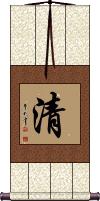
清 is a word that means clarity or clear in Chinese, Japanese Kanji, and old Korean Hanja.
Looking at the parts of this character, you have three splashes of water on the left, “life” on the top right, and the moon on the lower right.
Because of something Confucius said about 2500 years ago, you can imagine that this character means “live life with clarity like bright moonlight piercing pure water.” The Confucian idea is something like “Keep clear what is pure in yourself, and let your pure nature show through.” Kind of like saying, “Don't pollute your mind or body, so that they remain clear.”
This might be stretching the definition of this single Chinese character but the elements are there, and “clarity” is a powerful idea.
Korean note: Korean pronunciation is given above but this character is written with a slight difference in the "moon radical" in Korean. However, anyone who can read Korean Hanja, will understand this character with no problem (this is considered an alternate form in Korean). If you want the more standard Korean Hanja form (which is an alternate form in Chinese), just let me know.
Japanese note: When reading in Japanese, this Kanji has additional meanings of pure, purify, or cleanse (sometimes to remove demons or "exorcise"). Used more in compound words in Japanese than as a stand-alone Kanji.
Sacrifice
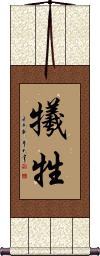
犧牲 means sacrifice in Chinese, Japanese Kanji, and old Korean Hanja.
There is a suggestion in this word that this regards sacrificing your life.
Note: Depending on the context, this can also mean victim or scapegoat in Japanese.
In original and ancient Chinese, this word referred to sacrificial animals. It can still have this meaning in a Buddhist context.
 The version of the first character used in modern Japan looks like the image to the right. If you order this from the Japanese master calligrapher, it will be written in this Japanese version.
Simplicity
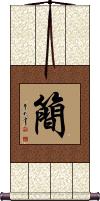
簡 expresses the idea of something simple or the essence of simplicity in life in Chinese.
This can also refer to a simple slip of bamboo for taking notes or writing a letter (especially in Korean Hanja).
Technically this is a word meaning simplicity and brevity in Japanese but it's rarely used in modern Japanese. Therefore, you should probably only select this character if your audience is Chinese.
See Also: Brevity
Overcome
Overcoming Hardships
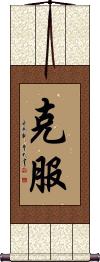
In Chinese, Japanese Kanji, and old Korean Hanja, 克服 means “overcome” (as in overcoming hardships, etc.). It can also mean to conquer, to put up with, or to endure.
This can be a conquest over a problem, disease, handicap, poverty, or illness. Other definitions include overcoming, bringing under control, subjugation, or victory over something.
This can be used as an inspirational wall scroll to remind someone to try to overcome difficulties that may arise in life.
Body
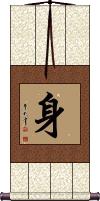
身 is how to write “body” as in your human body, in Chinese, Japanese Kanji, and Korean Hanja.
Depending on the context and certain language issues, this character can also mean: main part, hull, oneself, somebody, person, I, me, sword, lifetime, one's station in life, etc.
While this written word is universal in three languages, it still makes a rather odd selection for a wall scroll. Also, they tend to use 体 (karada) in Japanese for the body (depending on context).
See Also: Karada
Misery Loves Company
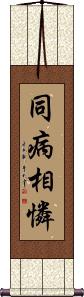
同病相憐 is a Chinese proverb that means “fellow sufferers empathize with each other” or to match it with a western idiom, “misery loves company.” This is also somewhat known in Korean Hanja.
This could be two people who were just dumped by a girlfriend/boyfriend or just divorced. They're drawn together either by their misery or because of the need to share their miserable experience with someone else.
同病相憐 is probably the saddest proverb in our collection.
Literally, the characters mean:
同 together with
病 illness, sickness, disease (in this case, just the mental anguish after some kind of event or life issue)
相 mutual, reciprocal, each other
憐 pity, sympathize
In Japanese, this is written with two extra Hiragana on the end like this: 同病相憐れむ
If you want the Japanese version,
don’t
use the button above but click here instead: Misery Loves Company in Japanese
Earth
(Used in Japanese version of five elements)
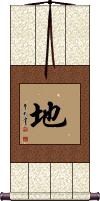
地 is the single-character element and title of the planet Earth in Chinese, old Korean Hanja, and Japanese Kanji.
Because this is a single character, the definition is a little ambiguous and can have many meanings depending on the context in which it is used. These meanings include: earth, ground, land, soil, dirt, place, territory, bottom (of a package, book, etc.), earth (one of the Japanese five elements), the region in question, the local area, skin, texture, fabric, material, weave, base, background, one's true nature, narrative (i.e. descriptive part of a story), real life, actuality, etc.
In Japanese, this Kanji can be pronounced several ways, including chi, ji, tsushi, or tsuchi.
地 is also an element of the Japanese version of the five elements (the original Chinese version uses a different version of earth).
Reiki
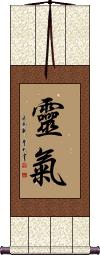
靈氣 is the title of a healing practice now found globally but with origins in Japan.
Special note: Outside of the context of the healing practice of Reiki, this means “aura” or “spiritual essence that surrounds all living things.” A Japanese person unfamiliar with the practice will take the “aura” meaning.
Reiki is a technique for stress reduction and relaxation that also heals. It can be compared to massage but is based on the idea that an unseen “life force energy” flows through us and is what causes us to be alive. If your life force energy is low, you'll be more likely to get sick or feel stressed. If your life force energy is abundant and flowing well, you become more capable of being happy and healthy.
There is a lot of information available if you want to Google this term - my job is to offer the calligraphy while you can decide if it is right for you.


Note: We are showing the ancient (traditional) form of the Reiki Kanji. I have seen Reiki written with the slightly simplified version and this more classic form. If you want the form of Reiki with the two strokes in the shape of an X on the second character and the modern first character, simply click on the Kanji characters to the right.
Note: 靈氣 is also a Chinese word, but in Chinese, these characters create a word that refers to a smart person or someone with high aspirations. It is not read as a healing method in Chinese.
In Korean Hanja, this can be read as a “mysterious atmosphere” by a Korean who is not familiar with the practice of Reiki (still has a cool meaning in Korean).
Impermanence
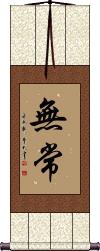
無常 is the state of being “not permanent,” “not enduring,” transitory, or evolving.
It can also mean variable or changeable. In some contexts, it can refer to a ghost that is supposed to take a soul upon death. Following that, this term can also mean to pass away or die.
In the Buddhist context, this is a reminder that everything in this world is ever-changing, and all circumstances of your life are temporary.
If you take the Buddhist philosophy further, none of these circumstances are real, and your existence is an illusion. Thus, the idea of the eternal soul is perhaps just your attachment to your ego. Once you release your attachment to all impermanent things, you will be on your way to enlightenment and Buddhahood.
Language notes for this word when used outside the context of Buddhism:
In Korean Hanja, this means uncertainty, transiency, mutability, or evanescent.
In Japanese, the definition orbits closer to the state of being uncertain.
Empress
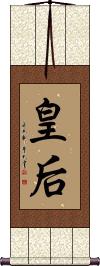
皇后 is the title of empress/emperess, the female form of the emperor.
皇后 is used in Chinese, Japanese Kanji, and old Korean Hanja.
While the emperor's reign was for life, if he died, his wife would hold his power. In this case, a woman was the ultimate ruler of the greater part of East Asia (now China) until her death and the succession of the emperor's firstborn son to lead the empire. Numerous times in various Chinese dynasties, an empress took power in this way.
The first character means emperor by itself.
The second character alone can mean “wife of an emperor or king” (the first character clarifies that we are talking about an empress and not a queen). It can also mean sovereign or last offspring, depending on context.
Note: In some books, this word is translated as queen. While only incorrect if you get technical (because an empress is theoretically a higher level than a queen), the meaning is very similar.
皇后 is sometimes used for the title of queen, but more technically, this is the wife of the emperor (a higher level than a queen).
Fatherly Master / Sifu / Shi Fu / Shifu
Martial Arts Teacher
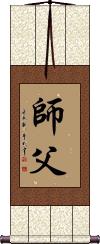
師父 means master in Chinese (occasionally used in Korean Hanja and Japanese). In the context of Martial Arts, this is the master and teacher who instructs students.
The second character by itself means father. Thus, you get the “Fatherly Master” translation. There's an old Chinese saying that goes something like, “One who is your teacher for one day is your father for life.”
Language notes: I've often seen this romanized as “sifu,” this is actually the Cantonese romanization. In Mandarin Chinese, it's “Shifu.” The pronunciation in Mandarin is actually like “sure foo” (using typical English pronunciation). There's an “R-sound” in there, which is not obvious from the romanization. Many martial arts studios incorrectly pronounce this like “she foo” (which is actually the Japanese pronunciation). In Cantonese, it sounds like “Sea foo” (almost like “seafood,” minus the “d” at the end).
師父 is kind of a weird selection for a calligraphy wall scroll; this entry is more for educational purposes. But you are welcome to buy it if it suits your circumstances.
This in-stock artwork might be what you are looking for, and ships right away...

Gallery Price: $61.00
Your Price: $33.88

Gallery Price: $103.00
Your Price: $56.88

Gallery Price: $61.00
Your Price: $33.88

Gallery Price: $31.00
Your Price: $16.88


Gallery Price: $61.00
Your Price: $33.88

Gallery Price: $61.00
Your Price: $33.88
Longevity / Long Life Unique Calligraphy Scroll
Discounted Blemished
Gallery Price: $47.00
Your Price: $26.00

Gallery Price: $61.00
Your Price: $33.88
Decorative Longevity / Long Life Calligraphy Wall Scroll
Discounted Blemished
Gallery Price: $31.00
Your Price: $17.00
Gallery Price: $198.00
Your Price: $109.88

Decorative Friends At Sunset Of Life
Chinese Proverb Art
Discounted Blemished
Gallery Price: $61.00
Your Price: $33.88
The following table may be helpful for those studying Chinese or Japanese...
| Title | Characters | Romaji (Romanized Japanese) | Various forms of Romanized Chinese | |
| Birth Life | 生 | shou / iku / sho / iku | shēng / sheng1 / sheng | |
| New Life | 新生 | waka ki / wakaki | xīn shēng xin1 sheng1 xin sheng xinsheng | hsin sheng hsinsheng |
| Eternal Wheel of Life | 法輪 法轮 | hourin / horin horin / horin | fǎ lún / fa3 lun2 / fa lun / falun | |
| Soul Mates | 靈魂伴侶 灵魂伴侣 | reikon hanryo reikonhanryo | líng hún bàn lǚ ling2 hun2 ban4 lv3 ling hun ban lv linghunbanlv | ling hun pan lü linghunpanlü |
| Student | 學生 学生 | gakusei | xué shēng xue2 sheng1 xue sheng xuesheng | hsüeh sheng hsüehsheng |
| Wind and Rain | 風雨 风雨 | fuu-u / fu-u | fēng yǔ / feng1 yu3 / feng yu / fengyu | feng yü / fengyü |
| Karma | 業 业 | gou / go | yè / ye4 / ye | yeh |
| Moderation Temperance | 節制 节制 | sessei / sesei | jié zhì / jie2 zhi4 / jie zhi / jiezhi | chieh chih / chiehchih |
| Passions Feelings Emotions | 情 | jou / nasake jo / nasake | qíng / qing2 / qing | ch`ing / ching |
| Peach Peaches | 桃 | momo | táo / tao2 / tao | t`ao / tao |
| Heaven and Earth | 天地 | tenchi | tiān dì / tian1 di4 / tian di / tiandi | t`ien ti / tienti / tien ti |
| Smooth Sailing | 一帆風順 一帆风顺 | yī fán fēng shùn yi1 fan2 feng1 shun4 yi fan feng shun yifanfengshun | i fan feng shun ifanfengshun |
|
| Clarity | 清 | sei | qīng / qing1 / qing | ch`ing / ching |
| Sacrifice | 犧牲 / 犠牲 牺牲 | gi sei / gisei | xī shēng / xi1 sheng1 / xi sheng / xisheng | hsi sheng / hsisheng |
| Simplicity | 簡 简 | kan | jiǎn / jian3 / jian | chien |
| Overcome | 克服 / 剋服 克服 | koku fuku / kokufuku | kè fú / ke4 fu2 / ke fu / kefu | k`o fu / kofu / ko fu |
| Body | 身 | mi | shēn / shen1 / shen | |
| Misery Loves Company | 同病相憐 同病相怜 | doubyou shou awaremu doubyoushouawaremu dobyo sho awaremu | tóng bìng xiāng lián tong2 bing4 xiang1 lian2 tong bing xiang lian tongbingxianglian | t`ung ping hsiang lien tungpinghsianglien tung ping hsiang lien |
| Earth | 地 | chi / ji / tsushi / tsuchi | dì / di4 / di | ti |
| Reiki | 靈氣 灵气 霊気 | reiki | líng qì / ling2 qi4 / ling qi / lingqi | ling ch`i / lingchi / ling chi |
| Impermanence | 無常 无常 | mujou / mujo | wú cháng / wu2 chang2 / wu chang / wuchang | wu ch`ang / wuchang / wu chang |
| Empress | 皇后 | kou gou / kougou / ko go | huáng hòu huang2 hou4 huang hou huanghou | |
| Fatherly Master Sifu Shi Fu Shifu | 師父 师父 | shi fu / shifu | shī fù / shi1 fu4 / shi fu / shifu | shih fu / shihfu |
| In some entries above you will see that characters have different versions above and below a line. In these cases, the characters above the line are Traditional Chinese, while the ones below are Simplified Chinese. | ||||

Successful Chinese Character and Japanese Kanji calligraphy searches within the last few hours...



