Many custom options


And formats



Lines in Chinese / Japanese
Buy a Lines calligraphy wall scroll here!
Personalize your custom “Lines” project by clicking the button next to your favorite “Lines” title below.
Lines

萊恩斯 is the name Lines in Chinese (Mandarin).
Lines

ラインズ is the name Lines in Japanese Katakana.
Note: Because this title is entirely Japanese Katakana, it should be written by a Japanese calligrapher.
Haiku

俳句 is the word haiku, a 17-syllable poem.
This is usually arranged in 3 lines of 5, 7, and 5 syllables.
Strong Body, Strong Mind
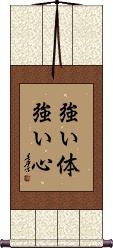
強い体強い心 is a way to write “strong mind, strong body” in Japanese.
Each of the two lines starts with 強い (tsuyoi) which means: strong; powerful; mighty; potent; resistant; resilient; durable; tough; stiff; hard; inflexible.
The body is represented with 体 (the ancient version is 體, romanized as karada), which means: body; build; physique; posture; torso; trunk; health.
Mind is represented with 心 (kokoro), which can mean heart, mind, or soul, depending on context.
強い體強い心 is not a common phrase in Japanese, so it's not the most natural title for calligraphy. In English, you might want to write it, “strong mind, strong body” but, “strong mind, strong body,” is more natural in Japanese.
Note: Because this selection contains some special Japanese Hiragana characters, it should be written by a Japanese calligrapher.
Flying Tigers AVG
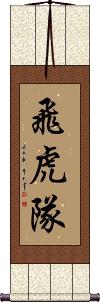
飛虎隊 is the full Chinese title of the “Flying Tigers Group.”
These were the American pilots that volunteered to go to China and fight the Japanese before the entry of the USA into World War Two. These fighter pilots were so esteemed in China that fallen American pilots could always find refuge in villages and safe passage and escape to areas of China that were not occupied by Japan at that time. Chinese villagers helped such fallen pilots with full knowledge that when the Japanese occupation forces found out, all the men, women, and children in the village would be massacred by Japanese troops (there are more than a few known cases of such massacres).
The Flying Tigers successfully kept supply lines to the Chinese resistance open and divided Japanese forces at a crucial time while America prepared to join WWII officially.
A wall scroll like this honors the men who risked or gave their lives as noble volunteers and is a reminder of the best moment in the history of Sino-American relations.
These three characters literally mean “flying tiger(s) group/team/squad.”
Note: Hanging these characters on your wall will not make you any friends with Japanese people who are aware of this history (most Japanese have no idea, as Japan’s involvement in WWII has all but been erased from school textbooks in Japan).
These search terms might be related to Lines:
Inner Strength is Better Than Outward Appearance
Not the results for Lines that you were looking for?
Below are some entries from our dictionary that may match your Lines search:
| Characters If shown, 2nd row is Simp. Chinese |
Pronunciation Romanization |
Simple Dictionary Definition |
白 see styles |
bái bai2 pai yuki ゆき |
More info & calligraphy: White(1) white; (2) (See ボラ・1) striped mullet fry (Mugil cephalus); (3) (See 科白・1) (spoken) line (in a play, film, etc.); one's lines; (4) {mahj} white dragon tile; (5) {mahj} winning hand with a pung (or kong) of white dragon tiles; (6) (abbreviation) (rare) (See 白耳義・ベルギー) Belgium; (7) (abbreviation) (archaism) (See 白人・1) white person; Caucasian; (female given name) Yuki White, pure, clear; make clear, inform. |
五行 see styles |
wǔ xíng wu3 xing2 wu hsing gogyou / gogyo ごぎょう |
More info & calligraphy: Five Elements(1) (See 五大・ごだい・1) the five elements (in Chinese philosophy: wood, fire, earth, metal and water); the five phases; wu xing; (2) {Buddh} five practices of the Bodhisattvas; (3) (See 六信五行) the five pillars of Islam; (surname, given name) Gogyou The five lines of conduct. I. According to the 起信論 Awakening of Faith they are almsgiving; keeping the commandments; patience under insult; zeal or progress; meditation. II. According to the 涅槃經 Nirvana Sutra they are saintly or bodhisattva deeds; arhat, or noble deeds; deva deeds; children's deeds (i. e. normal good deeds of men, devas, and Hinayanists); sickness conditions, e. g. illness, delusion, etc.; — into all these lines of conduct and conditions a Bodhisattva enters. III. The five elements, or tanmātra— wood, fire, earth, metal, and water; or earth, water, ire, air, and ether (or space) as taught by the later Mahāyāna philosophy; idem 五大. |
俳句 see styles |
pái jù pai2 ju4 p`ai chü pai chü haiku はいく |
More info & calligraphy: Haikuhaiku; 17-mora poem, usu. in 3 lines of 5, 7 and 5 morae |
ハンク see styles |
panku パンク |
More info & calligraphy: Hank |
ラインズ see styles |
rainzu ラインズ |
More info & calligraphy: Lines |
交 see styles |
jiāo jiao1 chiao yoshimi よしみ |
to hand over; to deliver; to pay (money); to turn over; to make friends; (of lines) to intersect; variant of 跤[jiao1] (1) association; fellowship; (2) change (of season, year, etc.); (personal name) Yoshimi Interlock, intersect; crossed; mutual; friendship; to hand over, pay. |
句 see styles |
jù ju4 chü ku く |
sentence; clause; phrase; classifier for phrases or lines of verse (n,n-suf) (1) section (i.e. of text); sentence; passage; paragraph; (n,n-suf) (2) {ling} phrase; (n,n-suf) (3) verse (of 5 or 7 mora in Japanese poetry; of 4, 5, or 7 characters in Chinese poetry); (n,n-suf) (4) haiku; first 17 morae of a renga, etc.; (n,n-suf) (5) maxim; saying; idiom; expression; (n,n-suf) (6) {comp} clause (e.g. in a database query language) A sentence, phrase, clause; also used for a place. |
排 see styles |
pái pai2 p`ai pai hai はい |
to arrange in order; to line up; to exclude; to eliminate; to repel; to expel; to discharge; (literary) to push aside; to force open; to rehearse; row; line; platoon; (bound form) steak; chop; (bound form) raft; classifier for rows or lines (of people or things) (prefix) anti- |
撏 挦 see styles |
xián xian2 hsien |
to pull out (esp. hair or feathers); to pick; to pluck; fig. to extract (lines from a text) |
条 see styles |
nagashi ながし |
(n,ctr) (1) article (in a document); clause; section; provision; (counter) (2) counter for lines, stripes, streaks, rays, etc.; (conjunction) (3) (as とは言い条) although; though; (conjunction) (4) (used in letters) since; as; because; inasmuch as; (5) (hist) (See 条坊制) jō; north-south division of an imperial city consisting of west-east streets and their corresponding wards (in the jō-bō system); (given name) Nagashi |
溜 see styles |
liù liu4 liu ryuu / ryu りゅう |
swift current; rapids; (dialect) (of speech, actions etc) skilled; proficient; (of movements) quick; speedy; (bound form) rain runoff from a roof; (bound form) roof gutter; classifier for rows, lines etc; surroundings; neighborhood; (dialect) to practice; (dialect) to plaster; to fill in the cracks (with cement, lime plaster etc) (surname) Ryū |
爻 see styles |
yáo yao2 yao kou / ko こう |
the solid and broken lines of the eight trigrams 八卦[ba1 gua4], e.g. ☶ (See 卦) yao (line representing yin or yang that comprises one third of a trigram) |
瑑 see styles |
zhuàn zhuan4 chuan |
engraved lines |
一筆 see styles |
hitofude ひとふで |
(1) one stroke (of a brush); (2) a few lines (of writing); note; short letter; (dropping) a line; (3) writing in one go (without stopping to apply more ink to the brush); (4) parcel (of land); (5) (いっぴつ only) same handwriting; (surname) Hitofude |
七律 see styles |
qī lǜ qi1 lu:4 ch`i lü chi lü |
verse form consisting of 8 lines of 7 characters, with rhyme on alternate lines (abbr. for 七言律詩|七言律诗[qi1 yan2 lu : 4 shi1]) |
三行 see styles |
sān xíng san1 xing2 san hsing miyuki みゆき |
(g,p) Miyuki Three lines of action that affect karma, i.e. the ten good deeds that cause happy karma; the ten evil deeds that cause unhappy karma; 不動業 or 無動行 karma arising without activity, e.g. meditation on error and its remedy. |
串線 串线 see styles |
chuàn xiàn chuan4 xian4 ch`uan hsien chuan hsien |
to get the lines crossed |
九字 see styles |
jiǔ zì jiu3 zi4 chiu tzu kuji くじ |
{Buddh} (See 臨兵闘者皆陣裂在前) nine-character charm chanted with ritual gestures to ward off evil (esp. by mountain ascetics and adherents of Esoteric Buddhism) The nine magical characters 臨兵鬪者皆陳列在前 implying that the armed forces are arrayed against the powers of evil. After reciting these words, four vertical and five horizontal lines, forming a grid, are drawn in the air to show that the forces are arrayed. It was used among Taoists and soldiers, and is still used in Japan, especially when going into the mountains. |
今様 see styles |
imayou / imayo いまよう |
(noun - becomes adjective with の) (1) modern style; contemporary style; current fashion; (2) (abbreviation) (See 今様歌) verse form from the Heian and Kamakura periods consisting of 4 lines each divided into two parts of 7 and 5 syllables |
全線 全线 see styles |
quán xiàn quan2 xian4 ch`üan hsien chüan hsien zensen ぜんせん |
the whole front (in a war); the whole length (of a road or railway line) (1) the whole (railway) line; the entire (bus) route; (2) all lines; all routes; (3) the whole front (in war); (4) all fronts |
兩棲 两栖 see styles |
liǎng qī liang3 qi1 liang ch`i liang chi |
amphibious; dual-talented; able to work in two different lines |
分点 see styles |
bunten ぶんてん |
(1) {astron} equinoctal point; equinoctial point; (2) division points (along lines) |
化行 see styles |
huà xíng hua4 xing2 hua hsing kean |
(化行二教) The two lines of teaching: i. e. in the elements, for conversion and admission, and 行教 or 制教 in the practices and moral duties especially for the Order, as represented in the Vinaya; cf. 化制. |
十行 see styles |
shí xíng shi2 xing2 shih hsing jūgyō |
The ten necessary activities in the fifty-two stages of a bodhisattva, following on the 十信and 十住; the two latter indicate personal development 自利. These ten lines of action are for the universal welfare of others 利他. They are: joyful service; beneficial service; never resenting; without limit; never out of order; appearing in any form at will; unimpeded; exalting the pāramitās amongst all beings; perfecting the Buddha-law by complete virtue; manifesting in all things the pure, final, true reality. |
句數 句数 see styles |
jù shù ju4 shu4 chü shu |
number of sentences; number of lines (in verse etc) |
台詞 台词 see styles |
tái cí tai2 ci2 t`ai tz`u tai tzu daishi だいし serifu せりふ |
an actor's lines; script (kana only) speech; words; one's lines; remarks |
台辞 see styles |
daiji だいじ |
words; one's lines |
因襲 因袭 see styles |
yīn xí yin1 xi2 yin hsi inshuu / inshu いんしゅう |
to follow old patterns; to imitate existing models; to continue along the same lines convention; tradition; long-established custom |
地内 see styles |
chiuchi ちうち |
grounds; premises; land within boundary lines; (surname) Chiuchi |
地壟 地垄 see styles |
dì lǒng di4 long3 ti lung |
lines on ridges on ploughed field |
Click here for more Lines results from our dictionary
The following table may be helpful for those studying Chinese or Japanese:
| Title | Characters | Romaji (Romanized Japanese) | Various forms of Romanized Chinese | |
| Lines | 萊恩斯 莱恩斯 | lái ēn sī lai2 en1 si1 lai en si laiensi | lai en ssu laienssu |
|
| Lines | ラインズ | rainzu | ||
| Haiku | 俳句 | haiku | pái jù / pai2 ju4 / pai ju / paiju | p`ai chü / paichü / pai chü |
| Strong Body, Strong Mind | 強い體強い心 強い体強い心 | tsuyo i karada tsuyo i kokoro tsuyoikaradatsuyoikokoro | ||
| Flying Tigers AVG | 飛虎隊 飞虎队 | fēi hǔ duì fei1 hu3 dui4 fei hu dui feihudui | fei hu tui feihutui |
|
| In some entries above you will see that characters have different versions above and below a line. In these cases, the characters above the line are Traditional Chinese, while the ones below are Simplified Chinese. | ||||

Successful Chinese Character and Japanese Kanji calligraphy searches within the last few hours...



