Many custom options...


And formats...



Hate in Chinese / Japanese...
Buy a Hate calligraphy wall scroll here!
Personalize your custom “Hate” project by clicking the button next to your favorite “Hate” title below...
Love and Hate
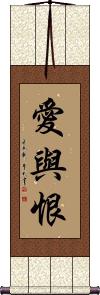
Whether you want to make a joke about what marriage really is or just feel that the world is full of love and hate, this selection is for you.
愛與恨 happens to literally translate. So the first character is love. The middle character is a connecting particle-like “and” in English. The last character is hate.
Upon request, we can omit the “and” character and just put a dot to separate love and hate if you prefer.
Love and Hate
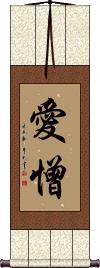
愛憎 is a weird selection for a calligraphy wall scroll. But if you really want it, we'll do it.
This version is most appropriate if your audience is Japanese or Korean (for Koreans who can read the ancient Korean Hanja).
The first character means love or affection.
The second character means hate, dislike, detest, or loathe.
Not the results for Hate that you were looking for?
Below are some entries from our dictionary that may match your Hate search...
| Characters If shown, 2nd row is Simp. Chinese |
Pronunciation Romanization |
Simple Dictionary Definition |
愛憎 爱憎 see styles |
ài zēng ai4 zeng1 ai tseng aizou / aizo あいぞう |
More info & calligraphy: Love and Hatelove and hate Love and hate, desire and dislike. |
四無量心 四无量心 see styles |
sì wú liàng xīn si4 wu2 liang4 xin1 ssu wu liang hsin shi muryōshin |
More info & calligraphy: Brahmavihara - The Four Immeasurables |
を see styles |
o を |
(particle) (1) indicates direct object of action; (particle) (2) indicates subject of causative expression; (particle) (3) indicates an area traversed; (particle) (4) indicates time (period) over which action takes place; (particle) (5) indicates point of departure or separation of action; (particle) (6) (See が・1) indicates object of desire, like, hate, etc. |
使 see styles |
shǐ shi3 shih tsukasa つかさ |
to make; to cause; to enable; to use; to employ; to send; to instruct sb to do something; envoy; messenger (1) messenger; (2) (abbreviation) (See 検非違使) police and judicial chief (Heian and Kamakura periods); (3) {Buddh} (See 煩悩・2) klesha (polluting thoughts such as greed, hatred and delusion, which result in suffering); (female given name) Tsukasa To send; cause; a messenger; a pursuer, molester, lictor, disturber, troubler, intp. as 煩惱 kleśa, affliction, distress, worldly cares, vexations, and as consequent reincarnation. There are categories of 10, 16, 98, 112, and 128 such troublers, e. g. desire, hate, stupor, pride, doubt, erroneous views, etc., leading to painful results in future rebirths, for they are karma-messengers executing its purpose. Also 金剛童子 q. v. |
堲 see styles |
jí ji2 chi |
hate |
忌 see styles |
jì ji4 chi ki き |
to be jealous of; fear; dread; scruple; to avoid or abstain from; to quit; to give up something (1) mourning; mourning period; (suffix noun) (2) anniversary of one's death Avoid, tabu, dread; hate, jealous. |
恚 see styles |
huì hui4 hui i |
rage Hate, anger, rage. |
恨 see styles |
hèn hen4 hen kon |
to hate; to regret Hate, annoyed, vexed. 恨心; 怨恨; 恨怒. |
惡 恶 see styles |
wù wu4 wu o |
to hate; to loathe; ashamed; to fear; to slander agha. Bad, evil, wicked, hateful; to hate, dislike; translit. a, cf. 阿. |
憎 see styles |
zēng zeng1 tseng zō |
to detest Hate, dislike. |
憝 see styles |
duì dui4 tui |
dislike; hate |
懟 怼 see styles |
duì dui4 tui |
dislike; hate |
懫 see styles |
zhí zhi2 chih |
enraged; resentful; to hate; to desist |
柸 see styles |
pēi pei1 p`ei pei |
to hate; bear grudge |
涯 see styles |
yá ya2 ya hate はて |
border; horizon; shore horizon a shore |
疾 see styles |
jí ji2 chi tsuguo つぐお |
(bound form) disease; ailment; (bound form) swift; (literary) to hate; to abhor (personal name) Tsuguo Sickness, an attack of illness: haste, speedy: angry. |
癉 瘅 see styles |
dàn dan4 tan |
to hate |
譈 see styles |
duì dui4 tui |
dislike; hate |
七使 see styles |
qī shǐ qi1 shi3 ch`i shih chi shih shichishi |
The seven messengers, agents, or kleśas—desire 欲愛; anger, or hate 瞋恚; attachment, or clinging 有愛; pride or arrogance 慢; ignorance, or unenlightenment 無明; false views 見; and doubt 疑. |
七情 see styles |
qī qíng qi1 qing2 ch`i ch`ing chi ching shichijou / shichijo しちじょう |
seven emotional states; seven affects of traditional Chinese medical theory and therapy, namely: joy 喜[xi3], anger 怒[nu4], anxiety 憂|忧[you1], thought 思[si1], grief 悲[bei1], fear 恐[kong3], fright 驚|惊[jing1]; seven relations (1) seven emotions (in The Book of Rites: joy, anger, sorrow, fear, love, hate, desire); seven emotions (in Buddhism: joy, anger, sorrow, pleasure, love, hate, desire); (2) seven effects (of a traditional Chinese medicine); (surname) Shichijō The seven emotions : pleasure, anger, sorrow, joy, love, hate, desire. |
三垢 see styles |
sān gòu san1 gou4 san kou miyoshi みよし |
(personal name) Miyoshi The three defilers—desire, hate, stupidity (or ignorance), idem 三毒. |
三惑 see styles |
sān huò san1 huo4 san huo sanwaku; sannaku さんわく; さんなく |
{Buddh} three mental disturbances A Tiantai classification of the three delusions, also styled 三煩惱; 三漏; 三垢; 三結; trials or temptations, leakages, uncleannesses, and bonds. The first of the following three is common to all disciples, the two last to bodhisattvas. They arise from (a) 見, 思, 惑 things seen and thought, i.e. illusions from imperfect perception, with temptation to love, hate, etc.; to be rid of these false views and temptations is the discipline and nirvāṇa of ascetic or Hīnayāna Buddhists. Mahāyāna proceeds further in and by its bodhisattva aims, which produce their own difficulties, i.e. (b) 塵沙惑 illusion and temptation through the immense variety of duties in saving men; and (c) 無明惑 illusions and temptations that arise from failure philosophically to understand things in their reality. |
三想 see styles |
sān xiǎng san1 xiang3 san hsiang sansō |
The three evil thoughts are the last, desire, hate, malevolence; the three good thoughts are 怨想 thoughts of (love to) enemies, 親想 the same to family and friends, 中人想 the same to those who are neither enemies nor friends, i.e. to all; v. 智度論 72. |
三株 see styles |
sān zhū san1 zhu1 san chu mikabu みかぶ |
(place-name) Mikabu The three tree-trunks, or main stems—desire, hate, stupidity; v. 三毒. |
三根 see styles |
sān gēn san1 gen1 san ken mine みね |
(place-name, surname) Mine The three (evil) 'roots'— desire, hate, stupidity, idem 三毒. Another group is the three grades of good roots, or abilities 上, 中, 下 superior, medium, and inferior. Another is the three grades of faultlessness 三無漏根. |
三毒 see styles |
sān dú san1 du2 san tu sandoku さんどく |
{Buddh} (See 煩悩・2) the three kleshas that poison the heart of man (desire, ill will and ignorance) The three poisons, also styled 三根; 三株; they are 貪 concupiscence, or wrong desire, 瞋 anger, hate, or resentment, and 痴 stupidity, ignorance, unintelligence, or unwillingness to accept Buddha-truth; these three are the source of all the passions and delusions. They represent in part the ideas of love, hate, and moral inertia. v. 智度論 19, 31. |
三火 see styles |
sān huǒ san1 huo3 san huo sanka |
The three fires—desire, hate, and stupidity; v. 三毒. |
三病 see styles |
sān bìng san1 bing4 san ping sanbyō |
The three ailments: (1) (a) 貪 lust, for which the 不淨觀 meditation on uncleanness is the remedy; (b) 瞋 anger, or hate, remedy 慈悲觀 meditation on kindness and pity; (c) 癡 stupidity, or ignorance, remedy 因緣觀 meditation on causality. (2) (a) 謗 Slander of Mahāyāna; (b) 五逆罪 the five gross sins; (c) to be a "heathen" or outsider; the forms recorded seem to be icchantika, ecchantika, and aicchantika. Cf. 三毒. |
三障 see styles |
sān zhàng san1 zhang4 san chang sanshō |
The three vighna, i.e. hinderers or barriers, of which three groups are given: (1) (a) 煩惱障 the passions, i.e. 三毒 desire, hate, stupidity; (b) 業障 the deeds done; (c) 報障 the retributions. (2) (a) 皮煩惱障 ; (b) 肉煩惱障 ; (c) 心煩惱障 skin, flesh, and heart (or mind) troublers, i.e. delusions from external objects: internal views, and mental ignorance. (3) 三重障 the three weighty obstructions: (a) self-importance, 我慢; (b) envy, 嫉妬; (c) desire, 貧欲. |
九結 九结 see styles |
jiǔ jié jiu3 jie2 chiu chieh kyūketsu |
The nine bonds that bind men to mortality: love, hate, pride, ignorance, (wrong)views, possessions (or grasping), doubt, envy, meanness (or selfishness). They are the 六隨眠 plus grasping, envy, and meanness. |
Click here for more Hate results from our dictionary
The following table may be helpful for those studying Chinese or Japanese...
| Title | Characters | Romaji (Romanized Japanese) | Various forms of Romanized Chinese | |
| Love and Hate | 愛與恨 爱与恨 | ài yǔ hèn ai4 yu3 hen4 ai yu hen aiyuhen | ai yü hen aiyühen |
|
| Love and Hate | 愛憎 爱憎 | ai zou / aizou / ai zo | ài zèng / ai4 zeng4 / ai zeng / aizeng | ai tseng / aitseng |
| In some entries above you will see that characters have different versions above and below a line. In these cases, the characters above the line are Traditional Chinese, while the ones below are Simplified Chinese. | ||||

Successful Chinese Character and Japanese Kanji calligraphy searches within the last few hours...



