Many custom options


And formats



Fix in Chinese / Japanese
Buy a Fix calligraphy wall scroll here!
Personalize your custom “Fix” project by clicking the button next to your favorite “Fix” title below.
1. Fix
2. Fix the roof before the rain; Dig the well before you are thirsty
3. Have a Walking Stick at the Ready Before You Stumble
5. Samadhi

菲克斯 is the name Fix in Chinese (Mandarin).

フィックス is the name Fix in Japanese Katakana.
Note: Because this title is entirely Japanese Katakana, it should be written by a Japanese calligrapher.
Fix the roof before the rain; Dig the well before you are thirsty
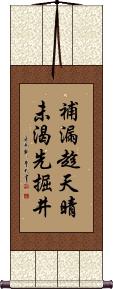
补漏趁天晴未渴先掘井 is a Chinese proverb that literally translates as: Mend the roof while the weather is fine, [and when you are] not yet thirsty, dig the well beforehand.
In simple terms, this means: Always being prepared in advance.
See Also: Have a Walking Stick at the Ready Before You Stumble
Have a Walking Stick at the Ready Before You Stumble
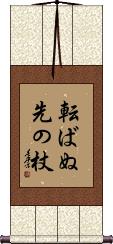
転ばぬ先の杖 is a Japanese proverb that literally translates as: Have a walking stick ready before stumbling.
This is similar to the English idiom, “A stitch in time saves nine.”
In simple terms, this means: Always being prepared in advance.
Note: Because this selection contains some special Japanese Hiragana characters, it should be written by a Japanese calligrapher.
See Also: Fix the Roof Before the Rain; Dig the Well Before You Are Thirsty
In Good Order
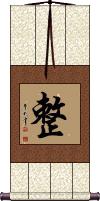
整 is a single Chinese character that can mean: in good order, whole, complete, entire, in order, orderly, to repair, to mend, to renovate, and/or to fix something or somebody.
This was added for a customer who wanted a single character that meant orderly. It's kind of unusual for a wall scroll.
My Korean Hanja dictionary defines it as orderly, neat, tidy, and/or whole.
Note: In Japanese, this Kanji is usually understood as a male given name Hitoshi (other Kanji can also be Hitoshi). It is used in combination with other Kanji or Hiragana to create words about orderliness. Unless your name is Hitoshi, this single character is best if your audience is Chinese.
Samadhi
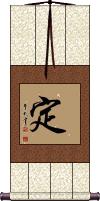
定 is the single-character way to express the idea of Samadhi in Chinese and Japanese.
A single-character title like this is open to many interpretation. So 定 can mean to set, to fix, to determine, to decide, to order, certainly, truly, settle, or compose the mind.
In the Buddhist context, this means “Perfect absorption of thought into the one object of meditation,” “The mind fixed in one direction,” “Internal state of imperturbability or tranquility,” or “Exempt from all external sensations.”
Better Late Than Never
It's Never Too Late Too Mend
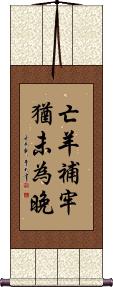
Long ago in what is now China, there were many kingdoms throughout the land. This time period is known as “The Warring States Period” by historians because these kingdoms often did not get along with each other.
Sometime around 279 B.C. the Kingdom of Chu was a large but not particularly powerful kingdom. Part of the reason it lacked power was the fact that the King was surrounded by “yes men” who told him only what he wanted to hear. Many of the King's court officials were corrupt and incompetent which did not help the situation.
The King was not blameless himself, as he started spending much of his time being entertained by his many concubines.
One of the King's ministers, Zhuang Xin, saw problems on the horizon for the Kingdom, and warned the King, “Your Majesty, you are surrounded by people who tell you what you want to hear. They tell you things to make you happy and cause you to ignore important state affairs. If this is allowed to continue, the Kingdom of Chu will surely perish, and fall into ruins.”
This enraged the King who scolded Zhuang Xin for insulting the country and accused him of trying to create resentment among the people. Zhuang Xin explained, “I dare not curse the Kingdom of Chu but I feel that we face great danger in the future because of the current situation.” The King was simply not impressed with Zhuang Xin's words.
Seeing the King's displeasure with him and the King's fondness for his court of corrupt officials, Zhuang Xin asked permission from the King that he may take leave of the Kingdom of Chu, and travel to the State of Zhao to live. The King agreed, and Zhuang Xin left the Kingdom of Chu, perhaps forever.
Five months later, troops from the neighboring Kingdom of Qin invaded Chu, taking a huge tract of land. The King of Chu went into exile, and it appeared that soon, the Kingdom of Chu would no longer exist.
The King of Chu remembered the words of Zhuang Xin and sent some of his men to find him. Immediately, Zhuang Xin returned to meet the King. The first question asked by the King was “What can I do now?”
Zhuang Xin told the King this story:
A shepherd woke one morning to find a sheep missing. Looking at the pen saw a hole in the fence where a wolf had come through to steal one of his sheep. His friends told him that he had best fix the hole at once. But the Shepherd thought since the sheep is already gone, there is no use fixing the hole.
The next morning, another sheep was missing. And the Shepherd realized that he must mend the fence at once. Zhuang Xin then went on to make suggestions about what could be done to reclaim the land lost to the Kingdom of Qin, and reclaim the former glory and integrity of the Kingdom of Chu.
The Chinese idiom shown above came from this reply from Zhuang Xin to the King of Chu almost 2,300 years ago.
It translates roughly into English as...
“Even if you have lost some sheep, it's never too late to mend the fence.”
This proverb, 亡羊补牢犹未为晚, is often used in modern China when suggesting in a hopeful way that someone change their ways, or fix something in their life. It might be used to suggest fixing a marriage, quitting smoking, or getting back on track after taking an unfortunate path in life among other things one might fix in their life.
I suppose in the same way that we might say, “Today is the first day of the rest of your life” in our western cultures to suggest that you can always start anew.
Note: This does have Korean pronunciation but is not a well-known proverb in Korean (only Koreans familiar with ancient Chinese history would know it). Best if your audience is Chinese.
These search terms might be related to Fix:
2. Right Resolve / Right Thought / Right Intention / Perfect Resolve
A Truly Determined Person Will Find a Solution
Drink Up! / Cheers!
Even a Fool May Sometimes Come Up With a Good Idea
Fall Down Seven Times, Get Up Eight
Give Up Desire
Good Good Study, Day Day Up
Have a Walking Stick at the Ready Before You Stumble
Massage
Never Forget Your First Resolution
Never Give Up
No Place Like Home
One Who Walks by the River May End Up With Wet Feet
Rise Up With Thrift and Diligence
Safe / Secure
Set Your Heart Ablaze
Settle
Solution
Swindle
Take Up a Challenge
Therapeutic Massage
There’s No Place Like Home
Unwavering Determination and Resolve
Wake Up to Reality
Not the results for Fix that you were looking for?
Below are some entries from our dictionary that may match your Fix search:
| Characters If shown, 2nd row is Simp. Chinese |
Pronunciation Romanization |
Simple Dictionary Definition |
安 see styles |
ān an1 an yasuji やすじ |
More info & calligraphy: Calm / Tranquility(pref,suf) (1) cheap; (prefix) (2) (See 安請け合い) rash; thoughtless; careless; indiscreet; frivolous; (personal name) Yasuji Peace, tranquil, quiet, pacify; to put, place; where ? how? |
定 see styles |
dìng ding4 ting yasushi やすし |
More info & calligraphy: Samadhi(1) (See 案の定・あんのじょう) certainty; reality; actuality; (prefix noun) (2) (See 定宿) regular; permanent; (3) {Buddh} (See 三昧・さんまい・1,禅定・ぜんじょう・1) samadhi (state of intense concentration achieved through meditation); (given name) Yasushi To fix, settle. samādhi. 'Composing the mind'; 'intent contemplation'; 'perfect absorption of thought into the one object of meditation.' M. W. Abstract meditation, the mind fixed in one direction, or field. (1) 散定 scattered or general meditation (in the world of desire). (2) 禪定 abstract meditation (in the realms of form and beyond form). It is also one of the five attributes of the dharmakāya 法身, i. e. an internal state of imperturbability or tranquility, exempt from all external sensations, 超受陰; cf. 三摩提. |
整 see styles |
zhěng zheng3 cheng hitoshi ひとし |
More info & calligraphy: In Good Order(male given name) Hitoshi |
フィックス see styles |
fikkusu フィックス |
More info & calligraphy: Fix |
奠 see styles |
diàn dian4 tien ten |
to fix; to settle; a libation to the dead To settle, offer, condole. |
屬 属 see styles |
zhǔ zhu3 chu satsuka さつか |
to join together; to fix one's attention on; to concentrate on (surname) Satsuka belong to |
弄 see styles |
nòng nong4 nung rō |
to do; to manage; to handle; to play with; to fool with; to mess with; to fix; to toy with play with |
注 see styles |
zhù zhu4 chu chuu / chu ちゅう |
(bound form) to pour into; to flow into; to inject; (bound form) to focus (one's spirit, gaze etc) on a single point; to concentrate; (bound form) stake (in gambling); classifier for stakes, sums of money, transactions or beams of light; variant of 註|注[zhu4] (noun/participle) annotation; explanatory note; comment; (given name) Chuu Fix, record; flow. |
畫 画 see styles |
huà hua4 hua ga |
to draw; to paint; picture; painting (CL:幅[fu2],張|张[zhang1]); to draw (a line) (variant of 劃|划[hua4]); stroke of a Chinese character (variant of 劃|划[hua4]); (calligraphy) horizontal stroke (variant of 劃|划[hua4]) Draw, paint, picture, sketch; devise, fix. |
登 see styles |
dēng deng1 teng minoru みのる |
to scale (a height); to ascend; to mount; to publish or record; to enter (e.g. in a register); to press down with the foot; to step or tread on; to put on (shoes or trousers) (dialect); to be gathered and taken to the threshing ground (old) (given name) Minoru Ascend, advance, start; attain, ripen; to note, fix. |
盯 see styles |
dīng ding1 ting |
to watch attentively; to fix one's attention on; to stare at; to gaze at |
繫 系 see styles |
xì xi4 hsi kei |
to connect; to arrest; to worry To fasten, attach to, connect; think of, be attached to, fix the thoughts on. |
著 着 see styles |
zhù zhu4 chu akira あきら |
to make known; to show; to prove; to write; book; outstanding (1) (written) work; book; (suffix) (2) (after an author's name) (written) by; (3) (obsolete) clearness; obviousness; conspicuousness; (personal name) Akira To manifest, display, publish, fix; interchanged with 着. In a Buddhist sense it is used for attachment to anything, e.g. the attachment of love, desire, greed, etc.; To cover, put on; cause; place; complete; ought, must. |
處 处 see styles |
chù chu4 ch`u chu tokoro ところ |
(bound form) place; locality; (bound form) part; aspect; (bound form) office; department; bureau; classifier for locations: spot, point (out-dated kanji) (n,suf) (1) place; spot; scene; site; (2) (kana only) address; (3) (kana only) district; area; locality; (4) (kana only) one's house; (5) (kana only) point; aspect; side; facet; (6) (kana only) passage (in text); part; (7) (kana only) space; room; (8) (kana only) thing; matter; (9) (kana only) whereupon; as a result; (10) (kana only) about to; on the verge of; (11) (kana only) was just doing; was in the process of doing; have just done; just finished doing; (surname) Tokoro To dwell, abide; fix, decide, punish; a place, state. āyatana, 阿耶怛那, also tr. 入, place or entrance of the sense, both the organ and the sensation, or sense datum; hence the 十二處 twelve āyatana, i. e. six organs, and six sense data that enter for discrimination. |
裝 装 see styles |
zhuāng zhuang1 chuang shō |
adornment; to adorn; dress; clothing; costume (of an actor in a play); to play a role; to pretend; to install; to fix; to wrap (something in a bag); to load; to pack To dress, make up, pretend, pack, load, store; a fashion. |
限 see styles |
xiàn xian4 hsien sachiyo さちよ |
to limit; to restrict; (bound form) limit; bound (irregular okurigana usage) (1) end; finish; stop; (2) bounds; limits; (3) delivery date (of a futures contract); (4) finale (of a noh song); end of an act (in joruri or kabuki); final performance of the day (in vaudeville); (suf,ctr) (5) counter for slices (esp. thick slices); counter for cuts (e.g. fish, meat); (particle) (6) (kana only) only; just; (7) (kana only) since; after; (8) (kana only) remaining (in a particular state); (personal name) Sachiyo Limit, boundary, to fix. |
鞏 巩 see styles |
gǒng gong3 kung |
(bound form) to fix in place; to make firm and secure |
一定 see styles |
yī dìng yi1 ding4 i ting kazusada かずさだ |
surely; certainly; definitely; fixed; settled; a certain ...; a given ... (vs,vt,vi) (1) to fix; to settle; to standardize; to regularize; (can be adjective with の) (2) constant; definite; uniform; defined; certain; prescribed; (given name) Kazusada |
佈置 布置 see styles |
bù zhì bu4 zhi4 pu chih |
to put in order; to arrange; to decorate; to fix up; to deploy See: 布置 |
修正 see styles |
xiū zhèng xiu1 zheng4 hsiu cheng nobumasa のぶまさ |
to revise; to amend; to rectify (noun, transitive verb) amendment; correction; revision; modification; alteration; retouching; update; fix; (given name) Nobumasa to fix |
修理 see styles |
xiū lǐ xiu1 li3 hsiu li shuri しゅり |
to repair; to fix; to prune; to trim; (coll.) to sort sb out; to fix sb (noun, transitive verb) repair; mending; fixing; servicing; (surname) Shuri to cultivate |
停心 see styles |
tíng xīn ting2 xin1 t`ing hsin ting hsin teishin |
To fix or settle the mind in meditation, cf. 五停心觀. |
凝視 凝视 see styles |
níng shì ning2 shi4 ning shih gyoushi / gyoshi ぎょうし |
to gaze at; to fix one's eyes on (noun, transitive verb) stare; gaze; fixation |
取巧 see styles |
qǔ qiǎo qu3 qiao3 ch`ü ch`iao chü chiao |
quick fix; opportune short cut (around a difficulty); cheap trick (to get what one wants); to pull a fast one |
困る see styles |
komaru こまる |
(v5r,vi) (1) to be troubled; to have difficulty; to be in a fix; to be at a loss; to be stumped; to be embarrassed; (v5r,vi) (2) to be bothered; to be inconvenienced; to be annoyed; (v5r,vi) (3) to be badly off; to be hard up; to be in straitened circumstances |
固定 see styles |
gù dìng gu4 ding4 ku ting kotei / kote こてい |
to fix; to fasten; to set rigidly in place; fixed; set; regular (n,vs,vt,vi) (1) fixing (in place); being fixed (in place); securing; anchoring; fastening down; (n,vs,vt,vi) (2) fixing (e.g. salary, capital); keeping the same; (n,vs,vt,vi) (3) {biol} fixation (histology); (4) (net-sl) (abbreviation) (See 固定ハンドル・1) user name (on an online forum like 2ch where the majority of users post anonymously); (5) (net-sl) (abbreviation) (See 固定ハンドル・2) user of an online handle (instead of posting anonymously) |
奠定 see styles |
diàn dìng dian4 ding4 tien ting |
to establish; to fix; to settle |
安裝 安装 see styles |
ān zhuāng an1 zhuang1 an chuang |
to install; to erect; to fix; to mount; installation |
定價 定价 see styles |
dìng jià ding4 jia4 ting chia |
to set a price; to fix a price |
定出 see styles |
dìng chū ding4 chu1 ting ch`u ting chu |
to determine; to fix upon; to set (a target, a price etc) |
Click here for more Fix results from our dictionary
The following table may be helpful for those studying Chinese or Japanese:
| Title | Characters | Romaji (Romanized Japanese) | Various forms of Romanized Chinese | |
| Fix | 菲克斯 | fēi kè sī fei1 ke4 si1 fei ke si feikesi | fei k`o ssu feikossu fei ko ssu |
|
| Fix | フィックス | fikkusu / fikusu | ||
| Fix the roof before the rain; Dig the well before you are thirsty | 補漏趁天晴未渴先掘井 补漏趁天晴未渴先掘井 | bǔ lòu chèn tiān qíng wèi kě xiān jué jǐng bu3 lou4 chen4 tian1 qing2 wei4 ke3 xian1 jue2 jing3 bu lou chen tian qing wei ke xian jue jing | pu lou ch`en t`ien ch`ing wei k`o hsien chüeh ching pu lou chen tien ching wei ko hsien chüeh ching |
|
| Have a Walking Stick at the Ready Before You Stumble | 転ばぬ先の杖 | koro ba nu saki no tsue korobanusakinotsue | ||
| In Good Order | 整 | hitoshi | zhěng / zheng3 / zheng | cheng |
| Samadhi | 定 | sada | dìng / ding4 / ding | ting |
| Better Late Than Never | 亡羊補牢猶未為晚 亡羊补牢犹未为晚 | wáng yáng bǔ láo yóu wèi wéi wǎn wang2 yang2 bu3 lao2 you2 wei4 wei2 wan3 wang yang bu lao you wei wei wan | wang yang pu lao yu wei wei wan wangyangpulaoyuweiweiwan |
|
| In some entries above you will see that characters have different versions above and below a line. In these cases, the characters above the line are Traditional Chinese, while the ones below are Simplified Chinese. | ||||

Successful Chinese Character and Japanese Kanji calligraphy searches within the last few hours...



