Many custom options...


And formats...



All Day Long in Chinese / Japanese...
Buy an All Day Long calligraphy wall scroll here!
Personalize your custom “All Day Long” project by clicking the button next to your favorite “All Day Long” title below...
One Day Seems Like 1000 Years
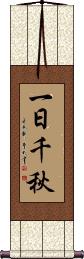
一日千秋 is a Japanese and Chinese proverb about missing someone.
一日千秋 is often used to express how hard it is to wait for someone's return or to be away from someone.
Some will translate this as “one day feels like a very long time” or “waiting for someone (something) is hard.”
You might see this romanized as a single word, Ichijitsusenshuu, or as “Ichijitsu Senshuu” from Japanese.
If you break down the characters one-by-one, we get:
一 = one/a
日 = day/sun (can also represent time or date)
千 = 1000/thousand
秋 = autumn/fall
Together, 千秋 can mean “autumn comes thousand times” (or 1000 years). It can also be read as 1000 periods of time.
However, it relays the idea of heartache as you wait for someone you miss.
Better Late Than Never
It's Never Too Late Too Mend
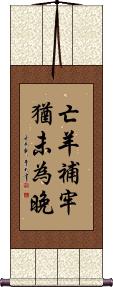
Long ago in what is now China, there were many kingdoms throughout the land. This time period is known as “The Warring States Period” by historians because these kingdoms often did not get along with each other.
Sometime around 279 B.C. the Kingdom of Chu was a large but not particularly powerful kingdom. Part of the reason it lacked power was the fact that the King was surrounded by “yes men” who told him only what he wanted to hear. Many of the King's court officials were corrupt and incompetent which did not help the situation.
The King was not blameless himself, as he started spending much of his time being entertained by his many concubines.
One of the King's ministers, Zhuang Xin, saw problems on the horizon for the Kingdom, and warned the King, “Your Majesty, you are surrounded by people who tell you what you want to hear. They tell you things to make you happy and cause you to ignore important state affairs. If this is allowed to continue, the Kingdom of Chu will surely perish, and fall into ruins.”
This enraged the King who scolded Zhuang Xin for insulting the country and accused him of trying to create resentment among the people. Zhuang Xin explained, “I dare not curse the Kingdom of Chu but I feel that we face great danger in the future because of the current situation.” The King was simply not impressed with Zhuang Xin's words.
Seeing the King's displeasure with him and the King's fondness for his court of corrupt officials, Zhuang Xin asked permission from the King that he may take leave of the Kingdom of Chu, and travel to the State of Zhao to live. The King agreed, and Zhuang Xin left the Kingdom of Chu, perhaps forever.
Five months later, troops from the neighboring Kingdom of Qin invaded Chu, taking a huge tract of land. The King of Chu went into exile, and it appeared that soon, the Kingdom of Chu would no longer exist.
The King of Chu remembered the words of Zhuang Xin and sent some of his men to find him. Immediately, Zhuang Xin returned to meet the King. The first question asked by the King was “What can I do now?”
Zhuang Xin told the King this story:
A shepherd woke one morning to find a sheep missing. Looking at the pen saw a hole in the fence where a wolf had come through to steal one of his sheep. His friends told him that he had best fix the hole at once. But the Shepherd thought since the sheep is already gone, there is no use fixing the hole.
The next morning, another sheep was missing. And the Shepherd realized that he must mend the fence at once. Zhuang Xin then went on to make suggestions about what could be done to reclaim the land lost to the Kingdom of Qin, and reclaim the former glory and integrity of the Kingdom of Chu.
The Chinese idiom shown above came from this reply from Zhuang Xin to the King of Chu almost 2,300 years ago.
It translates roughly into English as...
“Even if you have lost some sheep, it's never too late to mend the fence.”
This proverb, 亡羊补牢犹未为晚, is often used in modern China when suggesting in a hopeful way that someone change their ways, or fix something in their life. It might be used to suggest fixing a marriage, quitting smoking, or getting back on track after taking an unfortunate path in life among other things one might fix in their life.
I suppose in the same way that we might say, “Today is the first day of the rest of your life” in our western cultures to suggest that you can always start anew.
Note: This does have Korean pronunciation but is not a well-known proverb in Korean (only Koreans familiar with ancient Chinese history would know it). Best if your audience is Chinese.
This in-stock artwork might be what you are looking for, and ships right away...


Not the results for All Day Long that you were looking for?
Below are some entries from our dictionary that may match your All Day Long search...
| Characters If shown, 2nd row is Simp. Chinese |
Pronunciation Romanization |
Simple Dictionary Definition |
幟 帜 see styles |
zhì zhi4 chih noboru のぼる |
flag (1) (kana only) nobori; long, narrow banner attached to a pole on one side and a horizontal rod along the top; (2) (kana only) Boys' Day nobori; carp streamer; (given name) Noboru |
昡 see styles |
xuàn xuan4 hsüan |
long day; extended; relaxed |
昶 see styles |
chǎng chang3 ch`ang chang hisashi ひさし |
(of the day) long; old variant of 暢|畅[chang4] (given name) Hisashi |
一日 see styles |
yī rì yi1 ri4 i jih hitoichi ひといち |
(n,adv) (1) (dated) one day; (adv,n) (2) (dated) all day (long); the whole day; (3) (poetic term) 1st day of the month; (place-name) Hitoichi A sun, or day from sunrise to sunset. |
亙古 亘古 see styles |
gèn gǔ gen4 gu3 ken ku kouko / koko こうこ |
throughout time; from ancient times (up to the present) (archaism) (See 亘古) from long ago up until the present day |
十二 see styles |
shí èr shi2 er4 shih erh tooji とおじ |
twelve; 12 12; twelve; (given name) Tooji dvātriṃśa. Thirty-two. 三十二應 (or 三十二身) The thirty-two forms of Guanyin, and of Puxian, ranging from that of a Buddha to that of a man, a maid, a rakṣas; similar to the thirty-three forms named in the Lotus Sūtra. 三十二相三十二大人相 dvātriṃśadvaralakṣaṇa. The thirty-two lakṣaṇas, or physical marks of a cakravartī, or 'wheel-king', especially of the Buddha, i. e. level feet, thousand-spoke wheel-sign on feet, long slender fingers, pliant hands and feet, toes and fingers finely webbed, full-sized heels, arched insteps, thighs like a royal stag, hands reaching below the knees well-retracted male organ, height and stretch of arms equal, every hair-root dark coloured, body hair graceful and curly, golden-hued body, a 10 ft. halo around him, soft smooth skin, the 七處, i. e. two soles, two palms, two shoulders, and crown well rounded, below the armpits well-filled, lion-shaped body, erect, full shoulders, forty teeth, teeth white even and close, the four canine teeth pure white, lion-jawed, saliva improving the taste of all food, tongue long and broad, voice deep and resonant, eyes deep blue, eyelashes like a royal bull, a white ūrnā or curl between the eyebrows emitting light, an uṣṇīṣa or fleshy protuberance on the crown. These are from the 三藏法數 48, with which the 智度論 4, 涅盤經 28, 中阿含經, 三十ニ相經 generally agree. The 無量義經 has a different list. 三十二相經 The eleventh chapter of the 阿含經. 三十二相經願 The twenty-first of Amitābha's vows, v. 無量壽經. 三十三 trayastriṃśat. Thirty-three. 三十三天忉利天; 憺梨天, 多羅夜登陵舍; 憺利夜登陵奢; 憺利耶憺利奢 Trayastriṃśas. The Indra heaven, the second of the six heavens of form. Its capital is situated on the summit of Mt. Sumeru, where Indra rules over his thirty-two devas, who reside on thirty-two peaks of Sumeru, eight in each of the four directons. Indra's capital is called 殊勝 Sudarśana, 喜見城 Joy-view city. Its people are a yojana in height, each one's clothing weighs 六鐵 (1; 4 oz. ), and they live 1, 000 years, a day and night being equal to 100 earthly years. Eitel says Indra's heaven 'tallies in all its details with the Svarga of Brahminic mythology' and suggests that 'the whole myth may have an astronomical meaning', or be connected, with 'the atmosphere with its phenomena, which strengthens Koeppen's hypothesis explaining the number thirty-three as referring to the eight Vasus, eleven Rudras, twelve Ādityas, and two Aśvins of Vedic mythology'. In his palace called Vaijayanta 'Indra is enthroned with 1, 000 eyes with four arms grasping the vajra. There he revels in numberless sensual pleasures together with his wife Śacī... and with 119, 000 concubines with whom he associates by means of transformation'.; dvādaśa, twelve. |
半天 see styles |
bàn tiān ban4 tian1 pan t`ien pan tien hanten はんてん |
half of the day; a long time; quite a while; midair; CL:個|个[ge4] (1) traditional short winter coat resembling a haori without gussets; (2) livery coat; (3) half the sky; (4) mid-air; middle of the sky |
半晌 see styles |
bàn shǎng ban4 shang3 pan shang |
half of the day; a long time; quite a while |
半響 半响 see styles |
bàn xiǎng ban4 xiang3 pan hsiang |
half the day; a long time; quite a while |
夙夜 see styles |
sù yè su4 ye4 su yeh shakuya しゃくや |
morning and night; always; at all times (n,adv) from morning till night; day and night; always; (personal name) Shakuya since long ago |
尽日 see styles |
jinjitsu じんじつ |
(n,adv) (1) all day long; (n,adv) (2) last day of the month; last day of the year; New Year's Eve |
成天 see styles |
chéng tiān cheng2 tian1 ch`eng t`ien cheng tien |
(coll.) all day long; all the time |
成日 see styles |
chéng rì cheng2 ri4 ch`eng jih cheng jih soniru そんいる |
all day long; the whole day; the whole time (given name) Son'iru |
整天 see styles |
zhěng tiān zheng3 tian1 cheng t`ien cheng tien |
all day long; whole day |
整日 see styles |
zhěng rì zheng3 ri4 cheng jih |
all day long; the whole day |
日永 see styles |
hinaga ひなが |
long day (esp. of spring); (place-name, surname) Hinaga |
日長 see styles |
hinaga ひなが |
long day (esp. of spring); (place-name, surname) Hinaga |
春昼 see styles |
shunchuu / shunchu しゅんちゅう |
(archaism) spring day (which seems long and quiet) |
時日 时日 see styles |
shí rì shi2 ri4 shih jih jijitsu じじつ |
time; auspicious time; time and date; long period of time; this day date; time |
永日 see styles |
hisaka ひさか |
long spring day; (personal name) Hisaka |
竟日 see styles |
jìng rì jing4 ri4 ching jih |
(literary) all day long |
終天 终天 see styles |
zhōng tiān zhong1 tian1 chung t`ien chung tien |
all day long; all one's life |
終日 终日 see styles |
zhōng rì zhong1 ri4 chung jih hinemosu(gikun); himemosu(gikun)(ok) ひねもす(gikun); ひめもす(gikun)(ok) |
all day long (adverb) (poetic term) (kana only) for the whole day; all day all day |
遅日 see styles |
chijitsu ちじつ |
long spring day; (given name) Chijitsu |
長日 长日 see styles |
cháng rì chang2 ri4 ch`ang jih chang jih chōnichi |
he long day, or succeeding days prolonged. |
一日中 see styles |
ichinichijuu / ichinichiju いちにちぢゅう |
(n,n-adv) all day long; all the day; throughout the day |
三連休 see styles |
sanrenkyuu / sanrenkyu さんれんきゅう |
three-day weekend; long weekend; three holidays in a row |
日暮し see styles |
higurashi ひぐらし |
(n,adj-no,adv) from morning to evening; all day long |
長明燈 长明灯 see styles |
cháng míng dēng chang2 ming2 deng1 ch`ang ming teng chang ming teng chōmyō tō |
altar lamp burning day and night lit. long illumination lamp |
一天到晚 see styles |
yī tiān dào wǎn yi1 tian1 dao4 wan3 i t`ien tao wan i tien tao wan |
all day long; the whole day |
Click here for more All Day Long results from our dictionary
The following table may be helpful for those studying Chinese or Japanese...
| Title | Characters | Romaji (Romanized Japanese) | Various forms of Romanized Chinese | |
| One Day Seems Like 1000 Years | 一日千秋 | ichi jitsu sen shuu ichijitsusenshuu ichi jitsu sen shu | yí rì qiān qiū yi2 ri4 qian1 qiu1 yi ri qian qiu yiriqianqiu | i jih ch`ien ch`iu ijihchienchiu i jih chien chiu |
| Better Late Than Never | 亡羊補牢猶未為晚 亡羊补牢犹未为晚 | wáng yáng bǔ láo yóu wèi wéi wǎn wang2 yang2 bu3 lao2 you2 wei4 wei2 wan3 wang yang bu lao you wei wei wan | wang yang pu lao yu wei wei wan wangyangpulaoyuweiweiwan |
|
| In some entries above you will see that characters have different versions above and below a line. In these cases, the characters above the line are Traditional Chinese, while the ones below are Simplified Chinese. | ||||

Successful Chinese Character and Japanese Kanji calligraphy searches within the last few hours...



