Many custom options...


And formats...



Not what you want?
Try other similar-meaning words, fewer words, or just one word.
1*Ifnow Sysdate Sleep15 0 in Chinese / Japanese...
Buy an 1*Ifnow Sysdate Sleep15 0 calligraphy wall scroll here!
Personalize your custom “1*Ifnow Sysdate Sleep15 0” project by clicking the button next to your favorite “1*Ifnow Sysdate Sleep15 0” title below...
Switched to secondary search mode due to lack of results using primary.
These secondary results may not be very accurate. Try a different but similar meaning word or phrase for better results. Or...
Look up 1*Ifnow Sysdate Sleep15 0 in my Japanese Kanji & Chinese Character Dictionary(My dictionary is a different system then the calligraphy search you just tried)
If you want a special phrase, word, title, name, or proverb, feel free to contact me, and I will translate your custom calligraphy idea for you.
4. One Day Seems Like 1000 Years
5. 1 Peter 3:13
6. 100 Years of Happy Marriage
7. 17 Seventeen
8. 1000 good moves ruined by 1 bad
10. Brought Together from 1000 Miles Away by Fate
11. Eighteen / 18
12. The one who retreats 50 paces mocks the one to retreats 100
13. Hebrews 13:8
14. Even The 100-Foot Bamboo Can Grow One More Foot
15. John 14:15
16. John 14:18
17. John 3:16
18. Joshua 24:15
19. A Journey of 1000 Miles Begins with a Single Step
20. One Justice Can Overpower 100 Evils
21. Know Your Enemy, Know Yourself, and Win 100 Battles
22. The Lord's Prayer / Luke 11:2-4
23. Maintain An Army For 1000 Days, Use It For An Hour
24. The Lord's Prayer / Mathew 6:9-13
25. A House Might be Worth 1 Million Dollars, But Good Neighbors are Worth 10 Million
26. Read 10,000 Books, Travel 10,000 Miles
27. A Journey of 1000 Miles Feels Like One
28. Better to Travel 10,000 Miles than Read 10,000 Books
29. Walking 100 Miles: Stopping at 90 miles, is the same as stopping half-way
1 Corinthians 13:4-8
ai wa kan youdeari ai wa shinsetsudesu mata hito o netamimasen ai wa jiman sezu kouman ni narimasen reigi ni hansuru koto o sezu jibun no rieki o motomezu okorazu hito no shita aku o omowazu fusei o yorokobazu ni shinri o yorokobimasu subete o gaman shi s
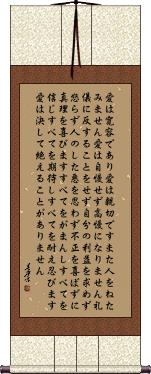
Here is 1st Corinthians 13:4-8 (just the first sentence of verse 8) in Japanese.
In the familiar NIV, this would read:
Love is patient, love is kind. It does not envy, it does not boast, it is not proud.
It does not dishonor others, it is not self-seeking, it is not easily angered, it keeps no record of wrongs.
Love does not delight in evil but rejoices with the truth.
It always protects, always trusts, always hopes, always perseveres.
Love never fails...
The Japanese text is from the 新改訳聖書 (Shinkaiyaku) or New Japanese Bible. Popular among most Protestant denominations in modern Japan.
Note: Because this selection contains some special Japanese Hiragana characters, it should be written by a Japanese calligrapher.
1 Corinthians 13:5
bù zuò hài xiū de shì bù qiú zì jǐ de yì chu bù qīng yì fā nù bù jì suàn rén de è
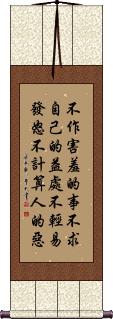
Here is 1 Corinthians 13:5 in Chinese.
The text with punctuation:
不作害羞的事。不求自己的益处。不轻易发怒。不计算人的恶。
Hand-painted calligraphy does not retain punctuation.
This translation is from the Chinese Union Bible.
You may know it from the KJV as:
Doth not behave itself unseemly, seeketh not her own, is not easily provoked, thinketh no evil.
1 Corinthians 14:22
zhè yàng kàn lái shuō fāng yán bù shì wéi xìn de rén zuò zhèng jù nǎi shì wéi bù xìn de rén zuò xiān zhī jiǎng dào bù shì wéi bù xìn de rén zuò zhèng jù nǎi shì wéi xìn de rén
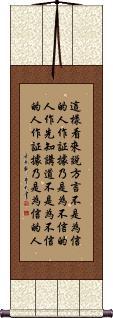
Here is 1 Corinthians 14:22 in Chinese.
The text with punctuation:
这样看来,说方言,不是为信的人作证据,乃是为不信的人。作先知讲道,不是为不信的人作证据,乃是为信的人。
Hand-painted calligraphy does not retain punctuation.
This translation is from the Chinese Union Bible.
You may know it from the KJV as:
Wherefore tongues are for a sign, not to them that believe, but to them that believe not: but prophesying serveth not for them that believe not, but for them which believe.
One Day Seems Like 1000 Years
yí rì qiān qiū
ichi jitsu sen shuu
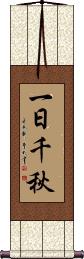
一日千秋 is a Japanese and Chinese proverb about missing someone.
一日千秋 is often used to express how hard it is to wait for someone's return or to be away from someone.
Some will translate this as “one day feels like a very long time” or “waiting for someone (something) is hard.”
You might see this romanized as a single word, Ichijitsusenshuu, or as “Ichijitsu Senshuu” from Japanese.
If you break down the characters one-by-one, we get:
一 = one/a
日 = day/sun (can also represent time or date)
千 = 1000/thousand
秋 = autumn/fall
Together, 千秋 can mean “autumn comes thousand times” (or 1000 years). It can also be read as 1000 periods of time.
However, it relays the idea of heartache as you wait for someone you miss.
1 Peter 3:13
Nǐ men ruò shì rè xīn xíng shàn yǒu shéi hài nǐ men ne
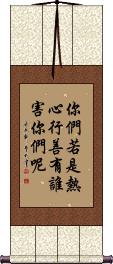
Here is 1 Peter 3:13 in Chinese.
The text with punctuation:
你们若是热心行善,有谁害你们呢?
Hand-painted calligraphy does not retain punctuation.
This translation is from the Chinese Union Bible.
You may know it from the KJV as:
And who is he that will harm you, if ye be followers of that which is good?
100 Years of Happy Marriage
bǎi nián hǎo hé
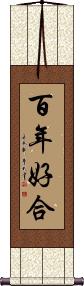
百年好合 is a wish or greeting, often heard at Chinese weddings, for a couple to have 100 good years together.
Some will translate this more naturally into English as: “May you live a long and happy life together.”
The character breakdown:
百 = 100
年 = Years
好 = Good (Happy)
合 = Together
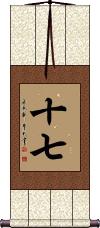
17 Seventeen
1000 good moves ruined by 1 bad
bú pà qiān zhāo huì zhǐ pà yī zhāo shú
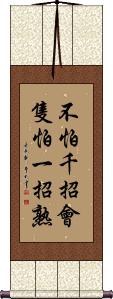
不怕千招会只怕一招熟 is a Chinese proverb that literally translates as: Do not worry about making a thousand clever moves; what [one has to] fear is one bad move.
Figuratively, this means: Even if you have made many clever moves before, one wrong move will ruin the whole game.
I compare this to the English saying, “It takes only one Aw-shit to wipe out a thousand Attaboys.”
Corinthians 13:4
All you need to know about LOVE
ài shì héng jiǔ rěn nài yòu yǒu én cí ài shì bú jì dù ài shì bú zì kuā bù zhāng kuáng
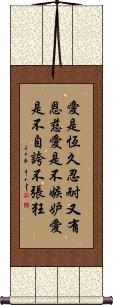
愛是恆久忍耐又有恩慈愛是不嫉妒愛是不自誇不張狂 is 1st Corinthians 13:4 in Chinese.
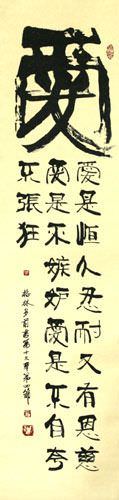
With large “love” character added.
In English, this reads:
1st Corinthians 13:4 (KJV) Charity suffereth long, and is kind; charity envieth not; charity vaunteth not itself, is not puffed up...
1st Corinthians 13:4 (NIV) Love is patient, love is kind. It does not envy, it does not boast, it is not proud.
1st Corinthians 13:4 (Basic English) Love is never tired of waiting; love is kind; love has no envy; love has no high opinion of itself, love has no pride.
The Chinese translation follows the love meaning, rather than the King James' use of “charity.” I was a little confused when writing this description with the significant differences between the NIV vs. KJV translations. After speaking to a Greek scholar about this, it would seem that the KJV has an almost errant translation with the use of “charity” in place of “love.”
We used the most popular Christian Chinese Bible, which is the Chinese Union Version (CUV). The CUV was first published in 1919. We use this so that the Chinese translation would be as accurate and standard as possible. Any Chinese Christian worth their salt will easily be able to identify this verse when they see these characters.
If you want a big “love” character written above the verse on your artwork, just make a note in the “special instructions” tab when you are customizing your artwork. There is no extra charge for that service on this special verse.
Corinthians 13:4
ai ha nintai tsuyoi. ai ha nasakebukai. netama nai. ai ha jiman se zu, takabura nai.

愛は忍耐強い。愛は情け深い。ねたまない。愛は自慢せず、高ぶらない。is 1st Corinthians 13:4 in Japanese.
In English, this reads:
1st Corinthians 13:4 (KJV) Charity suffereth long, and is kind; charity envieth not; charity vaunteth not itself, is not puffed up...
1st Corinthians 13:4 (NIV) Love is patient, love is kind. It does not envy, it does not boast, it is not proud.
1st Corinthians 13:4 (Basic English) Love is never tired of waiting; love is kind; love has no envy; love has no high opinion of itself, love has no pride.
If you want a big “love” character written above the verse on your artwork, just make a note in the “special instructions” tab when you are customizing your artwork. There is no extra charge for that service on this special verse.
Note: Because this selection contains some special Japanese Hiragana characters, it should be written by a Japanese calligrapher.
Brought Together from 1000 Miles Away by Fate
yǒu yuán qiān lǐ lái xiāng huì
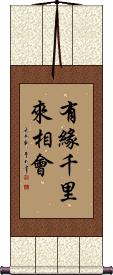
有緣千里來相會 means that fate or destiny has caused us to meet from a thousand miles away.
The 有緣 part suggests something that is connected as if by a thread due to fate, destiny, or karma.
This romantic phrase is seen in Chinese greeting cards. It relays the idea that your love was meant to be and that you were destined to meet (regardless of what distance or obstacles might have made such a meeting unlikely).
See Also: Red Thread
Eighteen / 18
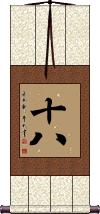
This means eighteen (18).
This can be pronounced seipai, toya, or jūhachi in Japanese. It can also be a Japanese personal name, Toya.
This would be the way to write the Buddhist Sanskrit word aṣṭādaśa (meaning 18) in Chinese, old Korean Hanja, and Japanese Kanji.
The one who retreats 50 paces mocks the one to retreats 100
The pot calls the kettle black
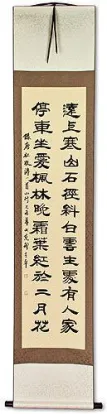
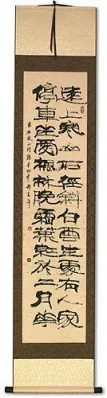
wù shí bù xiào bǎi bù
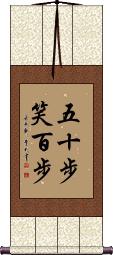
五十步笑百步 is a Chinese proverb that means the one who retreats 50 paces mocks the one who retreats 100 paces.
During the Warring States Period of what is now China (475 - 221 B.C.), the King of Wei was in love with war. He often fought with other kingdoms just for spite or fun.
One day, the King of Wei asked the philosopher Mencius, “I love my people, and all say I do the best for them. I move the people from famine-stricken areas to places of plenty and transport grains from rich areas to the poor. Nobody goes hungry in my kingdom, and I treat my people far better than other kings. But why does the population of my kingdom not increase, and why does the population of other kingdoms not decrease?”
Mencius answered, “Since you love war, I will make this example: When going to war, and the drums beat to start the attack, some soldiers flee for their lives in fear. Some run 100 paces in retreat, and others run 50 steps. Then the ones who retreated 50 paces laugh and taunt those who retreated 100 paces, calling them cowards mortally afraid of death. Do you think this is reasonable?
The King of Wei answered, “Of course not! Those who run 50 paces are just as timid as those who run 100 paces.”
Mencius then said, “You are a king who treats his subjects better than other kings treat their people, but you are so fond of war that your people suffer from great losses in battle. Therefore, your population does not grow. While other kings allow their people to starve to death, you send your people to die in war. Is there any difference?”
This famous conversation led to the six-character proverb shown here. It serves as a warning to avoid hypocrisy. It goes hand-in-hand with the western phrase, “The pot calls the kettle black,” or the Biblical phrase, “Before trying to remove a splinter from your neighbor's eye, first remove the plank from your own eye.”
Hebrews 13:8
yē sū jī dū zuó rì jīn rì yī zhí dào yǒng yuǎn shì yī yàng de
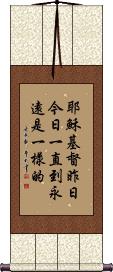
耶穌基督昨日今日一直到永遠是一樣的 is Hebrews 13:8 which reads, Jesus Christ the same yesterday, and today, and forever.
Even The 100-Foot Bamboo Can Grow One More Foot
bǎi chǐ gān tóu gèng jìng yī bù
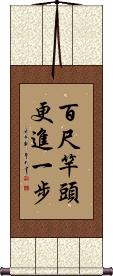
百尺竿头更进一步 is a proverb that literally translates as: [Even a] one-hundred foot [tall] bamboo [can] progress even one [more] step.
Figuratively, this means: After having achieved a fair degree of success, one should try to do still better.
John 14:15
nǐ mén ruò ài wǒ jiù bì zūn shǒu wǒ de mìng lìng
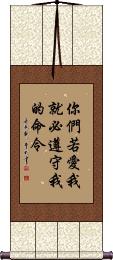
你們若愛我就必遵守我的命令 is the translation of John 14:15 into Chinese.
This comes from the Chinese Union Bible which comes from a revised King James version. This Chinese Bible was originally translated and printed in 1919 (several revisions since then).
Because of the origin being the KJV, I'll say that in English, this would be, “If ye love me, keep my commandments...”
In basic English, this would be, “If you have love for me, you will keep my laws.”
John 14:18
wǒ bù piě xià nǐ mén wéi gū ér wǒ bì dào nǐ mén zhè lǐ lái
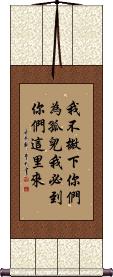
我不撇下你們為孤兒我必到你們這里來 is the translation of John 14:18 into Chinese.
This comes from the Chinese Union Bible which comes from a revised version of the King James. This Chinese Bible was originally translated and printed in 1919 (several revisions since then).
Because of the origin being the KJV, I'll say that in English, this would be, “I will not leave you comfortless: I will come to you...”
In basic English, this would be, “I will not let you be without a friend: I am coming to you.”
John 3:16
shén ài shì rén shèn zhì jiāng tā de dú shēng zǐ cì gè tā mén jiào yí qiè xìn tā de bú zhì miè wáng fǎn dé yǒng shēng

神愛世人甚至將他的獨生子賜給他們叫一切信他的不至滅亡反得永生 is the full translation of John 3:16 into Chinese.
This is from the Chinese Union Bible which comes from a revised version of the King James. This Chinese Bible was originally translated and printed in 1919 (several revisions since then).
Because of the origin being the KJV, I'll say that in English, this would be, “For God so loved the world, that he gave his only begotten Son, that whosoever believeth in him should not perish but have everlasting life.”
As with any translation, there are interesting cultural and linguistic issues. For instance, the word used for “world” in Chinese can also mean “common people.” So you could say that it means “For God so loved the common people...”
This does not take away from the text, as it will be understood with the same meaning and connotation.
There is no direct Greek-to-Chinese translation in print (that I know of), so this is the best available. Of course, you can ask any Greek person of faith, and they will claim that a bit is lost from the original Greek of the New Testament to any of the English versions of the Bible in print.
John 3:16
kami wa, minoru ni, sono hitori ko o o atae ni natta hodo ni, yo o aisare ta. Sore wa miko o shinjiru mono ga, hitori toshite horobiru koto naku, eien no inochi o motsu tame de aru.
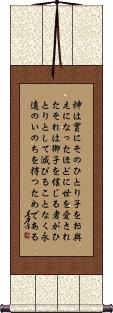
Here is the full translation of John 3:16 into Japanese.
This translation comes from the Shinkaiyaku Bible (a preferred translation by many Japanese Christians).
Just for reference, from the KJV, this reads, “For God so loved the world, that he gave his only begotten Son, that whosoever believeth in him should not perish but have everlasting life.”
Note: Because this selection contains some special Japanese Hiragana characters, it should be written by a Japanese calligrapher.
John 3:16 (first half)
shén ài shì rén shèn zhì jiāng tā de dú shēng zǐ cì gè tā mén
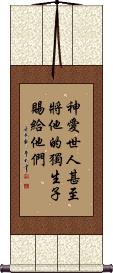
神愛世人甚至將他的獨生子賜給他們 is the first half of John 3:16 in Chinese.
It reads roughly, “For God so loved the world, that he gave his only begotten Son.”
This came directly from the Chinese Union Bible first printed in 1919.
Joshua 24:15
This House Serves the LORD
zhì yú wǒ hé wǒ jiā wǒ men bì dìng shì fèng yē hé huá
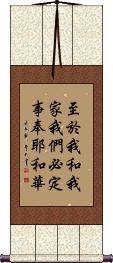
至於我和我家我們必定事奉耶和華 is the last sentence of Joshua 24:15 in Chinese.
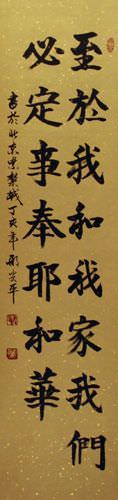
What your
calligraphy
might look like
from our
Chinese Master
Calligrapher
Joshua 24:15 (KJV) ...as for me and my house, we will serve the LORD.
Joshua 24:15 (NIV) ...as for me and my household, we will serve the LORD.
We used the only official Christian Chinese Bible that I know of so that the translation would be as accurate and standard as possible. Any Chinese Christian worth their salt will easily be able to identify this verse from the Chinese words on this scroll.
I think it is a bit like having a secret code on your wall that quietly expresses to whom you are faithful.
A great gift for your devout Christian or Jewish friend if they happen to be fond of Asian art.
Or perhaps a wonderful “conversation starter” for your own home.
Note: If you are curious, the last three characters represent the way “LORD” is used in most English Bibles. In Chinese, this is actually the phonetic name from Mandarin Chinese for “Jehovah.”
Joshua 24:15
This House Serves the LORD
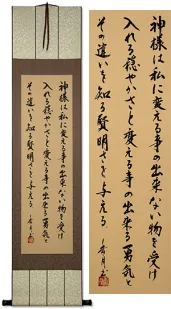
Watashi to watashinoie to wa omo ni tsukaeru
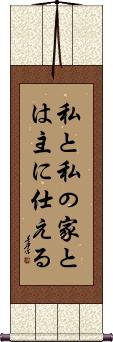
私と私の家とは、主に仕える is the last bit of Joshua 24:15 in Japanese.
Joshua 24:15 (KJV) ...as for me and my house, we will serve the LORD.
Joshua 24:15 (NIV) ...as for me and my household, we will serve the LORD.
This came from the Shinkaiyaku Japanese Bible. This is the most commonly-used Bible translation in Japan for both Protestants and Catholic Japanese folks.
I think it is a bit like having a secret code on your wall that quietly expresses to whom you are faithful.
This will be a nice gift for a friend or a wonderful expression of faith for your own home.
Note: Because this selection contains some special Japanese Hiragana characters, it should be written by a Japanese calligrapher.
A Journey of 1000 Miles Begins with a Single Step
qiān lǐ zhī xíng shǐ yú zú xià
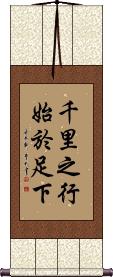
千里之行始於足下 is a Chinese proverb that means “a thousand-mile journey begins with the first step.”
This proverb figuratively means “big accomplishments come from an accumulation of little achievements made one by one.”
A Journey of 1000 Miles Begins with a Single Step
senri no michi mo ippo kara
sen ri no michi mo i-ppo ka ra
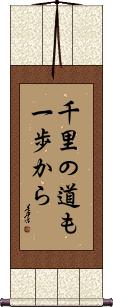
千里の道も一歩から is the Japanese version of an ancient Chinese proverb that means “a journey of a thousand miles begins with a single step.”
Some will also translate this as a 1000-mile road starts with one brick (a small amount).
In this case, the real measurement is an ancient Chinese “li” or 里, which is romanized as “ri” in Japanese. It's about half a kilometer, so three 里 would be a western mile. A journey of 333 miles begins with a single step, just doesn't sound as natural.
Note: Because this selection contains some special Japanese Hiragana characters, it should be written by a Japanese calligrapher.
One Justice Can Overpower 100 Evils
yī zhèng yā bǎi xié
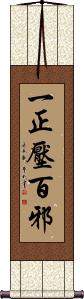
一正压百邪 is an ancient Chinese proverb and idiom that means “One Justice Can Overpower a Hundred Evils.”
While this proverb is famous in China, it has been around so long that its origins have been forgotten.
It could be something that Confucius or one of his disciples said, but no one can say for sure.
Know Your Enemy, Know Yourself, and Win 100 Battles
teki o shi ri o no o shi re ba hya ku sen aya u ka ra zu
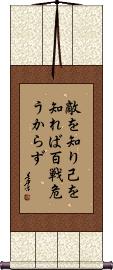
敵を知り己を知れば百戦危うからず is the longer/full Japanese version of this proverb. This means “Know your enemy, know yourself, and you will not fear a hundred battles.”
Others will translate this as “Know thy enemy, know thyself, yields victory in one hundred battles.”
Note: Because this selection contains some special Japanese Hiragana characters, it should be written by a Japanese calligrapher.
The Lord's Prayer / Luke 11:2-4
wǒ men zài tiān shàng de fù yǒu gǔ juǎn zhǐ zuò fù ā yuàn rén dōu zūn nǐ de míng wèi shèng yuàn nǐ de guó jiàng lín yuàn nǐ de zhǐ yì xíng zài dì shàng rú tóng xíng zài tiān shàng yǒu gǔ juǎn wú yuàn nǐ de zhǐ yì yún yún wǒ men rì yòng de yǐn shí tiān tiān cì gěi wǒ men shè miǎn wǒ men de zuì yīn wèi wǒ men yě shè miǎn fán kuī qiàn wǒ men de rén bù jiào wǒ men yù jiàn shì tàn jiù wǒ men tuō lí xiōng è yǒu gǔ juǎn wú mò jù
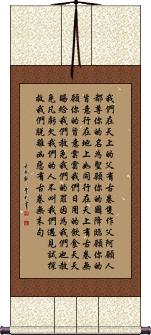
Here is the Lord's Prayer in Chinese from Luke 11:2-4.
The Chinese text with punctuation is:
Part of 11:2 ...我们在天上的父,有古卷只作父阿愿人都尊你的名为圣。愿你的国降临。愿你的旨意行在地上,如同行在天上。有古卷无愿你的旨意云云。
11:3 我们日用的饮食,天天赐给我们。
11:4 赦免我们的罪,因为我们也赦免凡亏欠我们的人。不叫我们遇见试探。救我们脱离凶恶。有古卷无末句。
Note that punctuation is not included in traditional Chinese calligraphy artwork.
From KJV, this is:
Part of 11:2 ...Our Father which art in heaven, Hallowed be thy name. Thy kingdom come. Thy will be done, as in heaven, so in earth.
11:3 Give us day by day our daily bread.
11:4 And forgive us our sins; for we also forgive everyone that is indebted to us. And lead us not into temptation, but deliver us from evil.
yǎng bīng qiān rì, yàng bīng yì shí
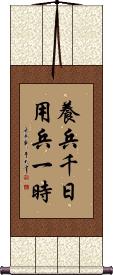
Nothing could be more true. When I was in the Marine Corps, we trained for years for combat that often lasts only hours.
養兵千日用兵一時 is a Chinese proverb that, also reminds me of a common phrase used in the military to describe combat: “Weeks of total boredom, punctuated with five minutes of sheer terror.”
This may have some roots in Sun Tzu's The Art of War. Though I can not find this passage in his writings.
On the subject of the Art of War, if you have a favorite passage, we can create a custom calligraphy scroll with that phrase.
The Lord's Prayer / Mathew 6:9-13
wǒ men zài tiān shàng de fù yuàn rén dōu zūn nǐ de míng wèi shèng yuàn nǐ de guó jiàng lín yuàn nǐ de zhǐ yì xíng zài dì shàng rú tóng xíng zài tiān shàng wǒ men rì yòng de yǐn shí jīn rì cì gěi wǒ men miǎn wǒ men de zhài rú tóng wǒ men miǎn le rén de zhài bù jiào wǒ men yù jiàn shì tàn jiù wǒ men tuō lí xiōng è yīn wèi guó dù quán bǐng róng yào quán shì nǐ de zhí dào yǒng yuǎn ā men
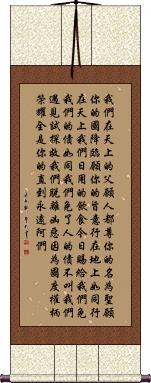
Here is the Lord's Prayer in Chinese from Mathew 6:9-13.
The Chinese text with punctuation is:
Part of 6:9 ...我们在天上的父,愿人都尊你的名为圣。
6:10 愿你的国降临,愿你的旨意行在地上,如同行在天上。
6:11 我们日用的饮食,今日赐给我们。
6:12 免我们的债,如同我们免了人的债。
6:13 不叫我们遇见试探,救我们脱离凶恶,因为国度,权柄,荣耀,全是你的,直到永远,阿们。
Note that punctuation is not included in traditional Chinese calligraphy artwork.
From KJV, this is:
Part of 6:9 ...Our Father which art in heaven, Hallowed be thy name.
6:10 Thy kingdom come. Thy will be done in earth, as it is in heaven.
6:11 Give us this day our daily bread.
6:12 And forgive us our debts, as we forgive our debtors.
6:13 And lead us not into temptation, but deliver us from evil: For thine is the kingdom, and the power, and the glory, forever. Amen.
A House Might be Worth 1 Million Dollars, But Good Neighbors are Worth 10 Million
bǎi wàn mǎi zhái qiān wàn mǎi lín
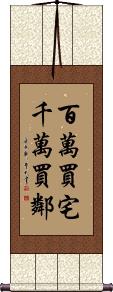
百万买宅千万买邻 is a Chinese proverb that literally translates as:
[It may cost a] million to buy a house, [but] ten million to find [good] neighbors.
Figuratively, this means:
Good neighbors are hard to find.
Good neighbors are even more important than the quality of one's house.
Read 10,000 Books, Travel 10,000 Miles
dú wàn juǎn shū, xíng wàn lǐ lù
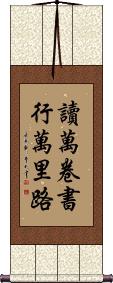
讀萬卷書行萬里路 is a lifelong suggestion for expanding your horizons by gaining knowledge, experience, and seeing the world.
Of course, this was written long ago when it was hard to travel 10,000 miles (at least 1000 years before the invention of the airplane).
With air travel and the business I'm in, I often achieve that lifetime goal on a monthly basis.
However, I am a little behind in the book count.
Note: An ancient Chinese mile (里 or lǐ) referred to in this proverb is about a third of a British/American mile. However, at that time, this was a great distance to travel.
A Journey of 1000 Miles Feels Like One
sen ri mo ichi ri
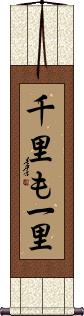
千里も一里 is a Japanese proverb that states “A journey of a thousand miles feels like only one mile.” It is understood that in the proverb, this applies when going to see the one you love.
Note that the “mile” or 里 used in this proverb is an old Chinese “li” (pronounced “ri” in Japanese). It's not actually a mile, as the measurement is really closer to 500 meters (it would take 3 of these to get close to a western mile). Still, 1000里 (333 miles) is a long way.
Better to Travel 10,000 Miles than Read 10,000 Books
xíng wàn lǐ lù shèng dú wàn juǎn shū
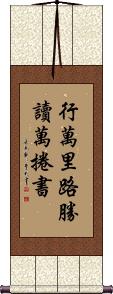
行万里路胜读万卷书 translates a few ways:
To travel ten thousand miles beats reading ten-thousand books.
Better to travel ten thousand li than to read ten thousand books. (a “li” is an ancient Chinese mile)
Traveling thousands of miles is better than reading thousands of books.
No matter how you slice it, this Chinese proverb is claiming that experience is more profound and meaningful than what you can get from a book. Go do it! Don't just read about it.
Walking 100 Miles: Stopping at 90 miles, is the same as stopping half-way
xíng bǎi lǐ zhě bàn jiǔ shí
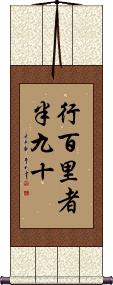
行百里者半九十 is an old Chinese proverb that speaks to the act of giving up. This phrase suggests that no matter how close you are to finishing your task or journey, giving up just before you finish is just as bad as giving up halfway.
50% finished or 90% finished, the result is the same: “You are not finished.”
You can take what you want from this proverb, but I think it suggests that you should finish what you start, and especially finish that last 10% of your journey or project so that you can honestly say “it's finished.”
Some notes: The character, 里, that I am translating as “mile” is an ancient “Chinese mile” which is actually about half a kilometer - it just doesn't sound right to say “When walking 100 half-kilometers...”
This in-stock artwork might be what you are looking for, and ships right away...
Gallery Price: $286.00
Your Price: $158.88
Gallery Price: $240.00
Your Price: $132.88
Gallery Price: $240.00
Your Price: $132.88

Gallery Price: $169.00
Your Price: $93.88
Gallery Price: $169.00
Your Price: $93.88
Gallery Price: $200.00
Your Price: $88.88
Gallery Price: $160.00
Your Price: $88.77

Gallery Price: $108.00
Your Price: $59.88
Gallery Price: $108.00
Your Price: $59.88
Gallery Price: $108.00
Your Price: $59.88
Gallery Price: $108.00
Your Price: $59.88
Gallery Price: $108.00
Your Price: $59.88
The following table may be helpful for those studying Chinese or Japanese...
| Title | Characters | Romaji (Romanized Japanese) | Various forms of Romanized Chinese | |
| 1 Corinthians 13:4-8 | 愛は寛容であり愛は親切ですまた人をねたみません愛は自慢せず高慢になりません礼儀に反することをせず自分の利益を求めず怒らず人のした悪を思わず不正を喜ばずに真理を喜びますすべてをがまんしすべてを信じすべてを期待しすべてを耐え忍びます愛は決して絶えることがありません | ai wa kan youdeari ai wa shinsetsudesu mata hito o netamimasen ai wa jiman sezu kouman ni narimasen reigi ni hansuru koto o sezu jibun no rieki o motomezu okorazu hito no shita aku o omowazu fusei o yorokobazu ni shinri o yorokobimasu subete o gaman shi s ai wa kan yodeari ai wa shinsetsudesu mata hito o netamimasen ai wa jiman sezu koman ni narimasen reigi ni hansuru koto o sezu jibun no rieki o motomezu okorazu hito no shita aku o omowazu fusei o yorokobazu ni shinri o yorokobimasu subete o gaman shi s | ||
| 1 Corinthians 13:5 | 不作害羞的事不求自己的益處不輕易發怒不計算人的惡 不作害羞的事不求自己的益处不轻易发怒不计算人的恶 | bù zuò hài xiū de shì bù qiú zì jǐ de yì chu bù qīng yì fā nù bù jì suàn rén de è bu4 zuo4 hai4 xiu1 de shi4 bu4 qiu2 zi4 ji3 de yi4 chu bu4 qing1 yi4 fa1 nu4 bu4 ji4 suan4 ren2 de e4 bu zuo hai xiu de shi bu qiu zi ji de yi chu bu qing yi fa nu bu ji suan ren de e | pu tso hai hsiu te shih pu ch`iu tzu chi te i ch`u pu ch`ing i fa nu pu chi suan jen te o pu tso hai hsiu te shih pu chiu tzu chi te i chu pu ching i fa nu pu chi suan jen te o |
|
| 1 Corinthians 14:22 | 這樣看來說方言不是為信的人作証據乃是為不信的人作先知講道不是為不信的人作証據乃是為信的人 这样看来说方言不是为信的人作证据乃是为不信的人作先知讲道不是为不信的人作证据乃是为信的人 | zhè yàng kàn lái shuō fāng yán bù shì wéi xìn de rén zuò zhèng jù nǎi shì wéi bù xìn de rén zuò xiān zhī jiǎng dào bù shì wéi bù xìn de rén zuò zhèng jù nǎi shì wéi xìn de rén zhe4 yang4 kan4 lai2 shuo1 fang1 yan2 bu4 shi4 wei2 xin4 de ren2 zuo4 zheng4 ju4 nai3 shi4 wei2 bu4 xin4 de ren2 zuo4 xian1 zhi1 jiang3 dao4 bu4 shi4 wei2 bu4 xin4 de ren2 zuo4 zheng4 ju4 nai3 shi4 wei2 xin4 de ren2 zhe yang kan lai shuo fang yan bu shi wei xin de ren zuo zheng ju nai shi wei bu xin de ren zuo xian zhi jiang dao bu shi wei bu xin de ren zuo zheng ju nai shi wei xin de ren | che yang k`an lai shuo fang yen pu shih wei hsin te jen tso cheng chü nai shih wei pu hsin te jen tso hsien chih chiang tao pu shih wei pu hsin te jen tso cheng chü nai shih wei hsin te jen che yang kan lai shuo fang yen pu shih wei hsin te jen tso cheng chü nai shih wei pu hsin te jen tso hsien chih chiang tao pu shih wei pu hsin te jen tso cheng chü nai shih wei hsin te jen |
|
| One Day Seems Like 1000 Years | 一日千秋 | ichi jitsu sen shuu ichijitsusenshuu ichi jitsu sen shu | yí rì qiān qiū yi2 ri4 qian1 qiu1 yi ri qian qiu yiriqianqiu | i jih ch`ien ch`iu ijihchienchiu i jih chien chiu |
| 1 Peter 3:13 | 你們若是熱心行善有誰害你們呢 你们若是热心行善有谁害你们呢 | Nǐ men ruò shì rè xīn xíng shàn yǒu shéi hài nǐ men ne ni3 men ruo4 shi4 re4 xin1 xing2 shan4 you3 shei2 hai4 ni3 men ne ni men ruo shi re xin xing shan you shei hai ni men ne | ni men jo shih je hsin hsing shan yu shei hai ni men ne | |
| 100 Years of Happy Marriage | 百年好合 | bǎi nián hǎo hé bai3 nian2 hao3 he2 bai nian hao he bainianhaohe | pai nien hao ho painienhaoho |
|
| 17 Seventeen | 十七 | juunana / juushichi junana / jushichi | shí qī / shi2 qi1 / shi qi / shiqi | shih ch`i / shihchi / shih chi |
| 1000 good moves ruined by 1 bad | 不怕千招會隻怕一招熟 不怕千招会只怕一招熟 | bú pà qiān zhāo huì zhǐ pà yī zhāo shú bu2 pa4 qian1 zhao1 hui4 zhi3 pa4 yi1 zhao1 shu2 bu pa qian zhao hui zhi pa yi zhao shu | pu p`a ch`ien chao hui chih p`a i chao shu pu pa chien chao hui chih pa i chao shu |
|
| Corinthians 13:4 | 愛是恆久忍耐又有恩慈愛是不嫉妒愛是不自誇不張狂 爱是恒久忍耐又有恩慈爱是不嫉妒爱是不自夸不张狂 | ài shì héng jiǔ rěn nài yòu yǒu én cí ài shì bú jì dù ài shì bú zì kuā bù zhāng kuáng ai4 shi4 heng2 jiu3 ren3 nai4 you4 you3 en2 ci2 ai4 shi4 bu2 ji4 du4 ai4 shi4 bu2 zi4 kua1 bu4 zhang1 kuang2 ai shi heng jiu ren nai you you en ci ai shi bu ji du ai shi bu zi kua bu zhang kuang | ai shih heng chiu jen nai yu yu en tz`u ai shih pu chi tu ai shih pu tzu k`ua pu chang k`uang ai shih heng chiu jen nai yu yu en tzu ai shih pu chi tu ai shih pu tzu kua pu chang kuang |
|
| Corinthians 13:4 | 愛は忍耐強い。愛は情け深い。ねたまない。愛は自慢せず、高ぶらない。 | ai ha nintai tsuyoi. ai ha nasakebukai. netama nai. ai ha jiman se zu, takabura nai. | ||
| Brought Together from 1000 Miles Away by Fate | 有緣千里來相會 有缘千里来相会 | yǒu yuán qiān lǐ lái xiāng huì you3 yuan2 qian1 li3 lai2 xiang1 hui4 you yuan qian li lai xiang hui youyuanqianlilaixianghui | yu yüan ch`ien li lai hsiang hui yu yüan chien li lai hsiang hui |
|
| Eighteen 18 | 十八 | sei pai / to ya seipai / toya | shí bā / shi2 ba1 / shi ba / shiba | shih pa / shihpa |
| The one who retreats 50 paces mocks the one to retreats 100 | 五十步笑百步 | wù shí bù xiào bǎi bù wu4 shi2 bu4 xiao4 bai3 bu4 wu shi bu xiao bai bu wushibuxiaobaibu | wu shih pu hsiao pai pu wushihpuhsiaopaipu |
|
| Hebrews 13:8 | 耶穌基督昨日今日一直到永遠是一樣的 耶稣基督昨日今日一直到永远是一样的 | yē sū jī dū zuó rì jīn rì yī zhí dào yǒng yuǎn shì yī yàng de ye1 su1 ji1 du1 zuo2 ri4 jin1 ri4 yi1 zhi2 dao4 yong3 yuan3 shi4 yi1 yang4 de ye su ji du zuo ri jin ri yi zhi dao yong yuan shi yi yang de | yeh su chi tu tso jih chin jih i chih tao yung yüan shih i yang te | |
| Even The 100-Foot Bamboo Can Grow One More Foot | 百尺竿頭更進一步 百尺竿头更进一步 | bǎi chǐ gān tóu gèng jìng yī bù bai3 chi3 gan1 tou2 geng4 jing4 yi1 bu4 bai chi gan tou geng jing yi bu baichigantougengjingyibu | pai ch`ih kan t`ou keng ching i pu pai chih kan tou keng ching i pu |
|
| John 14:15 | 你們若愛我就必遵守我的命令 你们若爱我就必遵守我的命令 | nǐ mén ruò ài wǒ jiù bì zūn shǒu wǒ de mìng lìng ni3 men2 ruo4 ai4 wo3 jiu4 bi4 zun1 shou3 wo3 de ming4 ling4 ni men ruo ai wo jiu bi zun shou wo de ming ling | ni men jo ai wo chiu pi tsun shou wo te ming ling | |
| John 14:18 | 我不撇下你們為孤兒我必到你們這里來 我不撇下你们为孤儿我必到你们这里来 | wǒ bù piě xià nǐ mén wéi gū ér wǒ bì dào nǐ mén zhè lǐ lái wo3 bu4 pie3 xia4 ni3 men2 wei2 gu1 er2 wo3 bi4 dao4 ni3 men2 zhe4 li3 lai2 wo bu pie xia ni men wei gu er wo bi dao ni men zhe li lai | wo pu p`ieh hsia ni men wei ku erh wo pi tao ni men che li lai wo pu pieh hsia ni men wei ku erh wo pi tao ni men che li lai |
|
| John 3:16 | 神愛世人甚至將他的獨生子賜給他們叫一切信他的不至滅亡反得永生 神爱世人甚至将他的独生子赐给他们叫一切信他的不至灭亡反得永生 | shén ài shì rén shèn zhì jiāng tā de dú shēng zǐ cì gè tā mén jiào yí qiè xìn tā de bú zhì miè wáng fǎn dé yǒng shēng shen2 ai4 shi4 ren2 shen4 zhi4 jiang1 ta1 de du2 sheng1 zi3 ci4 gei3 ta1 men2 jiao4 yi2 qie4 xin4 ta1 de bu2 zhi4 mie4 wang2 fan3 de2 yong3 sheng1 shen ai shi ren shen zhi jiang ta de du sheng zi ci gei ta men jiao yi qie xin ta de bu zhi mie wang fan de yong sheng | shen ai shih jen shen chih chiang t`a te tu sheng tzu tz`u kei t`a men chiao i ch`ieh hsin t`a te pu chih mieh wang fan te yung sheng shen ai shih jen shen chih chiang ta te tu sheng tzu tzu kei ta men chiao i chieh hsin ta te pu chih mieh wang fan te yung sheng |
|
| John 3:16 | 神は 實に そのひとり 子をお 與えになったほどに 世を 愛された. それは 御子を 信じる 者が ひとりとして 滅びることなく 永遠のいのちを 持つためである. | kami wa, minoru ni, sono hitori ko o o atae ni natta hodo ni, yo o aisare ta. Sore wa miko o shinjiru mono ga, hitori toshite horobiru koto naku, eien no inochi o motsu tame de aru. | ||
| John 3:16 (first half) | 神愛世人甚至將他的獨生子賜給他們 神爱世人甚至将他的独生子赐给他们 | shén ài shì rén shèn zhì jiāng tā de dú shēng zǐ cì gè tā mén shen2 ai4 shi4 ren2 shen4 zhi4 jiang1 ta1 de du2 sheng1 zi3 ci4 gei3 ta1 men2 shen ai shi ren shen zhi jiang ta de du sheng zi ci gei ta men | shen ai shih jen shen chih chiang t`a te tu sheng tzu tz`u kei t`a men shen ai shih jen shen chih chiang ta te tu sheng tzu tzu kei ta men |
|
| Joshua 24:15 | 至於我和我家我們必定事奉耶和華 至于我和我家我们必定事奉耶和华 | zhì yú wǒ hé wǒ jiā wǒ men bì dìng shì fèng yē hé huá zhi4 yu2 wo3 he2 wo3 jia1 wo3 men bi4 ding4 shi4 feng4 ye1 he2 hua2 zhi yu wo he wo jia wo men bi ding shi feng ye he hua | chih yü wo ho wo chia wo men pi ting shih feng yeh ho hua | |
| Joshua 24:15 | 私と私の家とは主に仕える | Watashi to watashinoie to wa omo ni tsukaeru | ||
| A Journey of 1000 Miles Begins with a Single Step | 千里之行始於足下 千里之行始于足下 | qiān lǐ zhī xíng shǐ yú zú xià qian1 li3 zhi1 xing2 shi3 yu2 zu2 xia4 qian li zhi xing shi yu zu xia qianlizhixingshiyuzuxia | ch`ien li chih hsing shih yü tsu hsia chien li chih hsing shih yü tsu hsia |
|
| A Journey of 1000 Miles Begins with a Single Step | 千里の道も一歩から | sen ri no michi mo i-ppo ka ra senrinomichimoi-ppokara sen ri no michi mo i-po ka ra | ||
| One Justice Can Overpower 100 Evils | 一正壓百邪 一正压百邪 | yī zhèng yā bǎi xié yi1 zheng4 ya1 bai3 xie2 yi zheng ya bai xie yizhengyabaixie | i cheng ya pai hsieh ichengyapaihsieh |
|
| Know Your Enemy, Know Yourself, and Win 100 Battles | 敵を知り己を知れば百戦危うからず | teki o shi ri o no o shi re ba hya ku sen aya u ka ra zu | ||
| The Lord's Prayer Luke 11:2-4 | 我們在天上的父有古卷隻作父阿願人都尊你的名為聖願你的國降臨願你的旨意行在地上如同行在天上有古卷無願你的旨意雲雲我們日用的飲食天天賜給我們赦免我們的罪因為我們也赦免凡虧欠我們的人不叫我們遇見試探救我們脫離凶惡有古卷無末句 我们在天上的父有古卷只作父阿愿人都尊你的名为圣愿你的国降临愿你的旨意行在地上如同行在天上有古卷无愿你的旨意云云我们日用的饮食天天赐给我们赦免我们的罪因为我们也赦免凡亏欠我们的人不叫我们遇见试探救我们脱离凶恶有古卷无末句 | wǒ men zài tiān shàng de fù yǒu gǔ juǎn zhǐ zuò fù ā yuàn rén dōu zūn nǐ de míng wèi shèng yuàn nǐ de guó jiàng lín yuàn nǐ de zhǐ yì xíng zài dì shàng rú tóng xíng zài tiān shàng yǒu gǔ juǎn wú yuàn nǐ de zhǐ yì yún yún wǒ men rì yòng de yǐn shí tiān tiān cì gěi wǒ men shè miǎn wǒ men de zuì yīn wèi wǒ men yě shè miǎn fán kuī qiàn wǒ men de rén bù jiào wǒ men yù jiàn shì tàn jiù wǒ men tuō lí xiōng è yǒu gǔ juǎn wú mò jù wo3 men zai4 tian1 shang4 de fu4 you3 gu3 juan3 zhi3 zuo4 fu4 a1 yuan4 ren2 dou1 zun1 ni3 de ming2 wei4 sheng4 yuan4 ni3 de guo2 jiang4 lin2 yuan4 ni3 de zhi3 yi4 xing2 zai4 di4 shang4 ru2 tong2 xing2 zai4 tian1 shang4 you3 gu3 juan3 wu2 yuan4 ni3 de zhi3 yi4 yun2 yun2 wo3 men ri4 yong4 de yin3 shi2 tian1 tian1 ci4 gei3 wo3 men she4 mian3 wo3 men de zui4 yin1 wei4 wo3 men ye3 she4 mian3 fan2 kui1 qian4 wo3 men de ren2 bu4 jiao4 wo3 men yu4 jian4 shi4 tan4 jiu4 wo3 men tuo1 li2 xiong1 e4 you3 gu3 juan3 wu2 mo4 ju4 wo men zai tian shang de fu you gu juan zhi zuo fu a yuan ren dou zun ni de ming wei sheng yuan ni de guo jiang lin yuan ni de zhi yi xing zai di shang ru tong xing zai tian shang you gu juan wu yuan ni de zhi yi yun yun wo men ri yong de yin shi tian tian ci gei wo men she mian wo men de zui yin wei wo men ye she mian fan kui qian wo men de ren bu jiao wo men yu jian shi tan jiu wo men tuo li xiong e you gu juan wu mo ju | wo men tsai t`ien shang te fu yu ku chüan chih tso fu a yüan jen tou tsun ni te ming wei sheng yüan ni te kuo chiang lin yüan ni te chih i hsing tsai ti shang ju t`ung hsing tsai t`ien shang yu ku chüan wu yüan ni te chih i yün yün wo men jih yung te yin shih t`ien t`ien tz`u kei wo men she mien wo men te tsui yin wei wo men yeh she mien fan k`uei ch`ien wo men te jen pu chiao wo men yü chien shih t`an chiu wo men t`o li hsiung o yu ku chüan wu mo chü wo men tsai tien shang te fu yu ku chüan chih tso fu a yüan jen tou tsun ni te ming wei sheng yüan ni te kuo chiang lin yüan ni te chih i hsing tsai ti shang ju tung hsing tsai tien shang yu ku chüan wu yüan ni te chih i yün yün wo men jih yung te yin shih tien tien tzu kei wo men she mien wo men te tsui yin wei wo men yeh she mien fan kuei chien wo men te jen pu chiao wo men yü chien shih tan chiu wo men to li hsiung o yu ku chüan wu mo chü |
|
| Maintain An Army For 1000 Days, Use It For An Hour | 養兵千日用兵一時 养兵千日用兵一时 | yǎng bīng qiān rì, yàng bīng yì shí yang3 bing1 qian1 ri4 yang4 bing1 yi4 shi2 yang bing qian ri yang bing yi shi | yang ping ch`ien jih yang ping i shih yang ping chien jih yang ping i shih |
|
| The Lord's Prayer Mathew 6:9-13 | 我們在天上的父願人都尊你的名為聖願你的國降臨願你的旨意行在地上如同行在天上我們日用的飲食今日賜給我們免我們的債如同我們免了人的債不叫我們遇見試探救我們脫離凶惡因為國度權柄榮耀全是你的直到永遠阿們 我们在天上的父愿人都尊你的名为圣愿你的国降临愿你的旨意行在地上如同行在天上我们日用的饮食今日赐给我们免我们的债如同我们免了人的债不叫我们遇见试探救我们脱离凶恶因为国度权柄荣耀全是你的直到永远阿们 | wǒ men zài tiān shàng de fù yuàn rén dōu zūn nǐ de míng wèi shèng yuàn nǐ de guó jiàng lín yuàn nǐ de zhǐ yì xíng zài dì shàng rú tóng xíng zài tiān shàng wǒ men rì yòng de yǐn shí jīn rì cì gěi wǒ men miǎn wǒ men de zhài rú tóng wǒ men miǎn le rén de zhài bù jiào wǒ men yù jiàn shì tàn jiù wǒ men tuō lí xiōng è yīn wèi guó dù quán bǐng róng yào quán shì nǐ de zhí dào yǒng yuǎn ā men wo3 men zai4 tian1 shang4 de fu4 yuan4 ren2 dou1 zun1 ni3 de ming2 wei4 sheng4 yuan4 ni3 de guo2 jiang4 lin2 yuan4 ni3 de zhi3 yi4 xing2 zai4 di4 shang4 ru2 tong2 xing2 zai4 tian1 shang4 wo3 men ri4 yong4 de yin3 shi2 jin1 ri4 ci4 gei3 wo3 men mian3 wo3 men de zhai4 ru2 tong2 wo3 men mian3 le ren2 de zhai4 bu4 jiao4 wo3 men yu4 jian4 shi4 tan4 jiu4 wo3 men tuo1 li2 xiong1 e4 yin1 wei4 guo2 du4 quan2 bing3 rong2 yao4 quan2 shi4 ni3 de zhi2 dao4 yong3 yuan3 a1 men wo men zai tian shang de fu yuan ren dou zun ni de ming wei sheng yuan ni de guo jiang lin yuan ni de zhi yi xing zai di shang ru tong xing zai tian shang wo men ri yong de yin shi jin ri ci gei wo men mian wo men de zhai ru tong wo men mian le ren de zhai bu jiao wo men yu jian shi tan jiu wo men tuo li xiong e yin wei guo du quan bing rong yao quan shi ni de zhi dao yong yuan a men | wo men tsai t`ien shang te fu yüan jen tou tsun ni te ming wei sheng yüan ni te kuo chiang lin yüan ni te chih i hsing tsai ti shang ju t`ung hsing tsai t`ien shang wo men jih yung te yin shih chin jih tz`u kei wo men mien wo men te chai ju t`ung wo men mien le jen te chai pu chiao wo men yü chien shih t`an chiu wo men t`o li hsiung o yin wei kuo tu ch`üan ping jung yao ch`üan shih ni te chih tao yung yüan a men wo men tsai tien shang te fu yüan jen tou tsun ni te ming wei sheng yüan ni te kuo chiang lin yüan ni te chih i hsing tsai ti shang ju tung hsing tsai tien shang wo men jih yung te yin shih chin jih tzu kei wo men mien wo men te chai ju tung wo men mien le jen te chai pu chiao wo men yü chien shih tan chiu wo men to li hsiung o yin wei kuo tu chüan ping jung yao chüan shih ni te chih tao yung yüan a men |
|
| A House Might be Worth 1 Million Dollars, But Good Neighbors are Worth 10 Million | 百萬買宅千萬買鄰 百万买宅千万买邻 | bǎi wàn mǎi zhái qiān wàn mǎi lín bai3 wan4 mai3 zhai2 qian1 wan4 mai3 lin2 bai wan mai zhai qian wan mai lin | pai wan mai chai ch`ien wan mai lin pai wan mai chai chien wan mai lin |
|
| Read 10,000 Books, Travel 10,000 Miles | 讀萬卷書行萬里路 读万卷书行万里路 | dú wàn juǎn shū, xíng wàn lǐ lù du2 wan4 juan3 shu1 xing2 wan4 li3 lu4 du wan juan shu xing wan li lu duwanjuanshuxingwanlilu | tu wan chüan shu hsing wan li lu | |
| A Journey of 1000 Miles Feels Like One | 千里も一里 | sen ri mo ichi ri senrimoichiri | ||
| Better to Travel 10,000 Miles than Read 10,000 Books | 行萬里路勝讀萬捲書 行万里路胜读万卷书 | xíng wàn lǐ lù shèng dú wàn juǎn shū xing2 wan4 li3 lu4 sheng4 du2 wan4 juan3 shu1 xing wan li lu sheng du wan juan shu | hsing wan li lu sheng tu wan chüan shu | |
| Walking 100 Miles: Stopping at 90 miles, is the same as stopping half-way | 行百里者半九十 | xíng bǎi lǐ zhě bàn jiǔ shí xing2 bai3 li3 zhe3 ban4 jiu3 shi2 xing bai li zhe ban jiu shi xingbailizhebanjiushi | hsing pai li che pan chiu shih hsingpailichepanchiushih |
|
| In some entries above you will see that characters have different versions above and below a line. In these cases, the characters above the line are Traditional Chinese, while the ones below are Simplified Chinese. | ||||

Successful Chinese Character and Japanese Kanji calligraphy searches within the last few hours...
AbbenhuisAbbyAbderrahimAbhishekAdelAdenAguilarAidaAidenAikidoAileenAimanAimeeAironeAjayAkariAlamoAlastairAleksandarAlenaAliaAliyahAlizayAlvinAlways and ForeverAlyssaAmberAminaAmirAmitabhaAmmarAnishaAnjaliAnjiAntyAphroditeAreebAresAriadneAriesArjunArloAshrafAsimAstroAthenaAtticusAureliaAyanAzkaAzraelBe Like WaterBeauBeautiful SpiritBeniBenjaminBenoitBentleyBethanyBetter to Be Happy Than RichBhumikaBibleBible VerseBishalBlack BeltBlack Dragon NinjitsuBlaiseBlessingsBradleyBrave WarriorBros Before HoesBrotherhoodBruce LeeBrysonBuddhaBudoBudokanCadeCaetanoCaineCallumCamilleCancerCareyCarpe DiemCarterCelestialChamChance MeetingChanteChesterChinese Happy BirthdayChristianChristianityCletusCocoCollinConorCorneliaCosimaCraigCurtisDaikomyoDamienDanielaDeclanDeepakDejuanDelilahDemon SlayerDennisDesireDestinyDevinDevonteDickDietrichDivine BlessingDogenDollyDoodDouble HappinessDougDragon FistDragon SpiritDrewDulceDustinDylonEast TimorEdithEduardoEdwardEdwinaEhsanEkaterinaElenaEliaElielEliseoElizaElyssaEmanEmmaEnolaEricaEshanEternal LoveEternal PeaceEthanEven Monkeys Fall from TreesFaizFarzanaFatinFear No EvilFilipeFinnleyFire DragonFloraForgive and ForgetForgive Me of My SinsFortune Favors the BoldFortune Favors the BraveFour Noble Truths: SufferingFredFreyaFuabiFuto FukutsuGabrielGabriellaGautamGiacomoGigiGiulianoGod Bless YouGod is My JudgeGoddess AphroditeGoju-RyuGomezGood HealthGood LuckGraysonGregGretaGypsyHabibiHadiHafizHaileyHamnaHanaHappinessHappiness in the AfterlifeHappy MarriageHarithaHasanHaydenHayleHayleyHeike



