Many custom options...


And formats...



Existence in Chinese / Japanese...
Buy an Existence calligraphy wall scroll here!
Personalize your custom “Existence” project by clicking the button next to your favorite “Existence” title below...
2. True Emptiness Yields Transcendent Existence
4. Sky / Ether / Void / Emptiness / Unreality
5. Live Together and Help Each Other
6. Live In The Moment / Live In The Now
7. Survive
10. Life Force
11. Samsara / Endless Cycle of Rebirth
12. Happy
14. Karma
16. Eternal Energy / Eternal Matter
18. Life in Harmony / Balanced Life
19. Mujo no Kaze / Wind of Impermanence
20. Live Strong
21. Impermanence
22. The Middle Way
Alone / Solitary Existence
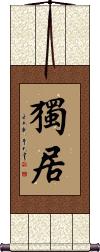
獨居 is a Chinese word that can be translated as to live alone, to live a solitary existence, solitude, solitary life, dwelling alone.
You might use a word like this regarding a hermit.
 In modern Japan, and Simplified Chinese, they use the version of the first character shown to the right. If you want this version please click on the character to the right instead of the button above.
True Emptiness Yields Transcendent Existence
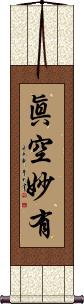
According to Soothill 眞空妙有 means:
The true void is the mysteriously existing, truly void, or immaterial, yet transcendentally existing.
眞空妙有 is the state of being nonexistent after removing all errant worldly influences. 眞空妙有 is achieved when all forms of existence are seen for their real nature.
Body / Karada
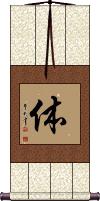
体 is used in Japanese to mean “body.”
体 can also refer to the form, style, corporeal existence, appearance, identity, or state of something or someone. 體 is also used in Buddhism in regard to the corporeal existence of someone (their earthy vessel). It's kind of a broad term that can be used in a lot of different ways.
As a single character, it's usually pronounced “karada” but it can also be pronounced “tai” or “te” (Japanese pronunciation borrowed from the original Chinese).
體 is not a common Kanji to use for a wall scroll. Only select this if you have a personal and meaningful reason to do so. Also, consider this version to be “Japanese only” - see below...
 In Chinese and old Korean Hanja, this character is written in the traditional form shown to the right. If you want this version, click on the character to the right instead of the button above.
Sky / Ether / Void / Emptiness / Unreality
(Used in Japanese version of five elements)
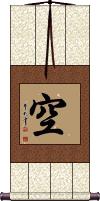
空 is a single character that means empty, void, hollow, vacant, vacuum, blank, nonexistent, vacuity, voidness, emptiness, non-existence, immateriality, unreality, the false or illusory nature of all existence, and being unreal.
In the Buddhist context, this relates to the doctrine that all phenomena and the ego have no reality but are composed of a certain number of skandhas or elements, which disintegrate. The void, the sky, space. The universal, the absolute, complete abstraction without relativity. The doctrine further explains that all things are compounds, or unstable organisms, possessing no self-essence, i.e. are dependent, or caused, come into existence only to perish. The underlying reality, the principle of eternal relativity, or non-infinity, i.e. śūnya, permeates all phenomena making possible their evolution.
From Sanskrit and/or Pali, this is the translation to Chinese and Japanese of the title śūnya or śūnyatā.
In Japanese, when pronounced as “ron” (sounds like “roan”) this can be a given name. It should be noted that this Kanji has about 5 different possible pronunciations in Japanese: kuu, kara, sora, ron, and uro. 空 is also an element in the Japanese version of the five elements.
Live Together and Help Each Other
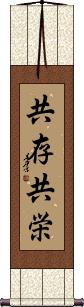
共存共栄 is a Japanese proverb that means “live together and help each other,” “existing together, thriving together,” or “co-existence and co-prosperity.”
Live In The Moment / Live In The Now
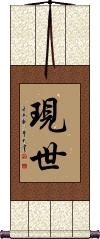
現世 is a very short way to write “live in the moment” or “live in the now” in Japanese.
This short word is open to interpretation. It's used in Japanese Buddhism to mean “the current epoch” or “the current age” (the current age is but a brief moment in the greater scope of existence). In that context, this is pronounced “utsushiyo” or “ustusiyo” in Japanese. Otherwise, it's pronounced “gensei” in Japanese.
Other translation possibilities include:
Earthly world
This world
This life
Present life
Present generation
Present incarnation
This existence
This (momentary) reality
Note: This is also a word in Chinese and old Korean Hanja. While the meaning is more or less the same, this is not recommended for a wall scroll if your audience is Chinese or Korean. This selection is best if your audience is Japanese.
Survive
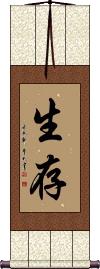
生存 means “to survive.” In some contexts, it can mean survival, to live, to exist, or existence.
生存 is not a common selection for a wall scroll, but a lot of people search for this term, so I added it to the database.
Heaven and Earth
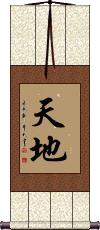
天地 is “Heaven and Earth” in Chinese, Japanese Kanji, and old Korean Hanja.
This title is used in many different contexts. It can be a general term but is also used by Buddhists and in other religions.
This can also be used to refer to all of nature, the universe, the top and bottom, the realm of life, or the sphere of existence.
Healthy Living
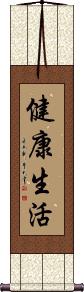
If you are into healthy living, 健康生活 might be an excellent selection for a wall scroll to hang in your home.
The first two characters speak of health, vitality, vigor, and being of sound body. The second two characters mean living or life (daily existence).
Life Force
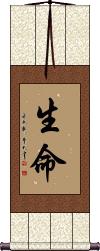
This Chinese, Korean and Japanese word means “life force” or simply “life.”
The first character means “life” or “birth.” The second means “life” or “fate.” Together they create the meaning of “life force,” though some will translate this as “existence” and sometimes “vitality.”
Samsara / Endless Cycle of Rebirth
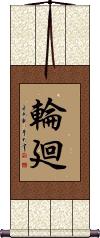
輪廻 is one of a few ways to express संसार or Saṃsāra in Chinese, Japanese, and old Korean.
The Buddhist term can be translated in several ways, including:
An endless cycle of death and rebirth.
The turning of the wheel.
To revolve.
Transmigration in six ways.
The wheel of transmigration.
The round of existence.
Happy
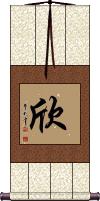
欣 is the type of happiness that you feel on the inside. It is the feeling of being released and delighted as well as being in a state of contentment. 欣 is more the internal happiness that perhaps only shows by the smile on your face. It can also be translated as “to take pleasure in” or “to rejoice.”
Note: 欣 is often used in compound words - especially in Korean Hanja.
As Japanese Kanji, this is so rare, that most Japanese people are not aware of its existence.
See Also: Happiness
Life is a Dew Drop
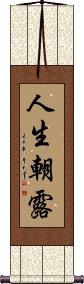
人生朝露 is a proverb that means “human life is like morning dew.”
Figuratively, this suggests the ephemeral and precarious nature of human existence.
Also translated as:
Man's life vanishes like a drop of dew.
A person's life is as fleeting as morning dew.
Life is as transient as morning due.
Karma (of your past lives)
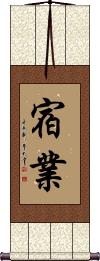
宿業 is the Buddhist concept of Past Karma. Simply put, it's the sum of all the good and bad from all previous lives (perhaps earlier in your current life). This term is not commonly used outside of the Buddhist faith (you'll have a tough time finding a non-Buddhist Asian person that knows this word).
Other ways to translate this are “The karma of previous existence,” “The karma remaining from prior existences,” or simply “Former karma.”
See Also: Buddhism
Living / Live Life
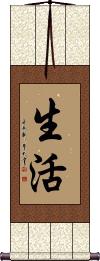
生活 means life, living, to live, or the state of being alive. It can also refer to your daily existence or livelihood. It can also be a suggestion to just “Live life.”
生活 is also the term used in other titles such as “healthy living” or Lance Armstrong's “Livestrong” campaign (Chinese title for Livestrong only).
If you need a reminder that you are alive and to take a breath, this might be the perfect wall scroll for you.
Eternal Energy / Eternal Matter
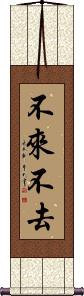
不來不去 is a Buddhist term, originally anāgamana-nirgama from Sanskrit.
This implies that things are neither coming into nor going out of existence.
This can also mean “all things are eternal,” or others will call this the Buddhist concept of the eternal conservation of energy.
This theory predates Albert Einstein and Isaac Newton.
Note: 不來不去 is not a well-known word for both Buddhists and non-Buddhists, so not all will recognize it.
Life in Every Breath
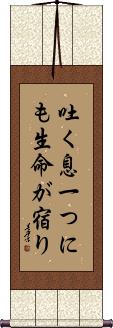
吐く息一つにも生命が宿り means “life in every breath” in Japanese.
This phrase is more like “every single breath as you live and dwell.”
The characters breakdown this way:
吐く息 (hakuiki) to breathe; exhaled air; one's breath; breathing.
一つ (hitotsu) one; only; just.
にも (nimo) also; too; as well; even.
生命 (seimei) life; existence; living.
が (ga) particle.
宿り (yadori) to lodge; to dwell; lodging; abode; shelter.
Note: Because this selection contains some special Japanese Hiragana characters, it should be written by a Japanese calligrapher.
Life in Harmony / Balanced Life
Harmonious Life
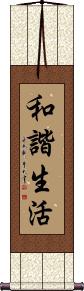
This 和諧生活 title suggests that you have, or want to get your life in balance.
The first two characters regard the idea of balance, harmony, and peace.
The second two characters mean “life.” More specifically this refers to your livelihood, career, and the daily activities that comprise your life or living. Some would translate those two characters as “one's daily existence.”
Note: We have a couple of titles for this idea. This version is more of a noun, thus "The Balanced Life" verses a verb form like "Balancing [Your] Life."
Mujo no Kaze / Wind of Impermanence
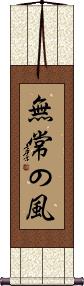
無常の風 is an old Japanese proverb that means the wind of impermanence or the wind of change in Japanese.
This can refer to the force that ends life, like the wind scattering a flower's petals. Life is yet another impermanent existence that is fragile, blown out like a candle.
The first two characters mean uncertainty, transiency, impermanence, mutability, variable, and/or changeable.
In some Buddhist contexts, 無常 can be analogous to a spirit departing at death (with a suggestion of the impermanence of life).
The last two characters mean “of wind” or a possessive like “wind of...” but Japanese grammar will have the wind come last in the phrase.
Live Strong
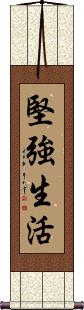
While hard to translate directly, 堅強生活 is the best way to write “Live Strong” in Chinese. If you are a cancer survivor or support Lance Armstrong's ideas, this is a nice selection for a wall scroll.
The first two characters mean strong or staunch. The last two mean living or life (daily existence). While the Chinese version is the reverse order of “Live Strong” it is the only way to write it in a natural form that is grammatically correct.
Note that we are in no way affiliated or connected to Lance or his foundation. This translation is offered because of multiple requests from customers whose philosophies or ideas match those of the Live Strong idea.
Impermanence
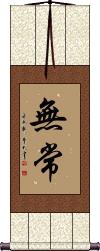
無常 is the state of being “not permanent,” “not enduring,” transitory, or evolving.
It can also mean variable or changeable. In some contexts, it can refer to a ghost that is supposed to take a soul upon death. Following that, this term can also mean to pass away or die.
In the Buddhist context, this is a reminder that everything in this world is ever-changing, and all circumstances of your life are temporary.
If you take the Buddhist philosophy further, none of these circumstances are real, and your existence is an illusion. Thus, the idea of the eternal soul is perhaps just your attachment to your ego. Once you release your attachment to all impermanent things, you will be on your way to enlightenment and Buddhahood.
Language notes for this word when used outside the context of Buddhism:
In Korean Hanja, this means uncertainty, transiency, mutability, or evanescent.
In Japanese, the definition orbits closer to the state of being uncertain.
The Middle Way
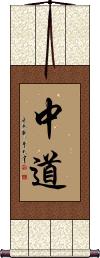
In the most basic translation, 中道 means road through the middle or middle road.
The expanded meaning can be moderation or the golden mean.
But if you are looking for this title, you are probably seeking the Buddhist definition, which is more complex.
中道 is the middle way or middle path of Buddhism. This has various interpretations. In general, it denotes the mean between two extremes and has special reference to the mean between realism and nihilism, or eternal substantial existence and annihilation.
The Buddha teaches that one should not take things to extremes. Don't be extremely evil and engage in debauchery and murder. But do not spend every waking out trying to be a perfect saint. Instead, take the middle path, try to help others, show loving kindness wherever you can, and try not to do harm. If you inadvertently harm another being, make amends if you can, and move on. Realize you are not perfect, but in time, a path of moderation lead toward proper living and enlightenment.
A Life of Serenity Yields Understanding
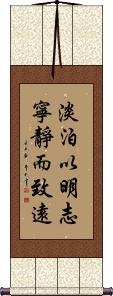
淡泊以明志寧靜而致遠 is a kind of complex ten-character proverb composed by Zhuge Liang about 1800 years ago.
淡泊以明志寧靜而致遠 is a Chinese proverb that means “Leading a simple life will yield a clear mind, and having inner peace will help you see far (into the world).”
What I have translated as “simple life” means NOT being materialistic and NOT competing in the rat race.
The last word means “far” but the deeper meaning is that you will surpass what you can currently see or understand. Perhaps even the idea of opening up vast knowledge and understanding of complex ideas.
The whole phrase has a theme that suggests that if you are NOT an aggressive, cut-throat person who fights their way to the top, no matter how many people they crush along the way, and instead seek inner peace, you will have a happier existence and be more likely to understand the meaning of life.
See Also: Serenity
Daodejing / Tao Te Ching - Chapter 27
The Mastery of Effortless Skill

Chapter 27 of the Daodejing reveals a profound truth about mastery: the highest skill leaves no trace, requires no force, and appears almost invisible.
善行無轍跡,
善言無瑕謫,
善數不用籌策,
善閉無關鍵而不可開,
善結無繩約而不可解。
是以聖人常善救人,
故無棄人;
常善救物,
故無棄物。
是謂襲明。
故善人者,不善人之師;
不善人者,善人之資。
不貴其師,不愛其資,
雖智大迷,
是謂要妙。
The sage moves through life with such natural harmony that nothing seems imposed; doors need no locks, knots require no rope, and actions leave no mark behind.
This is the essence of wúwéi (effortless action), where true ability arises from deep alignment with the Tao rather than deliberate effort.
At its heart, this chapter teaches compassion without exception. The sage “abandons no one and nothing,” recognizing value in all people and all things. Even those who seem flawed or unrefined are not rejected, but understood as part of a greater whole with each person both a student and a teacher in the unfolding of life.
Laozi reminds us that wisdom is not about perfection or control, but about subtle awareness. The truly skilled individual does not rely on tools, rules, or rigid structures; instead, they embody an intuitive understanding that makes their actions naturally complete.
In this way, excellence becomes quiet, effortless, and beyond imitation.
This teaching also reflects a deeper philosophical insight: Opposites are interdependent. The “good” person learns from the “not good,” and the “not good” provides the material for growth. To reject either is to misunderstand the balance of existence itself.
As calligraphy, Daodejing Chapter 27 serves as a reminder to cultivate inner mastery rather than outward display. It is a meditation on refinement, humility, and the quiet power of skill perfected through harmony with the natural order.
Note: The Chinese text used here is based on the early Mawangdui silk manuscript tradition (2nd century BCE). The Guodian manuscripts do NOT preserve Chapter 27 in full form.
These search terms might be related to Existence:
A Life of Happiness and Prosperity
A Life of Serenity Yields Understanding
Beautiful Life / Life in Perfect Harmony
Better to Sacrifice Your Life Than Your Principles
Birth / Life
Breath of Life
Choose Life
Do Not Fear Being Slow, Fear Standing Still
Embrace Life
Embrace Life / Embrace Living
Enjoy Life
Eternal Life / Everlasting Life / Immortality
Eternal Life / Future Life
Eternal Wheel of Life
Everyday Life
Forever Young / Long Life
Guan Shi Yin: Protector of Life
Humility / Being Humble
I Am Worthy of Being Loved
Inner Strength / Inner Well-Being and Health
Jesus is My Life
Journey of Life
Life Energy / Spiritual Energy
Life Force
Life Full of Love
Life Goes On
Life in Balance / Balancing Life
Life in Every Breath
Life in Harmony / Balanced Life
Life is a Dew Drop
Life is a Journey
Life is but a Dream
Life is Fun
Life is Good
Life is Good / Life is Beautiful
Life is Short
Life is What You Make It
Life is What You Make of It
Life of a Samurai
Life of Love
Life of Serenity
Life With Love
Life-Saving Sword
Living / Live Life
Longevity / Long Life
Longevity / Long Life Wishes
Love Life
Moral Principles of Life
Music is Life
My Life is Complete Because of You
My Life, My Rules
New Life
Principles of Life
Prosperous Life
Reality
Reality / Realistic
Reality and Illusion
Reincarnation / Life in Flux
Safety and Well-Being of the Family
Such is Life
Such is Life / Such is Destiny
Survival
Survival of the Fittest
The Buddha is in Each Sentient Being
The Good Life / Beautiful Life
The Key to Immortality is First Living a Life Worth Remembering
The Single Life
The Tao or Dao of Being Human / Humanity
The Two Most Important Days in Your Life...
This is Life
Through the Ups and Downs of Life
Thug Life
Ultimate Reality
Wake Up to Reality
Way of Life / Art of Life
The following table may be helpful for those studying Chinese or Japanese...
| Title | Characters | Romaji (Romanized Japanese) | Various forms of Romanized Chinese | |
| Alone Solitary Existence | 獨居 独居 | dokkyo / dokyo | dú jū / du2 ju1 / du ju / duju | tu chü / tuchü |
| True Emptiness Yields Transcendent Existence | 眞空妙有 | shin kuu myou u shinkuumyouu shin ku myo u | zhēn kōng miào yǒu zhen1 kong1 miao4 you3 zhen kong miao you zhenkongmiaoyou | chen k`ung miao yu chenkungmiaoyu chen kung miao yu |
| Body Karada | 體 体 | karada / tai / te | tǐ / ti3 / ti | t`i / ti |
| Sky Ether Void Emptiness Unreality | 空 | kuu / kara / sora / ron ku / kara / sora / ron | kōng / kong1 / kong | k`ung / kung |
| Live Together and Help Each Other | 共存共栄 | kyou son kyou ei kyousonkyouei kyo son kyo ei | ||
| Live In The Moment Live In The Now | 現世 现世 | gen sei / gensei | xiàn shì / xian4 shi4 / xian shi / xianshi | hsien shih / hsienshih |
| Survive | 生存 | seizon | shēng cún sheng1 cun2 sheng cun shengcun | sheng ts`un shengtsun sheng tsun |
| Heaven and Earth | 天地 | tenchi | tiān dì / tian1 di4 / tian di / tiandi | t`ien ti / tienti / tien ti |
| Healthy Living | 健康生活 | kenkou seikatsu kenkouseikatsu kenko seikatsu | jiàn kāng shēng huó jian4 kang1 sheng1 huo2 jian kang sheng huo jiankangshenghuo | chien k`ang sheng huo chienkangshenghuo chien kang sheng huo |
| Life Force | 生命 | seimei / inochi | shēng mìng sheng1 ming4 sheng ming shengming | |
| Samsara Endless Cycle of Rebirth | 輪廻 轮廻 | rinne | lún huí / lun2 hui2 / lun hui / lunhui | |
| Happy | 欣 | kin | xīn / xin1 / xin | hsin |
| Life is a Dew Drop | 人生朝露 | jin sei chou ro jinseichouro jin sei cho ro | rén shēng zhāo lù ren2 sheng1 zhao1 lu4 ren sheng zhao lu renshengzhaolu | jen sheng chao lu jenshengchaolu |
| Karma (of your past lives) | 宿業 宿业 | shukugou / shukugo | sù yè / su4 ye4 / su ye / suye | su yeh / suyeh |
| Living Live Life | 生活 | sei katsu / seikatsu | shēng huó sheng1 huo2 sheng huo shenghuo | |
| Eternal Energy Eternal Matter | 不來不去 不来不去 | furai fuko / furaifuko | bù lái bú qù bu4 lai2 bu2 qu4 bu lai bu qu bulaibuqu | pu lai pu ch`ü pulaipuchü pu lai pu chü |
| Life in Every Breath | 吐く息一つにも生命が宿り | hakuiki hitotsu nimo seimei ga yadori | ||
| Life in Harmony Balanced Life | 和諧生活 和谐生活 | hé xié shēng huó he2 xie2 sheng1 huo2 he xie sheng huo hexieshenghuo | ho hsieh sheng huo hohsiehshenghuo |
|
| Mujo no Kaze Wind of Impermanence | 無常の風 | mu jou no kaze mujounokaze mu jo no kaze | ||
| Live Strong | 堅強生活 坚强生活 | jiān qiáng shēng huó jian1 qiang2 sheng1 huo2 jian qiang sheng huo jianqiangshenghuo | chien ch`iang sheng huo chienchiangshenghuo chien chiang sheng huo |
|
| Impermanence | 無常 无常 | mujou / mujo | wú cháng / wu2 chang2 / wu chang / wuchang | wu ch`ang / wuchang / wu chang |
| The Middle Way | 中道 | chuu dou / chuudou / chu do | zhōng dào zhong1 dao4 zhong dao zhongdao | chung tao chungtao |
| A Life of Serenity Yields Understanding | 淡泊以明志寧靜而致遠 淡泊以明志宁静而致远 | dàn bó yǐ míng zhì, níng jìng ér zhì yuǎn dan4 bo2 yi3 ming2 zhi4, ning2 jing4 er2 zhi4 yuan3 dan bo yi ming zhi, ning jing er zhi yuan | tan po i ming chih, ning ching erh chih yüan | |
| Daodejing Tao Te Ching - Chapter 27 | 善行無轍跡善言無瑕謫善數不用籌策善閉無關鍵而不可開善結無繩約而不可解是以聖人常善救人故無棄人常善救物故無棄物是謂襲明故善人者不善人之師不善人者善人之資不貴其師不愛其資雖智大迷是謂要妙 善行无辙迹善言无瑕谪善数不用筹策善闭无关键而不可开善结无绳约而不可解是以圣人常善救人故无弃人常善救物故无弃物是谓袭明故善人者不善人之师不善人者善人之资不贵其师不爱其资虽智大迷是谓要妙 | shàn xíng wú zhé jì shàn yán wú xiá zhé shàn shù bù yòng chóu cè shàn bì wú guān jiàn ér bù kě kāi shàn jié wú shéng yuē ér bù kě jiě shì yǐ shèng rén cháng shàn jiù rén gù wú qì rén cháng shàn jiù wù gù wú qì wù shì wèi xí míng gù shàn rén zhě bù shàn rén zhī shī bù shàn rén zhě shàn rén zhī zī bù guì qí shī bù ài qí zī suī zhì dà mí shì wèi yào miào shan4 xing2 wu2 zhe2 ji4 shan4 yan2 wu2 xia2 zhe2 shan4 shu4 bu4 yong4 chou2 ce4 shan4 bi4 wu2 guan1 jian4 er2 bu4 ke3 kai1 shan4 jie2 wu2 sheng2 yue1 er2 bu4 ke3 jie3 shi4 yi3 sheng4 ren2 chang2 shan4 jiu4 ren2 gu4 wu2 qi4 ren2 chang2 shan4 jiu4 wu4 gu4 wu2 qi4 wu4 shi4 wei4 xi2 ming2 gu4 shan4 ren2 zhe3 bu4 shan4 ren2 zhi1 shi1 bu4 shan4 ren2 zhe3 shan4 ren2 zhi1 zi1 bu4 gui4 qi2 shi1 bu4 ai4 qi2 zi1 sui1 zhi4 da4 mi2 shi4 wei4 yao4 miao4 shan xing wu zhe ji shan yan wu xia zhe shan shu bu yong chou ce shan bi wu guan jian er bu ke kai shan jie wu sheng yue er bu ke jie shi yi sheng ren chang shan jiu ren gu wu qi ren chang shan jiu wu gu wu qi wu shi wei xi ming gu shan ren zhe bu shan ren zhi shi bu shan ren zhe shan ren zhi zi bu gui qi shi bu ai qi zi sui zhi da mi shi wei yao miao | shan hsing wu che chi shan yen wu hsia che shan shu pu yung ch`ou ts`e shan pi wu kuan chien erh pu k`o k`ai shan chieh wu sheng yüeh erh pu k`o chieh shih i sheng jen ch`ang shan chiu jen ku wu ch`i jen ch`ang shan chiu wu ku wu ch`i wu shih wei hsi ming ku shan jen che pu shan jen chih shih pu shan jen che shan jen chih tzu pu kuei ch`i shih pu ai ch`i tzu sui chih ta mi shih wei yao miao shan hsing wu che chi shan yen wu hsia che shan shu pu yung chou tse shan pi wu kuan chien erh pu ko kai shan chieh wu sheng yüeh erh pu ko chieh shih i sheng jen chang shan chiu jen ku wu chi jen chang shan chiu wu ku wu chi wu shih wei hsi ming ku shan jen che pu shan jen chih shih pu shan jen che shan jen chih tzu pu kuei chi shih pu ai chi tzu sui chih ta mi shih wei yao miao |
|
| In some entries above you will see that characters have different versions above and below a line. In these cases, the characters above the line are Traditional Chinese, while the ones below are Simplified Chinese. | ||||

Successful Chinese Character and Japanese Kanji calligraphy searches within the last few hours...



