Family Chinese & Japanese Calligraphy Wall Scrolls
You can customize a beautiful family wall scroll here.
Start by clicking on the button next to your favorite family title below...
2. Family Love / Domestic Bliss
3. Family / Members of a Family
8. Family Love
10. Happy Family
11. Safety and Well-Being of the Family
13. Any success can not compensate for failure in the home
14. Home is where the heart is
15. No man knows what he owes to his parents until he comes to have children of his own
16. Child
17. Spare the Rod, Spoil the Child
18. Brotherly and Sisterly Love
19. God Daughter
20. Grand Daughter
23. Loving Mother
24. Never Give Up
Family / Home
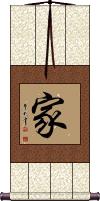
家 is the single character that means family in Chinese and Japanese.
It can also mean home or household depending on context.
Hanging this on your wall suggests that you put “family first.”
Pronunciation varies in Japanese depending on context. When pronounced “uchi” in Japanese, it means home, but when pronounced “ke,” it means family.
 Note that there is an alternate form of this character. It has an additional radical on the left side but no difference in meaning or pronunciation. The version shown above is the most universal, and is also ancient/traditional. The image shown to the right is only for reference.
Family Love / Domestic Bliss
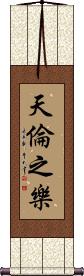
天倫之樂 means family love and joy, or domestic bliss.
The first two characters mean “the bonds of the family.”
The third character connects this to the fourth character which means happiness, joy, and cheerfulness.
Family / Members of a Family
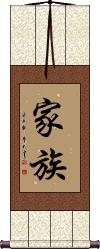
家族 is family in Japanese Kanji, Chinese and Korean.
This represents all the members of a family.
This can also mean household or clan, depending on the context.
Family Over Everything
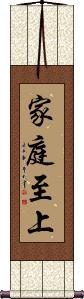
家庭至上 is a Chinese phrase that means “family above all else.”
The first two characters mean family, household, or home (they will be read as “family” in this case).
The last two characters mean supreme, paramount, or above all else.
Family and Friends
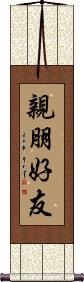
親朋好友 is a Chinese title that simply means “family and friends” or “kith and kin.”
If you read each character more literally, it's like, “relatives, friends, [and] good/close friends.”
Family and Friends
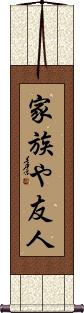
家族や友人 means “family and friends,” in Japanese.
Family Bond / Family Ties
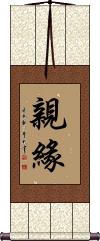
親緣 is a Chinese word that means affinity, family relationship, or consanguinity.
This speaks of the family bonds we have with others that share the same blood or ancestors.
Family Bond / Family Ties
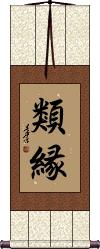
類縁 is a Japanese word that means affinity or family relationship.
This is about the bond shared by blood within a family or those from the same ancestor.
Family / Household
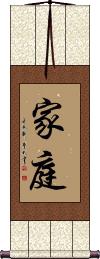
家庭/傢庭 is a common way to express family, household, or home in Chinese, Japanese Kanji, and old Korean Hanja.
However, for a wall scroll, we recommend the single-character form (which is just the first character of this two-character word). If you want that, just click here: Family Single-Character
The first character means “family” or “home.” The second means “courtyard” or “garden.” When combined, the meaning is a bit different, as it becomes “household” or “family.” The home and/or property traditionally has a strong relationship with family in Asia. Some Chinese, Korean, and Japanese families have lived in the same house for 7 or more generations!
Family Love
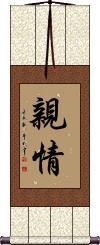
親情 means affection, especially for family members.
This can also be translated as “family love” or “love, especially within a married couple or between parents and children.”
Family Love
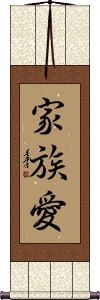
家族愛 is a Japanese title that means love of (one's) family, family love, or familial love.
Forever Family
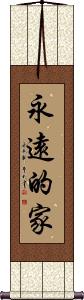
永遠的家 is a special phrase that we composed for a “family by adoption” or “adoptive family.”
It's the dream of every orphan and foster child to be formally adopted and find their “forever family.”
The first two characters mean forever, eternal, eternity, perpetuity, immortality, and/or permanence. The third character connects this idea with the last character which means “family” and/or “home.”
Happy Family
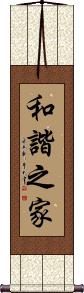
和諧之家 means “harmonious family” or “happy family” in Chinese.
The first two characters relay the idea of happiness and harmony.
The third character is a connecting or possessive article (connects harmony/happiness to family).
The last character means family but can also mean home or household.
Happy Family
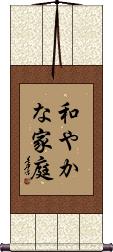
和やかな家庭 means “happy family” or “harmonious family” in Japanese.
The first three Kanji create a word that means mild, calm, gentle, quiet, or harmonious. After that is a connecting article. The last two Kanji mean family, home, or household.
Note: Because this selection contains some special Japanese Hiragana characters, it should be written by a Japanese calligrapher.
Safety and Well-Being of the Family
Kanai Anzen
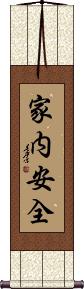
家內安全 is the Japanese way of saying “Family First.”
It's a Japanese proverb about the safety and well-being of your family and/or peace and prosperity in the household.
Some Japanese will hang an amulet in their home with these Kanji. The purpose is to keep your family safe from harm.
According to Shinto followers, hanging this in your home is seen as an invocation to God to always keep family members free from harm.
We were looking for a way to say “family first” in Japanese when this proverb came up in the conversation and research. While it doesn't say “family first,” it shows that the safety and well-being of your family is your first or most important priority. So, this proverb is the most natural way to express the idea that you put your family first.
See Also: Peace and Prosperity
One Family Under Heaven
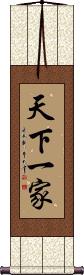
天下一家 is a proverb that can also be translated as “The whole world is one family.”
It is used to mean that all humans are related by decree of Heaven.
The first two characters can be translated as “the world,” “the whole country,” “descended from heaven,” “earth under heaven,” “the public,” or “the ruling power.”
The second two characters can mean “one family,” “a household,” “one's folks,” “a house” or “a home.” Usually, this is read as “a family.”
Note: This proverb can be understood in Japanese, though not commonly used.
Any success can not compensate for failure in the home
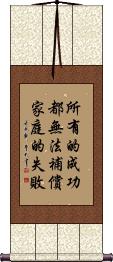
所有的成功都無法補償家庭的失敗 is a Chinese proverb that can be translated into English as “No success can compensate for failure in the home.”
Also, the word “home” can be exchanged with “family.”
Home is where the heart is
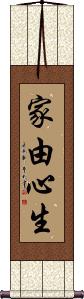
家由心生 is an old Chinese proverb that is roughly equal to the English idiom “Home is where the heart is.”
If you know Chinese, you may recognize the first character as home and the third as the heart.
Home is where the heart is
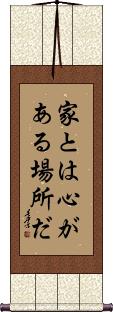
家とは心がある場所だ is, “Home is where the heart is,” in Japanese.
Most Japanese will take this to mean:
If you are with the person or at the place you love most, it becomes your true home.
Note: Because this selection contains some special Japanese Hiragana characters, it should be written by a Japanese calligrapher.
No man knows what he owes to his parents until he comes to have children of his own
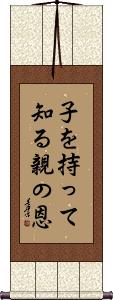
子を持って知る親の恩 literally translates as: Only after you have a baby, you would appreciate your parents (feel the way they do, etc).
This is a bit like the “walk a mile in another man's shoes” saying. Basically, it's about you cannot fully understand the plight of others until you experience it yourself. It also shows appreciation for the plight of parents.
This Japanese proverb can also be translated a few more ways:
No man knows what he owes to his parents till he comes to have children of his own.
One knows not what one owes to one's parents till one comes to have children of one's own.
Only after you have a baby, you will appreciate your parents or feel the way they do.
Only after becoming a parent yourself do you realize how much you owe [how indebted you are] to your own parents.
Note: Because this selection contains some special Japanese Hiragana characters, it should be written by a Japanese calligrapher.
Child
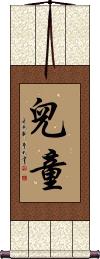
兒童 is how to write “child” in Chinese.
There are several ways to write child or offspring in Chinese, but this is the best form for calligraphy, or written (versus oral) form.
If children are essential to you, this might be the scroll you want. Or if you are a child at heart, this also works.
 In Japanese, they use a slightly-morphed version of the original Chinese first character. If you want the special Japanese version, please click on the Kanji image shown to the right, instead of the button above. Note: Japanese people would still be able to understand the Chinese version and vice versa.
Spare the Rod, Spoil the Child
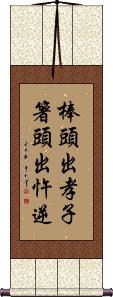
棒頭出孝子箸頭出忤逆 literally translates as:
A stick (or switch) produces filial sons; chopsticks produce disobedient [ones].
Figuratively, this means:
Strict discipline produces dutiful children, whereas indulgence produces disobedient ones.
This proverb is very similar to this English proverb:
“Spare the rod and spoil the child.”
Brotherly and Sisterly Love
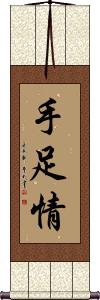
手足情 is the love between siblings.
When you love, protect, care for, and have a deep bond that only brothers or sisters can.
The actual translation is “Hand and Foot,” but the relationship between brothers or sisters is like that of hands and feet. They belong together and complete the body. Even though this says “hand and foot,” it will always be read with the brotherly and sisterly love meaning in Chinese.
Note: During the past 20 years, the “One child policy” in China is slowly making this term obsolete.
God Daughter
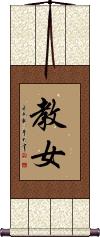
教女 is the title for a female child, which you have a sworn duty to raise should the girl's parents die.
The second character specifically designates that we are talking about a female child, thus the title God Daughter.
Grand Daughter
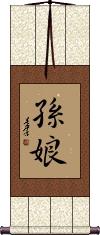
孫娘 is granddaughter in Japanese Kanji.
Mother and Daughter
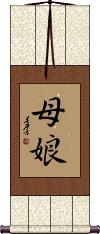
母娘 means “mother and daughter” in Japanese Kanji.
母娘 is an unusual selection for a calligraphy wall scroll and can be read in many different ways. Your native Japanese friends might wonder what you are trying to say.
Note: This will not make sense in Chinese.
See Also: Mother and Son
Mama / Mother / Mommy
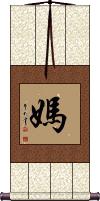
媽 is the oral way that most Chinese people refer to their mothers. Often, they will put this together twice (two of the same character in a row) to create a word that sounds like “Mama.” That's absolutely what little kids call their mothers in China. This Chinese “Mama” is the rough equivalent of “Mommy” in English. Beyond a certain age, Chinese will start to just say “Ma,” which is like saying “Mom.”
This entry is just here for a language lesson. This would make a strange wall scroll by Chinese standards. In Chinese, there are sometimes oral words that don't seem appropriate when written in calligraphy, and this is one of them. See our entry for “Loving Mother” for a better selection.
See Also: Loving Mother
Loving Mother
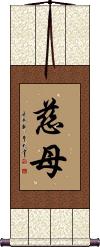
慈母 create the title of a loving mother, affectionate mother, or merciful mother.
A great gift for your mom.
Never Give Up
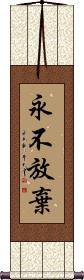
The first character means “eternal” or “forever,” and the second means “not” (together, they mean “never”). The last two characters mean “give up” or “abandon.” Altogether, you can translate this proverb as “never give up” or “never abandon.”
Depending on how you want to read this, 永不放棄 is also a statement that you will never abandon your hopes, dreams, family, or friends.
No one knows a son better than the father
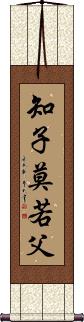
知子莫若父 can be translated as “No one knows a son better than his father.”
This idiom is based on the idea that after spending many years together, family members know everything about each other. Better than anyone else, a father knows the qualities and shortcomings of his son.
If you are looking for something about “father and son,” this is probably the best selection.
While this is the original proverb (very old), others have been composed about various combinations of mothers, sons, daughters, and fathers. Let me know if you need a custom version.
This in-stock artwork might be what you are looking for, and ships right away...

Gallery Price: $61.00
Your Price: $33.88

Gallery Price: $61.00
Your Price: $33.88
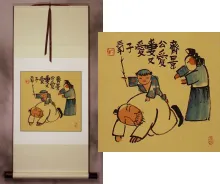
Gallery Price: $72.00
Your Price: $39.88

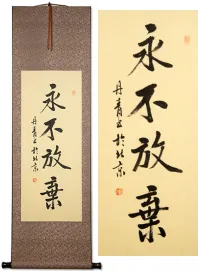
Gallery Price: $100.00
Your Price: $49.88
The following table may be helpful for those studying Chinese or Japanese...
| Title | Characters | Romaji (Romanized Japanese) | Various forms of Romanized Chinese | |
| Family Home | 家 / 傢 家 | ei / uchi / ke | jiā / jia1 / jia | chia |
| Family Love Domestic Bliss | 天倫之樂 天伦之乐 | tiān lún zhī lè tian1 lun2 zhi1 le4 tian lun zhi le tianlunzhile | t`ien lun chih le tienlunchihle tien lun chih le |
|
| Family Members of a Family | 家族 | ka zoku / kazoku | jiā zú / jia1 zu2 / jia zu / jiazu | chia tsu / chiatsu |
| Family Over Everything | 家庭至上 | jiā tíng zhì shàng jia1 ting2 zhi4 shang4 jia ting zhi shang jiatingzhishang | chia t`ing chih shang chiatingchihshang chia ting chih shang |
|
| Family and Friends | 親朋好友 亲朋好友 | qīn péng hǎo yǒu qin1 peng2 hao3 you3 qin peng hao you qinpenghaoyou | ch`in p`eng hao yu chinpenghaoyu chin peng hao yu |
|
| Family and Friends | 家族や友人 | kazoku ya yuujin kazokuyayuujin kazoku ya yujin | ||
| Family Bond Family Ties | 親緣 亲缘 | qīn yuán / qin1 yuan2 / qin yuan / qinyuan | ch`in yüan / chinyüan / chin yüan | |
| Family Bond Family Ties | 類縁 | ruien | ||
| Family Household | 家庭 / 傢庭 家庭 | ka tei / katei | jiā tíng / jia1 ting2 / jia ting / jiating | chia t`ing / chiating / chia ting |
| Family Love | 親情 亲情 | qīn qíng / qin1 qing2 / qin qing / qinqing | ch`in ch`ing / chinching / chin ching | |
| Family Love | 家族愛 | kazokuai / kazokuai | ||
| Forever Family | 永遠的家 永远的家 | yǒng yuǎn de jiā yong3 yuan3 de jia1 yong yuan de jia yongyuandejia | yung yüan te chia yungyüantechia |
|
| Happy Family | 和諧之家 和谐之家 | hé xié zhī jiā he2 xie2 zhi1 jia1 he xie zhi jia hexiezhijia | ho hsieh chih chia hohsiehchihchia |
|
| Happy Family | 和やかな家庭 | nago ya ka na ka tei nagoyakanakatei | ||
| Safety and Well-Being of the Family | 家內安全 家内安全 | ka nai an zen kanaianzen | ||
| One Family Under Heaven | 天下一家 | tenka ikka / tenkaikka / tenka ika | tiān xià yī jiā tian1 xia4 yi1 jia1 tian xia yi jia tianxiayijia | t`ien hsia i chia tienhsiaichia tien hsia i chia |
| Any success can not compensate for failure in the home | 所有的成功都無法補償家庭的失敗 所有的成功都无法补偿家庭的失败 | suǒ yǒu de chéng gōng dōu wú fǎ bǔ cháng jiā tíng de shī bài suo3 you3 de cheng2 gong1 dou1 wu2 fa3 bu3 chang2 jia1 ting2 de shi1 bai4 suo you de cheng gong dou wu fa bu chang jia ting de shi bai | so yu te ch`eng kung tou wu fa pu ch`ang chia t`ing te shih pai so yu te cheng kung tou wu fa pu chang chia ting te shih pai |
|
| Home is where the heart is | 家由心生 | jiā yóu xīn shēng jia1 you2 xin1 sheng1 jia you xin sheng jiayouxinsheng | chia yu hsin sheng chiayuhsinsheng |
|
| Home is where the heart is | 家とは心がある場所だ | ie to wa kokoro ga aru basho da ietowakokorogaarubashoda | ||
| No man knows what he owes to his parents until he comes to have children of his own | 子を持って知る親の恩 | ko wo motte shiru oya no on kowomotteshiruoyanoon | ||
| Child | 兒童 儿童 | jidou / jido | ér tóng / er2 tong2 / er tong / ertong | erh t`ung / erhtung / erh tung |
| Spare the Rod, Spoil the Child | 棒頭出孝子箸頭出忤逆 | bàng tóu chū xiào zǐ zhù tóu chū wǔ nì bang4 tou2 chu1 xiao4 zi3 zhu4 tou2 chu1 wu3 ni4 bang tou chu xiao zi zhu tou chu wu ni | pang t`ou ch`u hsiao tzu chu t`ou ch`u wu ni pang tou chu hsiao tzu chu tou chu wu ni |
|
| Brotherly and Sisterly Love | 手足情 | shǒu zú qíng shou3 zu2 qing2 shou zu qing shouzuqing | shou tsu ch`ing shoutsuching shou tsu ching |
|
| God Daughter | 教女 | jiào nǚ / jiao4 nv3 / jiao nv / jiaonv | chiao nü / chiaonü | |
| Grand Daughter | 孫娘 | mago musume magomusume | ||
| Mother and Daughter | 母娘 | haha musume hahamusume | ||
| Mama Mother Mommy | 媽 妈 | mā / ma1 / ma | ||
| Loving Mother | 慈母 | ji bo / jibo | cí mǔ / ci2 mu3 / ci mu / cimu | tz`u mu / tzumu / tzu mu |
| Never Give Up | 永不放棄 永不放弃 | yǒng bù fàng qì yong3 bu4 fang4 qi4 yong bu fang qi yongbufangqi | yung pu fang ch`i yungpufangchi yung pu fang chi |
|
| No one knows a son better than the father | 知子莫若父 | zhī zǐ mò ruò fù zhi1 zi3 mo4 ruo4 fu4 zhi zi mo ruo fu zhizimoruofu | chih tzu mo jo fu chihtzumojofu |
|
| In some entries above you will see that characters have different versions above and below a line. In these cases, the characters above the line are Traditional Chinese, while the ones below are Simplified Chinese. | ||||




