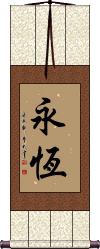
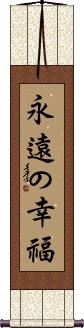
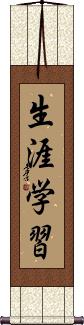
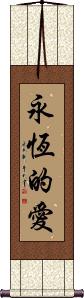
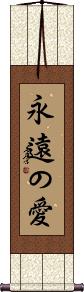
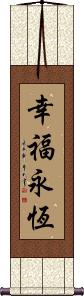
Eternal / Eternity
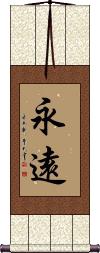
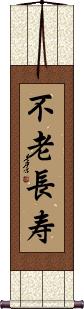
yǒng héng
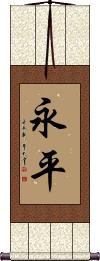
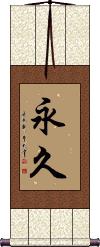
This is the Chinese word for eternity. The first character means always, forever and perpetual. The second character holds the meaning of permanent. Together, they create a word that means eternal, eternally or infinite time.
See Also... Immortality
This is the simplest form of eternity. This character can sometimes mean forever, always, or perpetual, depending on context.
Note: Not often seen as a single Kanji in Japanese. Best if your audience is Chinese.
See Also... Forever | Ever Lasting
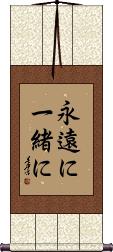
This is the Chinese, Korean and Japanese word for "forever".
If we take this word apart, the first character means "always", "forever" or "perpetual". While the second character means "far" or "distant".
See Also... Immortality
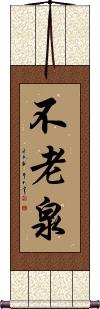
Infinity(Chinese / Korean)
This is the Chinese and Korean word meaning "infinity", "eternity", "infinitude", or simply "endless". In some contexts it can mean "immortality".
The first character means "never" or "not". The second means "exhausted", "finished", or "ending".
Note: This is a Japanese word, but rarely used in modern Japan.
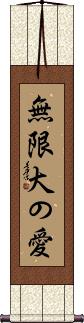
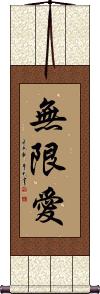
InfinityJapanese = Infinity / Chinese = No limits
This is the Chinese and Japanese word meaning infinity, unlimited or unbounded.
The first character means "never" or "not" or like a prefix "un-". The second means "limited", "restricted", or "bound".
Please note that the Japanese definition leans more toward "infinity" and the Chinese is more about being "boundless" or "without limits".
In Korean, this means infinity, infinitude, or boundlessness. But in Korean, this term has many interpretations or contexts, so your intended meaning might come out a little vague or ambiguous.
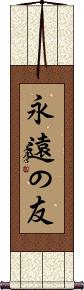
Eternal Friendship / Friends Forever(Japanese only)
ei en no yuu
The first two characters mean eternal, eternity, perpetuity, forever, immortality, and permanence.
The third character is a possessive article which sort of makes this selection mean "Love, of the eternal kind".
The last character is "friend" or "Friendship".
Eternal Love
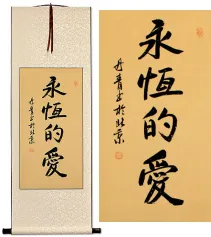
yǒng héng de ài
The first two characters mean eternal, eternally, everlasting, and/or perpetual.
The third character is a possessive article which sort of makes this selection mean "Love of the eternal kind".
The last character is "love".
This version is best if your audience is Chinese. We also have a Japanese version of this entry.
See Also... Forever Love | Eternal Love (japanese)
Back to the top of this page
Eternal Love (Japanese)
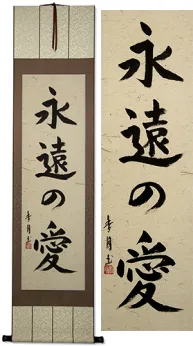
ei en no ai
The first two characters mean eternal, eternity, perpetuity, forever, immortality, and permanence.
The third character is a possessive article which sort of makes this selection mean "Love, of the eternal kind".
The last character is "love".
Cultural note: Most of the time, it is taboo to use the word "love" in Japanese. For instance, a Japanese man will say, "I like you", rather than, "I love you", to his spouse/girlfriend. However, this entry for eternal love is acceptable because of the way it is composed.
This entry is only appropriate if your audience is Japanese. We also have a Chinese version of this phrase.
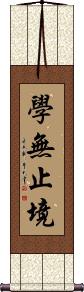
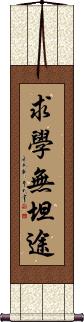
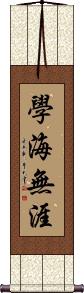
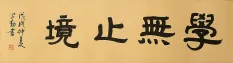
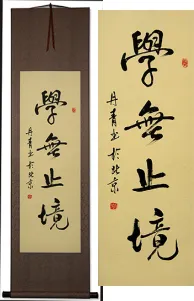
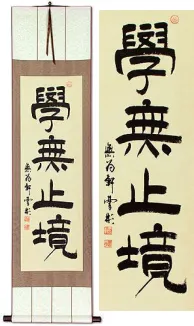
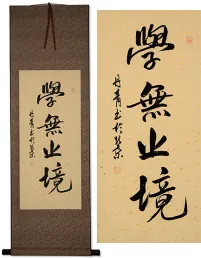
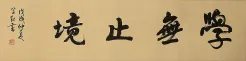
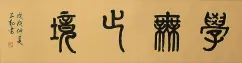
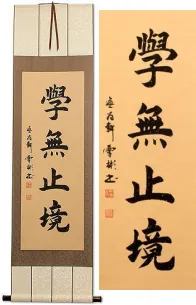
This Chinese philosophy tells of how we continue to learn throughout our lives. It can be translated in a few ways such as "Study has no end", "Knowledge is infinite", "No end to learning", "There's always something new to study", or "You live and learn".
The deeper meaning: Even when we finish school we are still students of the world gaining more knowledge from our surroundings with each passing day.
See Also... An Open Book Benefits Your Mind | Wisdom | Learn From Wisdom
Eternal Life / Everlasting Life Immortality
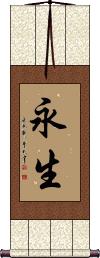
These are the last two words from John 3:16 in the Chinese Union Bible. Although not specifically Christian, this is the way to express ever-lasting life or eternal life in Chinese. In Japanese this can either mean eternal life or immortality.
See Also... Eternity | Rebirth | Reincarnation | Immortality
Back to the top of this page
Eternal Life / Future Life
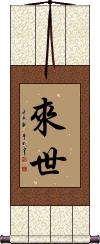
This word can be used in many different ways. It is often used to express the next life (life in heaven or wherever your soul is bound for). So it does have a religious overtone. However, it can also be used to express your life in the future - perhaps during your present lifetime. It can also be translated as "the next world", "the next generation", "the time that is to come", "otherworld", or simply "posterity".
See Also... Eternity | Rebirth | Reincarnation | Immortality
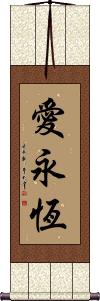
Love Eternal / Love Eternally
ài yǒng héng
The first character here means "love"
The last two mean eternal, eternally, everlasting, and/or perpetual.
This is the shortest way to express the idea of "love eternally" in Chinese.
See Also... Love Forever
Love Forever / Love Eternally
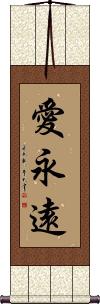
ài yǒng yuǎn ai ei en
The first character here means "love".
The last two mean forever, eternity, eternal, perpetuity, immortality, and/or permanence.
This is the shortest and most universal way to express this idea in Chinese and Japanese.
Japanese note: This sound more like a title than a phrase in Japanese (if that makes any sense). This is a great title for a romantic book, title of a movie, name of a perfume, or even a name for a store.
See Also... Eternal Love | Forever Love
Back to the top of this page
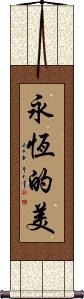
Eternal Beauty
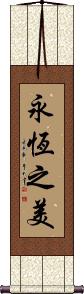
yǒng héng de měi
This is how to write "Eternal Beauty" in Chinese.
Have a Walking Stick at the Ready Before You StumbleJapanese Proverb
koro ba nu saki no tsue
Characters shown above are read vertically, starting from the right
This literally translates as: Have a walking stick ready before stumbling.
This is similar to the English idiom, "A stitch in time saves nine".
In simple terms, this means: Always be prepared in advance.
See Also... Fix Roof Before The Rain; Dig The Well Before You Are Thirsty
Always Try to do Better
sara ni ue o me za su
Characters shown above are read vertically, starting from the right
This Japanese phrase literally translates as: [After having achieved a fair degree of success,] one should still try to do better.
Others may translate this as, "Always try to improve", or "Always try to be better".
Back to the top of this page
Fix roof before the rain; Dig the well before you are thirsty
bǔ lòu chèn tiān qíng wèi kě xiān jué jǐng
Characters shown above are read vertically, starting from the right
This literally translates as: Mend the roof while the weather is fine, [and when you are] not yet thirsty, dig the well beforehand.
In simple terms, this means: Always be prepared in advance.
See Also... Have A Walking Stick At The Ready Before You Stumble
You are always a beauty in your lover’s eyes
qíng rén yǎn lǐ chū xī shī
Characters shown above are read vertically, starting from the right
Any woman with affection for Asian art and you will love a gift of this calligraphy on a wall scroll. She will melt in your arms as you tell her the meaning of these characters.
Contained in this phrase is a reference to the most beautiful woman in Chinese history. Her name was Xi Shi, and she was known to have good looks that need not fine robes or make up. Her charms were so powerful that she brought down an entire kingdom (in a successful effort to bring honor and pride back to her people).
Mind of the Beginner
chū xīn shoshin
This is often translated in Japanese as "beginner's mind". In Chinese, the dictionary definition is "one's original intention".
The first character means first, initial, primary, junior, beginning, or basic.
The second character means heart, mind, soul, or essence.
This is one of the five spirits of the warrior (budo), and is often used as a Japanese martial arts tenet. Under that context, places such as the Budo Dojo define it this way: The state of shoshin is that of a beginners mind. It is a state of awareness the remains always fully conscious, aware, and prepared to see things for the first time. The attitude of shoshin is essential to continued learning.
Back to the top of this page
Better to be Happy than Rich
Even if you are poor, you should still feel satisfied in your life...
...Satisfaction, happiness, and the meaning of your life come from within yourself and not from money or riches of the world.
In Chinese, there are a lot of four-character idiomatic phrases which express some very old philosophies. Though there are only four characters on this scroll, in Chinese the meanings often surpasses the dictionary definition of each character.
In this case, you should not set your expectations too high for the amount to money or riches you wish to have. One who sets their expectations too high, is almost always disappointed. Instead, you should cherish what you have, and seek to improve yourself from within, and not measure your personal worth by the size of your bank account.
See Also... A Sly Rabbit Will Have Three Openings To Its Den
You May Learn from Victory, You Will Learn from Failure
bǎi shèng nán lǜ dí sān zhé nǎi liáng yī
Characters shown above are read vertically, starting from the right
This literally translates as: [Even a general who has won a] hundred victories [may be] hard put to see through the enemy's [strategy], [but one who has] broken [his] arm three [times] [will] be a good doctor.
Figuratively, this means: One cannot always depend on past successes to guarantee future success, but one can always learn from lessons drawn from failure.
See Also... Failure - Mother Of Success | Experience - Mother Of Success | Fall Down 7 Times Get Up 8 | Hard Knocks
Brotherly and Sisterly Love
shǒu zú qíng
This is the love between siblings. When you love, protect, care for, and have a deep bond that only brothers or sisters can.
The actual translation is "Hand and Foot" but it is said the relationship between brothers or sisters is like that of hands and feet. They belong together, and complete the body. Even though this says "hand and foot", it will always be read with the brotherly and sisterly love meaning in Chinese.
Note: During the past 20 years, the "One child policy" in China is slowly making this term obsolete.
Back to the top of this page
Mark the boat to find the lost sword Ignoring the changing circumstances of the world
kè zhōu qiú jiàn kokushuukyuuken 각주구검
This is a warning to people that things are always in a state of change. Thus, you must take that into account, and not depend on the old ways, or a way that may have worked in the past but is no longer valid.
This idiom/proverb comes from the following story: A man was traveling in a ferry boat across a river. With him, he carried a valuable and treasured sword. Along the way, the man became overwhelmed and intoxicated by the beautiful view, and accidentally dropped his prized sword into the river. Thinking quickly, he pulled out a knife, and marked on the rail of the boat where exactly he has lost his sword.
When the boat arrived on the other side of the river, the man jumped out of the boat and searched for his sword right under where he'd made the mark. Of course, the boat had moved a great distance since he made the mark, and thus he could not find the sword.
While this man may seem foolhardy, we have to take a great lesson from this parable: Circumstances change, so one should use methods that can handle the change. In modern China, this is used in business to mean that one should not depend on old business models for a changing market.
FYI: This idiom dates back to the Spring and Autumn period (770–476 BC).
Choose Life
xuǎn zé shēng huó
This can mean to choose life instead of death (or suicide) or to choose to live life to the fullest.
I think of it as the key phrase used by Renton (Ewan McGregor) in the movie Trainspotting. While Chinese people will not think of Trainspotting when they see this phrase, for me, it will always be what comes near the end of this colorful rant:
Choose life. Choose a job. Choose a career. Choose a family. Choose a fucking big television, Choose washing machines, cars, compact disc players, and electrical tin can openers. Choose good health, low cholesterol and dental insurance. Choose fixed-interest mortgage repayments. Choose a starter home. Choose your friends. Choose leisure wear and matching luggage. Choose a three piece suite on hire purchase in a range of fucking fabrics. Choose DIY and wondering who the fuck you are on a Sunday morning. Choose sitting on that couch watching mind-numbing spirit-crushing game shows, stuffing fucking junk food into your mouth. Choose rotting away at the end of it all, pissing your last in a miserable home, nothing more than an embarrassment to the selfish, fucked-up brats you have spawned to replace yourself. Choose your future. Choose life.
This is the Chinese, Korean and Japanese word for "Gospel" or "Word of God". This is a specifically Christian word in Asia (not used for any other religion).
The first character means "blessing", "good fortune" or "good luck". This first character is a special character used throughout China to bring good tidings and fortune - especially during Chinese New Years. The second character means "sound", "noise" or "news".
Together, these characters create a word that means "The Good News" or "The Sound of Good Fortune".
When read by a Chinese or Japanese person, this word is always perceived as "The Christian Gospel", "Word of God", or even "The Voice of God".
See Also... Christianity | Jesus Christ | God Of Abraham
Back to the top of this page
Confidence is having faith in someone. Self-confidence is trusting that you have what it takes, to handle whatever happens. You feel sure of yourself and enjoy trying new things, without letting doubts or fears hold you back. When you have confidence in others, you rely on them.
The first character means faith, and the second can mean heart or soul. So you could say this means "faithful heart" or "faithful soul". In Korean especially, this word has a religious connotation.
In Japanese, this word can mean "faith", "belief" or "devotion".
See Also... Self-Confidence
Confucius: Golden Rule / Ethic of ReciprocityDo not do to others what you do not want done to yourself
Some may think of this as a "Christian trait" but actually it transcends many religions.
This Chinese teaching dates back to about 2,500 years ago in China. Confucius had always taught the belief in being benevolent (ren) but this idea was hard to grasp for some of his students, as benevolence could be kind-heartedness, or an essence of humanity itself.
When answering Zhong Gong's question as to what "ren" actually meant, Confucius said:
"When you go out, you should behave as if you were in the presence of a distinguished guest, when people do favors for you, act as if a great sacrifice was made for you. Whatever you wouldn't like done to you, do not do that thing to others. Don't complain at work or at home."
Hearing this, Zhong Gong said humbly, "Although I am not clever, I will do what you say."
From this encounter, the Chinese version of the "Golden Rule" or "Ethic of Reciprocity" came to be.
The characters you see above express, "Do not do to others whatever you do not want done to yourself."
See Also... Confucius Teachings | Benevolence
Crisis equals Danger plus Opportunity?
Separately, the first character here does mean "danger" or "to endanger" and the second character can mean "opportunity".
However, I want to debunk a myth that was propagated by some westerners who did not have a clear understanding of Asian languages...
While often, Chinese/Japanese/Korean compound words (words of two or more characters) are the sum of their parts, this is not always the case. The compound is often understood with a completely different meaning than the two characters individually.
Many have said that the Chinese/Japanese/Korean word for Crisis is made up of the characters for "danger" and "opportunity". This is true when phrased this way. However, it's not absolutely correct to say that "danger + opportunity = crisis" in Asian cultures.
English example: If I tell you that... Bovine creature + Guy behind the plate in baseball = Locomotive protection ...you would think I was mad. But consider that "cow + catcher = cowcatcher", which is the device that used to be found on steam engines to protect them if they hit an animal on the tracks. When we hear the word "cowcatcher" we don't separate the words into their individual meanings (necessarily). The same is true with the word for crisis in Chinese/Japanese/Korean. While you can separate the characters, few Asian people would automatically do so in their minds.
The final answer: It is a half-truth to say, "danger plus opportunity equals crisis" in Chinese/Japanese/Korean. Use this statement and concept with caution.
Also, the second character can mean "secret" or "machine" depending on context so I guess you have to say "a dangerous machine = crisis" or "danger + a secret = crisis". Both of these are only slightly more ridiculous than the first premise.
PS: This is probably not a great word for a scroll, unless you have a special use for it.
Back to the top of this page
The first two characters mean resolute with firm determination. The second two characters mean reliable.
Together, this creates a 4-character expression that clearly means dependable.
Devotion / Dedication Attentive / Focused
This means "paying attention".
The first character means "for a particular person, occasion, or purpose", "focused on one thing", "concentrated" and sometimes, "special".
The second character means "heart" by itself.
Together, these two characters make a word that means, "paying attention with your heart". It's often translated as, "dedication", as in "be absorbed in" or "concentrate one's efforts". It's also used to mean, "concentration (-ed)" and "engrossed", "devotionally (listening/watching)", "attentive".
My favorite translation, which comes from the Oxford Advanced Chinese/English Dictionary is, "wholehearted devotion".
If it seems like the meaning of this word is quite open, you are correct. The context in which the word is used matters a lot. It can mean different things depending on how you use it. This makes it kind of nice as you can decide what this means to you (within some limits). This word is always positive in meaning, so even if a Chinese person reads it differently than you, it will still have a good meaning.
In Japanese, they tend to use a variation of the second character which has one less stroke. If you want your calligraphy written this Japanese form, please click on the Kanji shown to the right instead of the button above. Note: Japanese and Chinese people will recognize either form.
See Also... Faith | Devotion
Drain the pond to get all the fishKill the goose that lays the golden eggs
jié zé ér yú
In 632 BC, Duke Wen of the Kingdom of Jin was about to lead an army against the forces of the Kingdom of Chu. The Duke asked one of his advisers, Jiu Fan, how they could possibly win the impending battle, as they were drastically outnumbered. Jiu Fan said, "All is fair in war", and went on to suggest a plan of dishonorable tactics (cheating). The Duke was not sure of this advice, so he asked another adviser, Yong Ji, who replied, "If you catch fish by draining the pond, you can certainly get all the fish. But there will be no fish the following year. You can cheat this one time in battle, but such tactics can only be used once, as the enemy will be wise in future encounters".
The Duke heard the words of his wiser adviser, but cheated to gain victory in the battle. However, he rewarded Yong Ji more than Jiu Fan at the victory celebration, stating that while Jiu Fan's advice gained one victory, the wise words of Yong Ji would last forever.
This Chinese idiom/proverb is still used, over 2600 years later to remind people not to burn bridges, cheat, or dishonor oneself in exchange for a short term gain, while sacrificing the future.
This is very similar to the meaning of the English phrase, "Kill the goose that lays the golden eggs".
Back to the top of this page
Drinking the water of a well, one should never forget who dug it
chī shuǐ bú wàng jué jǐng rén 흘수불망굴정인
Characters shown above are read vertically, starting from the right
This proverb suggests that one should always be grateful to those who helped you succeed.
And remember your ancestors and those that came before you whose sacrifices made your present life better.
Some Chinese will separate the intended meaning from the idiom and translate this as "Don't forget the people who once helped you". In Modern China, this idiom is virtually never used to refer to an actual well.
Note: This can be pronounced in Korean, but it's not a commonly-used phrase.
Enso - Japanese Zen Circle
en sou
This is Enso, which is really NOT a regular Japanese Kanji character. It falls more into the category of a symbol. In this case, it can be considered a religious symbol, as it is strongly-associated with Japanese Zen Buddhism.
Some call this "The Circle of Enlightenment". Others call it the "Infinity Circle". If you actually took the meanings of the two Kanji that make up the word "Enso", you could read it as "Mutual Circle" or "Circle of Togetherness". I think the Enso symbol can simply mean different things to different people. Therefore, you should let it have the meaning that you perceive.
Please note when you start making your customizations for an Enso wall scroll, you will see some possible ways it might be written, listed under the different calligraphy styles that we normally offer. However, Enso does not really conform to normal Asian calligraphy styles. Therefore, do not expect that you can make a style selection and expect the actual result to be identical. The appearance of your Enso will be determined by the artist's personal style, feeling, mood, etc. You cannot control or constrain that, to do so, would remove the art from the symbol.
Note: Our calligraphy selection process does not take this into account, as it was designed for Chinese characters and Japanese Kanji selection.
Please ignore the part where you are invited to pick a calligraphy style in the following pages.
Both our Japanese and Chinese master calligraphers are Buddhist (not as devout as monks, but Buddhist none the less). Therefore you can be assured that your Enso symbol will be written with the utmost effort and feeling.
By the way, when "Enso" is written in Kanji, it looks like this:  
Fall Down Seven Times, Get Up EightAlways rising after a fall or repeated failures
This Japanese proverb relays the vicissitudes of life. Some would more naturally translate it into English as "Always rising after a fall or repeated failures".
The first Kanji is literally "7". The second means "fall down" (sometimes this Kanji means "turn around", "revolve" or "turn over", but in this case, it's holds the meaning of "fall"). The third is "8". And the last is "get up", "rouse", or "rise".
Basically if you fail 7 times, you should recover from those events and be prepared to rise an 8th time. This is also applies if it is the world or circumstances that knock you down seven times... ...just remember that you have the ability to bounce back from any kind of adversity.
Note: This can be pronounced two ways. One is "shichi ten hakki". The other is "nana korobi ya oki" also written, "nanakorobi-yaoki".
Special Note: The second character is a Kanji that is not used in China. Therefore, please only select our Japanese master calligrapher for this selection.
Back to the top of this page
This is the full title of the "Flying Tigers Group". These were the American pilots that volunteered to go to China and fight the Japanese prior to the entry of the USA into World War Two. These fighter pilots were so esteemed in China, that fallen American pilots could always find refuge in villages, and safe passage and escape to areas of China that were not occupied by Japan at that time. Chinese villagers helped such fallen pilots with full knowledge that when the Japanese occupation forces found out, all the men, women, and children in the village would be massacred by Japanese troops (there are more than a few known cases of such massacres).
The Flying Tigers successfully kept supply lines to the Chinese resistance open, and divided Japanese forces at a crucial time while America prepared to officially join WWII.
A wall scroll like this honors the men who risked or gave their lives as noble volunteers, and is a reminder of the best moment in history of Sino-American relations.
These three characters literally mean "flying tiger(s) group/team/squad".
Note: Hanging these characters on your wall will not make you any friends with Japanese people who are aware or this history (most Japanese have no idea, as Japan's involvement in WWII has all but been erased from school textbooks in Japan).
Always Be Prepared
bǎo dài gān liáng nuǎn dài yī
Characters shown above are read vertically, starting from the right
This literally translates as: Carry [extra] food when [you are] full and [extra] clothes when [you are] warm.
Figuratively, this means: Always be prepared for a rainy day.
This the title for football or soccer in Japanese Kanji and old Korean Hanja. The sport is very popular in both Japan and Korea (Korea and Japan co-hosted the football World Cup in 2002 - a world-class sporting event held every four years that rivals the Olympics).
In Japan, they sometimes say サッカ (sakka) or フットボール (futto bouru) in place of the pronunciation shown above. This is supposed to sound like the English word "soccer" and "football / futbol" respectively.
The first Kanji means "kick" and the second means "ball". So technically, this means "kick ball" in Japanese and Korean (this is just an educational note - this will always be understood as the game of soccer / football).
FYI: This game would never be confused with American Football in Japan or Korea. Unlike the game of American basketball and baseball (both quite popular in Japan and Korea), there is only vague awareness of a rugby-like game that is also called football in the USA.
Back to the top of this page
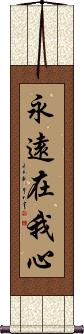
Forever In My HeartChinese
yǒng yuǎn zài wǒ xīn zhōng
Characters shown above are read vertically, starting from the right
This means, "forever in my heart", in Chinese.
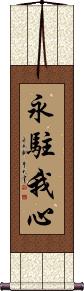
Forever In My HeartChinese
yǒng yuǎn zài wǒ xīn
This means, "forever in my heart", in Chinese.
This is the shorter, somewhat lyrical version of this phrase.
Forever In My HeartJapanese Only
i tsu ma de mo watashi no kokoro no naka ni
Characters shown above are read vertically, starting from the right
This means, "forever in my heart", in Japanese.
Back to the top of this page
Forever In My HeartJapanese Only
eien ni watashi no kokoro no nakani)
Characters shown above are read vertically, starting from the right
This means, "forever in my heart", in Japanese.
Note: There's more than one way to say "Forever in My Heart" in Japanese, so you'll find another version in our database.
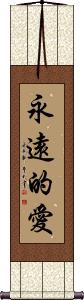
Forever Love
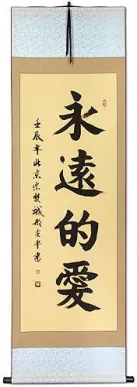
yǒng yuǎn de ài
The first two characters mean forever, eternal, eternity, perpetuity, immortality, and/or permanence.
The third character is a possessive article which sort of makes this selection mean "The forever kind of love".
The last character is "love".
See Also... Eternal Love
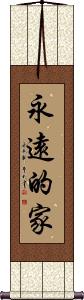
Forever Family
yǒng yuǎn de jiā
This is a special phrase that we composed for a "family by adoption" or "adoptive family".
It's the dream of every orphan and foster child to be formally adopted and find their "forever family".
The first two characters mean forever, eternal, eternity, perpetuity, immortality, and/or permanence. The third character connects this idea with the last character which means "family" and/or "home".
See Also... Family
Back to the top of this page
This single character means "forgive" in Chinese. In Korean, this kind of means forgive, but also has slightly different definitions of consider, excuse, faithful, believe.
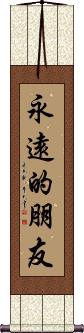
Friends Forever
yǒng yuǎn de péng yǒu
This is exactly what the title suggests. This means friends that are eternal or a friendship that will last forever - you will remain the best of friends as long as you live.
The first two characters mean forever, eternal, eternity, perpetuity, immortality, and/or permanence.
The middle character links the words (it's a possessive article).
The last two characters represent friendship, or simply "friends".
From Here to Eternity
cóng zhè lǐ dào yǒng héng
Characters shown above are read vertically, starting from the right
This is the translation of the phrase, "From here to eternity" into Mandarin Chinese.
Back to the top of this page
This is the act of greeting someone (can also be done when departing) with hands brought together in a prayerful manner. In India, this would be accompanied by the verbal greeting and blessing of "Namaste". In China, Japan, and Korea, this is how Buddhists will greet each other. Sometimes done by people who are not devout Buddhists in China, Japan and Korea to show respect or great thanks to someone for a gift, forgiveness, or some honor that has been bestowed. In Japan, this is almost always associated with a deep bow. In China where bowing is not an everyday occurrence, there may be a shallow bow but the act will be done with deep feeling. Korean culture seems to have more bowing than China, but less than Japan.
See Also... Namaste
God is Always With You
shàng dì yǔ nǐ cháng zài
Characters shown above are read vertically, starting from the right
The direct translation of these Chinese characters is "God Together [with] You Always Exist". Keep in mind that Chinese grammar is sometimes very different from English. This makes perfect sense in Chinese. Note: The title for God is the first two characters - the other words in the direct translation represent one character each.
This is the character which means "heaven" or "sky" in Chinese, Japanese Kanji, and old Korean Hanja.
Context of how this character is used determines if you are talking about heaven or the sky above (often they are the same concept anyway).
When combined with other characters, words like "today" and "tomorrow" are created. While sometimes the character for "sun" is used to mean "day", often "sky" represents "day" in Asian languages.
Example: "this sky" = "today", "next sky" = "tomorrow" in modern Chinese and Japanese (they also use "sun" in the same way - but the use of the "sun" character in words like today and tomorrow feels more ancient).
In Chinese culture, regardless of which religion, it's almost always assumed that God (and any other deities) live up above in the sky. This is probably how the idea of heaven being associated with this character began.
The equation goes something like this: God's domain is the sky, thus, the sky is heaven.
Note: As a single character, this is a little ambiguous, so you might want to choose our Kingdom of Heaven selection instead.
See Also... Heaven | God | Today | Sun
Back to the top of this page
Faithful / Honorable / Trustworthy Fidelity / Loyalty
This is a word that is often used to describe a person with an honest and loyal reputation. To put it simply, this applies to somebody you can trust (with your life).
In Chinese, this is often defined as good faith, honor, trust and justice.
In Korean, this word means fidelity, truthfulness, or faithfulness.
In Japanese: faith, fidelity and loyalty. It's also a Japanese male given name when pronounced "Nobuyoshi".
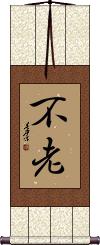
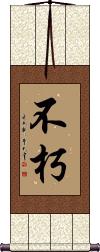
This means immortal or immortality in Chinese, Japanese Kanji and old Korean Hanja.
The literal translation is "without decay" or "never rotting". Basically this title speaks of something or someone who never dies and thus never rots or decays.
This can also be translated as everlasting, eternal or imperishable.
The incompetent boat pilot blames the river for his shortcomings
bù huì chēng chuán lài hé wān
Characters shown above are read vertically, starting from the right
This literally translates as: [One who] cannot steer the boat blames the bends in the river.
Figuratively, this means: One who is incompetent always tries to shift the blame elsewhere.
This is similar to the English idiom, "a poor workman/craftsman blames his tools".
Back to the top of this page
Infinite / Endless / Boundless
This means infinate or endless. Literally, this means "without (ever becoming) exhausted / poor", and in that context, can mean "inexhaustible" or "boundless", but this is usually read as "without end".
This is the kind of inner-strength that applies to a person who has will-power and can inspire themselves to do great things.
This word can also be the creed of a person that always pursues self-improvement.
Other translations: self-strengthening, striving for improvement, self-improvement, strive to become stronger, and self-renewal.
Integrity - Sincere Honest and Faithful
sei jitsu
This is the Japanese version of integrity which can also be defined as a combination of "sincere, honest and faithful".
Some may also define this as "loyal" or "loyalty". In some context, it can mean "genuine". Yes, all of this meaning in just one Japanese word!
Back to the top of this page
This is simply the name "Jesus" transliterated into Chinese. These characters hold a pronunciation in Mandarin that is closer to the real and original Hebrew Yeshua, instead of the incorrect way we have always pronounced Jesus in English with a hard "J" sound. While this name sounds like the real "Jesus" in Chinese, Christians in China are more likely to say "Christ" (Jidu) which holds more meaning than just sound.
If you are Latino and have been given the name "Jesus", this is also how to write your name in Chinese.
Joshua 24:15 - This House Serves the LORD
zhì yú wǒ hé wǒ jiā wǒ men bì dìng shì fèng yē hé huá
Depending on which English translation you like, here are the full English language version of Joshua 24:15 Joshua 24:15 (KJV) And if it seem evil unto you to serve the LORD, choose you this day whom ye will serve; whether the gods which your fathers served that were on the other side of the flood, or the gods of the Amorites, in whose land ye dwell: but as for me and my house, we will serve the LORD.
Joshua 24:15 (NIV) But if serving the LORD seems undesirable to you, then choose for yourselves this day whom you will serve, whether the gods your forefathers served beyond the River, or the gods of the Amorites, in whose land you are living. But as for me and my household, we will serve the LORD.
The characters shown here just dwell on the last line of the verse, "...as for me and my household, we will serve the LORD."
We used the only official Christian Chinese Bible that I know of so that the translation would be as accurate and standard as possible. Any Chinese Christian worth their salt will easily be able to identify this verse from the Chinese words on this scroll.
I think it is a bit like having a secret code on your wall that quietly expresses to whom your are faithful.
A great gift for your devout Christian or Jewish friend if they happen to be fond of Asian art.
Or perhaps a wonderful "conversation starter" for your own home.
Note: If you are curious, the last three characters represent they way "LORD" is used in most English Bibles. In Chinese, this is actually the phonetic name in Mandarin Chinese for "Jehovah".
To Know Hardship, One Must Experience It
bù dāng hé shàng bù zhī tóu lěng
Characters shown above are read vertically, starting from the right
This literally translates as: [One who has] not been a monk [does] not know [the feeling of a] cold head.
I need to explain that a Chinese Buddhist monk always has a shaved head, and thus a cold head in winter.
Figuratively, this means: One cannot know the true meaning of hardship until one has experienced it oneself.
This is an idiom in Chinese, so the figurative meaning is what people perceive when they hear or read this phrase. Just as in English, when someone says, "The grass is always greener", one will think about the idea of jealousy, rather than the quality of one's lawn.
Back to the top of this page
Kung Fu / Gong Fu
gōng fu kan fu / ku fu
One of the most famous types of martial arts in the world - and not just because of Bruce Lee.
Some translate the meaning as "Accomplishment by Great Effort". I think this is partially true, but directly translated it literally means "Merit/Achievement/Accomplishment Man". The word "fu" can sometimes mean "husband" or "porter", but in this case, it can only mean "man". However, few in China will think "man" when they hear the word "Gong Fu" spoken.
This term is also used for things other than martial arts. In fact, it's used to refer to a person with excellent skills in crafts that require a great deal of effort such as cooking, tea ceremonies, and calligraphy.
What a lot of people don't know is that the spelling of "Kung Fu" was actually taken from the old Wade Giles form of Romanization. Using this method, the sounds of the English "G" and "K" were both written as "K" and an apostrophe after the "K" told you it was supposed to sound like a "G". Nobody in the west knew this rule, so most people pronounce it with a "K-sound". And so Gong Fu will always be Kung Fu for most westerners.
Also, just to educate you a little more, the "O" in "Gong" has a sound like the English word "oh".
The popular Chinese dish "Kung Pao Chicken" suffers from the same problem. It should actually be "Gong Bao Chicken".
Historical note: Many will claim that Kung Fu was invented by the monks of the Shaolin monastery. This fact is argued in both directions by scholars of Chinese history. Perhaps it is more accurate to say that the Shaolin Monks brought the original fame to Kung Fu many generations ago.
Japanese note: While Japanese martial artists will recognize these characters, Katakana is more often used to approximate the pronunciation of "Kung Fu" with "カンフー". Some will argue as to whether this should be considered a Japanese word at all.
You May Learn from Victory, You Will Learn from Failure
katte erumono mo areba makete erumono mo aru
Characters shown above are read vertically, starting from the right
You may learn when everything goes right, but the lessons learned when everything goes wrong are more vivid and lead to long-lasting wisdom.
Another way to look at this: One cannot always depend on past successes to guarantee future success, but one can always learn from lessons drawn from failure.
Learn from Wisdom(When you see a wise person, try to be like them)
When you meet a wise person, you should learn from them and be inspired to become as wise as they are.
This is a pretty long phrase in English, but in Chinese it's only four characters.
However, in Chinese the deeper meaning often surpass the dictionary definition of each character.
In this case, you should seek wise people to learn from throughout your life...
Always try to learn enough to become equal to them. It also suggests that the process of learning and seeking wisdom is a non-ending cycle.
See Also... Knowledge
Back to the top of this page
Live in Prosperity
shēng huó yú fán róng zhōng
Characters shown above are read vertically, starting from the right
This means, "live in prosperity". It's kind of a suggestion to be prosperity the center of your world.
This is the way some people want to live (and you should always live for what you love). However, this phrase does not suggest a peaceful life - rather one that is always busy. It's not for everyone, but it might be for you.
See Also... Prosperity
Loyalty to Duty or Master
This is the simplest way to write the word loyalty in Chinese and Japanese. A single character like this leaves the meaning open. But alone, a Chinese or Japanese person would think of loyalty to duty or loyalty to one's master (in ancient times). I suppose that it could be loyalty to your boss or company in this day in age. This character can also mean fidelity or faithfulness.
LoyaltyJapanese Chinese Korean
Loyalty is staying true to someone. It is standing up for something you believe in without wavering. It is being faithful to your family, country, school, friends or ideals, when the going gets tough as well as when things are good. With loyalty, you build relationships that last forever.
Notes: 1. This written form of loyalty is universal in Chinese, Japanese Kanji, and old Korean Hanja.
2. There is also a Japanese version that is part of the Bushido Code which may be more desirable depending on whether your intended audience is Japanese or Chinese.
3. This version of loyalty is sometimes translated as devotion, sincerity, fidelity, or allegiance.
See Also... Honor | Trust | Integrity | Sincerity
Back to the top of this page
Loyalty / Faithful / Devoted
chuujitsu
This is a Japanese way to write "Loyalty" - it also contains the ideas of being faithful, devoted, true, and obedient.
The second character is a modified form only used in the Japanese lexicon, however, Chinese speakers can easily guess the meaning.
This is also a virtue of the Samurai Warrior See our page with just Code of the Samurai / Bushido here
Mind Your Own Business
bù gān jǐ shì bù zhāng kǒu yī wèn yáo tóu sān bù zhī yokeina osewa
Characters shown above are read vertically, starting from the right
This literally translates as: [About] matters [that] don't concern [you], do not open [your] mouth, [and] when questioned, always shake [your] head "No".
Figuratively, this means: It is best to remain reticent about other people's affairs and to refuse to make any comment on matters that don't concern you.
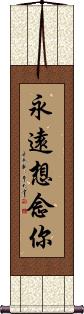
Miss You Forever
yǒng yuǎn xiǎng niàn nǐ
This is how to write "missing you forever" in Chinese.
The first two characters mean "forever" or "eternally". The third and forth characters mean "missing" or "longing for". The last character means "you".
This might suggest that you are missing someone whom you will never see again (depending on how you read it, or in what context it is used).
Back to the top of this page
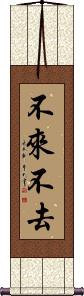
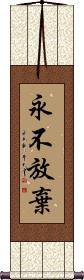
The first character means "eternal" or "forever", the second means "not" (together they mean "never"). The last two characters mean "give up" or "abandon". Altogether, you can translate this phrase as "never give up" or "never abandon".
Depending on how you want to read this, it is also a statement that you will never abandon your hopes, dreams, family or friends.
See Also... Undaunted | No Fear | Hope
Better Late Than NeverIt's Never Too Late Too Mend
wáng yáng bǔ láo yóu wèi wéi wǎn 망양보뢰유미위만
Long ago in what is now China, there were many kingdoms throughout the land. This time period is known as "The Warring States Period" by historians because these kingdoms often did not get along with each other.
Some time around 279 B.C. the Kingdom of Chu was a large, but not particularly powerful kingdom. Part of the reason it lacked power was the fact that the King was surrounded by "yes men" who told him only what he wanted to hear. Many of the King\’s court officials were corrupt and incompetent which did not help the situation.
The King was not blameless himself, as he started spending much of his time being entertained by his many concubines.
One of the King\’s ministers, Zhuang Xin, saw problems on the horizon for the Kingdom, and warned the King, "Your Majesty, you are surrounded by people who tell you what you want to hear. They tell you things to make you happy, and cause you to ignore important state affairs. If this is allowed to continue, the Kingdom of Chu will surely perish, and fall into ruins".
This enraged the King who scolded Zhuang Xin for insulting the country and accused him of trying to create resentment among the people. Zhuang Xin explained, "I dare not curse the Kingdom of Chu, but I feel that we face great danger in the future because of the current situation". The King was simply not impressed with Zhuang Xin\’s words. Seeing the King\’s displeasure with him and the King\’s fondness for his court of corrupt officials, Zhuang Xin asked permission of the King that he may take leave of the Kingdom of Chu, and travel to the State of Zhao to live. The King agreed, and Zhuang Xin left the Kingdom of Chu, perhaps forever.
Five months later, troops from the neighboring Kingdom of Qin invaded Chu, taking a huge tract of land. The King of Chu went into exile, and it appeared that soon, the Kingdom of Chu would no longer exist.
The King of Chu remembered the words of Zhuang Xin, and sent some of his men to find him. Immediately, Zhuang Xin returned to meet the King. The first question asked by the King was, "What can I do now?"
Zhuang Xin told the King this story:
A shepherd woke one morning to find a sheep missing. Looking at the pen saw a hole in the fence where a wolf had come through to steal one of his sheep. His friends told him that he had best fix the hole at once. But the Shepherd thought since the sheep is already gone, there is no use fixing the hole. The next morning, another sheep was missing. And the Shepherd realized that he must mend the fence at once. Zhuang Xin then went on to make suggestions about what could be done to reclaim the land lost to the Kingdom of Qin, and reclaim the former glory and integrity in the Kingdom of Chu.
The Chinese idiom shown above came from this reply from Zhuang Xin to the King of Chu almost 2,300 years ago. It translates roughly into English as... "Even if you have lost some sheep, it\’s never too late to mend the fence".
This phrase is often used in modern China when suggesting in a hopeful way that someone change their ways, or fix something in their life. It might be used to suggest fixing a marriage, quit smoking, or getting back on track after taking an unfortunate path in life among other things one might fix in their life.
I suppose in the same way that we might say, "Today is the first day of the rest of your life" in our western cultures to suggest that you can always start anew.
Note: This does have Korean pronunciation, but is not a well-known phrase in Korean (only Koreans familiar with ancient Chinese history would know it). Best if your audience is Chinese.
My Australian friends always say "No worries mate". It's caught on with me, though I drop the "mate" part since it confuses my fellow Americans.
If you would like to express the idea of "no worries" this is the best and most natural way to say it in Chinese.
The characters you see to the left can be translated as "put your mind at rest" or "to be at ease". You could literally translate "no worries" but it doesn't "flow" like this simple Chinese version.
For your info, the first character means to release, to free, to let go, to relax, or to rest. The second character means your heart or your mind.
Note that in Japanese and Korean, this holds the similar meaning of "peace of mind", but can also mean absentmindedness or carelessness depending on context.
Back to the top of this page
Open the Minds of the Next Generation To Stimulate Thinking
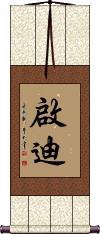
qǐ dí
This is another simple way to write "Phoenix" in Chinese. This is the specifically female element of phoenix, so this is how you write "female phoenix". This character is sometimes used to represent the female empress (many times in history, China was ruled by a woman, in much the same way queens came to power in Europe).
Note that the emperor is always represented as a dragon (not the male version of phoenix).
If you see yourself as a strong woman, this might be scroll for you to express "woman power" or "powerful woman" in a cool way.
Reincarnation / Transmigration of Souls
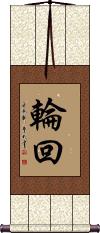
lún huí rin ne
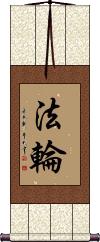
This is a universal word in Japanese and Chinese that expresses the Buddhist idea of "reincarnation", "transmigration of souls" or "the eternal cycle of birth and death". In some context, this can also mean "karma".
The first character means wheel, ring, turn, circle, loop or rotate. The second character can be thought of as a suffix meaning "-times". This second character can also refer to something that revolves, returns, goes back, or a counter for the number of occurrences of some event. Together the sum supersedes the parts and it means reincarnation. But knowing the seeing the essence of each character may help you understand some of the meaning behind the word.
If you request this selection from our Japanese master calligrapher, please expect that the second Kanji will look like the one shown to the right. This is the more common way to write this in Japanese. It's an alternate form of this character in Chinese (so neither way is technically wrong in either language).
See Also... Buddhism | Rebirth
Back to the top of this page
Rose Flowers Given, Frangrance Remains on Hands of Giver
zèng rén méi guī shǒu liú yú xiāng
Characters shown above are read vertically, starting from the right
This phrase has been translated several ways:
1. Roses given, fragrance in hand.
2. You present others roses, fragrance remains.
3. The fragrance of the rose always remains on the hand of those that bestow them.
4. A little bit of fragrance always clings to the hands which give the flowers
However, this literally translates as, "Give someone rose flowers, [your] hands keep [the] remaining fragrance".
Semper Fidelis / Always FaithfulU.S. Marines Slogan
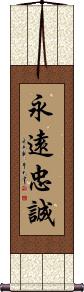
yǒng yuǎn zhōng chéng
This is the clearest and most natural way to translate "Semper Fidelis" or "Always Faithful" into Mandarin Chinese. This is specifically meant for U.S. Marines who often use the shortened term "Semper Fi".
The first two characters are a word that means always, forever, and/or eternally. The last two characters are a word that means fidelity, loyal, and/or devoted.
I spent 10 years in the Marines, so it was a no-brainer to add this to our calligraphy database.
Sincerity and Faithfulness
This word means sincere, solid, and faithful.
Back to the top of this page
God Is With You Always
shàn dì zǒng shì yǔ nǐ tóng zài
Characters shown above are read vertically, starting from the right
I was going to write this phrase as "God is with me always", but as a wall scroll, hanging in your room, it is talking to you (you're not talking), so it works better with you.
This is a nice phrase that any Chinese Christian would be happy to have on his/her wall.
If I annotate this, it sounds a little strange in English, but it's perfectly natural in Chinese:
上帝 God | 总是 always | 与 together with | 你 you | 同 together | 在 existing
Always Striving for Inner Strength
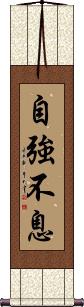
zì qiáng bú xī
This proverb or idiom suggests that the pursuit self-improvement is eternal. The first two characters mean inner-strength with the idea of self-improvement. The last two characters mean "never rest" or "striving without giving up".
Some will translate these four characters as, "Exert and strive hard without any let up".
Tai Chi Chuan / Tai Ji Quan
tài jí quán tai kyoku ken 태극권
This is the famous Taoist meditation and martial art exercise. The direct translation of these characters would be something like "grand ultimate fist", but that does not quite hit the mark for what this title really means.
An early-morning walk through any city in China near a park or open area will yield a view of Chinese people practicing this ancient technique.
The typical scene is an old man of no less than 80 years on this earth, with a wispy white beard and perhaps a sword in one hand. He makes slow moves that are impossibly smooth. He is steady-footed, and always in balance. For him, time is meaningless and proper form and technique is far more important than speed.
For the younger generation, faster moves may look impressive and seem smooth to the casual observer. But far more discipline and mental strength is needed to create perfectly smooth moves in virtual slow motion.
Note: There are two ways to Romanize these Chinese characters as seen in the title above. The pronunciation and actual characters are the same in Chinese. If you really used English sounds/words to pronounce this, it would be something like "tie jee chew-on" (just make the "chew-on" as one flowing syllable).
Back to the top of this page
This is the Chinese name for the Republic of China which is more commonly known as Taiwan. The island of Taiwan is actually considered a renegade province of mainland China. It became the last holdout of the former government of China after Chairman Mao took power during the revolution that followed WWII.
Note: There are two totally different ways two write the first character of Taiwan. They are not always considered Simplified and Traditional, but one is more simple than the other, so they fit that track. The more complex form is seen upper left of this box. The more simple form (looks like a house) can be seen to the right. If you want a certain style, please specify in the "special instructions" when you order.
See Also... Asia
Tao / Dao of the Heart / Soul
xīn dào
This means "The Way of the Heart" or "The Way of the Soul". The first character means "heart", but can also mean soul, spirit, mind, or your essence. In this case, it is most accurately translated with the heart or soul meaning.
The second character is Dao as in Daoism. Please note, this is the same thing as Tao as in Taoism (just Romanized differently - it's always been the same in Chinese for about 2300 years.
When Three People Gather, One Becomes a Teacher
sān rén xíng bì yǒu wǒ shī 삼인행유아사
Characters shown above are read vertically, starting from the right
This literally means, "when three people meet, one becomes the teacher".
This famous Chinese philosophy suggests that when people come together, they can always learn from each other.
One person must be the teacher and others learn. And in turn, the others become the teachers of the knowledge they posses.
It is important to remember that we all have something to teach, and we all have something to learn as well.
Back to the top of this page
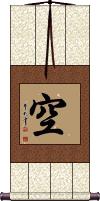
This means universe, cosmos or outer space in Chinese, Japanese Kanji, and old Korean Hanja. This can also mean air or midair depending on context. In Korean, this can mean eternity in some contexts.
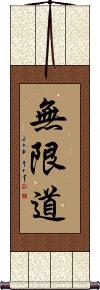
This means unlimited or unbounded. Literally, this means "without limits" or "without (being) bound".
A Traditional Warm Welcome
This would be the ultimate Chinese "welcome mat". Except it will be on your wall, and people will not step on it.
In a somewhat literal translation, you could say it means, "I feel happiness as I welcome you, as you have brought a shining light to this place with your arrival" or in a more simple way, "I am happy you've come as your presents really brightens up the place".
It has become common for this greeting to be announced by the staff upon the arrival of any customer in to a fancy store in China. You will also see these characters on the "welcome mats" in front of 4 and 5 star hotels in China.
Having this on a wall scroll is an extra nice touch. I have seen a few horizontal scrolls with this phrase on the wall behind the reception desk of better hotels, or near the front door of fine shops. At the most fancy department stores and restaurants in China, several greeters (almost always young women) will stand by the front door all wearing sashes with this phrase embroidered on them. As you walk in, they will bow and say "huan ying guang lin" to welcome you to the establishment.
Note: The first two and last two characters do make words in Korean Hanja, but seldom used as a sentence like this in Korean.
Back to the top of this page
Work Unselfishly for the Common Good
This can also mean: "Place Strict Standards on Oneself in Public Service". This Chinese phrase is often used to express how one should act as a government official. Most of us wish our public officials would hold themselves to higher standards. I wish I could send this scroll, along with the meaning to every member of Congress, and the President (or if I was from the UK, all the members of Parliament, and the PM)
The story behind this ancient Chinese idiom: A man named Cai Zun was born in China a little over 2000 years ago. In 24 AD, he joined an uprising led by Liu Xiu who later became the emperor of the Eastern Han Dynasty.
Later, the new emperor put Cai Zun in charge of the military court. Cai Zun exercised his power in strict accordance with military law, regardless of the offender's rank or background. He even ordered the execution of one of the emperor's close servants after the servant committed a serious crime.
Cai Zun led a simple life, but put great demands on himself to do all things in an honorable way. The emperor rewarded him for his honest character and honorable nature by promoting him to the rank of General and granting him the title of Marquis.
Whenever Cai Zun would receive an award, he would give credit to his men and share the reward with them. Cai Zun was always praised by historians who found many examples of his selfless acts that served the public interest. Sometime, long ago in history, people began to refer to Cai Zun as "ke ji feng gong".
See Also... Unselfish | Selflessness | Altruism
Zen / Chan / Meditation...as in Zen Buddhism
First let's correct something: The Japanese romanization for this character, "zen" has penetrated the English language. In English, it's almost always incorrectly used for phrases like "That's so zen". Nobody says "That's so meditation" - right? As the title of a sect, this would be like saying, "That's soooo Baptist!"
This character by itself just means "meditation". In that context, it should not be confined to use by any one religion or sect.
Regardless of the dictionary definition, more often than not, this character is associated with Buddhism. And here is one of the main reasons:
Zen is used as the title of a branch of Mahayana Buddhism which strongly emphasizes the practice of meditation.
However, it should be noted that Buddhism came from India, and "Chan Buddhism" evolved and developed in medieval China. The Chinese character "Chan" was eventually pronounced as "Zen" in Japanese. Chan Buddhists in China have a lot in common with Zen Buddhists in Japan.
More about the history of Zen Buddhism here.
Please also note that the Japanese Kanji character for zen has evolved a little in Japan, and the two boxes (kou) that you see at the top of the right side of the character have been replaced by three dots with tails. The original character would still be generally understood and recognized in Japanese (it's considered an ancient version in Japan), but if you want the specifically modern Japanese version, please click on the zen Kanji to the right. Technically, there is no difference in Tensho and Reisho versions of zen since they are ancient character styles that existed long before Japan had a written language.
There is also an alternate/shorthand/simplified Chinese version which has two dots or tails above the right-side radical. This version is also popular for calligraphy in China. If you want this version, just click the character to the right.
Further notes: Zen is just one of seven sects of Buddhism practiced in Japan. The others are 律 Ritsu (or Risshū), 法相 Hossō, 論 Sanron 華嚴 Kegon, 天台 Tendai, and 眞言 Shingon.
Goat / SheepYear of the Goat / Zodiac Sign
This is the character for goat or sheep in Chinese, old Korean, and Japanese.
If you were born in the year of the goat (sheep), you . . .
Are sophisticated and considerate Can always find the best solution to problems. Are tolerant. Are not afraid of hardship. Know how to save money (thrifty).
See also our Chinese Zodiac page.
Back to the top of this page
Together Forever
yǒng yuǎn zài yī qǐ
This is "together forever" in Chinese.
This is a great idea for couples making a commitment of a lifetime.
|