Many custom options...


And formats...



Sitting in Chinese / Japanese...
Buy a Sitting calligraphy wall scroll here!
Personalize your custom “Sitting” project by clicking the button next to your favorite “Sitting” title below...
3. Shikantaza
6. Choose Life
Sitting Quietly
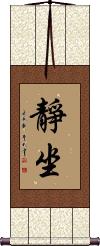
Alone, this word means quite sitting, to sit quietly, or to meditate.
If you add and change the context a bit, this could mean to stage a sit-in (perhaps a non-violent protest by Buddhist monks or people). But again, as a single word as calligraphy art, it is the sitting quietly in meditation meaning that will be perceived.
Sit in Meditation
Zazen
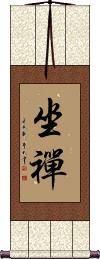
坐禪 describes the act of sitting in a state of deep meditation.
You'll notice that the second character is Chan/Zen (often used to title the meditative form of Buddhism).
In Korean Hanja, this means “religious meditation” (roughly the same as the Chinese definition).
Buddhists may define this as sitting in dhyāna, abstract meditation, fixed abstraction, or contemplation.
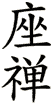 Japanese note: This will make sense in Japanese but the Kanji shown to the left are partially in ancient/traditional Japanese form. Japanese Buddhists may use 坐禪, 坐禅, 座禪, or 座禅. The most standard/modern Japanese form of this word is shown to the right. Click on the Kanji to the right (instead of the button above) if you want this specifically Japanese version.
Shikantaza
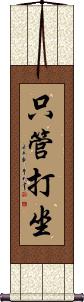
只管打坐 is the Japanese Buddhist term shikantaza which represents zazen meditation in which one focuses on sitting without actively seeking enlightenment.
Sometimes this is translated as “meditation of just sitting” or “meditation practice where one stays intensely focused without focusing on any particular object.”
Sometimes written, 祗管打坐 with the same pronunciation and perceived meaning.
Zen Contemplation
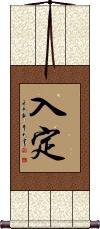
入定 is a title that can be defined as Zen contemplation in Japanese or sitting quietly in (Buddhist) meditation in Chinese. It also carries a similar meaning in Korean Hanja. Therefore, this is a universal term for meditation in the context of Buddhism throughout the Orient.
Can also be translated as “Meditatively equipoised” or “enter into meditation by stilling the karmic activities of deed, speech, and thought.”
The original Sanskrit word is samapanna. In Tibetan: snyoms par zhugs pa.
Sit Quietly in Meditation
A state of mind
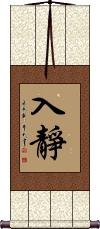
入靜 is used in Taoism and Qi Gong to describe the state you can reach while sitting quietly in meditation. It contains the idea of achieving a highly-tranquil and peaceful state. Some may describe this state as “sleeping while still awake.”
If you have a relaxation or meditation room, this is the calming wall scroll that you would want hanging in that room.
Choose Life
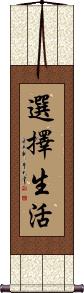
選擇生活 can mean to choose life instead of death (or suicide) or to choose to live life to the fullest.
I think of it as the key phrase used by Renton (Ewan McGregor) in the movie Trainspotting. While Chinese people will not think of Trainspotting when they see this phrase, for me, it will always be what comes near the end of this colorful rant:
Choose life. Choose a job. Choose a career. Choose a family. Choose a fucking big television. Choose washing machines, cars, compact disc players, and electrical tin can openers. Choose good health, low cholesterol, and dental insurance. Choose fixed-interest mortgage repayments. Choose a starter home. Choose your friends. Choose leisure wear and matching luggage. Choose a three-piece suite on-hire purchase in a range of fucking fabrics. Choose DIY and wondering who the fuck you are on a Sunday morning. Choose sitting on that couch watching mind-numbing, spirit-crushing game shows, stuffing fucking junk food into your mouth. Choose rotting away at the end of it all, pissing your last in a miserable home, nothing more than an embarrassment to the selfish, fucked-up brats you have spawned to replace yourself. Choose your future. Choose life.
This in-stock artwork might be what you are looking for, and ships right away...


Gallery Price: $60.00
Your Price: $36.88
These search terms might be related to Sitting:
Fate / Chance Meeting
Fortuitous Meeting
Not the results for sitting that you were looking for?
Below are some entries from our dictionary that may match your sitting search...
| Characters If shown, 2nd row is Simp. Chinese |
Pronunciation Romanization |
Simple Dictionary Definition |
東 东 see styles |
dōng dong1 tung yamato やまと |
More info & calligraphy: East(1) {mahj} east wind tile (chi: dōng); (2) {mahj} winning hand with a pung (or kong) of east wind tiles; (personal name) Yamato pūrva, east. |
坐禪 坐禅 see styles |
zuò chán zuo4 chan2 tso ch`an tso chan zazen |
More info & calligraphy: Sit in MeditationTo sit in dhyāna, i.e. abstract meditation, fixed abstraction, contemplation; its introduction to China is attributed to Bodhidharma (though it came earlier), and its extension to Tiantai. |
安禪 安禅 see styles |
ān chán an1 chan2 an ch`an an chan anzen |
More info & calligraphy: Reach Peace and Calm Through Meditation |
靜坐 静坐 see styles |
jìng zuò jing4 zuo4 ching tso seiza |
More info & calligraphy: Sitting Quietlyquiet sitting |
只管打坐 see styles |
zhǐ guǎn dǎ zuò zhi3 guan3 da3 zuo4 chih kuan ta tso shikan taza しかんたざ |
More info & calligraphy: Shikantazameditation of just sitting |
筵 see styles |
yán yan2 yen mushiro むしろ en えん |
bamboo mat for sitting (1) woven mat (esp. one made of straw); (2) (archaism) seat |
膝 see styles |
xī xi1 hsi hiza(p); hiza ひざ(P); ヒザ |
knee (1) knee; (2) lap; knee and thigh (while sitting) knee(s) |
鳧 凫 see styles |
fú fu2 fu keri けり kamo かも |
mallard; Anas platyrhyncha (kana only) gray-headed lapwing (Microsarcops cinereus); grey-headed lapwing; (1) (kana only) duck; (2) (kana only) easy mark; sucker; sitting duck |
鴨 鸭 see styles |
yā ya1 ya kamo かも |
duck (CL:隻|只[zhi1]); (slang) male prostitute (1) (kana only) duck; (2) (kana only) easy mark; sucker; sitting duck; (surname) Kamo a [wild] duck |
一席 see styles |
isseki いっせき |
sitting; feast; speech |
丈六 see styles |
zhàng liù zhang4 liu4 chang liu jouroku / joroku じょうろく |
(1) one jō and six shaku (4.85m); (2) statue of Buddha measuring one jō and six shaku; (3) sitting cross-legged; (place-name, surname) Jōroku Sixteen "feet", the normal height of a Buddha in his "transformation body" 化 身 nirmāṇa-kāya; said to be the height of the Buddha when he was on earth. |
下湯 see styles |
shimoyu しもゆ |
(1) sitz bath; sitting bath; bath for the lower half of the body; (2) lower pool (e.g. in an onsen); lower bath; (surname) Shimoyu |
両端 see styles |
ryoutan(p); ryouhashi; ryouhaji / ryotan(p); ryohashi; ryohaji りょうたん(P); りょうはし; りょうはじ |
(1) both ends; either end; both edges; (2) (りょうたん only) double-mindedness; sitting on the fence |
中乘 see styles |
zhōng shèng zhong1 sheng4 chung sheng chūjō |
The middle vehicle to nirvana, includes all intermediate or medial systems between Hīnayāna and Mahāyāna. It also corresponds with the state of a pratyekabuddha, who lives chiefly for his own salvation but partly for others, like a man sitting in the middle of a vehicle, leaving scarcely room for others. It is a definition made by Mahayanists unknown to Hīnayāna. |
中腰 see styles |
nakakoshi なかこし |
half-sitting posture; half-standing posture; half-rising posture; stooping position; (surname) Nakakoshi |
休場 see styles |
yasunba やすんば |
(n,vs,vi) (1) (temporary) closure (of a theater, entertainment venue, etc.); (n,vs,vt,vi) (2) absence (from a performance, match, etc.); sitting out; (n,vs,vt,vi) (3) {sumo} absence (from a bout or tournament); (n,vs,vi) (4) {stockm} holiday; closure (of a stock exchange); (place-name) Yasunba |
傍聴 see styles |
bouchou / bocho ぼうちょう |
(noun, transitive verb) listening (to a lecture, hearing, parliament session, etc.); attending (without participating); sitting in (e.g. on a meeting); observing |
傍観 see styles |
boukan / bokan ぼうかん |
(noun, transitive verb) looking on; standing by and watching; sitting back and watching; remaining a spectator |
兀坐 see styles |
wù zuò wu4 zuo4 wu tso gotsuza |
proper sitting meditation |
六行 see styles |
liù xíng liu4 xing2 liu hsing rokugyō |
Among Buddhists the term means the practice of the 六度 six pāramitās; it is referred, among outsiders, to the six austerities of the six kinds of heretics: (1) 自餓 starvation; (2) 投淵 naked cave-dwelling (or, throwing oneself down precipices); (3) 赴火 self-immolation, or self-torturing by fire; (4) 自坐 sitting naked in public; (5) 寂默 dwelling in silence among graves; (6) 牛狗 living as animals. |
共坐 see styles |
gòng zuò gong4 zuo4 kung tso gū za |
sitting together |
典座 see styles |
diǎn zuò dian3 zuo4 tien tso tenza; tenzo てんざ; てんぞ |
(Buddhism) the kitchen manager in a monastery; (Buddhism) (historical) monk responsible for various administrative and logistical duties {Buddh} (See 六知事) one of the six administrators of a Zen temple (in charge of food and other matters) The verger who indicates the order of sitting, etc. |
円座 see styles |
enza えんざ |
(n,vs,vi) sitting in circle; round straw mat; (place-name, surname) Enza |
出居 see styles |
dei / de でい |
(1) (archaism) sitting outdoors; (2) (See 寝殿造り) room that served both as a reception room and as a living room in a Heian-period mansion; (3) temporary sitting place installed in the garden at the imperial court, used on the occasion of archery or sumo ceremonies; (surname) Dei |
割座 see styles |
wariza わりざ |
sitting posture with the legs bent back on each side; Japanese traditional informal female sitting posture; w-sitting; reverse tailor style sitting |
半跏 see styles |
hanka はんか |
(abbreviation) (See 半跏趺坐) half lotus position (meditation posture); sitting with one foot placed on the opposite thigh |
危坐 see styles |
wéi zuò wei2 zuo4 wei tso kiza きざ |
(noun/participle) sitting up straight to sit without support |
危座 see styles |
kiza きざ |
(noun/participle) sitting up straight |
同坐 see styles |
douza / doza どうざ |
(noun/participle) sitting together; the same theater (theatre); involvement; entanglement; implication |
同席 see styles |
douseki / doseki どうせき |
(n,vs,adj-no,vi) (1) being present (at the same meeting, occasion, etc.); attendance (with); sitting with; sitting next to; (noun - becomes adjective with の) (2) same (seating) precedence; same rank |
Click here for more sitting results from our dictionary
The following table may be helpful for those studying Chinese or Japanese...
| Title | Characters | Romaji (Romanized Japanese) | Various forms of Romanized Chinese | |
| Sitting Quietly | 靜坐 静坐 | sei za / seiza | jìng zuò / jing4 zuo4 / jing zuo / jingzuo | ching tso / chingtso |
| Sit in Meditation | 坐禪 坐禅 | za zen / zazen | zuò chán / zuo4 chan2 / zuo chan / zuochan | tso ch`an / tsochan / tso chan |
| Shikantaza | 只管打坐 | shi kan ta za shikantaza | zhǐ guǎn dǎ zuò zhi3 guan3 da3 zuo4 zhi guan da zuo zhiguandazuo | chih kuan ta tso chihkuantatso |
| Zen Contemplation | 入定 | rù dìng / ru4 ding4 / ru ding / ruding | ju ting / juting | |
| Sit Quietly in Meditation | 入靜 入静 | rù jìng / ru4 jing4 / ru jing / rujing | ju ching / juching | |
| Choose Life | 選擇生活 选择生活 | xuǎn zé shēng huó xuan3 ze2 sheng1 huo2 xuan ze sheng huo xuanzeshenghuo | hsüan tse sheng huo hsüantseshenghuo |
|
| In some entries above you will see that characters have different versions above and below a line. In these cases, the characters above the line are Traditional Chinese, while the ones below are Simplified Chinese. | ||||

Successful Chinese Character and Japanese Kanji calligraphy searches within the last few hours...



