I am shipping orders on Thursday this week. News and More Info
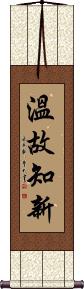
Buy a Learn New Ways From Old calligraphy wall scroll here!
Personalize your custom “Learn New Ways From Old” project by clicking the button next to your favorite “Learn New Ways From Old” title below...
New ideas coming from past history
溫故知新 is a proverb from Confucius that is used in Chinese, Japanese, and Korean cultures.
It can be translated in several ways:
Coming up with new ideas based on things learned in the past.
Examine things of the past, and obtain new knowledge.
Developing new ideas based on the study of the past.
Gain new insights through restudying old issues.
Understand the present by reviewing the past.
Learning from the past.
Review the old and know the new.
Taking a lesson from the past.
Taking a lesson from the wisdom of the ancients.
Follow the old ways.
The direct translation would be, “By asking old things, know new things.”
The Character meanings breakdown this way:
溫故 = ask old
知新 = know new
Explained: To learn new things that are outside of your experience, you can learn from old things of the past. You can find wisdom in history.
Note: Japanese use a variant of the first Kanji in modern times.
Therefore if you order this from a Japanese calligrapher, expect the first Kanji to look like 温 instead of 溫.
In addition to 温故知新 as mentioned above, this is sometimes written as 温古知新 in Japan.
This Chinese philosophy tells of how we continue to learn throughout our lives.
This proverb can be translated in a few ways such as “Study has no end,” “Knowledge is infinite,” “No end to learning,” “There's always something new to study,” or “You live and learn.”
The deeper meaning: Even when we finish school we are still students of the world gaining more knowledge from our surroundings with each passing day.
See Also: An Open Book Benefits Your Mind | Wisdom | Learn From Wisdom
氣功 or Qigong is the title of a technique that is somewhere between medical practice, meditation, and in some cases, religion.
The definition is blurred depending on which school of Qigong you are following. In some cases, it is even incorporated with martial arts.
Some people (even Chinese people) mix this title with Tai Chi (Tai Qi) exercises.
Lately, in China, people will claim to practice Tai Chi rather than Qigong because the Qigong title was recently used as a cover for an illegal pseudo-religious movement in China with the initials F.G. or F.D. (I can not write those names here for fear of our website being banned in China).
You can learn those names and more here: Further info about Qigong
If you are wondering why I wrote “Qi Gong” and “Chi Kung” as the title of this calligraphy entry, I should teach you a little about the various ways in which Chinese can be Romanized. One form writes this as “Chi Kung” or “Chikung” (Taiwan). In the mainland and elsewhere, it is Romanized as “Qi Gong” or “Qigong.” The pronunciation is the same in Taiwan, mainland, and Singapore Mandarin. Neither Romanization is exactly like English. If you want to know how to say this with English rules, it would be something like “Chee Gong” (but the “gong” has a vowel sound like the “O” in “go”).
Romanization is a really confusing topic and has caused many Chinese words to be mispronounced in the west. One example is “Kung Pao Chicken,” which should actually be more like “Gong Bao” with the “O” sounding like “oh” for both characters. Neither the Romanization system in Taiwan nor the Mainland is perfect, in my opinion, and leads to many misunderstandings.
In modern Japan, you may see this written as 気功, but the original 氣功 is still recognized. If you need the Japanese version, please contact me.
Past events not forgotten serve as teachers for later events.
The most literal translation to English of this ancient 前事不忘后事之师 Chinese proverb is:
“Past events not forgotten serve as teachers for later events.”
However, it's been translated several ways:
Don't forget past events, they can guide you in the future.
Benefit from past experience.
Past experience, if not forgotten, is a guide for the future.
Past calamity is my teacher.
A good memory for the past is a teacher for the future.
The remembrance of the past is the teacher of the future.
If one remembers the lessons of the past; They will serve as a guide to avoid mistakes in the future.
The origin:
This proverb comes from the 5th century B.C., just before the Warring States Period in the territory now known as China.
The head of the State of Jin, Zhi Bo, seized power in a coup. He did this with help from the armies of the State of Han and Wei. Instead of being grateful for the help from Han and Wei, he treacherously took the land of Han and Wei. Never satisfied, Zhi Bo employed the armies of Han and Wei to attack and seize the State of Zhao.
The king of Zhao took advice from his minister Zhang Mengtan and secretly contacted the Han and Wei armies to reverse their plans and attack the army of Zhi Bo instead. The plan was successful, and the State of Zhao was not only saved but was set to become a powerful kingdom in the region.
Zhang Mengtan immediately submitted his resignation to a confused king of Zhao. When asked why, Zhang Mengtan said, “I've done my duty to save my kingdom, but looking back at past experience, I know sovereign kings are never satisfied with the power or land at hand. They will join others and fight for more power and more land. I must learn from past experiences, as those experiences are the teachers of future events.”
The king could not dispute the logic in that statement and accepted Zhang Mengtan's resignation.
For generations, the State of Zhao continued to fight for power and land until finally defeated and decimated by the State of Qin (which led to the birth of the Qin Dynasty in 221 B.C.).
拳法 is a form of martial arts that can be translated in several ways.
Some will call it “fist principles,” “the way of the fist,” or even “law of the fist.” The first character literally means fist. The second can mean law, method, way, principle, or Buddhist teaching.
Kempo is really a potluck of martial arts. Often a combination of Chinese martial arts such as Shaolin Kung Fu with Japanese martial arts such as Karate, Jujutsu (Jujitsu), Aikido, and others. You may see the term “Kempo Karate,” which basically means Karate with other disciplines added. In this way, Kempo becomes an adjective rather than a title or school of martial arts.
These facts will long be argued by various masters and students of Kempo. Even the argument as to whether it should be spelled “kenpo” or “Kempo” ensues at dojos around the world (the correct Romaji should actually be “kenpou” if you precisely follow the rules).
The benefit of Kempo is that the techniques are easier to learn and master than pure Kung Fu (wu shu). Students are often taught basic Karate moves, kicks, and punches before augmenting the basic skills with complex Kung Fu techniques. This allows students of Kempo to achieve a level where they can defend themselves or fight in a relatively short amount of time (a few years rather than a decade or more).
Because the definition of this word is so fluid, I should make some notes here:
1. Purists in Okinawa will claim that “Okinawa Kenpo” or “Ryukyu Hon Kenpo” is the original and true version of this martial art from the old kingdom. It is actually little or no connection between Okinawa Kenpo and the way the word is used elsewhere.
2. In Chinese, where these characters are pronounced “quan fa” (sometimes Romanized as “chuan fa” because the Chinese-pinyin “q” actually sounds like an English “ch” sound), these characters do not hold the connotation of being a mixed martial art. It is simply defined as “the law of the fist.”
3. My Japanese dictionary oddly defines Kenpo as the “Chinese art of self-defense.” I personally don't feel this is the most common way that people perceive the word but just something you should know.
This in-stock artwork might be what you are looking for, and ships right away...
Gallery Price: $100.00
Your Price: $49.88
Below are some entries from our dictionary that may match your learn new ways from old search...
| Characters If shown, 2nd row is Simp. Chinese |
Pronunciation Romanization |
Simple Dictionary Definition |
脫亞入歐 脱亚入欧 see styles |
tuō yà rù ōu tuo1 ya4 ru4 ou1 t`o ya ju ou to ya ju ou |
to abandon the old (Asian) ways and learn from Europe; refers to the ideas that led to the Meiji Restoration and Japan's subsequent colonization projects in Asia |
The following table may be helpful for those studying Chinese or Japanese...
| Title | Characters | Romaji (Romanized Japanese) | Various forms of Romanized Chinese | |
| Learn New Ways From Old Onkochishin | 溫故知新 温故知新 | on ko chi shin onkochishin | wēn gù zhī xīn wen1 gu4 zhi1 xin1 wen gu zhi xin wenguzhixin | wen ku chih hsin wenkuchihhsin |
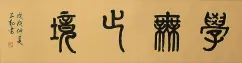
| Learning is Eternal | 學無止境 学无止境 | xué wú zhǐ jìng xue2 wu2 zhi3 jing4 xue wu zhi jing xuewuzhijing | hsüeh wu chih ching hsüehwuchihching |
|
| Qi Gong Chi Kung | 氣功 气功 | ki kou / kikou / ki ko | qì gōng / qi4 gong1 / qi gong / qigong | ch`i kung / chikung / chi kung |
| Past experience is the teacher for the future | 前事不忘后事之師 前事不忘后事之师 | qián shì bú wàng hòu shí zhī shī qian2 shi4 bu2 wang4 hou4 shi2 zhi1 shi1 qian shi bu wang hou shi zhi shi | ch`ien shih pu wang hou shih chih shih chien shih pu wang hou shih chih shih |
|
| Kenpo Kempo Quan Fa Chuan Fa | 拳法 | kenpou / kenpo | quán fǎ / quan2 fa3 / quan fa / quanfa | ch`üan fa / chüanfa / chüan fa |
| In some entries above you will see that characters have different versions above and below a line. In these cases, the characters above the line are Traditional Chinese, while the ones below are Simplified Chinese. | ||||
Successful Chinese Character and Japanese Kanji calligraphy searches within the last few hours...

All of our calligraphy wall scrolls are handmade.
When the calligrapher finishes creating your artwork, it is taken to my art mounting workshop in Beijing where a wall scroll is made by hand from a combination of silk, rice paper, and wood.
After we create your wall scroll, it takes at least two weeks for air mail delivery from Beijing to you.
Allow a few weeks for delivery. Rush service speeds it up by a week or two for $10!
When you select your calligraphy, you'll be taken to another page where you can choose various custom options.
The wall scroll that Sandy is holding in this picture is a "large size"
single-character wall scroll.
We also offer custom wall scrolls in small, medium, and an even-larger jumbo size.
Professional calligraphers are getting to be hard to find these days.
Instead of drawing characters by hand, the new generation in China merely type roman letters into their computer keyboards and pick the character that they want from a list that pops up.
There is some fear that true Chinese calligraphy may become a lost art in the coming years. Many art institutes in China are now promoting calligraphy programs in hopes of keeping this unique form
of art alive.
Even with the teachings of a top-ranked calligrapher in China, my calligraphy will never be good enough to sell. I will leave that to the experts.
The same calligrapher who gave me those lessons also attracted a crowd of thousands and a TV crew as he created characters over 6-feet high. He happens to be ranked as one of the top 100 calligraphers in all of China. He is also one of very few that would actually attempt such a feat.
Check out my lists of Japanese Kanji Calligraphy Wall Scrolls and Old Korean Hanja Calligraphy Wall Scrolls.
Some people may refer to this entry as Learn New Ways From Old Kanji, Learn New Ways From Old Characters, Learn New Ways From Old in Mandarin Chinese, Learn New Ways From Old Characters, Learn New Ways From Old in Chinese Writing, Learn New Ways From Old in Japanese Writing, Learn New Ways From Old in Asian Writing, Learn New Ways From Old Ideograms, Chinese Learn New Ways From Old symbols, Learn New Ways From Old Hieroglyphics, Learn New Ways From Old Glyphs, Learn New Ways From Old in Chinese Letters, Learn New Ways From Old Hanzi, Learn New Ways From Old in Japanese Kanji, Learn New Ways From Old Pictograms, Learn New Ways From Old in the Chinese Written-Language, or Learn New Ways From Old in the Japanese Written-Language.
104 people have searched for Learn New Ways From Old in Chinese or Japanese in the past year.
Learn New Ways From Old was last searched for by someone else on Oct 18th, 2025