Many custom options...


And formats...



Large Chinese in Chinese...
Buy a Large Chinese calligraphy wall scroll here!
Personalize your custom “Large Chinese” project by clicking the button next to your favorite “Large Chinese” title below...
1. Large River
3. Qian
4. Flourish and Blossom Everywhere
6. Lake
7. Tarzan
10. Legendary Turtle
11. Greatest Love
13. Tengu
14. Words Have Enormous Weight: One Word Worth Nine Caldrons
15. Holy Bible
16. Corinthians 13:4
Large River
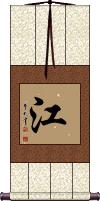
江 means large river in Chinese, Japanese Kanji, and old Korean Hanja. This generally refers to a river big enough that it's navigable by cargo boats, passenger boats, or small ships.
In Japanese, this can be a surname when pronounced as Minkou or just Kou.
Mighty / Powerful / Strong
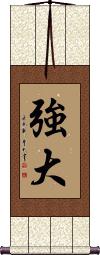
強大 can mean mighty, powerful, large, formidable, or strong.
This term is often used to describe soldiers/troops/warriors and whole armies.
Qian
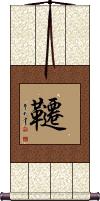
韆 can be a Chinese surname, Qian.
The meaning of this character can be thousand, a large quantity, or a swing.
Flourish and Blossom Everywhere
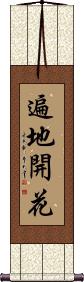
遍地開花 is a Chinese proverb that means “to blossom everywhere,” “to spring up all over the place,” or “to flourish on a large scale.”
遍地 = everywhere
開花 = opening flowers
No Limitations
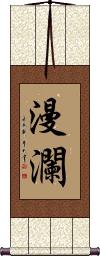
漫瀾 is the Chinese, Japanese Kanji, and old Korean Hanja for “Having no boundaries or limitations.”
This literally talks of the vastness of an ocean or river.
Character breakdown:
漫 = free; unrestrained; to inundate; overflowing; boundless.
澜 = swelling water; large wave.
Lake
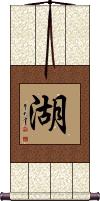
湖 means lake in Chinese, Japanese Kanji, and old Korean Hanja.
湖 is used in place names (like Lake Huron) and as a descriptive term for any large body of fresh water.
In Japanese, this can also be the female given name Reiku.
If your surname is Lake, this could be a good character for you.
Tarzan
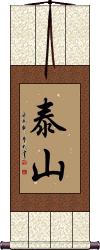
泰山 is Tarzan (a fictional character reared by apes in the jungle) in Mandarin Chinese.
The meaning of 泰山 is large mountain.
泰山 can also represent Taishan township in New Taipei City, Taiwan.
This can also be Mt. Taishan (or Tai Shan) in Shandong, the eastern sacred mountain of China.
In Japanese, this can be the surname Yasuyama or that same Mt. Taishan in China.
Value of Warrior Generals
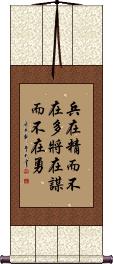
兵在精而不在多將在謀而不在勇 is a proverb that informs how it is better to have warriors of quality, rather than just a large quantity of warriors in your army/force.
This literally means: [Just as] warriors [are valued for their] quality and not [just] for quantity, [so] generals [are valued] for their tactics, not [just] for [their] bravery.
See Also: 兵在精而不在多
Prosperous Business
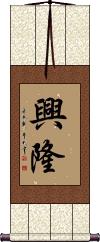
興隆 is a kind of prosperity that applies to a business. Something great to hang behind your desk if you are a small or large business owner. Doing so says that you either are a booming business or you wish success and prosperity for your business.
Can also be translated as thriving, flourishing, brisk business, and other words related to prosperity in business.
A good meaning in China but is a little antiquated in Japanese.
See Also: Prosperity
Legendary Turtle
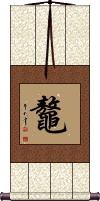
鼇 means “legendary turtle” in Chinese. 鼇 is a great mythological turtle that travels the seas. The creature is comparable to the dragon of China, however, it so happens that dragons became a bit more famous as history progressed. In modern Chinese, this character can just refer to a large sea turtle.
Note: 鼇 can be pronounced in Korean but this is a very rare Korean Hanja form - it hasn't been used in Korea for at least a few hundred years (even before they switched to Hangul characters).
Greatest Love
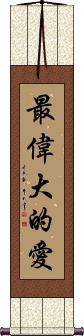
最偉大的愛 means “the greatest love” in Chinese.
Keeping in mind that Chinese is different than English, the first character is like “-est” or adding “the most” as a modifier to the next word.
The 2nd and 3rd characters mean great, mighty, and/or large.
The 4th is a possessive article.
The last is the character for love.
When you put it all together, you get a phrase that means the greatest love, enormous love, or the mightiest love.
Godai / Five Elements
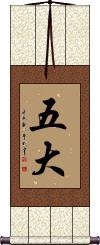
五大 is the Japanese title for the five elements.
In Japan, the five elements differ slightly from the original Chinese. Therefore, in Japanese philosophy, you have earth, water, fire, wind, and void (space).
The meaning of the first character is 5, but the second character means great or large. Some translate this as the five majors. 大 is only understood as “elements” when you have 五 in front of it.
In Buddhism, this can be short for 五大明王, or the five great and wise kings.
Tengu
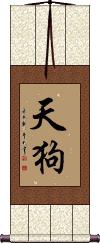
天狗 is the Japanese title for Tengu, which roughly translates as “heavenly dog.”
Tengu is a type of legendary creature found in Japanese folk religion and is also considered a type of Shinto god (kami) or yōkai (supernatural being).
The origin is Chinese, though this term is seldom used in Chinese anymore. It was a dog-like Chinese demon (Tiangou)
Although the title contains the word “dog,” the tengu are often depicted with human and bird-like characteristics. Sometimes they have large noses or beaks like birds.
Words Have Enormous Weight: One Word Worth Nine Caldrons
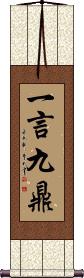
一言九鼎 is an ancient Chinese proverb used in modern times to talk of profound or powerful words.
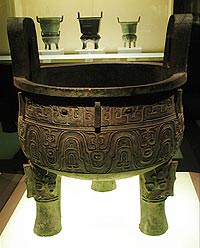 The literal meaning is “one word [worth] nine [sacred] tripods.” The tripod is a highly-prized three-legged (sometimes four-legged) metal pot or kettle of ancient China. They are often made of bronze, and the Emperor would have large ones gilded in gold. See the image to the right for an example.
Holy Bible
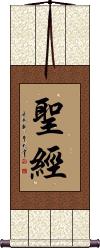
聖經 is how to write Bible in Chinese.
The first character means Holy, sacred, saint, or sage.
The second character means sacred book or scripture.
Each Sunday morning, if you are near a Catholic or Protestant Church, you will see plenty of Chinese people carrying their Bibles. Virtually every large or medium city in China has at least one Christian church. Beijing has about 14 Christian churches of Catholic and various Protestant denominations. That number doubles if you count all the church services that are for foreigners only and doubles again if you count all of the underground Christian Churches. Many Embassies (Canadian, Italian, French, etc.) offer Protestant and Catholic services. However, the U.S. Embassy is the most unfriendly in all of China, offering no such religious services, regularly denying entry, and kicking out Americans and others, whether or not they have official business.
Corinthians 13:4
All you need to know about LOVE
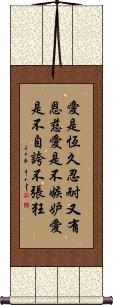
愛是恆久忍耐又有恩慈愛是不嫉妒愛是不自誇不張狂 is 1st Corinthians 13:4 in Chinese.
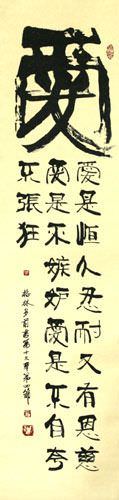
With large “love” character added.
In English, this reads:
1st Corinthians 13:4 (KJV) Charity suffereth long, and is kind; charity envieth not; charity vaunteth not itself, is not puffed up...
1st Corinthians 13:4 (NIV) Love is patient, love is kind. It does not envy, it does not boast, it is not proud.
1st Corinthians 13:4 (Basic English) Love is never tired of waiting; love is kind; love has no envy; love has no high opinion of itself, love has no pride.
The Chinese translation follows the love meaning, rather than the King James' use of “charity.” I was a little confused when writing this description with the significant differences between the NIV vs. KJV translations. After speaking to a Greek scholar about this, it would seem that the KJV has an almost errant translation with the use of “charity” in place of “love.”
We used the most popular Christian Chinese Bible, which is the Chinese Union Version (CUV). The CUV was first published in 1919. We use this so that the Chinese translation would be as accurate and standard as possible. Any Chinese Christian worth their salt will easily be able to identify this verse when they see these characters.
If you want a big “love” character written above the verse on your artwork, just make a note in the “special instructions” tab when you are customizing your artwork. There is no extra charge for that service on this special verse.
Better Late Than Never
It's Never Too Late Too Mend
Long ago in what is now China, there were many kingdoms throughout the land. This time period is known as “The Warring States Period” by historians because these kingdoms often did not get along with each other.
Sometime around 279 B.C. the Kingdom of Chu was a large but not particularly powerful kingdom. Part of the reason it lacked power was the fact that the King was surrounded by “yes men” who told him only what he wanted to hear. Many of the King's court officials were corrupt and incompetent which did not help the situation.
The King was not blameless himself, as he started spending much of his time being entertained by his many concubines.
One of the King's ministers, Zhuang Xin, saw problems on the horizon for the Kingdom, and warned the King, “Your Majesty, you are surrounded by people who tell you what you want to hear. They tell you things to make you happy and cause you to ignore important state affairs. If this is allowed to continue, the Kingdom of Chu will surely perish, and fall into ruins.”
This enraged the King who scolded Zhuang Xin for insulting the country and accused him of trying to create resentment among the people. Zhuang Xin explained, “I dare not curse the Kingdom of Chu but I feel that we face great danger in the future because of the current situation.” The King was simply not impressed with Zhuang Xin's words.
Seeing the King's displeasure with him and the King's fondness for his court of corrupt officials, Zhuang Xin asked permission from the King that he may take leave of the Kingdom of Chu, and travel to the State of Zhao to live. The King agreed, and Zhuang Xin left the Kingdom of Chu, perhaps forever.
Five months later, troops from the neighboring Kingdom of Qin invaded Chu, taking a huge tract of land. The King of Chu went into exile, and it appeared that soon, the Kingdom of Chu would no longer exist.
The King of Chu remembered the words of Zhuang Xin and sent some of his men to find him. Immediately, Zhuang Xin returned to meet the King. The first question asked by the King was “What can I do now?”
Zhuang Xin told the King this story:
A shepherd woke one morning to find a sheep missing. Looking at the pen saw a hole in the fence where a wolf had come through to steal one of his sheep. His friends told him that he had best fix the hole at once. But the Shepherd thought since the sheep is already gone, there is no use fixing the hole.
The next morning, another sheep was missing. And the Shepherd realized that he must mend the fence at once. Zhuang Xin then went on to make suggestions about what could be done to reclaim the land lost to the Kingdom of Qin, and reclaim the former glory and integrity of the Kingdom of Chu.
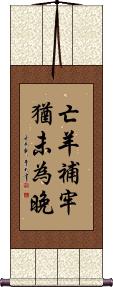
The Chinese idiom shown above came from this reply from Zhuang Xin to the King of Chu almost 2,300 years ago.
It translates roughly into English as...
“Even if you have lost some sheep, it's never too late to mend the fence.”
This proverb, 亡羊补牢犹未为晚, is often used in modern China when suggesting in a hopeful way that someone change their ways, or fix something in their life. It might be used to suggest fixing a marriage, quitting smoking, or getting back on track after taking an unfortunate path in life among other things one might fix in their life.
I suppose in the same way that we might say, “Today is the first day of the rest of your life” in our western cultures to suggest that you can always start anew.
Note: This does have Korean pronunciation but is not a well-known proverb in Korean (only Koreans familiar with ancient Chinese history would know it). Best if your audience is Chinese.
This in-stock artwork might be what you are looking for, and ships right away...
Gallery Price: $240.00
Your Price: $148.88

Gallery Price: $240.00
Your Price: $148.88

Gallery Price: $400.00
Your Price: $138.88
Gallery Price: $520.00
Your Price: $288.88
Gallery Price: $472.20
Your Price: $198.88
Gallery Price: $472.20
Your Price: $198.88


Gallery Price: $196.00
Your Price: $108.88
Gallery Price: $520.00
Your Price: $288.88
Gallery Price: $240.00
Your Price: $148.88
Gallery Price: $240.00
Your Price: $148.88
The following table may be helpful for those studying Chinese or Japanese...
| Title | Characters | Romaji (Romanized Japanese) | Various forms of Romanized Chinese | |
| Large River | 江 | kou / ko | jiāng / jiang1 / jiang | chiang |
| Mighty Powerful Strong | 強大 强大 | kyoudai / kyodai | qiáng dà / qiang2 da4 / qiang da / qiangda | ch`iang ta / chiangta / chiang ta |
| Qian | 韆 千 | qiān / qian1 / qian | ch`ien / chien | |
| Flourish and Blossom Everywhere | 遍地開花 遍地开花 | biàn dì kāi huā bian4 di4 kai1 hua1 bian di kai hua biandikaihua | pien ti k`ai hua pientikaihua pien ti kai hua |
|
| No Limitations | 漫瀾 漫澜 | man ran / manran | màn lán / man4 lan2 / man lan / manlan | |
| Lake | 湖 | mizumi | hú / hu2 / hu | |
| Tarzan | 泰山 | yasuyama | tài shān / tai4 shan1 / tai shan / taishan | t`ai shan / taishan / tai shan |
| Value of Warrior Generals | 兵在精而不在多將在謀而不在勇 兵在精而不在多将在谋而不在勇 | bīng zài jīng ér bú zài duō jiàng zài móu ér bú zài yǒng bing1 zai4 jing1 er2 bu2 zai4 duo1 jiang4 zai4 mou2 er2 bu2 zai4 yong3 bing zai jing er bu zai duo jiang zai mou er bu zai yong | ping tsai ching erh pu tsai to chiang tsai mou erh pu tsai yung | |
| Prosperous Business | 興隆 兴隆 | kou ryuu / kouryuu / ko ryu | xīng lóng xing1 long2 xing long xinglong | hsing lung hsinglung |
| Legendary Turtle | 鼇 | áo / ao2 / ao | ||
| Greatest Love | 最偉大的愛 最伟大的爱 | zuì wěi dà de ài zui4 wei3 da4 de ai4 zui wei da de ai zuiweidadeai | tsui wei ta te ai tsuiweitateai |
|
| Godai Five Elements | 五大 | godai | wǔ dà / wu3 da4 / wu da / wuda | wu ta / wuta |
| Tengu | 天狗 | ten gu / tengu | tiān gǒu / tian1 gou3 / tian gou / tiangou | t`ien kou / tienkou / tien kou |
| Words Have Enormous Weight: One Word Worth Nine Caldrons | 一言九鼎 | yī yán jiǔ dǐng yi1 yan2 jiu3 ding3 yi yan jiu ding yiyanjiuding | i yen chiu ting iyenchiuting |
|
| Holy Bible | 聖經 圣经 | shèng jīng sheng4 jing1 sheng jing shengjing | sheng ching shengching |
|
| Corinthians 13:4 | 愛是恆久忍耐又有恩慈愛是不嫉妒愛是不自誇不張狂 爱是恒久忍耐又有恩慈爱是不嫉妒爱是不自夸不张狂 | ài shì héng jiǔ rěn nài yòu yǒu én cí ài shì bú jì dù ài shì bú zì kuā bù zhāng kuáng ai4 shi4 heng2 jiu3 ren3 nai4 you4 you3 en2 ci2 ai4 shi4 bu2 ji4 du4 ai4 shi4 bu2 zi4 kua1 bu4 zhang1 kuang2 ai shi heng jiu ren nai you you en ci ai shi bu ji du ai shi bu zi kua bu zhang kuang | ai shih heng chiu jen nai yu yu en tz`u ai shih pu chi tu ai shih pu tzu k`ua pu chang k`uang ai shih heng chiu jen nai yu yu en tzu ai shih pu chi tu ai shih pu tzu kua pu chang kuang |
|
| Better Late Than Never | 亡羊補牢猶未為晚 亡羊补牢犹未为晚 | wáng yáng bǔ láo yóu wèi wéi wǎn wang2 yang2 bu3 lao2 you2 wei4 wei2 wan3 wang yang bu lao you wei wei wan | wang yang pu lao yu wei wei wan wangyangpulaoyuweiweiwan |
|
| In some entries above you will see that characters have different versions above and below a line. In these cases, the characters above the line are Traditional Chinese, while the ones below are Simplified Chinese. | ||||

Successful Chinese Character and Japanese Kanji calligraphy searches within the last few hours...



