Many custom options...


And formats...



Instrument in Chinese / Japanese...
Buy an Instrument calligraphy wall scroll here!
Personalize your custom “Instrument” project by clicking the button next to your favorite “Instrument” title below...
Viola
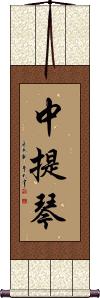
中提琴 is the Chinese title for the stringed musical instrument known in English as the viola.
Khánh
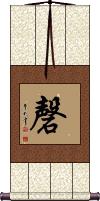
磬 means “chime stones,” but I'm including it here for those looking for the original Chinese character for the Vietnamese name Khánh.
Other definitions include ancient percussion instrument made of stone or jade pieces hung in a row and struck as a xylophone, sounding stone, ancient Chinese chime shaped like a chevron.
There is also a possibility that your original character is 慶 which means to celebrate or felicity. Contact me if you need that character.
Nguyen / Ruan
Surname
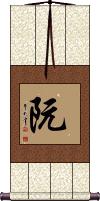
阮 is the original Chinese character that represented the Vietnamese surname Nguyễn before Vietnam stopped using Chinese characters and romanized their language. It is probably the most common surname in all of Vietnam. While romanized as Nguyen, it sounds more like the English word “Win” or “When.” 阮 can also represent the Nguyen Dynasty in Vietnam, which lasted from 1802 to 1945.
阮 is also the Chinese surname Ruan, most Chinese with this surname have ancestors from a small state named Ruan during the Shang Dynasty (1600-1046 BC) located in the southeast of modern-day Gansu Province.
In Japanese, this can be the rare surnames pronounced Min, Gen, Ken, Gan, or En.
Besides a surname, this character also represents an ancient musical instrument.
Not the results for instrument that you were looking for?
Below are some entries from our dictionary that may match your instrument search...
| Characters If shown, 2nd row is Simp. Chinese |
Pronunciation Romanization |
Simple Dictionary Definition |
磬 see styles |
qìng qing4 ch`ing ching kei / ke けい |
More info & calligraphy: Khánhsounding stone; qing; ancient Chinese chime shaped like a chevron (inverted 'v'), orig. of stone, today often metal, in Japan primarily used at Buddhist temples; (given name) Kei A piece of flat stone or metal, used as a gong, or for musical percussion. |
びり see styles |
hiri ヒリ |
piri (Korean double reed instrument) (kor:); (place-name) Hili (Pakistan) |
咪咪 see styles |
mī mī mi1 mi1 mi mi |
More info & calligraphy: Mimi |
ストリングス see styles |
sutoringusu ストリングス |
More info & calligraphy: Strings |
具 see styles |
jù ju4 chü tomo とも |
tool; device; utensil; equipment; instrument; talent; ability; to possess; to have; to provide; to furnish; to state; classifier for devices, coffins, dead bodies (1) tool; means; (2) ingredients (added to soup, rice, etc.); (counter) (3) counter for sets of armor, utensils, furniture, etc.; (female given name) Tomo All; complete; to present; implements; translit. gh. |
吹 see styles |
chuī chui1 ch`ui chui fuki ふき |
to blow; to play a wind instrument; to blast; to puff; to boast; to brag; to end in failure; to fall through (surname) Fuki To blow; puff, praise. |
嘂 see styles |
jiào jiao4 chiao |
old variant of 叫[jiao4]; ancient musical instrument similar to ocarina |
器 see styles |
qì qi4 ch`i chi utsuwa うつわ |
device; tool; utensil; CL:臺|台[tai2] (n,n-suf) (1) device; instrument; (n,n-suf) (2) vessel; container; (3) ability; capacity; calibre; caliber; (given name) Utsuwa A vessel, utensil, tool. |
塤 埙 see styles |
xūn xun1 hsün |
ocarina; wind instrument consisting of an egg-shaped chamber with holes |
壎 see styles |
xūn xun1 hsün |
ancient porcelain wind-instrument |
弦 see styles |
xián xian2 hsien yuzuru ゆずる |
bow string; string of musical instrument; watchspring; chord (segment of curve); hypotenuse; CL:根[gen1] (1) bowstring; (2) (See 絃・1) string (of a shamisen, etc.); stringed instrument; (3) {math} chord; (4) (rare) {geom} (See 斜辺) hypotenuse; (female given name) Yuzuru |
彈 弹 see styles |
tán tan2 t`an tan dan |
to pluck (a string); to play (a string instrument); to spring or leap; to shoot (e.g. with a catapult); (of cotton) to fluff or tease; to flick; to flip; to accuse; to impeach; elastic (of materials) A bullet, shot; to strum, snap; repress, impeach; translit. dan. |
搊 see styles |
chōu chou1 ch`ou chou |
pluck (stringed instrument) |
撥 拨 see styles |
bō bo1 po hatsu ばち |
to push aside with the hand, foot, a stick etc; to dial; to allocate; to set aside (money); to poke (the fire); to pluck (a string instrument); to turn round; classifier: group, batch (1) plectrum; pick; (2) drumstick for Japanese drums (e.g. taiko) To spread, open out, scatter, disseminate, detach, uproot. |
敔 see styles |
yǔ yu3 yü |
percussion instrument shaped as a hollow wooden tiger, with serrated strip across the back, across which one runs a drumstick |
斠 see styles |
jiào jiao4 chiao |
(old) instrument to even out the grain in a measuring vessel; to proofread; to collate |
柷 see styles |
zhù zhu4 chu |
percussion instrument, a tapering wooden box struck on the inside with a wooden stick |
檠 see styles |
qíng qing2 ch`ing ching |
instrument for straightening bows |
琴 see styles |
qín qin2 ch`in chin kotomi ことみ |
guqin 古琴[gu3 qin2] (a type of zither); musical instrument in general qin (7-stringed Chinese zither); guqin; (female given name) Kotomi lute |
竽 see styles |
yú yu2 yü u う |
free reed wind instrument similar to the sheng 笙[sheng1], used in ancient China (hist) yu; free reed wind instrument used in ancient China and Nara-period Japan |
笙 see styles |
shēng sheng1 sheng shouno / shono しょうの |
sheng, a free reed wind instrument with vertical bamboo pipes traditional Japanese wind instrument resembling panpipes; free-reed instrument used in Japanese court music; (female given name) Shouno |
筑 see styles |
zhù zhu4 chu tsuku つく |
five-string lute; Taiwan pr. [zhu2] (hist) zhu (ancient Chinese string instrument); (surname) Tsuku |
箏 筝 see styles |
zhēng zheng1 cheng sou / so そう koto こと |
see 古箏|古筝[gu3 zheng1] (1) koto (13-stringed Japanese zither); (2) zheng (Chinese zither); guzheng; (1) koto (13-stringed Japanese zither); (2) (archaism) stringed instrument; (3) zheng (Chinese zither); guzheng |
簧 see styles |
huáng huang2 huang shita した |
reed (of a music instrument); spring; coil (See リード) reed (of a musical instrument) |
絃 see styles |
xián xian2 hsien ito いと |
variant of 弦; bow string; string of musical instrument; watch spring; chord (straight line joining two points on a curve); hypotenuse (1) (See 弦・げん・2) string (of a shamisen, etc.); (2) stringed instrument; (female given name) Ito |
舌 see styles |
shé she2 she zetsu ぜつ |
tongue (1) tongue; (2) tongue-like object; clapper (of a bell); talon (of a lock); reed (of a musical instrument); (surname) Zetsu jihvā, 時乞縛; the tongue. |
號 号 see styles |
hào hao4 hao gou / go ごう |
ordinal number; day of a month; mark; sign; business establishment; size; ship suffix; horn (wind instrument); bugle call; assumed name; to take a pulse; classifier used to indicate number of people (n,n-suf) (1) number; edition; make; model; issue; part of that group; (2) sobriquet; pen-name; (suffix) (3) suffix attached to names of ships, trains, airplanes, etc.; (personal name) Gou To roar, call, cry, scream; sign, mark, designation. |
鑱 镵 see styles |
chán chan2 ch`an chan |
sharp instrument for digging |
三弦 see styles |
sān xián san1 xian2 san hsien sangen さんげん |
sanxian, large family of 3-stringed plucked musical instruments, with snakeskin covered wooden soundbox and long neck, used in folk music, opera and Chinese orchestra three-stringed instrument; samisen |
三絃 see styles |
sangen さんげん |
three-stringed instrument; samisen |
Click here for more instrument results from our dictionary
The following table may be helpful for those studying Chinese or Japanese...
| Title | Characters | Romaji (Romanized Japanese) | Various forms of Romanized Chinese | |
| Viola | 中提琴 | zhōng tí qín zhong1 ti2 qin2 zhong ti qin zhongtiqin | chung t`i ch`in chungtichin chung ti chin |
|
| Khánh | 磬 | kei / ke | qìng / qing4 / qing | ch`ing / ching |
| Nguyen Ruan | 阮 / 阮 阮 | Min / Gen | ruǎn / ruan3 / ruan | juan |
| In some entries above you will see that characters have different versions above and below a line. In these cases, the characters above the line are Traditional Chinese, while the ones below are Simplified Chinese. | ||||

Successful Chinese Character and Japanese Kanji calligraphy searches within the last few hours...



