Many custom options


And formats



Consciousness of Self in Chinese / Japanese
Buy a Consciousness of Self calligraphy wall scroll here!
Personalize your custom “Consciousness of Self” project by clicking the button next to your favorite “Consciousness of Self” title below.
Consciousness of Self
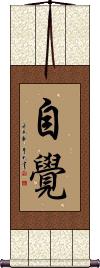
自覺 is the idea of being conscious, self-aware, and sometimes “on one's own initiative.”
 After WWII, they started using a simplified form of the second Kanji for this word in Japan. That version is shown to the right, and you can click on that Kanji if you want the modern Japanese form. Otherwise, the characters shown in the upper left are the correct ones for ancient/old/traditional Chinese, Japanese, and Korean.
Self Consciousness
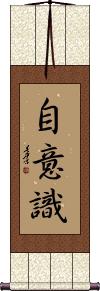
自意識 is the idea of being conscious and self-aware in Japanese Kanji and old Korean Hanja.
This is not a normal word in Chinese.
Kensho - Initial Enlightenment
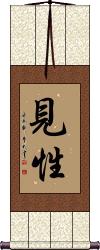
見性 has the same meaning as Satori but refers to the initial state or initial experience of enlightenment.
This can also mean “self-discovery,” “self-awareness,” or “consciousness of one's character.”
In a very religious context, this means to behold the Buddha nature within oneself.
This term is exclusively used by devout Buddhists. It is not a common term, and remains an unknown concept to most Japanese and Chinese people. Some Japanese people will dispute whether this title is valid in the Japanese language. Only order this if you are sure this title is right for you.
See Also: Buddhism | Enlightenment
This in-stock artwork might be what you are looking for, and ships right away...


Not the results for consciousness of self that you were looking for?
Below are some entries from our dictionary that may match your consciousness of self search:
| Characters If shown, 2nd row is Simp. Chinese |
Pronunciation Romanization |
Simple Dictionary Definition |
見性 见性 see styles |
jiàn xìng jian4 xing4 chien hsing kenshou / kensho けんしょう |
More info & calligraphy: Kensho - Initial EnlightenmentTo behold the Buddha-nature within oneself, a common saying of the Chan (Zen) or Intuitive School. |
自意識 see styles |
jiishiki / jishiki じいしき |
More info & calligraphy: Self Consciousness |
五智 see styles |
wǔ zhì wu3 zhi4 wu chih gochi ごち |
(place-name, surname) Gochi The five kinds of wisdom of the 眞言宗 Shingon School. Of the six elements 六大 earth, water, fire, air (or wind), ether (or space) 曇空, and consciousness (or mind 識 ), the first five form the phenomenal world, or Garbhadhātu, the womb of all things 胎藏界, the sixth is the conscious, or perceptive, or wisdom world, the Vajradhātu 金剛界, sometimes called the Diamond realm. The two realms are not originally apart, but one, and there is no consciousness without the other five elements. The sixth element, vijñāna, is further subdivided into five called the 五智 Five Wisdoms: (1) 法界體性智 dharmadhātu-prakṛti-jñāna, derived from the amala-vijñāna, or pure 識; it is the wisdom of the embodied nature of the dharmadhātu, defined as the six elements, and is associated with Vairocana 大日, in the centre, who abides in this samādhi; it also corresponds to the ether 空 element. (2) 大圓鏡智 adarśana-jñāna, the great round mirror wisdom, derived from the ālaya-vijñāna, reflecting all things; corresponds to earth, and is associated with Akṣobhya and the east. (3) 平等性智 samatā-jñāna, derived from mano-vijñāna, wisdom in regard to all things equally and universally; corresponds to fire, and is associated with Ratnasaṃbhava and the south. (4) 妙觀察智 pratyavekṣaṇa-jñāna, derived from 意識, wisdom of profound insight, or discrimination, for exposition and doubt-destruction; corresponds to water, and is associated with Amitābha and the west. (5) 成所作智 kṛtyānuṣṭhāna-jñāna, derived from the five senses, the wisdom of perfecting the double work of self-welfare and the welfare of others; corresponds to air 風 and is associated with Amoghasiddhi and the north. These five Dhyāni-Buddhas are the 五智如來. The five kinds of wisdom are the four belonging to every Buddha, of the exoteric cult, to which the esoteric cult adds the first, pure, all-refecting, universal, all-discerning, and all-perfecting. |
八識 八识 see styles |
bā shì ba1 shi4 pa shih hasshiki; hachishiki はっしき; はちしき |
{Buddh} eight consciousnesses (one for each of the five senses, consciousness of the mind, self-consciousness and store consciousness) The eight parijñāna, or kinds of cognition, perception, or consciousness. They are the five senses of cakṣur-vijñāna, śrotra-v., ghrāna-v., jihvā-v., and kāya-v., i.e. seeing, hearing, smelling, tasting, and touch. The sixth is mano-vijñāna, the mental sense, or intellect, v. 末那. It is defined as 意 mentality, apprehension, or by some as will. The seventh is styled kliṣṭa-mano-vijñāna 末那識 discriminated from the last as 思量 pondering, calculating; it is the discriminating and constructive sense, more than the intellectually perceptive; as infected by the ālaya-vijñāna., or receiving "seeds" from it, it is considered as the cause of all egoism and individualizing, i.e. of men and things, therefore of all illusion arising from assuming the seeming as the real. The eighth is the ālaya-vijñāna, 阿頼耶識 which is the storehouse, or basis from which come all "seeds"of consciousness. The seventh is also defined as the ādāna 阿陀那識 or "laying hold of" or "holding on to" consciousness. |
末那 see styles |
mò nà mo4 na4 mo na mana まな |
{Buddh} (See 末那識) manas (defiled mental consciousness, which gives rise to the perception of self) manāḥ; manas; intp. by 意 mind, the (active) mind. Eitel says: 'The sixth of the chadâyatana, the mental faculty which constitutes man as an intelligent and moral being. ' The 末那識 is defined by the 唯識論 4 as the seventh of the 八識, namely 意, which means 思量 thinking and measuring, or calculating. It is the active mind, or activity of mind, but is also used for the mind itself. |
自覚 see styles |
jigaku じがく |
(noun, transitive verb) self-consciousness; self-awareness; (surname) Jigaku |
末那識 末那识 see styles |
mò nà shì mo4 na4 shi4 mo na shih manashiki まなしき |
{Buddh} manas-vijnana (defiled mental consciousness, which gives rise to the perception of self) (Skt. manas) |
染汚意 染污意 see styles |
rǎn wū yì ran3 wu1 yi4 jan wu i zenma i |
A name for the seventh vijñāna, the mind of contamination, i. e. in egoism, or wrong notions of the self. |
無分別心 无分别心 see styles |
wú fēn bié xīn wu2 fen1 bie2 xin1 wu fen pieh hsin mu funbetsu shin |
The mind free from particularization, especially from affection and feelings; passionless; translates avikalpa; (a) unconditioned or absolute, as in the 眞如; (b) conditioned, as in dhyāna. Particularization includes memory, reason, self-consciousness; the mind free from particularization is free from these. |
第二能變 第二能变 see styles |
dì èr néng biàn di4 er4 neng2 bian4 ti erh neng pien daini nōhen |
The second power of change, the kliṣṭamano-vijñāna, disturbed-mind, consciousness, or self-consciousness which gives form to the universe. The first power of change is the ālaya-vijñāna. |
自己意識 see styles |
jikoishiki じこいしき |
self-consciousness |
自我意識 自我意识 see styles |
zì wǒ yì shí zi4 wo3 yi4 shi2 tzu wo i shih jigaishiki じがいしき |
self-awareness self-consciousness |
自意識過剰 see styles |
jiishikikajou / jishikikajo じいしきかじょう |
(n,adj-no,adj-na) excessive self-consciousness; excessively self-conscious person |
The following table may be helpful for those studying Chinese or Japanese:
| Title | Characters | Romaji (Romanized Japanese) | Various forms of Romanized Chinese | |
| Consciousness of Self | 自覺 自觉 / 自覚 | jikaku | zì jué / zi4 jue2 / zi jue / zijue | tzu chüeh / tzuchüeh |
| Self Consciousness | 自意識 自意识 | jiishiki / jishiki | ||
| Kensho - Initial Enlightenment | 見性 见性 | ken shou / kenshou / ken sho | jiàn xìng jian4 xing4 jian xing jianxing | chien hsing chienhsing |
| In some entries above you will see that characters have different versions above and below a line. In these cases, the characters above the line are Traditional Chinese, while the ones below are Simplified Chinese. | ||||

Successful Chinese Character and Japanese Kanji calligraphy searches within the last few hours...



