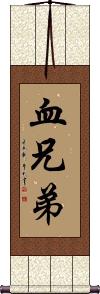
Buy a Blood Brother calligraphy wall scroll here!
Personalize your custom “Blood Brother” project by clicking the button next to your favorite “Blood Brother” title below...
1. Big Brother / Elder Brother
2. Blood
4. Big Brother
9. Brothers
10. The More We Sweat in Training, The Less We Bleed in Battle
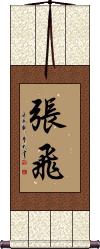
11. Zhang Fei
12. Fraternity
13. Vampire
14. Sincere Heart
16. Penis
17. Hua Mulan
血液 is the word for blood (liquid blood) in Chinese, Japanese Kanji, and old Korean Hanja.
兄弟 is a Chinese, Japanese Kanji, and old Korean Hanja title for brothers.
Some notes: It's kind of an uncommon title for a wall scroll.
In Chinese, this is usually understood as brothers. In Japanese, it can extend to mean “brothers and sisters” or siblings.
There is more than one way to translate the ancient Chinese military proverb, 平时多流汗战时少流血. Here are a few interpretations:
A drop of sweat spent in a drill is a drop of blood saved in war.
More practice will give one a better chance of success in real situations.
The more you sweat in training, the less you bleed in battle.
I heard this many times when I was a U.S. Marine but I had no idea at the time that it was actually an old Chinese proverb.
See Also: Blood Sweat and Tears
University Brotherhood / House
吸血鬼 is how to say “vampire” in Chinese, Japanese Kanji, and old Korean Hanja.
Quite literally, this means “Suck Blood Ghost” or, more naturally, in English, “Ghost Who Sucks Blood.” This title is also used for leeches and blood-sucking vermin.
Just like the word “vampire” in English, this title is used in Asian languages colloquially to refer to “cruel exploiters,” and especially in China, it can be used to refer to “capitalists exploiting the workers.”
Alone on a wall scroll, this will be understood with just the “vampire” or “bloodsucker” meaning.
When you take 血心 apart, you find the sum is slightly different than the parts. The first character means blood, and the second means heart. It is important to note that for thousands of years, it was believed that your heart was both your soul and your mind in Asian culture. When you add blood to the heart, it is your whole being - the pure and clean dedication of your whole soul.
Most Chinese dictionaries define this as the sincerity of heart or a MEDICAL TERM!!!
Please think carefully before ordering this selection - it was only added as others have used this for coffee cups and other novelties (though perhaps naively).
NOT APPROPRIATE FOR
CUSTOM CALLIGRAPHY
陰莖 is the most common title for penis in Chinese. There are at least 10 more ways to express “penis.”
A colloquial term used commonly in Chinese is “little brother.”
This selection is not appropriate for custom calligraphy. I only added this entry because thousands of people searched for penis on our website. You guys are weird!
Another way to say penis is "male root," pronounced "nán gēn" in Chinese, "dan kon" in Japanese, and 남근 or "nam geun" in Korean. This is shown to the right.
花木蘭 is the name of the famous Chinese woman warrior Hua Mulan.
She was made famous in the west by Disney's animated movie, “Mulan.”
Most of the historical information about her comes from an ancient poem. It starts with a concerned Mulan, as she is told a man from each family is to serve conscription in the army. Her father is too old, and her brother is too young. Mulan decides to take the place of her father. After twelve years of war, the army returns, and the best warriors are awarded great posts in the government and riches. Mulan turns down all offers and asks only for a good horse for the long trip home. When Mulan greets visiting comrades wearing her old clothes, they are shocked to find the warrior they rode into battle with for years is actually a woman.
Perhaps a pacifist view or perhaps the best kind of victory; 兵不血刃 reflect this idea:
The edges of the swords not being stained with blood.
You could also translate it as: Win victory without firing a shot.
The first character means army or force. The second character means without or none. The last two characters mean bloodstained knives. So it represents a returning victorious army without bloodstained knives. 兵不血刃 is the very literal sense of this Chinese proverb. The title definition is more accurate to the way this proverb is understood.
Asking yourself why the direct or literal translation is different?
...Think of compound words in English such as “nevertheless” if we break it apart to “never the less,” we will have trouble getting the real definition of “in spite of that.” Similar things happen when multiple characters create a compounded word in Chinese.
真主 is how Chinese Muslims refer to God (it literally means “True Master”).
Oddly, in China, two different names for God have emerged. Even though Muslims, Christians, and Jews all worship the same God of Abraham.
In Arabic, the word Allah is just the Arabic way to say, God. Arab Christians pray to Allah, just like Arab Muslims. Somehow in China, the title of God diverged.
If you are curious, there are millions of Muslims throughout China but especially in the northwest portion of China known as Xinjiang. Here you will find descendants of Turkmen, Persian, Arab, and other ethnicities. Some are mixed with Han-Chinese blood; others appear to be pure Turkmen. Many have fair complexions, green eyes, and light hair but all are citizens of China. A visit to Xinjiang will shift your paradigm and blow away all of your stereotypes about what it means to be Chinese.
手足情 is the love between siblings.
When you love, protect, care for, and have a deep bond that only brothers or sisters can.
The actual translation is “Hand and Foot,” but the relationship between brothers or sisters is like that of hands and feet. They belong together and complete the body. Even though this says “hand and foot,” it will always be read with the brotherly and sisterly love meaning in Chinese.
Note: During the past 20 years, the “One child policy” in China is slowly making this term obsolete.
This in-stock artwork might be what you are looking for, and ships right away...
Gallery Price: $120.00
Your Price: $61.88
The following table may be helpful for those studying Chinese or Japanese...
| Title | Characters | Romaji (Romanized Japanese) | Various forms of Romanized Chinese | |
| Big Brother Elder Brother | 阿兄 | akei | ā xiōng / a1 xiong1 / a xiong / axiong | a hsiung / ahsiung |
| Blood | 血液 | ketsu eki / ketsueki | xuè yè / xue4 ye4 / xue ye / xueye | hsüeh yeh / hsüehyeh |
| Wise Younger Brother | 賢弟 贤弟 | ken tei / kentei | xián dì / xian2 di4 / xian di / xiandi | hsien ti / hsienti |
| Big Brother | 老大哥 | lǎo dà gē lao3 da4 ge1 lao da ge laodage | lao ta ko laotako |
|
| Blood Sweat and Tears | 血汗 | kekkan / kekan | xuè hàn / xue4 han4 / xue han / xuehan | hsüeh han / hsüehhan |
| Blood Brothers | 血兄弟 | chi kyou dai chikyoudai chi kyo dai | xuè xiōng dì xue4 xiong1 di4 xue xiong di xuexiongdi | hsüeh hsiung ti hsüehhsiungti |
| Brother and Sister | 兄姉 | keishi / kyoudai keishi / kyodai | ||
| Blood Sweat and Tears | 血汗淚 血汗泪 | xiě hàn lèi xie3 han4 lei4 xie han lei xiehanlei | hsieh han lei hsiehhanlei |
|
| Brothers | 兄弟 | kyou dai / kyoudai / kyo dai | xiōng dì / xiong1 di4 / xiong di / xiongdi | hsiung ti / hsiungti |
| The More We Sweat in Training, The Less We Bleed in Battle | 平時多流汗戰時少流血 平时多流汗战时少流血 | píng shí duō liú hàn zhàn shí shǎo liú xuè ping2 shi2 duo1 liu2 han4 zhan4 shi2 shao3 liu2 xue4 ping shi duo liu han zhan shi shao liu xue | p`ing shih to liu shih shao liu hsüeh ping shih to liu shih shao liu hsüeh |
|
| Zhang Fei | 張飛 张飞 | chou hi / chouhi / cho hi | zhāng fēi zhang1 fei1 zhang fei zhangfei | chang fei changfei |
| Fraternity | 兄弟會 兄弟会 | xiōng dì huì xiong1 di4 hui4 xiong di hui xiongdihui | hsiung ti hui hsiungtihui |
|
| Vampire | 吸血鬼 | kyuu ketsu ki kyuuketsuki kyu ketsu ki | xī xuě guǐ xi1 xue3 gui3 xi xue gui xixuegui | hsi hsüeh kuei hsihsüehkuei |
| Sincere Heart | 血心 | xuě xīn / xue3 xin1 / xue xin / xuexin | hsüeh hsin / hsüehhsin | |
| Family Bond Family Ties | 類縁 | ruien | ||
| Family Bond Family Ties | 親緣 亲缘 | qīn yuán / qin1 yuan2 / qin yuan / qinyuan | ch`in yüan / chinyüan / chin yüan | |
| Penis | 陰莖 / 陰茎 阴茎 | in kei / inkei | yīn jīng / yin1 jing1 / yin jing / yinjing | yin ching / yinching |
| Hua Mulan | 花木蘭 花木兰 | huā mù lán hua1 mu4 lan2 hua mu lan huamulan | ||
| Bloodless Victory | 兵不血刃 | bīng bù xuè rèn bing1 bu4 xue4 ren4 bing bu xue ren bingbuxueren | ping pu hsüeh jen pingpuhsüehjen |
|
| Allah God of Islam | 真主 | zhēn zhǔ / zhen1 zhu3 / zhen zhu / zhenzhu | chen chu / chenchu | |
| Brotherly and Sisterly Love | 手足情 | shǒu zú qíng shou3 zu2 qing2 shou zu qing shouzuqing | shou tsu ch`ing shoutsuching shou tsu ching |
|
| In some entries above you will see that characters have different versions above and below a line. In these cases, the characters above the line are Traditional Chinese, while the ones below are Simplified Chinese. | ||||
Successful Chinese Character and Japanese Kanji calligraphy searches within the last few hours...

All of our calligraphy wall scrolls are handmade.
When the calligrapher finishes creating your artwork, it is taken to my art mounting workshop in Beijing where a wall scroll is made by hand from a combination of silk, rice paper, and wood.
After we create your wall scroll, it takes at least two weeks for air mail delivery from Beijing to you.
Allow a few weeks for delivery. Rush service speeds it up by a week or two for $10!
When you select your calligraphy, you'll be taken to another page where you can choose various custom options.
The wall scroll that Sandy is holding in this picture is a "large size"
single-character wall scroll.
We also offer custom wall scrolls in small, medium, and an even-larger jumbo size.
Professional calligraphers are getting to be hard to find these days.
Instead of drawing characters by hand, the new generation in China merely type roman letters into their computer keyboards and pick the character that they want from a list that pops up.
There is some fear that true Chinese calligraphy may become a lost art in the coming years. Many art institutes in China are now promoting calligraphy programs in hopes of keeping this unique form
of art alive.
Even with the teachings of a top-ranked calligrapher in China, my calligraphy will never be good enough to sell. I will leave that to the experts.
The same calligrapher who gave me those lessons also attracted a crowd of thousands and a TV crew as he created characters over 6-feet high. He happens to be ranked as one of the top 100 calligraphers in all of China. He is also one of very few that would actually attempt such a feat.
Check out my lists of Japanese Kanji Calligraphy Wall Scrolls and Old Korean Hanja Calligraphy Wall Scrolls.
Some people may refer to this entry as Blood Brother Kanji, Blood Brother Characters, Blood Brother in Mandarin Chinese, Blood Brother Characters, Blood Brother in Chinese Writing, Blood Brother in Japanese Writing, Blood Brother in Asian Writing, Blood Brother Ideograms, Chinese Blood Brother symbols, Blood Brother Hieroglyphics, Blood Brother Glyphs, Blood Brother in Chinese Letters, Blood Brother Hanzi, Blood Brother in Japanese Kanji, Blood Brother Pictograms, Blood Brother in the Chinese Written-Language, or Blood Brother in the Japanese Written-Language.
115 people have searched for Blood Brother in Chinese or Japanese in the past year.
Blood Brother was last searched for by someone else on Oct 18th, 2025