Many custom options...


And formats...



Welfare in Chinese / Japanese...
Buy a Welfare calligraphy wall scroll here!
Personalize your custom “Welfare” project by clicking the button next to your favorite “Welfare” title below...
People’s Livelihood and Welfare
Minsheng
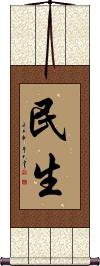
民生 is the Chinese, Japanese Kanji, and old Korean Hanja for people’s livelihood, people’s welfare, or public welfare.
It is a product of benevolence for your fellow humans.
Mutual Welfare and Benefit
Jita-Kyoei
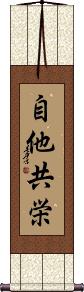
自他共栄 can be translated in a few different ways. Here are some possibilities:
Benefit mutually and prosper together.
Mutual welfare and benefit.
A learning concept of mutual benefit and welfare (that applies to all fields of society).
Mutual prosperity.
The first two characters are easy to explain. They are “self” and “others.” Together, these two characters create a word that means “mutual” (literally “me and them”).
The third character can have different meanings depending on context. Here, it means “in common” or “to share.”
The fourth character suggests the idea of “prosperity,” “flourishing,” or becoming “glorious.”
It should be noted that these Kanji are used almost exclusively in the context of Judo martial arts. 自他共榮 is not a common or recognized Japanese proverb outside of Judo.
You may see this romanized as Jita-Kyoei or Jitakyoei.
In modern Japanese Kanji, the last character looks like  instead of
  . If you want the older/traditional version, please let us know when you place your order.
Happiness
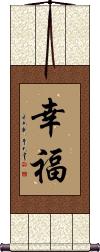
幸福 is a general state of happiness that can also be translated as truly blessed, welfare, well-being, or fortunate.
Peaceful / Tranquil / Calm / Free From Worry
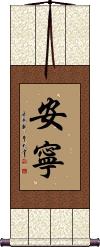
This is a nice word that means peaceful, tranquil, calm, composed, “free from worry,” “public peace,” tranquility, good health, well-being, or welfare in Chinese and Korean.
Note: The definition in Japanese is not so broad but still means peaceful or “public peace.”
Eternal Happiness
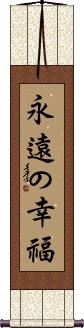
永遠の幸福 means “eternal happiness” in Japanese.
永遠 means eternal, eternity, perpetuity, forever, immortality, and permanence.
の is a possessive article which sort of makes this selection mean “happiness, of the eternal kind.”
幸福 means happiness, though this word can be translated as truly blessed, joy, happy, welfare, well-being, or fortunate.
Police / Public Security Bureau
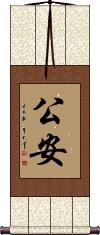
公安 is the Chinese, Japanese Kanji, and old Korean Hanja title for (The Ministry of) Public Security. 公安 can also generally mean public safety, public security, or public welfare. It is a positive term in Japan, where some even name their daughters “Kouan” (this title).
In China, this is the kinder name for the PSB or Public Security Bureau. It's really the national police of China - occasionally brutal and seldom properly-trained or educated. Once in a while, you find a PSB officer who lives up to the title of 公安. Before the 1989 massacre, it was the PSB officers who refused to stop nor kill any of the protesting college students (so they're not all bad). The Chinese government had to call in soldiers from Inner Mongolia to kill thousands of protesters.
Not the results for Welfare that you were looking for?
Below are some entries from our dictionary that may match your Welfare search...
| Characters If shown, 2nd row is Simp. Chinese |
Pronunciation Romanization |
Simple Dictionary Definition |
司徒 see styles |
sī tú si1 tu2 ssu t`u ssu tu shito しと |
More info & calligraphy: Stu(hist) (See 六卿) Minister of Civil Administration and Social Welfare (Zhou dynasty China) |
幸福 see styles |
xìng fú xing4 fu2 hsing fu shiawase しあわせ |
More info & calligraphy: Happiness(noun or adjectival noun) happiness; well-being; joy; welfare; blessedness; (surname, female given name) Shiawase |
民生 see styles |
mín shēng min2 sheng1 min sheng minsei / minse みんせい |
More info & calligraphy: People’s Livelihood and Welfarepublic welfare; the people's livelihood; (given name) Minsei |
爲 为 see styles |
wèi wei4 wei tame ため |
variant of 為|为[wei4] (out-dated kanji) (1) (kana only) good; advantage; benefit; welfare; (2) (kana only) sake; purpose; objective; aim; (3) (kana only) consequence; result; effect; (4) (kana only) affecting; regarding; concerning; (surname) Tame To do; to make; to effect; to be; because of; for. |
九儀 九仪 see styles |
jiǔ yí jiu3 yi2 chiu i ku gi |
The nine "Indian" ways of showing respect, according to Xuanzang — asking about welfare; bowing the head; holding high the hands; bowing with folded hands; bending the knee; kneeling; hands and knees on the ground; elbows and knees ditto; the whole body prostrate. |
五智 see styles |
wǔ zhì wu3 zhi4 wu chih gochi ごち |
(place-name, surname) Gochi The five kinds of wisdom of the 眞言宗 Shingon School. Of the six elements 六大 earth, water, fire, air (or wind), ether (or space) 曇空, and consciousness (or mind 識 ), the first five form the phenomenal world, or Garbhadhātu, the womb of all things 胎藏界, the sixth is the conscious, or perceptive, or wisdom world, the Vajradhātu 金剛界, sometimes called the Diamond realm. The two realms are not originally apart, but one, and there is no consciousness without the other five elements. The sixth element, vijñāna, is further subdivided into five called the 五智 Five Wisdoms: (1) 法界體性智 dharmadhātu-prakṛti-jñāna, derived from the amala-vijñāna, or pure 識; it is the wisdom of the embodied nature of the dharmadhātu, defined as the six elements, and is associated with Vairocana 大日, in the centre, who abides in this samādhi; it also corresponds to the ether 空 element. (2) 大圓鏡智 adarśana-jñāna, the great round mirror wisdom, derived from the ālaya-vijñāna, reflecting all things; corresponds to earth, and is associated with Akṣobhya and the east. (3) 平等性智 samatā-jñāna, derived from mano-vijñāna, wisdom in regard to all things equally and universally; corresponds to fire, and is associated with Ratnasaṃbhava and the south. (4) 妙觀察智 pratyavekṣaṇa-jñāna, derived from 意識, wisdom of profound insight, or discrimination, for exposition and doubt-destruction; corresponds to water, and is associated with Amitābha and the west. (5) 成所作智 kṛtyānuṣṭhāna-jñāna, derived from the five senses, the wisdom of perfecting the double work of self-welfare and the welfare of others; corresponds to air 風 and is associated with Amoghasiddhi and the north. These five Dhyāni-Buddhas are the 五智如來. The five kinds of wisdom are the four belonging to every Buddha, of the exoteric cult, to which the esoteric cult adds the first, pure, all-refecting, universal, all-discerning, and all-perfecting. |
休戚 see styles |
kyuuseki / kyuseki きゅうせき |
weal and woe; joys and sorrows; welfare |
低保 see styles |
dī bǎo di1 bao3 ti pao |
subsistence allowance; welfare (abbr. for 城市居民最低生活保障[cheng2 shi4 ju1 min2 zui4 di1 sheng1 huo2 bao3 zhang4]) |
八覺 八觉 see styles |
bā jué ba1 jue2 pa chüeh hachikaku |
The eight (wrong) perceptions or thoughts, i.e. desire; hate; vexation (with others); 親里 home-sickness; patriotism (or thoughts of the country's welfare); dislike of death; ambition for one's clan or family; slighting or being rude to others. 華嚴經 13. |
公益 see styles |
gōng yì gong1 yi4 kung i koueki / koeki こうえき |
public good; public welfare; public interest (noun - becomes adjective with の) (See 私益) public interest; public benefit; public good |
利福 see styles |
rifuku りふく |
well-being; welfare; benefits and happiness; (surname) Rifuku |
十行 see styles |
shí xíng shi2 xing2 shih hsing jūgyō |
The ten necessary activities in the fifty-two stages of a bodhisattva, following on the 十信and 十住; the two latter indicate personal development 自利. These ten lines of action are for the universal welfare of others 利他. They are: joyful service; beneficial service; never resenting; without limit; never out of order; appearing in any form at will; unimpeded; exalting the pāramitās amongst all beings; perfecting the Buddha-law by complete virtue; manifesting in all things the pure, final, true reality. |
厚生 see styles |
kousei / kose こうせい |
(1) welfare; public welfare; social welfare; (2) (abbreviation) (See 厚生省) (former) Ministry of Health and Welfare; (g,p) Kōsei |
厚相 see styles |
koushou / kosho こうしょう |
Welfare Minister |
問訉 问訉 see styles |
wèn fàn wen4 fan4 wen fan monbon |
To make inquiry; ask about another's welfare, orally or by folding the hands; interrogate; try a case. |
地官 see styles |
chikan ちかん |
(hist) (See 六官) Ministry of Civil Administration and Social Welfare (Zhou dynasty China) |
安危 see styles |
ān wēi an1 wei1 an wei anki あんき |
safety and danger; safety fate; safety; welfare security |
安否 see styles |
anpi(p); anpu; anbu(ok); anbi(ok) あんぴ(P); あんぷ; あんぶ(ok); あんび(ok) |
safety; welfare; well-being |
康福 see styles |
koufuku / kofuku こうふく |
peace and happiness; health and happiness; well-being; welfare |
懸念 悬念 see styles |
xuán niàn xuan2 nian4 hsüan nien kenen(p); kennen(ik) けねん(P); けんねん(ik) |
suspense in a movie, play etc; concern for sb's welfare (noun, transitive verb) worry; fear; anxiety; concern |
掛鉤 挂钩 see styles |
guà gōu gua4 gou1 kua kou |
to couple; to link; to hook together; (fig.) (preceded by 與|与[yu3] + {entity}) to establish contact (with {entity}); (Tw) to collude (with {entity}); (fig.) to link (marketing efforts with production etc); to peg (welfare payments to inflation etc); to tie (remuneration to performance etc); hook (on which to hang something); latch hook; coupling |
民政 see styles |
mín zhèng min2 zheng4 min cheng minsei / minse みんせい |
civil administration (1) (See 軍政・1) civil administration; civil government; (2) politics focused on the promotion of public welfare |
民福 see styles |
minpuku みんぷく |
national welfare |
済世 see styles |
yasuyo やすよ |
saving the world; promoting national welfare; (female given name) Yasuyo |
為め see styles |
tame ため |
(irregular okurigana usage) (1) (kana only) good; advantage; benefit; welfare; (2) (kana only) sake; purpose; objective; aim; (3) (kana only) consequence; result; effect; (4) (kana only) affecting; regarding; concerning |
生保 see styles |
shoubo / shobo しょうぼ |
(1) (abbreviation) (See 生命保険) life insurance; (2) (abbreviation) (See 生活保護・せいかつほご) livelihood protection; public assistance; welfare; (place-name) Shoubo |
盛衰 see styles |
shèng shuāi sheng4 shuai1 sheng shuai seisui / sesui せいすい |
to flourish then decline; rise and fall rise and fall; ups and downs; welfare; vicissitudes prosperity and adversity |
社協 see styles |
shakyou / shakyo しゃきょう |
(abbreviation) (from 社会福祉協議会) Council of Social Welfare |
福利 see styles |
fú lì fu2 li4 fu li yoshinori よしのり |
material benefit; benefit in kind; (social) welfare welfare; (given name) Yoshinori welfare |
福址 see styles |
fú zhǐ fu2 zhi3 fu chih fukushi |
welfare |
Click here for more Welfare results from our dictionary
The following table may be helpful for those studying Chinese or Japanese...
| Title | Characters | Romaji (Romanized Japanese) | Various forms of Romanized Chinese | |
| People’s Livelihood and Welfare | 民生 | minsei | mín shēng min2 sheng1 min sheng minsheng | |
| Mutual Welfare and Benefit | 自他共榮 自他共荣 / 自他共栄 | ji ta kyou ei jitakyouei ji ta kyo ei | ||
| Happiness | 幸福 | koufuku / kofuku | xìng fú / xing4 fu2 / xing fu / xingfu | hsing fu / hsingfu |
| Peaceful Tranquil Calm Free From Worry | 安寧 安宁 | an nei / annei | ān níng / an1 ning2 / an ning / anning | |
| Eternal Happiness | 永遠の幸福 | ei en no kou fuku eiennokoufuku ei en no ko fuku | ||
| Police Public Security Bureau | 公安 | kou an / kouan / ko an | gōng ān / gong1 an1 / gong an / gongan | kung an / kungan |
| In some entries above you will see that characters have different versions above and below a line. In these cases, the characters above the line are Traditional Chinese, while the ones below are Simplified Chinese. | ||||

Successful Chinese Character and Japanese Kanji calligraphy searches within the last few hours...



