Many custom options...


And formats...



Subtle in Chinese / Japanese...
Buy a Subtle calligraphy wall scroll here!
Personalize your custom “Subtle” project by clicking the button next to your favorite “Subtle” title below...
1. Holding Flowers with Subtle Smile
2. Mysterious
3. Love for Humanity / Brotherly Love
4. Flower in the Mirror, Moon on Water
5. One frost doesn't make winter
Holding Flowers with Subtle Smile
An idiom for heart-to-heart communication
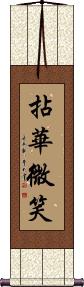
拈華微笑 is a Chinese, Korean, and Japanese Buddhist title that relays the idea of “heart-to-heart communication,” or “thought transference.”
The literal translation is, “holding a flower and subtly smiling,” or “the holding of a flower with a subtle smile.” It is the visual act and emotion that communicates more volume than words can say.
Mysterious
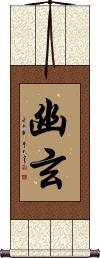
幽玄 is the Chinese, Japanese Kanji, and old Korean Hanja word meaning dim, deep, mysterious, subtle grace, hidden beauty, mysterious profundity, elegant simplicity, or subtle and profound.
This can also be the Japanese personal name Yuugen or Yugen.
Love for Humanity / Brotherly Love
benevolence, love
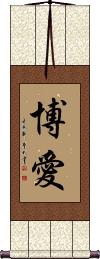
In Chinese and Korean, 博愛 means a universal fraternity, brotherhood, or universal love.
In Japanese, this means charity, benevolence, philanthropy, or love for humanity.
Please note these subtle differences and take that into account depending on your intended audience (Chinese, Korean or Japanese).
See Also: Benevolence | Altruism
Flower in the Mirror, Moon on Water
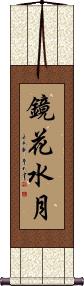
鏡花水月 is an old Asian proverb that means “flowers in a mirror and the moon reflected in the lake” or “flowers reflected on a mirror and the moon reflected on the water's surface.”
Literally, 鏡花水月 reads “Mirror Flower, Water Moon.”
Figuratively this can be used to represent a lot of different ideas. It can be used to express an unrealistic rosy view or viewing things through rose-tinted spectacles. So you can use it to relay an idea about something that is visible but has no substance,
something that can be seen but not touched, or something beautiful but unattainable such as dreams or a mirage.
This expression is used to describe things like the subtle and profound beauty of poems that cannot be described in words.
鏡 = Mirror (or lens)
花 = Flower(s)
水 = Water
月 = Moon
Can also be written 水月鏡花 (just a slight change in word/character order).
One frost doesn't make winter

一次霜凍不代表整個冬天 is a proverb that means “One frost doesn't make winter.”
The deeper meaning is that a single early sign of cold weather doesn't signify the full onset or severity of winter; it's about the gradual transition of seasons, patience, and not jumping to conclusions.
It's a reminder to stay resilient, wait for the real season to arrive, and not let one small event define the whole experience, similar to how one kind word can warm you for months.
While the origin of this proverb is murky (not originally Chinese, likely a modern adaptation of “One swallow does not a summer make”), this idea aligns with the Chinese solar terms (二十四節氣), which mark subtle shifts, like the transition from "cold dew" (寒露) to "frost falls" (霜降).
Kyojitsu: Falsehood and Truth
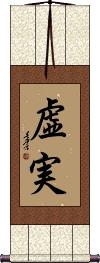
虚実 is a Japanese word that means “falsehood [and] truth” or “fiction [and] fact.”
This concept is used in warfare, gameplay, and martial arts strategies. 虚実 can be a strategy of real and/or deceptive moves. This gets to some Sun Tzu Art of War stuff where in warfare a strategic move is either a real and serious move or it is a deceptive blow.
Let's explore each character in more depth:
虚 was originally written 虛 (there is a very subtle difference in the strokes at the bottom of the character) and means unpreparedness, falsehood, emptiness, void, abstract theory, empty or unoccupied, diffident or timid, false, humble or modest, virtual, or in vain.
In the Buddhist context, 虛 represents the Pali/Sanskrit word “śūnya,” meaning empty, vacant, unreal, unsubstantial, untrue, space, humble, or in vain.
In ancient Eastern/Chinese astronomy, 虛 represents the “Emptiness” constellation (one of the 28 mansions in the sky).
実 was originally 實 in Chinese (they currently write it as 实 in Simplified Chinese) with the meaning, truth, reality, sincerity, honesty, fidelity, and substance.
The Buddhist context is similar, adding real, true, honest, really, solid, definitely, sincere, solid, fixed, full, to fill, fruit, kernel, verily, in fact, the supreme fact, or ultimate reality to the definition.
Daodejing / Tao Te Ching - Chapter 27
The Mastery of Effortless Skill

Chapter 27 of the Daodejing reveals a profound truth about mastery: the highest skill leaves no trace, requires no force, and appears almost invisible.
善行無轍跡,
善言無瑕謫,
善數不用籌策,
善閉無關鍵而不可開,
善結無繩約而不可解。
是以聖人常善救人,
故無棄人;
常善救物,
故無棄物。
是謂襲明。
故善人者,不善人之師;
不善人者,善人之資。
不貴其師,不愛其資,
雖智大迷,
是謂要妙。
The sage moves through life with such natural harmony that nothing seems imposed; doors need no locks, knots require no rope, and actions leave no mark behind.
This is the essence of wúwéi (effortless action), where true ability arises from deep alignment with the Tao rather than deliberate effort.
At its heart, this chapter teaches compassion without exception. The sage “abandons no one and nothing,” recognizing value in all people and all things. Even those who seem flawed or unrefined are not rejected, but understood as part of a greater whole with each person both a student and a teacher in the unfolding of life.
Laozi reminds us that wisdom is not about perfection or control, but about subtle awareness. The truly skilled individual does not rely on tools, rules, or rigid structures; instead, they embody an intuitive understanding that makes their actions naturally complete.
In this way, excellence becomes quiet, effortless, and beyond imitation.
This teaching also reflects a deeper philosophical insight: Opposites are interdependent. The “good” person learns from the “not good,” and the “not good” provides the material for growth. To reject either is to misunderstand the balance of existence itself.
As calligraphy, Daodejing Chapter 27 serves as a reminder to cultivate inner mastery rather than outward display. It is a meditation on refinement, humility, and the quiet power of skill perfected through harmony with the natural order.
Note: The Chinese text used here is based on the early Mawangdui silk manuscript tradition (2nd century BCE). The Guodian manuscripts do NOT preserve Chapter 27 in full form.
This in-stock artwork might be what you are looking for, and ships right away...
Gallery Price: $322.00
Your Price: $178.88



Gallery Price: $89.00
Your Price: $49.00
Gallery Price: $108.00
Your Price: $59.88
Gallery Price: $89.00
Your Price: $49.00

Gallery Price: $90.00
Your Price: $35.00
Gallery Price: $53.00
Your Price: $29.00

Gallery Price: $29.00
Your Price: $16.00


Gallery Price: $90.00
Your Price: $38.00
These search terms might be related to Subtle:
A Sly Rabbit Has Three Openings to Its Den
Clever
Clever / Superb / Wonderful
Cunning / Sly / Sneaky
Sly
Those Who Understand Are Clever, Those Who Know Themselves Are Truly Wise
Not the results for Subtle that you were looking for?
Below are some entries from our dictionary that may match your Subtle search...
| Characters If shown, 2nd row is Simp. Chinese |
Pronunciation Romanization |
Simple Dictionary Definition |
妙 see styles |
miào miao4 miao myou / myo みょう |
More info & calligraphy: Clever / Superb / Wonderful(noun or adjectival noun) (1) strange; weird; odd; curious; (noun or adjectival noun) (2) wonder; mystery; miracle; excellence; (noun or adjectival noun) (3) cleverness; adroitness; knack; skill; (surname) Myō su, sat, mañju, sūkṣma. Wonderful, beautiful, mystic, supernatural, profound, subtle, mysterious. su means good, excellent, surpassing, beautiful, fine, easy. sat means existing, real, good. mañju means beautiful, lovely, charming. Intp. in Chinese as 不可思議 beyond thought or discussion; 絕待 special, outstanding; 無比 incomparable; 精微深遠 subtle and profound. |
幽玄 see styles |
yōu xuán you1 xuan2 yu hsüan yuugen / yugen ゆうげん |
More info & calligraphy: Mysterioussubtle |
精神 see styles |
jīng shen jing1 shen5 ching shen seishin / seshin せいしん |
More info & calligraphy: Spirit(1) mind; spirit; soul; heart; ethos; (2) attitude; mentality; will; intention; (3) spirit (of a matter); essence; fundamental significance; (given name) Seishin Vitality; also the pure and spiritual, the subtle, or recondite. |
拈華微笑 拈华微笑 see styles |
niān huá wéi xiào nian1 hua2 wei2 xiao4 nien hua wei hsiao nengemishou / nengemisho ねんげみしょう |
More info & calligraphy: Holding Flowers with Subtle Smilethe holding of a flower and the subtle smile |
鏡花水月 镜花水月 see styles |
jìng huā shuǐ yuè jing4 hua1 shui3 yue4 ching hua shui yüeh kyoukasuigetsu / kyokasuigetsu きょうかすいげつ |
More info & calligraphy: Flower in the Mirror, Moon on Water(yoji) flowers reflected on a mirror and the moon reflected on the water's surface; something that is visible but having no substance; the subtle and profound beauty of poems that cannot be described in words |
塵 尘 see styles |
chén chen2 ch`en chen chiri ちり |
dust; dirt; earth (1) dust; (2) trash; garbage; rubbish; dirt; (3) (usu. as 塵ほども...ない) negligible amount; tiny bit; (4) hustle and bustle (of life); worldly cares; impurities of the world; (5) (abbreviation) {sumo} (See 塵手水) ritual gestures indicating that a fight will be clean guṇa, in Sanskrit inter alia means 'a secondary element', 'a quality', 'an attribute of the five elements', e.g. 'ether has śabda or sound for its guṇa and the ear for its organ'. In Chinese it means 'dust, small particles; molecules, atoms, exhalations'. It may be intp. as an atom, or matter, which is considered as defilement; or as an active, conditioned principle in nature, minute, subtle, and generally speaking defiling to pure mind; worldly, earthly, the world. The six guṇas or sensation-data are those of sight, sound, smell, taste, touch, and thought. |
微 see styles |
wēi wei1 wei honoka ほのか |
tiny; miniature; slightly; profound; abtruse; to decline; one millionth part of; micro-; Taiwan pr. [wei2] (noun or adjectival noun) (1) minuteness; (numeric) (2) one millionth; (female given name) Honoka sūkṣma. Minute, small, slight; abstruse, subtle; disguised; not; used in the sense of a molecule seven times larger than 極微 an atom; translit. vi, bi. |
細 细 see styles |
xì xi4 hsi hososaki ほそさき |
thin or slender; finely particulate; thin and soft; fine; delicate; trifling; (of a sound) quiet; frugal (1) (abbreviation) (See 細引き,細糸) fine thread; hempen cord; (prefix noun) (2) slender; narrow; weak; (suffix noun) (3) (as ぼそ) narrowness; (surname) Hososaki Fine, small, minute, in detail: careful. |
三細 三细 see styles |
sān xì san1 xi4 san hsi sansai |
The three refined, or subtle conceptions, in contrast with the 六麤 cruder or common concepts, in the Awakening of Faith 起信論. The three are 無明業相 "ignorance", or the unenlightened condition, considered as in primal action, the stirring of the perceptive faculty; 能見相 ability to perceive phenomena; perceptive faculties; 境界相 the object perceived, or the empirical world. The first is associated with the 體corpus or substance, the second and third with function, but both must have co-existence, e.g. water and waves. v. 六麤. |
五唯 see styles |
wǔ wéi wu3 wei2 wu wei goyui |
(五唯量) pañcatanmātrāṇi, the five subtle or rudimentary elements out of which rise the five sensations of sound, touch, form, taste, and smell. They are the fourth of the 二十五諦. |
伺察 see styles |
sì chá si4 cha2 ssu ch`a ssu cha shisatsu |
deep, subtle analysis that penetrates to the core of things |
味唯 see styles |
wèi wéi wei4 wei2 wei wei miyui |
subtle element or rudiment of taste |
城府 see styles |
chéng fǔ cheng2 fu3 ch`eng fu cheng fu joufu / jofu じょうふ |
subtle; shrewd; sophisticated town; town walls; (place-name) Jōfu |
妙色 see styles |
miào sè miao4 se4 miao se myōshiki |
surūpa, 蘇樓波. The wonderful form or body, i.e. of a Buddha's saṃbhogakāya and his Buddha-land. |
妙觀 妙观 see styles |
miào guān miao4 guan1 miao kuan myōkan |
The wonderful system of the three Tiantai meditations; v. 三諦, 三觀. |
小味 see styles |
komi こみ |
(n,adj-na,adj-no) (See 大味・おおあじ・1) delicate flavor; subtle feeling; subtlety; delicacy; (surname) Komi |
幽微 see styles |
yōu wēi you1 wei1 yu wei yuubi / yubi ゆうび |
faint; subtle (of sound, scent etc); profound; mysterious; dim (adjectival noun) dim; indistinct |
幽致 see styles |
yōu zhì you1 zhi4 yu chih yūchi |
subtle |
廉纖 廉纤 see styles |
lián xiān lian2 xian1 lien hsien rensen |
subtle |
微候 see styles |
bikou / biko びこう |
(1) sign or symptom of a disease (usu. more subtle than a symptom); (2) augury; foretoken; harbinger |
微妙 see styles |
wēi miào wei1 miao4 wei miao mimyou / mimyo みみょう |
subtle (noun or adjectival noun) (obsolete) unspeakably wonderful; sublime; exquisite; marvelous Abstruse, recondite, mysterious. |
微密 see styles |
wēi mì wei1 mi4 wei mi mimitsu |
Mysterious, secret, occult. |
微細 微细 see styles |
wēi xì wei1 xi4 wei hsi bisai びさい |
microminiature (technology) (noun or adjectival noun) minute; fine; detailed; subtle Minute, fine, refined, subtle. |
微義 微义 see styles |
wēi yì wei1 yi4 wei i migi |
subtle object |
微薄 see styles |
wēi bó wei1 bo2 wei po mihaku |
scanty; meager subtle and light |
微行 see styles |
wēi xíng wei1 xing2 wei hsing bikou / biko びこう |
(n,vs,vi) traveling incognito; travelling incognito Minute, refined, or subtle action. |
暗香 see styles |
àn xiāng an4 xiang1 an hsiang ankou / anko あんこう |
subtle fragrance scent of a flower floating about in the air; lingering scent of a flower in the darkness; (given name) Ankou |
最微 see styles |
zuì wēi zui4 wei1 tsui wei saimi |
extremely subtle |
極細 极细 see styles |
jí xì ji2 xi4 chi hsi gokuboso ごくぼそ |
(can be adjective with の) (1) superfine; extra-fine; extremely thin; (2) extra-fine woollen yarn extremely subtle |
機微 see styles |
kibi きび |
(1) subtleties; niceties; fine points; inner workings; secrets; (adjectival noun) (2) subtle; sensitive |
Click here for more Subtle results from our dictionary
The following table may be helpful for those studying Chinese or Japanese...
| Title | Characters | Romaji (Romanized Japanese) | Various forms of Romanized Chinese | |
| Holding Flowers with Subtle Smile | 拈華微笑 拈华微笑 | nenge misho nengemisho | niān huá wēi xiào nian1 hua2 wei1 xiao4 nian hua wei xiao nianhuaweixiao | nien hua wei hsiao nienhuaweihsiao |
| Mysterious | 幽玄 | yū gen / yūgen | yōu xuán / you1 xuan2 / you xuan / youxuan | yu hsüan / yuhsüan |
| Love for Humanity Brotherly Love | 博愛 博爱 | hakuai | bó ài / bo2 ai4 / bo ai / boai | po ai / poai |
| Flower in the Mirror, Moon on Water | 鏡花水月 镜花水月 | kyou ka sui getsu kyoukasuigetsu kyo ka sui getsu | jìng huā shuǐ yuè jing4 hua1 shui3 yue4 jing hua shui yue jinghuashuiyue | ching hua shui yüeh chinghuashuiyüeh |
| One frost doesn't make winter | 一次霜凍不代表整個冬天 一次霜冻不代表整个冬天 | yī cì shuāng dòng bù dài biǎo zhěng gè dōng tiān yi1 ci4 shuang1 dong4 bu4 dai4 biao3 zheng3 ge4 dong1 tian1 yi ci shuang dong bu dai biao zheng ge dong tian | i tz`u shuang tung pu tai piao cheng ko tung t`ien i tzu shuang tung pu tai piao cheng ko tung tien |
|
| Kyojitsu: Falsehood and Truth | 虚実 | kyo jitsu / kyojitsu | ||
| Daodejing Tao Te Ching - Chapter 27 | 善行無轍跡善言無瑕謫善數不用籌策善閉無關鍵而不可開善結無繩約而不可解是以聖人常善救人故無棄人常善救物故無棄物是謂襲明故善人者不善人之師不善人者善人之資不貴其師不愛其資雖智大迷是謂要妙 善行无辙迹善言无瑕谪善数不用筹策善闭无关键而不可开善结无绳约而不可解是以圣人常善救人故无弃人常善救物故无弃物是谓袭明故善人者不善人之师不善人者善人之资不贵其师不爱其资虽智大迷是谓要妙 | shàn xíng wú zhé jì shàn yán wú xiá zhé shàn shù bù yòng chóu cè shàn bì wú guān jiàn ér bù kě kāi shàn jié wú shéng yuē ér bù kě jiě shì yǐ shèng rén cháng shàn jiù rén gù wú qì rén cháng shàn jiù wù gù wú qì wù shì wèi xí míng gù shàn rén zhě bù shàn rén zhī shī bù shàn rén zhě shàn rén zhī zī bù guì qí shī bù ài qí zī suī zhì dà mí shì wèi yào miào shan4 xing2 wu2 zhe2 ji4 shan4 yan2 wu2 xia2 zhe2 shan4 shu4 bu4 yong4 chou2 ce4 shan4 bi4 wu2 guan1 jian4 er2 bu4 ke3 kai1 shan4 jie2 wu2 sheng2 yue1 er2 bu4 ke3 jie3 shi4 yi3 sheng4 ren2 chang2 shan4 jiu4 ren2 gu4 wu2 qi4 ren2 chang2 shan4 jiu4 wu4 gu4 wu2 qi4 wu4 shi4 wei4 xi2 ming2 gu4 shan4 ren2 zhe3 bu4 shan4 ren2 zhi1 shi1 bu4 shan4 ren2 zhe3 shan4 ren2 zhi1 zi1 bu4 gui4 qi2 shi1 bu4 ai4 qi2 zi1 sui1 zhi4 da4 mi2 shi4 wei4 yao4 miao4 shan xing wu zhe ji shan yan wu xia zhe shan shu bu yong chou ce shan bi wu guan jian er bu ke kai shan jie wu sheng yue er bu ke jie shi yi sheng ren chang shan jiu ren gu wu qi ren chang shan jiu wu gu wu qi wu shi wei xi ming gu shan ren zhe bu shan ren zhi shi bu shan ren zhe shan ren zhi zi bu gui qi shi bu ai qi zi sui zhi da mi shi wei yao miao | shan hsing wu che chi shan yen wu hsia che shan shu pu yung ch`ou ts`e shan pi wu kuan chien erh pu k`o k`ai shan chieh wu sheng yüeh erh pu k`o chieh shih i sheng jen ch`ang shan chiu jen ku wu ch`i jen ch`ang shan chiu wu ku wu ch`i wu shih wei hsi ming ku shan jen che pu shan jen chih shih pu shan jen che shan jen chih tzu pu kuei ch`i shih pu ai ch`i tzu sui chih ta mi shih wei yao miao shan hsing wu che chi shan yen wu hsia che shan shu pu yung chou tse shan pi wu kuan chien erh pu ko kai shan chieh wu sheng yüeh erh pu ko chieh shih i sheng jen chang shan chiu jen ku wu chi jen chang shan chiu wu ku wu chi wu shih wei hsi ming ku shan jen che pu shan jen chih shih pu shan jen che shan jen chih tzu pu kuei chi shih pu ai chi tzu sui chih ta mi shih wei yao miao |
|
| In some entries above you will see that characters have different versions above and below a line. In these cases, the characters above the line are Traditional Chinese, while the ones below are Simplified Chinese. | ||||

Successful Chinese Character and Japanese Kanji calligraphy searches within the last few hours...



