Many custom options...


And formats...



My Practice in Chinese / Japanese...
Buy a My Practice calligraphy wall scroll here!
Personalize your custom “My Practice” project by clicking the button next to your favorite “My Practice” title below...
1. Training / Practice / Cultivation
4. Shugyo
5. Skill Acquired Through Hard Training
6. Uechi-Ryu
7. Tarot
10. Jin Shin Jyutsu
11. Shinken Shobu
13. Seeking Truth
14. Keiko Shin
15. Reiki
16. Forest Bathing
19. Takemusu Aiki
20. Discipline
21. Wisdom comes from Experience
22. Benevolent and Skilled Doctor
23. Temperance
25. Shikantaza
26. Yoga
27. Seeing one’s Nature and becoming a Buddha
28. Islam
30. The More We Sweat in Training, The Less We Bleed in Battle
31. Respect out of fear is never genuine; Reverence out of respect is never false
32. Rank Holder
33. Hyakuren-Jitoku
36. Daruma / Damo
37. Dana: Almsgiving and Generosity
39. One Heart / One Mind / Heart and Soul
40. Kempo Karate / Law of the Fist Empty Hand
Training / Practice / Cultivation
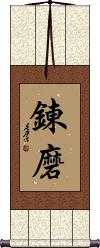
錬磨 is a Japanese word that means training, practice/practise, or cultivation.
Practice / Train / Drill
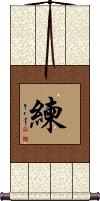
練 is a Chinese, Japanese, and Korean word that is the simplest way to say practice, train, drill, exercise, or to describe the effort taken to perfect one's skill.
Training / Drill
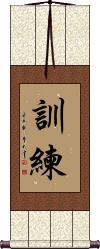
If training or drill is important to you (especially for military drill and training), 訓練 might be just the thing for a drill master to hang behind his/her desk.
This term is universal in Chinese, Japanese Kanji, and old Korean Hanja. It can also mean practice or exercise, depending on context.
Shugyo
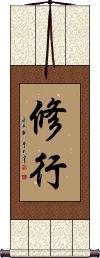
修行 is shugyō or shugyou in Japanese. It refers to ascetic practices, training, practice, discipline, and study.
修行 is also a word in the original Chinese, referring more to religious studies and practices.
In the Buddhist context, this represents caryā. In Buddhism, this relates to one's conduct, observing and doing, cultivating oneself in the right practice, and/or being pious.
Skill Acquired Through Hard Training
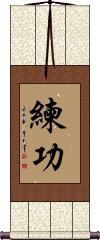
練功 is a martial arts term that can mean to practice and attain working skills, feats of practice/practise, or skills acquired through hard training.
練功 is often used as a martial arts term but can apply to other skills (or professions).
Uechi-Ryu
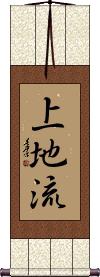
上地流 or Uechi-Ryū is the short name for a traditional style of Okinawan karate.
Uechi-Ryū is named after its creator, Kanbun Uechi. Uechi was an Okinawan man who left at the age of 19 for China to study Chinese martial arts and medicine.
The meaning of this title is “Uechi Flow,” “Uechi Style,” or “Uechi School.” Although, the name 上地 or Uechi can mean “higher stages of practice” in the Buddhist context. Therefore, you can stretch the meaning to be “Higher-Stages-of-Practice Style.”
Tarot
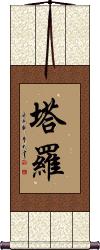
塔羅 is the title for the practice of using tarot cards in Chinese.
Joushiki Wo Koeru
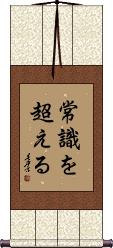
This Japanese phrase, “常識を超える” or “Jōshiki Wo Koeru” means “beyond common sense.”
常識 alone can be translated as “common sense,” “good sense,” “common knowledge”,“general knowledge,” “common practice,” “accepted practice,” or “social etiquette.”
The rest of the phrase indicates exceeding, overtaking, surpassing, transcending, or an idea of going beyond something.
More ways to translate this whole phrase:
Over what was known.
Surpassing common sense.
Beyond the ordinary.
Going beyond conventional knowledge.
Beyond conventional wisdom.
Note: Because this selection contains some special Japanese Hiragana characters, it should be written by a Japanese calligrapher.
Perseverance is the Key
Skills cannot be perfected without perseverance in practice
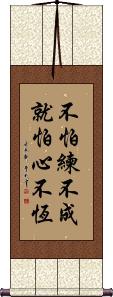
不怕练不成就怕心不恒 literally translates as: Do not worry about not being able to master [a skill]; What [one should] be concerned about is lack of perseverance.
Figuratively, this means: One's skills cannot be perfected without perseverance in practice.
For me, I've learned that you can only get so much from school or studying. You've really got to do “on-the-job training” to perfect your ability and skill.
For martial arts students: You can read about a kick in a book, or someone can tell you about a certain kick but until you practice the kick, there's no way you'll master it.
Jin Shin Jyutsu
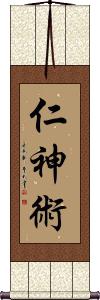
仁神術 is Jin Shin Jyutsu or Jin Shin Jutsu.
This is a practice of calming the mind and clearing the flow of Qi energy in the body. Jin Shin Jyutsu has some commonality with the practice of Reiki.
A good translation of 仁神術 would be “Benevolent Spirit Method.”
We can break that down into all of the possible meanings:
仁 = benevolence (esp. as a virtue of Confucianism), consideration, compassion, humanity, charity, kindness, or virtue.
神 = deity, soul, spirit, mysterious, psyche, god, divinity, spiritual powers, deva, divine, spiritual, or supernatural.
術 = way, method, means, art, trick, or plan. The correct romaji for this 術 Kanji should be “jutsu.” However, in martial arts, this is often written “jitsu” but in this case, “jyutsu” became common.
Shinken Shobu
Death Match
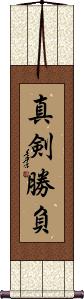
In modern Japanese, 真剣勝負 means to take something very seriously.
The literal and historical meaning is “real sword battle.” In old times, a Samurai apprentice would practice with a wooden practice sword. Once trained and qualified, they would wield a real steel sword made for battle and killing. They were ready for a “death match” or Shinken Shobu.
真剣 is an adjective that has come to mean serious/earnest. The literal translation is “real sword.”
勝負 in the simplest terms, means match, contest, game, or bout. Depending on the context, it could also mean victory or defeat, winning and losing, or the outcome of a battle.
There is a suggestion in Shinken Shobu that you train with serious and real intent, as we should train with the same fervor and dedication as if the battle was real. “Train as we fight.”
See Also: The More We Sweat in Training the Less We Bleed in Battle | Cry in the Dojo - Laugh on the Battlefield
Uechi-Ryu Karate-Do
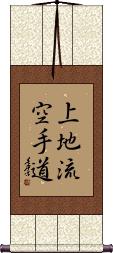
上地流空手道 is the title of the Uechi-Ryu Karate-Do school of Okinawan martial arts.
Uechi means “higher stages of practice” in a Buddhist context.
Seeking Truth
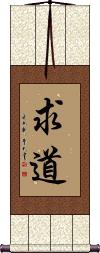
求道 means seeking for truth, or to seek (practice for, strive for) enlightenment.
求道 is used mostly in a Buddhist context, so some non-Buddhists may not recognize it.
Keiko Shin
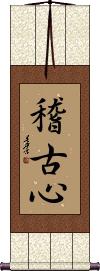
稽古心 is Keiko Shin in Japanese Kanji.
The first two characters, 稽古 mean to learn from the ancients, to study the classic texts, practice, training, or study.
The last character, 心, means heart or mind.
Reiki
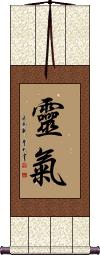
靈氣 is the title of a healing practice now found globally but with origins in Japan.
Special note: Outside of the context of the healing practice of Reiki, this means “aura” or “spiritual essence that surrounds all living things.” A Japanese person unfamiliar with the practice will take the “aura” meaning.
Reiki is a technique for stress reduction and relaxation that also heals. It can be compared to massage but is based on the idea that an unseen “life force energy” flows through us and is what causes us to be alive. If your life force energy is low, you'll be more likely to get sick or feel stressed. If your life force energy is abundant and flowing well, you become more capable of being happy and healthy.
There is a lot of information available if you want to Google this term - my job is to offer the calligraphy while you can decide if it is right for you.


Note: We are showing the ancient (traditional) form of the Reiki Kanji. I have seen Reiki written with the slightly simplified version and this more classic form. If you want the form of Reiki with the two strokes in the shape of an X on the second character and the modern first character, simply click on the Kanji characters to the right.
Note: 靈氣 is also a Chinese word, but in Chinese, these characters create a word that refers to a smart person or someone with high aspirations. It is not read as a healing method in Chinese.
In Korean Hanja, this can be read as a “mysterious atmosphere” by a Korean who is not familiar with the practice of Reiki (still has a cool meaning in Korean).
Forest Bathing
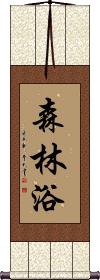
森林浴 is the title for forest bathing or Shinrinyoku in Japanese and Senlinyu in Chinese.
This is simply the practice of spending time in a forest, often including walking or deep breathing as a form of therapy.
Also defined as forest therapy or a peaceful walk through the woods for health benefits.
Evolve / Evolution
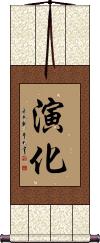
演化 means to evolve or evolution in Chinese.
The first character means to develop, evolve, practice, perform, or extend.
The second character means to make into, to change into, to transform, or to metamorphose.
Intense / Serious
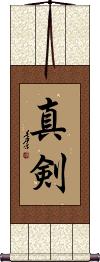
真剣 is a Japanese word that means intense, serious, or earnest. It describes a person who is deep, serious, and a true thinker or dreamer.
Literally, this means “true sword,” as compared to a sharpened wooden practice sword blank. It's real, true, and serious.
Takemusu Aiki
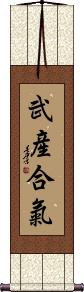
武産合氣 is one of the core spiritual concepts developed by Morihei Ueshiba to support his practice of Aikido.
Breaking down the characters:
武 - Bu (as in Bushido) is read as “Take” here. It means martial.
産 - Musu means innocent or naive, but also refers to the idea of birth and creation.
合氣 - Aiki as in Aikido - unifying spirit.
Discipline

鍛練 is the Japanese Kanji and Korean Hanja word used for discipline.
This has a meaning like “forging or creating something from lots of training and practice.” My Japanese dictionary translates this as “tempering, forging, hardening, disciplining, training.”
This is for Japanese and Korean only. In Chinese, these characters might be translated as (physical) “exercise.”


The modern form of the second Japanese Kanji looks like the first image to the right. There’s also an alternate modern form after that, and finally, an alternate traditional form. Because calligraphy is an art, the calligrapher could choose any of these possible forms. Let us know if you have a preference.
See Also: Self-Control | Will-Power
Wisdom comes from Experience
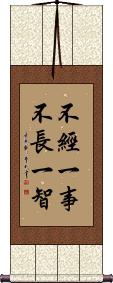
You can translate this 不经一事不长一智 Chinese proverb in a couple of ways.
The first is: You cannot gain knowledge without practice.
The second, and perhaps more popular way is: Wisdom comes from experience.
It literally means if you are inattentive to your affairs or situations you encounter, you will not gain or grow any wisdom or intellect.
Benevolent and Skilled Doctor
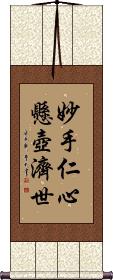
妙手仁心悬壶济世 is a phrase that celebrates the benevolence, skill, and service to his/her patients.
Here's a breakdown of the characters:
妙手 miào shǒu admirable skill in curing disease (when used in reference to doctors).
仁心 rén xīn kindheartedness, charity, benevolent heart.
悬壶济世 xuán hú jì shì practice medicine or pharmacy to help the people or the public.
Temperance
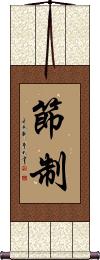
In short, 節制 or temperance is knowing when to say “when.”
Temperance is the practice of moderation and restraint (in fact, this Asian word is often translated as moderation or restraint).
It was one of the five tenets held to be vital to society in Hellenic culture. It is also one of the Four Cardinal Virtues considered central to Christian behavior by the Catholic Church.
Note: Also considered to be one of the Seven Heavenly Virtues.
Zen Understanding
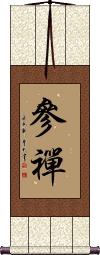
參禪 is a title that speaks of reaching an understanding (of Zen or the world). It also means “to practice meditation.” The two concepts lead you to the idea that meditation leads to understanding. 參禪 is pretty deep, so you can do your research or decide what this means for you.
This can also be defined in a more complex way as “thoroughly penetrating with meditative insight.”
Shikantaza
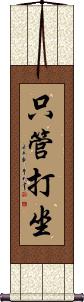
只管打坐 is the Japanese Buddhist term shikantaza which represents zazen meditation in which one focuses on sitting without actively seeking enlightenment.
Sometimes this is translated as “meditation of just sitting” or “meditation practice where one stays intensely focused without focusing on any particular object.”
Sometimes written, 祗管打坐 with the same pronunciation and perceived meaning.
Yoga
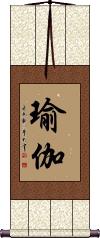
瑜伽 is probably the most common and universal title for Yoga.
In Chinese and Japanese, this is considered a Buddhist practice. 瑜伽 is really a loanword from an original Buddhist Sanskrit word.
Yoga can also be written 瑜誐 or 遊迦. The literal meaning is a yoke, yoking, union, especially an ecstatic union of the individual soul with a divine being or spirit and the individual soul with the universal soul.
Note: Yoga is sometimes written incorrectly as 瑜珈 in Chinese. Watch out for that.
Seeing one’s Nature and becoming a Buddha
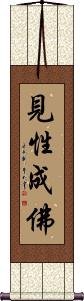
見性成佛 is a universal phrase that suggests that one may see one's nature and accomplish Buddhahood.
見性 suggests penetrating deep inside oneself to see one's “Original finally
Mind.”
成佛 refers to a sentient being who dispenses with illusions and delusions
through ascetic practice, is enlightened to the truth, and becomes a Buddha.
This is used by Mahayana, Chan, and Zen Buddhists in China, Korea, and Japan.
You will also see this with the last character written as 仏 in Japanese. In the religious context, 佛 is commonly used to mean Buddha. If you want the other version, see Kenshō Jōbutsu 見性成仏
Islam
The religion of the Hui People
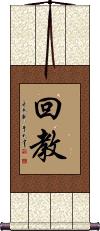
回教 means “Hui Religion” in Chinese.
It refers specifically to the Hui people (Huizu), who have typical Oriental looks but are Muslim (practice the religion of Islam). Hui people can be found throughout China, often establishing Muslim neighborhoods in many cities.
My Japanese dictionary lists this as the all-Kanji way to write Islam as well.
In Korean, the first character is used as a short name to say Muslim.
Sexy / Voluptuous
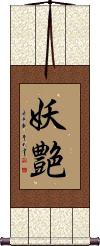
妖艶 means sexy, fascinating, voluptuous, or bewitching in Japanese Kanji. 妖艶 / 妖艷 is specifically in regards to women.
This has a dictionary meaning of flirtatious or bewitchingly pretty in Chinese. However, in practice, this would refer to a sexy but bitchy woman in modern China.
This is also a word in old Korean Hanja; however, I have not confirmed how it is perceived in Korean culture.
This may not be appropriate for a wall scroll unless your audience is Japanese only.
 Note: The second character can also be written in the alternate version shown to the right.
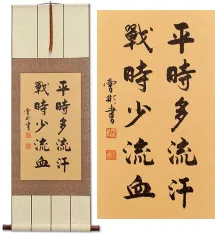
The More We Sweat in Training, The Less We Bleed in Battle
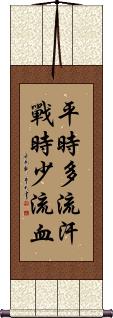
There is more than one way to translate the ancient Chinese military proverb, 平时多流汗战时少流血. Here are a few interpretations:
A drop of sweat spent in a drill is a drop of blood saved in war.
More practice will give one a better chance of success in real situations.
The more you sweat in training, the less you bleed in battle.
I heard this many times when I was a U.S. Marine but I had no idea at the time that it was actually an old Chinese proverb.
See Also: Blood Sweat and Tears
Respect out of fear is never genuine; Reverence out of respect is never false
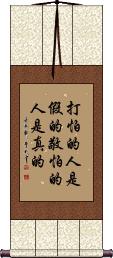
打怕的人是假的敬怕的人是真的 is a proverb that seems to be aimed at world leaders or others in power. Perhaps a suggestion to avoid the practice of “fear-mongering” opting instead for a policy of benevolence and justice.
An example: When the Bush administration told Pakistan they could either join America in the “war on terror,” or expect some bombs to be coming their way, Bush gained this kind of “less-than-genuine respect” from Pakistanis.
Leaders in places like North Korea and even Saudi Arabia reap the same bogus respect from their own citizens.
Note that calligraphers do not like to repeat the same characters in exactly the same way in the same piece of artwork. So expect the characters that are repeated to be written in different forms in the real artwork (unlike the way they are displayed to the left).
Rank Holder
The one who has achieved rank in martial arts
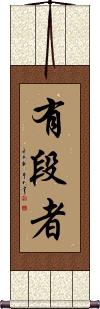
有段者 is a Japanese term for someone who holds rank in karate, judo, etc.
This term theoretically applies to anyone with rank (above a white belt). However, some schools or dojos may reserve this title for a holder of a black belt.
I'd suggest that you only order this phrase if you have honestly reached this level.
This title does kind of make sense in Chinese but only to those Chinese who practice “kong shou dao” (karate) or when used in the context of martial arts.
Hyakuren-Jitoku
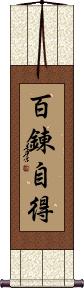
百錬自得 is a Japanese proverb that means only if you practice something 100 times will it become a part of yourself.
Some translate it in a short form like “Well train, self-gain.”
The first two characters are a word that means “100 forges” (or to forge 100 times). It translates more naturally as well-tempered, well-drilled, or well-trained.
The last two characters mean “self-benefit” or “self-gain.” It can also be translated into English as contented, self-satisfaction, realizing (through one's ability), or being paid back for one's deeds.
Reiki - Master Symbol
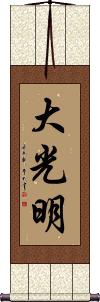
大光明 is the master symbol “Daikomyo” or “Dai Ko Myo,” which is usually associated with the healing practice of Reiki.
This title can be translated as “Great Bright Light.” This symbol, as used in Reiki, alludes to “Enlightened Nature” or the radiance of a purified soul or deity.
Pronunciations in Chinese and Korean are included above but this title has no meaning except when used by a Reiki practitioner. In fact, this title is not that well known by those outside the Reiki community in Japan.
In Chinese, this would be interpreted as “Great Bright Future” (the second two characters alone create a word that means “bright future” in Chinese).
Hishiryo / Not-Thinking
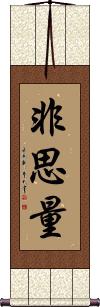
Hishiryō (非思量) literally means not-thinking.
Hishiryo can be described as a state of mind beyond thinking and non-thinking during the practice of Zazen.
Shiryō (思量) means “thinking,” and hi (非) is a prefix for negation and opposition.
Therefore, hishiryo amounts to “unthink” or “not the matter of thinking.” The word hishiryo appears in Dogen Zenji’s Fukanzazengi, Shobogenzo Zazengi, Shobogenzo Zazenshin, and Keizan Zenji’s Zazen Yojinki. It is one of the most important words used to describe zazen. Hishiryo in these writings comes from a dialogue between Yakusan Igen (745-828) and an unnamed monk, which is described in Keitoku, Dentoroku, and other Zen texts.
The above is an abridged except from School of Shodo: Hishiryo
I suggest you visit that page for a full explanation.
Daruma / Damo

達磨 in Japanese usually refers to Daruma, a tumbling doll with a round red-painted body.
In Japan, Daruma is a good-luck doll which is supposed to in the shape of Bodhidharma, with a blank eye to be completed when a person's wish is granted.
達磨 is also Bodhidharma or Dharma. 達磨 comes from an ancient word that means holding fast and keeping ordinances, statutes, laws, or practice.
This is also a title for Damo, or Bodhidharma, the twenty-eighth Indian and first Chinese patriarch, who arrived in China A.D. 520, the reputed founder of the Chan or Intuitional School in China. He is described as son of a king in southern India. He famously engaged in silent meditation for nine years.
Dana: Almsgiving and Generosity
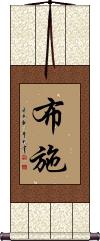
布施 is the Buddhist practice of giving known as Dāna or दान from Pali and Sanskrit.
Depending on the context, this can be alms-giving, acts of charity, or offerings (usually money) to a priest for reading sutras or teachings.
Some will put Dāna in these two categories:
1. The pure or unsullied charity, which looks for no reward here but only in the hereafter.
2. The sullied almsgiving whose object is personal benefit.
The first kind is, of course, the kind that a liberated or enlightened person will pursue.
Others will put Dāna in these categories:
1. Worldly or material gifts.
2. Unworldly or spiritual gifts.
You can also separate Dāna into these three kinds:
1. 財布施 Goods such as money, food, or material items.
2. 法布施 Dharma, as an act to teach or bestow the Buddhist doctrine onto others.
3. 無畏布施 Courage, as an act of facing fear to save someone or when standing up for someone or standing up for righteousness.
The philosophies and categorization of Dāna will vary among various monks, temples, and sects of Buddhism.
Breaking down the characters separately:
布 (sometimes written 佈) means to spread out or announce, but also means cloth. In ancient times, cloth or robs were given to the Buddhist monks annually as a gift of alms - I need to do more research, but I believe there is a relationship here.
施 means to grant, to give, to bestow, to act, to carry out, and by itself can mean Dāna as a single character.
Dāna can also be expressed as 檀那 (pronounced “tán nà” in Mandarin and dan-na or だんな in Japanese). 檀那 is a transliteration of Dāna. However, it has colloquially come to mean some unsavory or unrelated things in Japanese. So, I think 布施 is better for calligraphy on your wall to remind you to practice Dāna daily (or whenever possible).
Qi Gong / Chi Kung
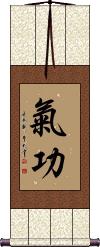
氣功 or Qigong is the title of a technique that is somewhere between medical practice, meditation, and in some cases, religion.
The definition is blurred depending on which school of Qigong you are following. In some cases, it is even incorporated with martial arts.
Some people (even Chinese people) mix this title with Tai Chi (Tai Qi) exercises.
Lately, in China, people will claim to practice Tai Chi rather than Qigong because the Qigong title was recently used as a cover for an illegal pseudo-religious movement in China with the initials F.G. or F.D. (I can not write those names here for fear of our website being banned in China).
You can learn those names and more here: Further info about Qigong
If you are wondering why I wrote “Qi Gong” and “Chi Kung” as the title of this calligraphy entry, I should teach you a little about the various ways in which Chinese can be Romanized. One form writes this as “Chi Kung” or “Chikung” (Taiwan). In the mainland and elsewhere, it is Romanized as “Qi Gong” or “Qigong.” The pronunciation is the same in Taiwan, mainland, and Singapore Mandarin. Neither Romanization is exactly like English. If you want to know how to say this with English rules, it would be something like “Chee Gong” (but the “gong” has a vowel sound like the “O” in “go”).
Romanization is a really confusing topic and has caused many Chinese words to be mispronounced in the west. One example is “Kung Pao Chicken,” which should actually be more like “Gong Bao” with the “O” sounding like “oh” for both characters. Neither the Romanization system in Taiwan nor the Mainland is perfect, in my opinion, and leads to many misunderstandings.
In modern Japan, you may see this written as 気功, but the original 氣功 is still recognized. If you need the Japanese version, please contact me.
One Heart / One Mind / Heart and Soul
Isshin
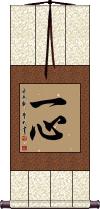
一心 can be translated as “one mind,” “single-minded focus,” or “wholehearted devotion,” from Chinese, Japanese Kanji, and old Korean Hanja.
Colloquially or figuratively, it means: wholeheartedly; heart and soul; of one mind; single-mindedness, wholeheartedness; one's whole heart; with the whole mind or heart; one mind in heart.
I'm not kidding, all of those came right from the dictionary for this one title.
In martial arts usage, this term emphasizes total commitment, where intent, attention, and action are unified without distraction.
In Japanese budō, it often conveys wholehearted dedication to practice or principle, whereas in Chinese usage it tends toward inner mental cultivation.
In Buddhism, this can refer to the bhūtatathatā, or the whole of things; the universe as one mind, or a spiritual unity.
In Japanese, this can be the female given name, Hitomi.
Kempo Karate / Law of the Fist Empty Hand
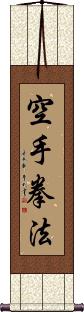
空手拳法 is the Kanji title for Kempo Karate.
The first two characters mean “karate” - technically they express “empty hand.”
The last two express “fist law” which is Romanized from Japanese as “Kenpo” or “Kempo.”
That “empty hand” translation can be understood better when you grasp the idea that karate is a martial art without weapons (other than the weapons organic to your body, such as your foot, hand, fist, etc). When you practice karate, you do so with empty hands (no weapons).
Note: There is also an antiquated way to write karate. It has the same pronunciation but a different first character which means “Tang” as in the Tang Dynasty. Some dojos use that form - let us know if you need that alternate form, and we'll add it.
Purified Spirit / Enlightened Attitude
A Japanese martial arts title/concept
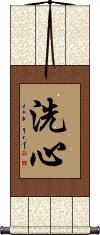
The first Kanji alone means to wash, bathe, primness, cleanse or purify.
The second Kanji means heart, mind, soul, or essence.
Together, these two Kanji create a word defined as “purified spirit” or “enlightened attitude” within Japanese martial arts.
洗心 is one of the five spirits of the warrior (budo) and is often used as a Japanese martial arts tenet. Under that context, it's often defined as a spirit that protects and harmonizes the universe. Senshin is a spirit of compassion that embraces and serves all humanity and whose function is to reconcile discord in the world. It holds all life to be sacred. It is the Buddha mind.
This title will only be familiar to Japanese who practice certain martial arts. Others may not recognize this word at all.
洗心 does not show up as a word in too many Chinese dictionaries, but it can be read and has the same meaning in Chinese.
 There is an issue with the first character. The original, and probably most correct version is shown above. However, many dojo documents and other sources have used a more simple first character. Arguments ensue about which version is correct. If you want to be correct in the Japanese language, use the "Select and Customize" button above. If you want to match the Kanji used by your dojo, click the Kanji shown to the right. There is a slightly different meaning with this first character which means before, ahead, previous, future, precedence.
Kenjutsu / Kenjitsu
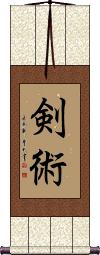
In Japanese, the modern definition, using simple terms, 剣術 is “A martial art involving swords” or “The art of the sword.”
However, in Chinese, this is the word for fencing (as in the Olympic sport).
I will suppose that you want this for the Japanese definition, which comes from skills and techniques developed in the 15th century. At that time, Kenjutsu (or swordsmanship) was a strictly military art taught to Samurai and Bushi (soldiers). The fact that swords are rarely used in military battles anymore, and with the pacification of Japan after WWII, Kenjutsu is strictly a ceremonial practice often studied as a form of martial art (more for the discipline aspect rather than practical purpose).
Language note: The Korean definition is close to the Japanese version described above. However, it should be noted that this can mean “fencing” depending on the context in Japanese, Chinese, and Korean.

 Character variation notes: There are slight variations possible with the second character. Either way is correct and understood by both Japanese and Chinese folks.
Since there are about 5 common ways to write the sword character, if you are particular about which version you want, please note that in the “special instructions” when you place your order.
Romanization note: This term is often Romanized as Kenjitsu; however, following the rules of Japanese Romaji, it should be Kenjutsu.
Zen / Chan / Meditation
...as in Zen Buddhism
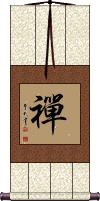
First, let's correct something: The Japanese romanization for this character, “Zen” has penetrated the English language. In English, it's almost always incorrectly used for phrases like “That's so zen.” Nobody says, “That's so meditation” - right? As the title of a sect, this would be like saying, “That's so Baptist!"
禪 by itself just means “meditation.” In that context, it should not be confined to use by any one religion or sect.
Regardless of the dictionary definition, more often than not, this character is associated with Buddhism. And here is one of the main reasons:
Zen is used as the title of a branch of Mahayana Buddhism, which strongly emphasizes meditation practice.
However, it should be noted that Buddhism came from India, and “Chan Buddhism” evolved and developed in medieval China. The Chinese character “Chan” was eventually pronounced as “Zen” in Japanese. Chan Buddhists in China have much in common with Zen Buddhists in Japan.
More about the history of Zen Buddhism here.
Please also note that the Japanese Kanji character for Zen has evolved a little in Japan, and the two boxes (kou) that you see at the top of the right side of the character have been replaced by three dots with tails.
 The original character would still be generally understood and recognized in Japanese (it's considered an ancient version in Japan) but if you want the specifically modern Japanese version, please click on the zen Kanji to the right. Technically, there is no difference between the Tensho and Reisho versions of Zen since they are ancient character styles that existed long before Japan had a written language.
 There is also an alternate/shorthand/simplified Chinese version, which has two dots or tails above the right-side radical. This version is also popular for calligraphy in China. If you want this version, just click the character to the right.
Further notes: Zen is just one of seven sects of Buddhism practiced in Japan. The others are 律 Ritsu (or Risshū), 法相 Hossō, 論 Sanron 華嚴 Kegon, 天台 Tendai, and 眞言 Shingon.
This in-stock artwork might be what you are looking for, and ships right away...

Starting at: $28.88
Gallery Price: $220.00
Your Price: $112.88

Gallery Price: $31.00
Your Price: $16.88

Gallery Price: $72.00
Your Price: $39.88

Gallery Price: $50.00
Your Price: $29.88

Gallery Price: $72.00
Your Price: $39.88

Gallery Price: $50.00
Your Price: $29.88

The following table may be helpful for those studying Chinese or Japanese...
| Title | Characters | Romaji (Romanized Japanese) | Various forms of Romanized Chinese | |
| Training Practice Cultivation | 錬磨 | ren ma / renma | ||
| Practice Train Drill | 練 练 | ren | liàn / lian4 / lian | lien |
| Training Drill | 訓練 训练 | kunren | xùn liàn / xun4 lian4 / xun lian / xunlian | hsün lien / hsünlien |
| Shugyo | 修行 | shu gyou / shugyou / shu gyo | xiū xíng / xiu1 xing2 / xiu xing / xiuxing | hsiu hsing / hsiuhsing |
| Skill Acquired Through Hard Training | 練功 练功 | renkou / renko | liàn gōng lian4 gong1 lian gong liangong | lien kung lienkung |
| Uechi-Ryu | 上地流 | ue chi ryuu uechiryuu ue chi ryu | ||
| Tarot | 塔羅 塔罗 | tǎ luó / ta3 luo2 / ta luo / taluo | t`a lo / talo / ta lo | |
| Joushiki Wo Koeru | 常識を超える | jou shiki wo ko e ru joushikiwokoeru jo shiki wo ko e ru | ||
| Perseverance is the Key | 不怕練不成就怕心不恆 不怕练不成就怕心不恒 | bú pà liàn bù chéng jiù pà xīn bù héng bu2 pa4 lian4 bu4 cheng2 jiu4 pa4 xin1 bu4 heng2 bu pa lian bu cheng jiu pa xin bu heng | pu p`a lien pu ch`eng chiu p`a hsin pu heng pu pa lien pu cheng chiu pa hsin pu heng |
|
| Jin Shin Jyutsu | 仁神術 | jin shin jutsu jinshinjutsu | rén shén shù ren2 shen2 shu4 ren shen shu renshenshu | jen shen shu jenshenshu |
| Shinken Shobu | 真剣勝負 | shinken shoubu shinkenshoubu shinken shobu | ||
| Uechi-Ryu Karate-Do | 上地流空手道 | ue chi ryuu kara te dou uechiryuukaratedou ue chi ryu kara te do | ||
| Seeking Truth | 求道 | gu dou / gudou / gu do | qiú dào / qiu2 dao4 / qiu dao / qiudao | ch`iu tao / chiutao / chiu tao |
| Keiko Shin | 稽古心 | keiko shin / keikoshin | ||
| Reiki | 靈氣 灵气 霊気 | reiki | líng qì / ling2 qi4 / ling qi / lingqi | ling ch`i / lingchi / ling chi |
| Forest Bathing | 森林浴 | shin rin yoku shinrinyoku | sēn lín yù sen1 lin2 yu4 sen lin yu senlinyu | sen lin yü senlinyü |
| Evolve Evolution | 演化 | yǎn huà / yan3 hua4 / yan hua / yanhua | yen hua / yenhua | |
| Intense Serious | 真剣 | shin ken / shinken | ||
| Takemusu Aiki | 武産合氣 | take musu ai ki takemusuaiki | ||
| Discipline | 鍛練 / 鍛錬 锻练 | tan ren / tanren | duàn liàn duan4 lian4 duan lian duanlian | tuan lien tuanlien |
| Wisdom comes from Experience | 不經一事不長一智 不经一事不长一智 | bù jīng yī shì bù zhǎng yī zhì bu4 jing1 yi1 shi4 bu4 zhang3 yi1 zhi4 bu jing yi shi bu zhang yi zhi bujingyishibuzhangyizhi | pu ching i shih pu chang i chih puchingishihpuchangichih |
|
| Benevolent and Skilled Doctor | 妙手仁心懸壺濟世 妙手仁心悬壶济世 | miào shǒu rén xīn xuán hú jì shì miao4 shou3 ren2 xin1 xuan2 hu2 ji4 shi4 miao shou ren xin xuan hu ji shi | miao shou jen hsin hsüan hu chi shih | |
| Temperance | 節制 节制 | sessei / sesei | jié zhì / jie2 zhi4 / jie zhi / jiezhi | chieh chih / chiehchih |
| Zen Understanding | 參禪 参禅 | cān chán / can1 chan2 / can chan / canchan | ts`an ch`an / tsanchan / tsan chan | |
| Shikantaza | 只管打坐 | shi kan ta za shikantaza | zhǐ guǎn dǎ zuò zhi3 guan3 da3 zuo4 zhi guan da zuo zhiguandazuo | chih kuan ta tso chihkuantatso |
| Yoga | 瑜伽 | yu ga / yuga | yú jiā / yu2 jia1 / yu jia / yujia | yü chia / yüchia |
| Seeing one’s Nature and becoming a Buddha | 見性成佛 见性成佛 | ken shou jou butsu kenshoujoubutsu ken sho jo butsu | jiàn xìng chéng fó jian4 xing4 cheng2 fo2 jian xing cheng fo jianxingchengfo | chien hsing ch`eng fo chienhsingchengfo chien hsing cheng fo |
| Islam | 回教 | kai kyou / kaikyou / kai kyo | huí jiào / hui2 jiao4 / hui jiao / huijiao | hui chiao / huichiao |
| Sexy Voluptuous | 妖艶 / 妖艷 妖艳 | you en / youen / yo en | yāo yàn / yao1 yan4 / yao yan / yaoyan | yao yen / yaoyen |
| The More We Sweat in Training, The Less We Bleed in Battle | 平時多流汗戰時少流血 平时多流汗战时少流血 | píng shí duō liú hàn zhàn shí shǎo liú xuè ping2 shi2 duo1 liu2 han4 zhan4 shi2 shao3 liu2 xue4 ping shi duo liu han zhan shi shao liu xue | p`ing shih to liu shih shao liu hsüeh ping shih to liu shih shao liu hsüeh |
|
| Respect out of fear is never genuine; Reverence out of respect is never false | 打怕的人是假的敬怕的人是真的 | dǎ pà de rén shì jiǎ de jìng pà de rén shì zhēn de da3 pa4 de ren2 shi4 jia3 de jing4 pa4 de ren2 shi4 zhen1 de da pa de ren shi jia de jing pa de ren shi zhen de | ta p`a te jen shih chia te ching p`a te jen shih chen te ta pa te jen shih chia te ching pa te jen shih chen te |
|
| Rank Holder | 有段者 | yuu dan sha yuudansha yu dan sha | yǒu duàn zhě you3 duan4 zhe3 you duan zhe youduanzhe | yu tuan che yutuanche |
| Hyakuren-Jitoku | 百錬自得 | hyaku ren ji toku hyakurenjitoku | ||
| Reiki - Master Symbol | 大光明 | dai kou myou daikoumyou dai ko myo | dà guāng míng da4 guang1 ming2 da guang ming daguangming | ta kuang ming takuangming |
| Hishiryo Not-Thinking | 非思量 | hi shi ryou hishiryou hi shi ryo | fēi sī liáng fei1 si1 liang2 fei si liang feisiliang | fei ssu liang feissuliang |
| Daruma Damo | 達磨 达磨 | daruma | dá mó / da2 mo2 / da mo / damo | ta mo / tamo |
| Dana: Almsgiving and Generosity | 布施 | fuse | bù shī / bu4 shi1 / bu shi / bushi | pu shih / pushih |
| Qi Gong Chi Kung | 氣功 气功 | ki kou / kikou / ki ko | qì gōng / qi4 gong1 / qi gong / qigong | ch`i kung / chikung / chi kung |
| One Heart One Mind Heart and Soul | 一心 | isshin / ishin | yī shì dài yi1 shi4 dai4 yi shi dai yishidai | i shih tai ishihtai |
| Kempo Karate Law of the Fist Empty Hand | 空手拳法 | kara te ken pou karatekenpou kara te ken po | kōng shǒu quán fǎ kong1 shou3 quan2 fa3 kong shou quan fa kongshouquanfa | k`ung shou ch`üan fa kungshouchüanfa kung shou chüan fa |
| Purified Spirit Enlightened Attitude | 洗心 先心 | sen shin / senshin | xǐ xīn / xi3 xin1 / xi xin / xixin | hsi hsin / hsihsin |
| Kenjutsu Kenjitsu | 剣術 剑术 | kenjutsu | jiàn shù / jian4 shu4 / jian shu / jianshu | chien shu / chienshu |
| Zen Chan Meditation | 禪 禅 | zen | chán / chan2 / chan | ch`an / chan |
| In some entries above you will see that characters have different versions above and below a line. In these cases, the characters above the line are Traditional Chinese, while the ones below are Simplified Chinese. | ||||

Successful Chinese Character and Japanese Kanji calligraphy searches within the last few hours...



