Many custom options...


And formats...



If You Have Not Been a Monk How Can You Know What It is Like to- in Chinese / Japanese...
Buy an If You Have Not Been a Monk How Can You Know What It is Like to- calligraphy wall scroll here!
Personalize your custom “If You Have Not Been a Monk How Can You Know What It is Like to-” project by clicking the button next to your favorite “If You Have Not Been a Monk How Can You Know What It is Like to-” title below...
3. Warrior Monk / Soldier Priest
4. If you have not been a monk, how can you know what it is like to be a vegetarian?
5. To Know Hardship, One Must Experience It
6. Dogen
7. Shidan
9. A Rising Tide Lifts All Boats
10. Shaolin Disciple
11. Ikkyu
12. Namu Dai Bosa
13. Grand Master / Great Teacher
14. Nirvana
16. Paramartha
18. Meet the Buddha, Kill the Buddha
19. Push or Knock
20. 7. Right Mindfulness / Right Memory / Perfect Mindfulness
21. Sangha
Buddhist Monk
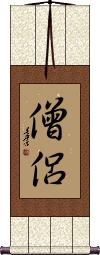
僧侶/僧侶 is a Japanese title for a Buddhist monk.
The first Kanji means Buddhist priest or monk by itself.
The second Kanji means follower or companion.
 Note, if you order this from the Japanese master calligrapher, the first character will look a bit more like the Kanji shown to the right than the Kanji shown above. Let us know if you have a preference, as both versions are technically-correct in both Chinese and Japanese.
Sangha / Order of Monks
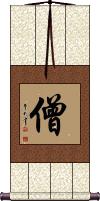
僧 is the single-character or short form of Sangha, the Buddhist idea of community or order (of monks, nuns, or followers of the Buddha).
Alone, this character can simply mean “monk” (Just means monk in Japanese).
 Note that when writing this as Kanji, Japanese will tend to write this in the form shown to the right. If you select our Japanese master calligrapher, please expect this special Kanji form.
Warrior Monk / Soldier Priest
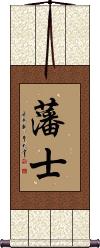
藩士 is a strange title for a wall scroll, but it may suit you if you see yourself as a warrior monk.
This title is not commonly used but will be understood in Chinese and Japanese. It can also be read as “armed monks.”
If you have not been a monk, how can you know what it is like to be a vegetarian?
Only by experiencing hardship will allow you understand the plight of others
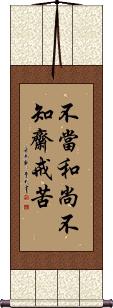
不當和尚不知齋戒苦 literally translates as:
[One who has] not been a monk [does not] know the suffering of [being on a] vegetarian diet.
This is a bit like the “walk a mile in another man's shoes” saying. Basically, it's about you cannot fully understand the plight of others until you experience it yourself.
To Know Hardship, One Must Experience It
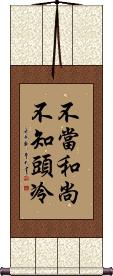
不當和尚不知頭冷 is a Chinese proverb that literally translates as: [One who has] not been a monk [does] not know [the feeling of a] cold head.
I need to explain that a Chinese Buddhist monk always has a shaved head, and thus a cold head in winter.
Figuratively, this means: One cannot know the true meaning of hardship until one has experienced it oneself.
This is an idiom in Chinese, so the figurative meaning is what people perceive when they hear or read this phrase. Just as in English, when someone says, "The grass is always greener," one will think about the idea of jealousy, rather than the quality of one’s lawn.
Dogen
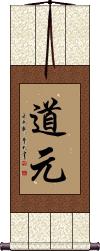
Usually, when people are looking for 道元 or “Dogen,” they are referring to the Japanese Zen monk by this name.
He lived from 1200-1253. This Dogen name or title literally means “The Way Origin” or “Beginning of the Path.” It is understood to mean “beginning of right doctrine or faith” in the context of his name and work to establish the Sōtō school of Zen in Japan.
To accomplish that task, this humble monk traveled from Japan and across China to find the more original or pure forms of Buddhism.
Shidan
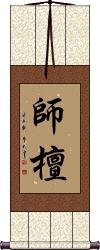
This can means teacher, monk, or patron/donor.
Ten Commandments
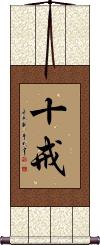
十戒 means Ten Commandments or Ten Precepts.
In the Buddhist context, these are prohibitions consisting of five commandments for the layman:
1. Not to destroy life 不殺生 Pāṇātipātāveramaṇi.
2. Not to steal 不倫盜 Adinnādānāver.
3. Not to commit adultery 不婬慾 Abrahmacaryaver.
4. Not to lie 不妄語 Musāvādāver.
5. Not to take intoxicating liquor 不飮酒 Suramereyya-Majjapamādaṭṭhānāver.
The ten commandments for the monk are the preceding five plus:
6. Not to eat food outside of regulated hours 不非時食 Vikāla-Bhojanāver.
7. Not to use garlands or perfumes 不著華鬘好香塗身 Mālā- Gandha-Vilepana-Dhāraṇa-Maṇḍana-Vibhūṣanaṭṭhānā.
8. Not to sleep on high or broad beds (chastity) 不坐高廣大牀 Uccāsayanā-Mahāsayanā.
9. Not to take part in singing, dancing, musical or theatrical performances 不歌舞倡伎不往觀聽 Nacca-Gīta-Vādita-Visūkadassanāver.
10. To refrain from acquiring uncoined or coined gold, or silver, or jewels 不得捉錢金銀寶物 Jātarūpa-Rajata-Paṭīggahaṇāver.
These original Buddhist commandments date back to about 2500 years ago. The English definitions above are followed by Chinese characters and original Pali pronunciation.
Under the Māhayāna Buddhism, these ten commands for the monk were changed, to accord with the new environment of the monk, to the following: not to kill, not to steal, to avoid all unchastity, not to lie, not to slander, not to insult, not to chatter, not to covet, not to give way to anger, to harbor no skepticism.
A Rising Tide Lifts All Boats
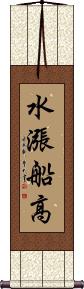
水漲船高 means “A rising tide lifts all boats/ships” in Chinese.
This idiom first appeared in the “Wudeng Huiyuan” (五燈會元) by the Song Dynasty monk Puji (普濟).
There is also a version that says “The longer the water flows, the higher the boat rises” or “水長船高”.
Acknowledgments: Thanks to Mac Lee for a factual correction to this entry.
Shaolin Disciple
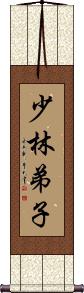
少林弟子 means Shaolin Disciple in Chinese.
This could also refer to a Shaolin Practitioner or a Shaolin Monk.
Ikkyu
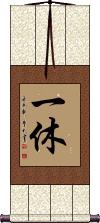
一休 is the Japanese name Ikkyuu, Ikkyū, or Ikyu.
This can sort of mean “instant” or “a rest.”
Chinese people will recognize this as the name of a famous Japanese Buddhist monk.
Namu Dai Bosa
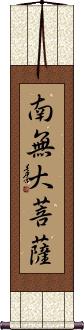
南無大菩薩 means to submit to or pay homage to the great Bodhisattva.
The last three characters, 大菩薩, can mean bodhisattva-mahāsattva, refer to one who has reached enlightenment but vows to save all beings before becoming a buddha or a high and noble monk.
Grand Master / Great Teacher
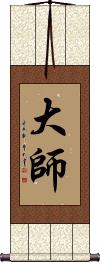
大師 is a way to title a great master, grand master, or great teacher.
This can be used in the context of martial arts or a Buddhist teacher. Thus, it can be used to title a living Buddha, Bodhisattva, or high-ranking monk.
Nirvana
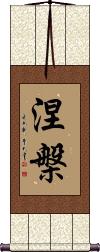
涅槃/涅盤 are the Chinese characters that mean Nirvāṇa. I will let you decide what Nirvana means to you.
This can also be translated as “Buddha's death and salvation” or “death of a Buddhist monk,” depending on the context. However, this is not seen with any bad meaning. You could replace “death” with “moving on,” as that is how it's seen in a Buddhist context.
More info from our dictionary: Nirvana
Silent / Solitary
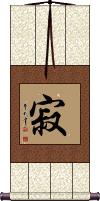
寂 means silent, solitary, quiet, calm, still, rest, or tranquil.
This also has a strong association with Buddhism where it can mean “entering into Nirvana.” In that context, this is sometimes used to refer to the passing of a Buddhist monk (he is silent, as he has entered Nirvana). For the living, this is about tranquility (especially of mind).
Some will also use this to mean “elegant simplicity.”
From Sanskrit, this can represent praśama, vivikta, śānti, or nibbāna (nirvāṇa).
Paramartha
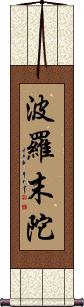
波羅末陀 is the Chinese and Japanese way to write the ancient Sanskrit word Paramārtha or परमार्थ which now means the highest truth, ultimate truth, ultimate reality, or fundamental meaning.
Paramārtha is the name of a famous Buddhist monk born in 499 CE. Paramārtha traveled the world (including Cambodia and territories that are now part of China) to spread the teachings of Buddhism by translating scriptures into the local languages so the truth could be understood by the masses.
So, we should all want to be a Paramārtha who brings the ultimate truth, knowledge, and enlightenment to others.
Hishiryo / Not-Thinking
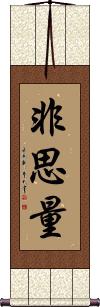
Hishiryō (非思量) literally means not-thinking.
Hishiryo can be described as a state of mind beyond thinking and non-thinking during the practice of Zazen.
Shiryō (思量) means “thinking,” and hi (非) is a prefix for negation and opposition.
Therefore, hishiryo amounts to “unthink” or “not the matter of thinking.” The word hishiryo appears in Dogen Zenji’s Fukanzazengi, Shobogenzo Zazengi, Shobogenzo Zazenshin, and Keizan Zenji’s Zazen Yojinki. It is one of the most important words used to describe zazen. Hishiryo in these writings comes from a dialogue between Yakusan Igen (745-828) and an unnamed monk, which is described in Keitoku, Dentoroku, and other Zen texts.
The above is an abridged except from School of Shodo: Hishiryo
I suggest you visit that page for a full explanation.
Meet the Buddha, Kill the Buddha
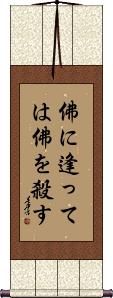
This controversial Buddhist koan means “On encountering Buddha, you should kill him.”
This is the short concise Japanese version of an original statement by ninth-century Chinese Buddhist monk Linji Yixuan, “If You Meet The Buddha On The Road, Kill Him.”
This takes some explaining... The concept here is that if you think you have seen, experienced, or achieved true enlightenment, the chances that you really have are so slim that you should kill or dismiss that idea.
Another suggestion is that one's path to becoming a Buddha is one's own, and one should not get caught up in religious fervor, and avoid “showing off” that they are a Buddhist.
Helpful references for this concept:
Lion's Roar addresses "If You Meet The Buddha On The Road, Kill Him"
Kill the Buddha
Note: Because this selection contains some special Japanese Hiragana characters, it should be written by a Japanese calligrapher.
Push or Knock
To weigh one's words
During the Tang Dynasty, a man named Jia Dao (born in the year 779), a well-studied scholar and poet, went to the capital to take the imperial examination.
One day as he rides a donkey through the city streets, a poem begins to form in his mind. A portion of the poem comes into his head like this:
“The bird sits on the tree branch near a pond,
A monk approaches and knocks at the gate...”
At the same time, he wondered if the word “push” would be better than “knock” in his poem.
As he rides down the street, he imagines the monk pushing or knocking. Soon he finds himself making motions of pushing and shaking a fist in a knocking motion as he debates which word to use. He is quite a sight as he makes his way down the street on his donkey with hands and fists flying about as the internal debate continues.
As he amuses people along the street, he becomes completely lost in his thoughts and does not see the mayor's procession coming in the opposite direction. Jia Bao is blocking the way for the procession to continue down the road, and the mayor's guards immediately decide to remove Jia Bao by force. Jia Bao, not realizing that he was in the way, apologizes, explains his poetic dilemma and awaits his punishment for blocking the mayor's way.
The mayor, Han Yu, a scholar and author of prose himself, finds himself intrigued by Jia Dao's poem and problem. Han Yu gets off his horse and addresses Jia Bao, stating, “I think knock is better.” The relieved Jia Bao raises his head and is invited by the mayor to join the procession, and are seen riding off together down the street, exchanging their ideas and love of poetry.
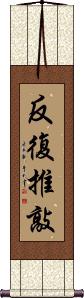
In modern Chinese, this 反復推敲 idiom is used when someone is trying to decide which word to use in their writing or when struggling to decide between two things when neither seems to have a downside.
7. Right Mindfulness / Right Memory / Perfect Mindfulness
Samyak Smriti / Samyak Smrti / Samma Sati
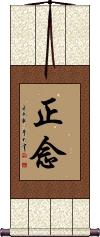
正念 is one of the Noble Eightfold Paths of Buddhism. Right Mindfulness, along with Right Effort and Right Concentration, constitute the path to Concentration or Perfect Thought.
Right Mindfulness is about remaining focused on one's body, feelings, mind, and mental qualities. It's also about being ardent, aware, and mindful, and supposes that you've already put aside worldly desire and aversion.
Monk Bhikkhu Bodhi described this as “The mind is deliberately kept at the level of bare attention, a detached observation of what is happening within us and around us in the present moment.” When practicing right mindfulness, the mind is trained to remain in the present, open, quiet, and alert, contemplating the present event.
Another definition: Ongoing mindfulness of body, feelings, thinking, and objects of thought.
This term is exclusively used by devout Buddhists. It is not a common term, and is remains an unknown concept to most Japanese and Chinese people.
See Also: Buddhism | Enlightenment | Noble Eightfold Path
Sangha
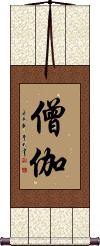
In Buddhism, 僧伽 refers to a community of monks and/or nuns (one of the “Three Jewels”). In general terms, it can simply mean “all followers of the Buddha.”
Notes: Though there are not vast numbers of Chinese Hindus, in the Hindu faith, this term means “community together.”
The original Sanskrit word is also Romanized as samgha.
The first character means “monk.” The second character means Buddha or Shakyamuni.
僧伽 is a transliteration of the original Sanskrit, but it uses two very profound Chinese characters related to Buddhism.
Some may pronounce this as “seng qie” or “seng jia” in Mandarin (two possible pronunciations for the second character). Note that “qie” sounds like “chee-ah” using typical English pronunciation. Chinese Romanization is not actually designed to match English sounds.
Note that when writing this as Kanji, Japanese will tend to write the first character in the form shown to the right. If you select our Japanese master calligrapher, please expect this special Kanji form. However, it should also be noted that this is not a common term in Japanese (except by certain sects of Buddhism or perhaps devout Buddhists in Japan).
This in-stock artwork might be what you are looking for, and ships right away...
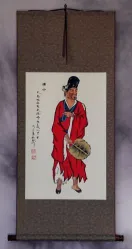
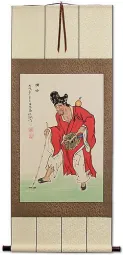
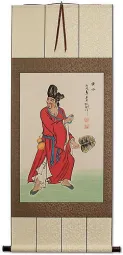
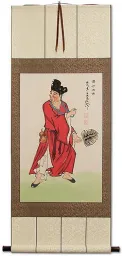
Ji Gong
The Mad Monk Of China
Wall Scroll
Discounted Blemished
Gallery Price: $63.00
Your Price: $35.00
The following table may be helpful for those studying Chinese or Japanese...
| Title | Characters | Romaji (Romanized Japanese) | Various forms of Romanized Chinese | |
| Buddhist Monk | 僧侶 / 僧侶 僧侶 | sou ryo / souryo / so ryo | ||
| Sangha Order of Monks | 僧 | sou / so | sēng / seng1 / seng | |
| Warrior Monk Soldier Priest | 藩士 | sou hei / souhei / so hei | sēng bīng seng1 bing1 seng bing sengbing | seng ping sengping |
| If you have not been a monk, how can you know what it is like to be a vegetarian? | 不當和尚不知齋戒苦 不当和尚不知斋戒苦 | bù dāng hé shang bù zhī zhāi jiè kǔ bu4 dang1 he2 shang bu4 zhi1 zhai1 jie4 ku3 bu dang he shang bu zhi zhai jie ku | pu tang ho shang pu chih chai chieh k`u pu tang ho shang pu chih chai chieh ku |
|
| To Know Hardship, One Must Experience It | 不當和尚不知頭冷 不当和尚不知头冷 | bù dāng hé shàng bù zhī tóu lěng bu4 dang1 he2 shang4 bu4 zhi1 tou2 leng3 bu dang he shang bu zhi tou leng | pu tang ho shang pu chih t`ou leng pu tang ho shang pu chih tou leng |
|
| Dogen | 道元 | dou gen / dougen / do gen | dào yuán / dao4 yuan2 / dao yuan / daoyuan | tao yüan / taoyüan |
| Shidan | 師檀 师檀 | shidan | shī tán / shi1 tan2 / shi tan / shitan | shih t`an / shihtan / shih tan |
| Ten Commandments | 十戒 | jukkai / jukai | shí jiè / shi2 jie4 / shi jie / shijie | shih chieh / shihchieh |
| A Rising Tide Lifts All Boats | 水漲船高 水涨船高 | shuǐ zhǎng chuán gāo shui3 zhang3 chuan2 gao1 shui zhang chuan gao shuizhangchuangao | shui chang ch`uan kao shuichangchuankao shui chang chuan kao |
|
| Shaolin Disciple | 少林弟子 | shǎo lín dì zǐ shao3 lin2 di4 zi3 shao lin di zi shaolindizi | shao lin ti tzu shaolintitzu |
|
| Ikkyu | 一休 | Ikkyū / Ikyū | yī xiū / yi1 xiu1 / yi xiu / yixiu | i hsiu / ihsiu |
| Namu Dai Bosa | 南無大菩薩 南无大菩萨 | namu dai bosa namudaibosa | ||
| Grand Master Great Teacher | 大師 大师 | daishi | dà shī / da4 shi1 / da shi / dashi | ta shih / tashih |
| Nirvana | 涅槃 / 涅盤 涅盘 | ne han / nehan | niè pán / nie4 pan2 / nie pan / niepan | nieh p`an / niehpan / nieh pan |
| Silent Solitary | 寂 | jaku | jì / ji4 / ji | chi |
| Paramartha | 波羅末陀 波罗末陀 | ha ra ma da haramada | bō luó mò tuó bo1 luo2 mo4 tuo2 bo luo mo tuo boluomotuo | po lo mo t`o polomoto po lo mo to |
| Hishiryo Not-Thinking | 非思量 | hi shi ryou hishiryou hi shi ryo | fēi sī liáng fei1 si1 liang2 fei si liang feisiliang | fei ssu liang feissuliang |
| Meet the Buddha, Kill the Buddha | 佛に逢っては佛を殺す | butsu ni atte wa butsu o korosu | ||
| Push or Knock | 反復推敲 反复推敲 | fǎn fù tuī qiāo fan3 fu4 tui1 qiao1 fan fu tui qiao fanfutuiqiao | fan fu t`ui ch`iao fanfutuichiao fan fu tui chiao |
|
| 7. Right Mindfulness Right Memory Perfect Mindfulness | 正念 | sei nen / seinen | zhèng niàn zheng4 nian4 zheng nian zhengnian | cheng nien chengnien |
| Sangha | 僧伽 | sougya / sogya | sēng qié / seng1 qie2 / seng qie / sengqie | seng ch`ieh / sengchieh / seng chieh |
| In some entries above you will see that characters have different versions above and below a line. In these cases, the characters above the line are Traditional Chinese, while the ones below are Simplified Chinese. | ||||
Successful Chinese Character and Japanese Kanji calligraphy searches within the last few hours...



