Many custom options


And formats



Blow in Chinese / Japanese
Buy a Blow calligraphy wall scroll here!
Personalize your custom “Blow” project by clicking the button next to your favorite “Blow” title below.
Blow

布洛 is the name Blow in Chinese (Mandarin).
Blow

ブロウ is the name Blow in Japanese Katakana.
Note: Because this title is entirely Japanese Katakana, it should be written by a Japanese calligrapher.
Ikken Hissatsu
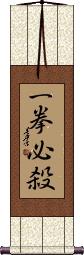
一拳必殺 is Ikken Hissatsu, a Japanese martial arts term that means to annihilate with one blow.
This translates directly as “one fist, certain death.”
Wisdom from Hard Knocks
The school of hard knocks
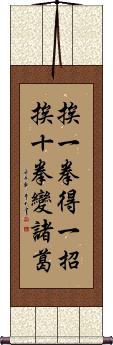
挨一拳得一招挨十拳變諸葛 is a Chinese proverb that literally translates as: Receive one blow, [and one] learns a lesson; Receive ten blows, [and one] becomes a great Zhuge [Liang].
You must first understand that a man named Zhuge Liang was one of the great strategists and philosophers in Chinese history. He's known as a man of great wisdom.
Figuratively, this phrase means:
One can learn much from failure or “hard knocks.”
Allah / God of Islam
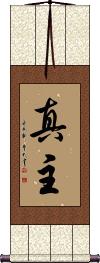
真主 is how Chinese Muslims refer to God (it literally means “True Master”).
Oddly, in China, two different names for God have emerged. Even though Muslims, Christians, and Jews all worship the same God of Abraham.
In Arabic, the word Allah is just the Arabic way to say, God. Arab Christians pray to Allah, just like Arab Muslims. Somehow in China, the title of God diverged.
If you are curious, there are millions of Muslims throughout China but especially in the northwest portion of China known as Xinjiang. Here you will find descendants of Turkmen, Persian, Arab, and other ethnicities. Some are mixed with Han-Chinese blood; others appear to be pure Turkmen. Many have fair complexions, green eyes, and light hair but all are citizens of China. A visit to Xinjiang will shift your paradigm and blow away all of your stereotypes about what it means to be Chinese.
Kyojitsu: Falsehood and Truth
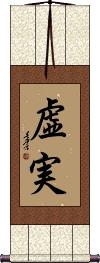
虚実 is a Japanese word that means “falsehood [and] truth” or “fiction [and] fact.”
This concept is used in warfare, gameplay, and martial arts strategies. 虚実 can be a strategy of real and/or deceptive moves. This gets to some Sun Tzu Art of War stuff where in warfare a strategic move is either a real and serious move or it is a deceptive blow.
Let's explore each character in more depth:
虚 was originally written 虛 (there is a very subtle difference in the strokes at the bottom of the character) and means unpreparedness, falsehood, emptiness, void, abstract theory, empty or unoccupied, diffident or timid, false, humble or modest, virtual, or in vain.
In the Buddhist context, 虛 represents the Pali/Sanskrit word “śūnya,” meaning empty, vacant, unreal, unsubstantial, untrue, space, humble, or in vain.
In ancient Eastern/Chinese astronomy, 虛 represents the “Emptiness” constellation (one of the 28 mansions in the sky).
実 was originally 實 in Chinese (they currently write it as 实 in Simplified Chinese) with the meaning, truth, reality, sincerity, honesty, fidelity, and substance.
The Buddhist context is similar, adding real, true, honest, really, solid, definitely, sincere, solid, fixed, full, to fill, fruit, kernel, verily, in fact, the supreme fact, or ultimate reality to the definition.
These search terms might be related to Blow:
Bash
Carry On, Undaunted
Chop Wood, Carry Water
Gust
Knee Strike
Push or Knock
Rage / Frenzy / Berserk
Rage / Fury
Shock
Strike While the Iron is Hot
Not the results for Blow that you were looking for?
Below are some entries from our dictionary that may match your Blow search:
| Characters If shown, 2nd row is Simp. Chinese |
Pronunciation Romanization |
Simple Dictionary Definition |
金星 see styles |
jīn xīng jin1 xing1 chin hsing kinboshi きんぼし |
More info & calligraphy: Venus / Gold Star(1) dazzling victory; (2) {sumo} win of a rank-and-file wrestler over the grand champion; (surname) Kinboshi Śukra, the planet Venus. |
ボディ see styles |
bodi ボディ |
More info & calligraphy: Boddie |
刮 see styles |
guā gua1 kua |
to scrape; to blow; to shave; to plunder; to extort |
吹 see styles |
chuī chui1 ch`ui chui fuki ふき |
to blow; to play a wind instrument; to blast; to puff; to boast; to brag; to end in failure; to fall through (surname) Fuki To blow; puff, praise. |
呠 see styles |
pēn pen1 p`en pen |
to spurt; to blow out; to puff out; to snort |
宛 see styles |
wǎn wan3 wan ango あんご |
winding; as if (1) aim; object; purpose; end; (2) expectations; prospects; hopes; (3) something that can be relied upon; (4) (ksb:) snack served with alcoholic drink; (suffix noun) (5) pad; guard; (n-suf,n-pref) (6) blow; strike; (suffix) (7) addressed to; (8) (kana only) per; (personal name) Ango completely |
捍 see styles |
hàn han4 han mamoru まもる |
to ward off (a blow); to withstand; to defend (given name) Mamoru |
擤 see styles |
xǐng xing3 hsing |
to blow (one's nose) |
欨 see styles |
xū xu1 hsü |
(literary) to blow or breathe upon; happy |
炸 see styles |
zhà zha4 cha zaa / za ザー |
to burst; to explode; to blow up; to bomb; (coll.) to fly into a rage; (coll.) to scamper off; to scatter (prefix) {food} (in names of Chinese dishes) deep-fried (chi: zhá) |
颳 刮 see styles |
guā gua1 kua |
to blow (of the wind) |
颼 飕 see styles |
sōu sou1 sou |
to blow (as of wind); sound of wind; sough |
鰒 鳆 see styles |
fù fu4 fu fugu ふぐ awabi あわび |
Haliotis gigantea; sea ear (kana only) puffer fish; blow fish; fugu; globefish; swellfish; (kana only) abalone; ear shell |
龡 see styles |
chuì chui4 ch`ui chui |
to blow (a flute); archaic version of 吹 |
一打 see styles |
yī dá yi1 da2 i ta ichida いちだ |
dozen stroke; blow |
一撃 see styles |
ichigeki いちげき |
(noun, transitive verb) (1) one blow; one hit; one stroke; (noun, transitive verb) (2) summiting on the first attempt (oft. without prior knowledge about the route; in climbing); on-sight; flashing |
一本 see styles |
hitomoto ひともと |
(1) one long cylindrical thing; one film, TV show, etc.; one goal, home run, etc.; one telephone call; (2) one version; (3) one book; a certain book; (4) (martial arts term) ippon; one point; a blow; (5) experienced geisha; (suffix noun) (6) single-minded focus on ...; (surname) Hitomoto |
一泡 see styles |
hitoawa ひとあわ |
blow; shock |
一発 see styles |
ippatsu いっぱつ |
(1) shot; charge; explosion; (2) blow; punch; (3) (baseb) home run; (n,n-adv) (4) try; attempt |
倒す see styles |
taosu たおす kokasu こかす |
(transitive verb) (1) to throw down; to bring down; to blow down; to fell; to knock down; to set (something) down on its side; to turn (something) on its side; (2) to kill; to defeat; to beat; (3) to overthrow; to trip up; to ruin; (4) to leave unpaid; to cheat; (v4s,vt) (archaism) to knock down; to knock over |
側杖 see styles |
sobazue そばづえ |
blow received by a bystander; getting dragged in to somebody else's fight |
傍杖 see styles |
sobazue そばづえ |
blow received by a bystander; getting dragged in to somebody else's fight |
刮掉 see styles |
guā diào gua1 diao4 kua tiao |
to scrape off; to shave off (whiskers etc); (of the wind) to blow something away |
刺中 see styles |
cì zhòng ci4 zhong4 tz`u chung tzu chung |
to hit with a piercing blow |
勁吹 劲吹 see styles |
jìng chuī jing4 chui1 ching ch`ui ching chui |
(of wind) to blow strongly; (fig.) (of trends, changes etc) to sweep through society |
吭哧 see styles |
kēng chi keng1 chi5 k`eng ch`ih keng chih |
to puff and blow; to whimper |
吹く see styles |
fuku ふく |
(v5k,vi) (1) to blow (of the wind); (transitive verb) (2) to blow (one's breath); to breathe out; to blow on (hot tea, candles, etc.); to puff; (transitive verb) (3) to play (a wind instrument); to blow (a whistle, trumpet, etc.); to whistle (a tune); (v5k,vt,vi) (4) (See 噴く) to emit (smoke, fire, etc.); to spout; to spew; to puff out; (v5k,vt,vi) (5) to sprout; to put forth (buds); (v5k,vt,vi) (6) to appear (on the surface); to form; to be coated with (powder, rust, etc.); (v5k,vi) (7) (slang) (See 吹き出す・3) to burst out laughing; to burst into laughter; (transitive verb) (8) to brag; to talk big; (transitive verb) (9) to smelt; to mint |
吹乾 吹干 see styles |
chuī gān chui1 gan1 ch`ui kan chui kan |
to blow-dry |
吹光 see styles |
chuī guāng chui1 guang1 ch`ui kuang chui kuang suikō |
To blow out a light, a blown-out light. |
吹去 see styles |
chuī qù chui1 qu4 ch`ui ch`ü chui chü suiko |
to blow away |
Click here for more Blow results from our dictionary
The following table may be helpful for those studying Chinese or Japanese:
| Title | Characters | Romaji (Romanized Japanese) | Various forms of Romanized Chinese | |
| Blow | 布洛 | bù luò / bu4 luo4 / bu luo / buluo | pu lo / pulo | |
| Blow | ブロウ | burou / buro | ||
| Ikken Hissatsu | 一拳必殺 | ikken hissatsu ikkenhissatsu iken hisatsu | ||
| Wisdom from Hard Knocks | 挨一拳得一招挨十拳變諸葛 挨一拳得一招挨十拳变诸葛 | ái yī quán dé yī zhāo ái shí quán biàn zhū gě ai2 yi1 quan2 de2 yi1 zhao1 ai2 shi2 quan2 bian4 zhu1 ge3 ai yi quan de yi zhao ai shi quan bian zhu ge | ai i ch`üan te i chao ai shih ch`üan pien chu ko ai i chüan te i chao ai shih chüan pien chu ko |
|
| Allah God of Islam | 真主 | zhēn zhǔ / zhen1 zhu3 / zhen zhu / zhenzhu | chen chu / chenchu | |
| Kyojitsu: Falsehood and Truth | 虚実 | kyo jitsu / kyojitsu | ||
| In some entries above you will see that characters have different versions above and below a line. In these cases, the characters above the line are Traditional Chinese, while the ones below are Simplified Chinese. | ||||

Successful Chinese Character and Japanese Kanji calligraphy searches within the last few hours...



