Many custom options


And formats



達磨 in Chinese / Japanese
Buy an 達磨 calligraphy wall scroll here!
Personalize your custom “達磨” project by clicking the button next to your favorite “達磨” title below.
Daruma / Damo

達磨 in Japanese usually refers to Daruma, a tumbling doll with a round red-painted body.
In Japan, Daruma is a good-luck doll which is supposed to in the shape of Bodhidharma, with a blank eye to be completed when a person's wish is granted.
達磨 is also Bodhidharma or Dharma. 達磨 comes from an ancient word that means holding fast and keeping ordinances, statutes, laws, or practice.
This is also a title for Damo, or Bodhidharma, the twenty-eighth Indian and first Chinese patriarch, who arrived in China A.D. 520, the reputed founder of the Chan or Intuitional School in China. He is described as son of a king in southern India. He famously engaged in silent meditation for nine years.
Bodhidharma
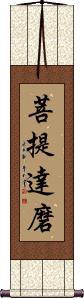
菩提達磨 is the title Bodhidharma in Chinese and Japanese.
Bodhidharma, commonly known as Damo, is reputed as the founder of the Chan (Zen) or Intuitional or Mystic School.
He likely came from south India and spread Mahayana Buddhism throughout China (even meeting the Emperor) and his disciples likely spread this all the way to Korea, Japan, and beyond in the 5th and 6th centuries.
Sometimes the last character varies in Chinese to 摩 instead of 磨 - let me know if you need a certain variation when you order.
Dharma / Damo / Daruma
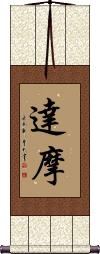
達摩 is the Chinese and Japanese title for Dharma (a short name for Bodhidharma).
He's known in Chinese as Damo and in Japanese as Daruma.
Note: In Japanese, they tend to write the last character as  versus
  . If you choose the Japanese master calligrapher, expect it to be written in the Japanese version.
Bodhidharma
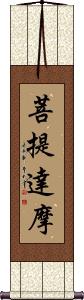
菩提達摩 is the Chinese Bodhidharma.
This refers to a man commonly known as Damo, reputed as the founder of Chan (Zen) Buddhism. His original name is believed to be Bodhitara (菩提多羅).
Note: Often, the last character is written as versus .
Not the results for 達磨 that you were looking for?
Below are some entries from our dictionary that may match your 達磨 search:
| Characters If shown, 2nd row is Simp. Chinese |
Pronunciation Romanization |
Simple Dictionary Definition |
達磨 达磨 see styles |
dá mó da2 mo2 ta mo daruma だるま |
More info & calligraphy: Daruma / Damodharma; also 達摩; 達麼; 達而麻耶; 曇摩; 馱摩 tr. by 法. dharma is from dhara, holding, bearing, possessing, etc.; and means 'that which is to be held fast or kept, ordinance, statute, law, usage, practice'; 'anything right.' M.W. It may be variously intp. as (1) characteristic, attribute, predicate; (2) the bearer, the transcendent substratum of single elements of conscious life; (3) element, i.e. a part of conscious life; (4) nirvāṇa, i.e. the Dharma par excellence, the object of Buddhist teaching; (5) the absolute, the real; (6) the teaching or religion of Buddha; (7) thing, object, appearance. Also, Damo, or Bodhidharma, the twenty-eighth Indian and first Chinese patriarch, who arrived in China A.D. 520, the reputed founder of the Chan or Intuitional School in China. He is described as son of a king in southern India; originally called Bodhitara. He arrived at Guangdong, bringing it is said the sacred begging-bowl, and settled in Luoyang, where he engaged in silent meditation for nine years, whence he received the title of wall-gazing Brahman 壁觀婆羅門, though he was a kṣatriya. His doctrine and practice were those of the 'inner light', independent of the written word, but to 慧可 Huike, his successor, he commended the Laṅkāvatāra-sūtra as nearest to his views. There are many names with Dharma as initial: Dharmapāla, Dharmagupta, Dharmayaśas, Dharmaruci, Dharmarakṣa, Dharmatrāta, Dharmavardhana, etc. |
菩提達磨 菩提达磨 see styles |
pú tí dá mó pu2 ti2 da2 mo2 p`u t`i ta mo pu ti ta mo bodaidaruma ぼだいだるま |
More info & calligraphy: BodhidharmaBodhidharma, commonly known as Damo, v. 達; reputed as the founder of the Chan (Zen) or Intuitional or Mystic School. His original name is given as 菩提多羅 Bodhitara. |
火達磨 see styles |
hidaruma ひだるま |
body covered with flames |
血達磨 see styles |
chidaruma ちだるま |
covered in blood |
達磨堂 see styles |
darumadou / darumado だるまどう |
(place-name) Darumadou |
達磨宗 达磨宗 see styles |
dá mó zōng da2 mo2 zong1 ta mo tsung darumashuu / darumashu だるましゅう |
(1) (rare) (See 禅宗) Zen (Buddhism); (2) (derogatory term) (archaism) (See 達磨歌) confusing style of middle-age Japanese poetry The Damo, or Dharma sect, i.e. the 禪宗 Meditation, or Intuitional School. |
達磨寺 see styles |
darumadera だるまでら |
(personal name) Darumadera |
達磨山 see styles |
darumayama だるまやま |
(personal name) Darumayama |
達磨忌 达磨忌 see styles |
dá mó jì da2 mo2 ji4 ta mo chi darumaki だるまき |
ceremony held in honor (honour) of Bodhidharma (October 5) The anniversary of Bodhidharma's death, fifth of the tenth month. |
達磨歌 see styles |
darumauta だるまうた |
(rare) confusing song or poem (esp. used derogatorily to describe a style of middle-age Japanese poetry popularized by Fujiwara no Teika) |
達磨町 see styles |
darumachou / darumacho だるまちょう |
(place-name) Darumachō |
達磨石 see styles |
darumaishi だるまいし |
(place-name) Darumaishi |
達磨船 see styles |
darumasen だるません |
barge; lighter |
達磨蛙 see styles |
darumagaeru; darumagaeru ダルマガエル; だるまがえる |
(kana only) Daruma pond frog (Pelophylax porosus) |
達磨鮫 see styles |
darumazame; darumazame だるまざめ; ダルマザメ |
(kana only) cookie-cutter shark (Isistius brasiliensis); cigar shark |
雪達磨 see styles |
yukidaruma ゆきだるま |
snowman |
尸羅達磨 尸罗达磨 see styles |
shī luó dá mó shi1 luo2 da2 mo2 shih lo ta mo Shiradaruma |
Śīladharma, a śramaṇa of Khotan. |
蘆葉達磨 芦叶达磨 see styles |
lú yè dá mó lu2 ye4 da2 mo2 lu yeh ta mo Royō Daruma |
Bodhidharma and his rush-leaf boat in which he is said to have crossed the Yangze. |
達磨不識 达磨不识 see styles |
dá mó bù shì da2 mo2 bu4 shi4 ta mo pu shih Datsuma fushiki |
Bodhidharma's don't know |
達磨大師 达磨大师 see styles |
dá mó dà shī da2 mo2 da4 shi1 ta mo ta shih darumadaishi だるまだいし |
(personal name) Darumadaishi Master Bodhidharma |
達磨廓然 达磨廓然 see styles |
dá mó kuò rán da2 mo2 kuo4 ran2 ta mo k`uo jan ta mo kuo jan Datsuma kakunen |
Bodhidharma's emptiness |
達磨波羅 达磨波罗 see styles |
dá mó bō luó da2 mo2 bo1 luo2 ta mo po lo Datsumahara |
Dharmapāla |
達磨菩提 达磨菩提 see styles |
dá mó pú tí da2 mo2 pu2 ti2 ta mo p`u t`i ta mo pu ti Datsumabodai |
Dharmabodhi |
達磨陣那 达磨阵那 see styles |
dá mó zhèn nà da2 mo2 zhen4 na4 ta mo chen na Damachinna |
Dhammadinnā |
達磨馱都 达磨驮都 see styles |
dá mó tuó dū da2 mo2 tuo2 du1 ta mo t`o tu ta mo to tu darumadatsu |
dharmadhātu, tr. 法界 'the element of law or of existence' (M.W.); all psychic and non-psychic processes (64 dharmas), with the exception of rūpa-skandha and mano-ayatana (11), grouped as one dharma element; the storehouse or matrix of phenomena, all-embracing totality of things; in the Tantric school, Vairocana divided into Garbhadhātu (material) and Vajradhātu (indestructible); a relic of the Buddha. |
阿毗達磨 see styles |
ā pí dá mó a1 pi2 da2 mo2 a p`i ta mo a pi ta mo |
阿毗曇; 阿鼻達磨 abhidharma. The śāstras, which discuss Buddhist philosophy or metaphysics; defined by Buddhaghōsa as the law or truth (dharma) which (abhi) goes beyond or behind the law; explained by傳 tradition, 勝法 surpassing law, 無比法 incomparable law, 對法 comparing the law, 向法 directional law, showing cause and effect. The阿毗達磨藏 or 阿毗達磨論藏 is the abhidharma-piṭaka, the third part of the tripiṭaka. In the Chinese canon it consists of 大乘論 Mahāyāna treatises, 小乘論 Hīnayāna treatises, and 藏諸論 those brought in during the Song and Yuan dynasties. The阿毗達磨倶舍論 abhidharma-kośa-śāstra, tr. By Xuanzang, is a philosophical work by Vasubandhu refuting doctrines of the Vibhāṣā school. There are many works of which abhidharma forms part of the title. |
阿毘達磨 阿毘达磨 see styles |
ā pí dá mó a1 pi2 da2 mo2 a p`i ta mo a pi ta mo abidatsuma あびだつま |
{Buddh} abhidharma; texts that contain detailed reworkings of the Buddhist sutras abhidharma |
阿浮達磨 阿浮达磨 see styles |
ā fú dá mó a1 fu2 da2 mo2 a fu ta mo abudatsuma |
abdhuta-dharma |
阿鼻達磨 阿鼻达磨 see styles |
ā bí dá mó a1 bi2 da2 mo2 a pi ta mo abidatsuma |
abhidharma |
雪達磨式 see styles |
yukidarumashiki ゆきだるましき |
snowballing (phenomenon, effect) |
Click here for more 達磨 results from our dictionary
The following table may be helpful for those studying Chinese or Japanese:
| Title | Characters | Romaji (Romanized Japanese) | Various forms of Romanized Chinese | |
| Daruma Damo | 達磨 达磨 | daruma | dá mó / da2 mo2 / da mo / damo | ta mo / tamo |
| Bodhidharma | 菩提達磨 菩提达磨 | bodai daruma bodaidaruma | pú tí dá mó pu2 ti2 da2 mo2 pu ti da mo putidamo | p`u t`i ta mo putitamo pu ti ta mo |
| Dharma Damo Daruma | 達摩 / 達磨 达摩 / 达磨 | daru ma / daruma | dá mó / da2 mo2 / da mo / damo | ta mo / tamo |
| Bodhidharma | 菩提達摩 / 菩提達磨 菩提达摩 / 菩提达磨 | bo dai daru ma bodaidaruma | pú tí dá mó pu2 ti2 da2 mo2 pu ti da mo putidamo | p`u t`i ta mo putitamo pu ti ta mo |
| In some entries above you will see that characters have different versions above and below a line. In these cases, the characters above the line are Traditional Chinese, while the ones below are Simplified Chinese. | ||||

Successful Chinese Character and Japanese Kanji calligraphy searches within the last few hours...



