Many custom options...


And formats...



Zong1 in Chinese / Japanese...
Buy a Zong1 calligraphy wall scroll here!
Personalize your custom “Zong1” project by clicking the button next to your favorite “Zong1” title below...
Soke / Shuke
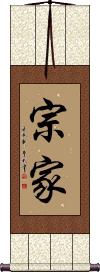
宗家 is a Japanese word that means “head of the family” or “originator.”
In Chinese, this is an honor name for Shandao (善導), a writer of commentaries on the sutras of the Pure Land sect of Buddhism.
Henzon

亨宗 is the name Henzon in Chinese (Mandarin).
Zen Buddhism
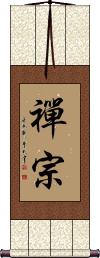
禪宗 is one way to title “Zen Buddhism.” Because the original pronunciation of Zen in Chinese is Chan, you'll also see this expressed as Chan Buddhism.
From the Buddhist Dictionary:
The Chan, meditative or intuitional, sect is usually said to have been established in China by Bodhidharma, the twenty-eighth patriarch, who brought the tradition of the Buddha-mind from India. This sect, believing in direct enlightenment, disregarded ritual and sūtras and depended upon the inner light and personal influence for the propagation of its tenets, founding itself on the esoteric tradition supposed to have been imparted to Kāśyapa by the Buddha, who indicated his meaning by plucking a flower without further explanation. Kāśyapa smiled in apprehension and is supposed to have passed on this mystic method to the patriarchs. The successor of Bodhidharma was 慧可 Huike, and he was succeeded by 僧璨 Sengcan, 道信 Daoxin, 弘忍 Hongren, 慧能 Huineng, and 神秀 Shenxiu, the sect dividing under the two latter into the southern and northern schools: the southern school became prominent, producing 南嶽 Nanyue and 靑原 Qingyuan, the former succeeded by 馬祖 Mazu, the latter by 石頭 Shitou. From Mazu's school arose the five later schools.
Mizong-Yi
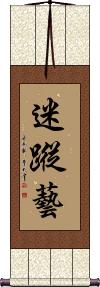
迷蹤藝 is the Chinese martial arts known as Mizong-Yi or Mizongyi, based on deception and mobility.
If you directly translate 迷蹤藝, you get something like “Lost Track Skill,” “Lost in the Art,” or “Mysterious Footwork Technique.”
Pure Land Buddhism / Jodo Buddhism
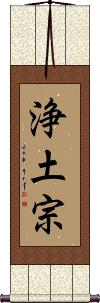
浄土宗 is the title of Japanese “Pure Land Buddhism.” This form is also romanized/known as “Jodo Shu” (jōdo shū).
Also known as Amidism for the fact that this is a branch of Mahayana (Mahāyāna) Buddhism which focuses on Amitabha (Amitābha) Buddha. This form of Buddhism, along with Chinese characters, came to Japan via China in the 5th century, according to most historians.
Notes:
Pure Land Buddhism is also known as 


 (jōdo bukkyō).
Some will just express it with just (Pure Land).
See Also: Shin Buddhism
Mixed Martial Arts
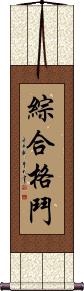
綜合格鬥 is a common Chinese title for “Mixed Martial Arts” or “MMA.”
The characters or words in this title break down this way:
綜合 zōng hé = composite, synthesized, to sum up, to integrate, and/or to synthesize.
格 gé = style, frame, or rule.
斗 dòu = fight, to battle, or to struggle.
Tom Clan Generational Poem

爾昌友延嗣捷開文裔光宗傳世澤遠晉本立道隆積善家國重學業廣成芳 is the Tom Clan Generational Poem.
If you are interested in this poem, you probably already know the meaning, so for now we'll forgo including a translation.
Shaolin Generational Poem
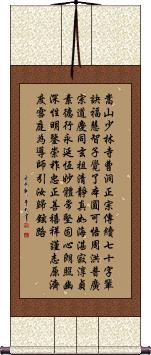
This is a poem, including a title, that celebrates the tactics and virtues of the Shaolin Kung Fu Monks for future generations.
Not the results for zong1 that you were looking for?
Below are some entries from our dictionary that may match your zong1 search...
| Characters If shown, 2nd row is Simp. Chinese |
Pronunciation Romanization |
Simple Dictionary Definition |
宗家 see styles |
zōng jiā zong1 jia1 tsung chia muneie / munee むねいえ |
More info & calligraphy: Soke / ShukeA name for Shandao 善導 (d. 681), a writer of commentaries on the sutras of the Pure Land sect, and one of its principal literary men; cf. 念佛宗. |
禪宗 禅宗 see styles |
chán zōng chan2 zong1 ch`an tsung chan tsung Zenshū |
More info & calligraphy: Zen BuddhismThe Chan, meditative or intuitional, sect usually said to have been established in China by Bodhidharma, v. 達, the twenty-eighth patriarch, who brought the tradition of the Buddha-mind from India. Cf. 楞 13 Laṅkāvatāra sūtra. This sect, believing in direct enlightenment, disregarded ritual and sūtras and depended upon the inner light and personal influence for the propagation of its tenets, founding itself on the esoteric tradition supposed to have been imparted to Kāśyapa by the Buddha, who indicated his meaning by plucking a flower without further explanation. Kāśyapa smiled in apprehension and is supposed to have passed on this mystic method to the patriarchs. The successor of Bodhidharma was 慧可 Huike, and he was succeeded by 僧璨 Sengcan; 道信 Daoxin; 弘忍 Hongren; 慧能 Huineng, and 神秀 Shenxiu, the sect dividing under the two latter into the southern and northern schools: the southern school became prominent, producing 南嶽 Nanyue and 靑原 Qingyuan, the former succeeded by 馬祖 Mazu, the latter by 石頭 Shitou. From Mazu's school arose the five later schools, v. 禪門. |
淨土宗 净土宗 see styles |
jìng tǔ zōng jing4 tu3 zong1 ching t`u tsung ching tu tsung Jōdo Shū |
Pure Land Buddhism The Pure-land sect, whose chief tenet is salvation by faith in Amitābha; it is the popular cult in China, also in Japan, where it is the Jōdo sect; it is also called 蓮宗(蓮花宗) the Lotus sect. Established by Hui-yuan 慧遠 of the Chin dynasty (317— 419), it claims P'u-hsien 普賢 Samantabhadra as founder. Its seven chief textbooks are 無量淸淨平等覺經; 大阿彌陀經; 無量壽經; 觀無量壽經; 阿彌陀經; 稱讚淨土佛攝受經; and 鼓音聲三陀羅尼經. The淨土眞宗 is the Jōdo-Shin, or Shin sect of Japan. |
宗 see styles |
zōng zong1 tsung motoi もとい |
school; sect; purpose; model; ancestor; clan; to take as one's model (in academic or artistic work); classifier for batches, items, cases (medical or legal), reservoirs (1) (rare) origin; source; (2) (rare) virtuous ancestor; (given name) Motoi Ancestors, ancestral; clan; class, category. kind; school, sect; siddhānta, summary, main doctrine, syllogism, proposition, conclusion, realization. Sects are of two kinds: (1) those founded on principles having historic continuity, as the twenty sects of the Hīnayāna, the thirteen sects of China, and the fourteen sects of Japan: (2) those arising from an individual interpretation of the general teaching of Buddhism, as the sub-sects founded by Yongming 永明 (d. 975), 法相宗, 法性宗, 破相宗, or those based on a peculiar interpretation of one of the recognized sects, as the Jōdo-shinshū 淨土眞宗 found by Shinran-shōnin. There are also divisions of five, six, and ten, which have reference to specific doctrinal differences. Cf. 宗派. |
棕 see styles |
zōng zong1 tsung |
palm; palm fiber; coir (coconut fiber); brown |
椶 棕 see styles |
zōng zong1 tsung |
variant of 棕[zong1] |
樅 枞 see styles |
zōng zong1 tsung momi もみ |
used in 樅陽|枞阳[Zong1 yang2] (kana only) Japanese fir (Abies firma); momi fir; (given name) Momi |
猣 see styles |
zōng zong1 tsung |
dog giving birth to three puppies |
綜 综 see styles |
zōng zong1 tsung souji / soji そうじ |
(bound form) to synthesize; to combine; Taiwan pr. [zong4] warp controller (on a loom); (personal name) Souji |
翪 see styles |
zōng zong1 tsung |
uneven flight of a bird |
腙 see styles |
zōng zong1 tsung |
hydrazone (chemistry) |
豵 see styles |
zōng zong1 tsung |
litter of pigs; little pig |
踪 see styles |
zōng zong1 tsung |
variant of 蹤|踪[zong1] |
蹤 踪 see styles |
zōng zong1 tsung ato |
(bound form) footprint; trace; tracks tracks |
騌 骔 see styles |
zōng zong1 tsung |
variant of 騣|鬃[zong1] |
騣 鬃 see styles |
zōng zong1 tsung |
variant of 鬃[zong1] |
鬃 see styles |
zōng zong1 tsung |
bristles; horse's mane |
鬉 鬃 see styles |
zōng zong1 tsung |
disheveled hair; horse's mane |
鬷 see styles |
zōng zong1 tsung |
kettle on legs |
鯮 see styles |
zōng zong1 tsung |
long spiky-head carp |
䗥 see styles |
zōng zong1 tsung |
used in 螉䗥[weng1 zong1] |
一宗 see styles |
yī zōng yi1 zong1 i tsung isshuu / isshu いっしゅう |
sect; denomination; (given name) Kazumune one school |
七宗 see styles |
qī zōng qi1 zong1 ch`i tsung chi tsung hichisou / hichiso ひちそう |
(place-name) Hichisou The seven Japanese sects of 律 Ritsu (or Risshū), 法相 Hossō, 論 Sanron 華嚴Kegon, 天台 Tendai, 眞言 Shingon, and 禪Zen. |
三宗 see styles |
sān zōng san1 zong1 san tsung mimune みむね |
(surname) Mimune The three Schools of 法相宗, 破相宗 , and 法性宗 q.v., representing the ideas of 空, 假, and 不空假, i.e. unreality, temporary reality, and neither; or absolute, relative, and neither. |
世宗 see styles |
shì zōng shi4 zong1 shih tsung sejon セジョン |
Sejong the Great or Sejong Daewang (1397-1450), reigned 1418-1450 as fourth king of Joseon or Chosun dynasty, in whose reign the hangeul alphabet was invented (place-name) Sejong City (South Korea) |
中宗 see styles |
zhōng zōng zhong1 zong1 chung tsung nakamune なかむね |
(surname) Nakamune The school or principle of the mean, represented by the 法相宗 Dharmalakṣaṇa school, which divides the Buddha's teaching into three periods, the first in which he preached 有 existence, the second 空 non-existence, the third 中 neither, something 'between' or above them, e. g. a realm of pure spirit, vide the 深密經 Saṃdhinirmocana-sūtra and the Lotus Sutra. |
九宗 see styles |
jiǔ zōng jiu3 zong1 chiu tsung ku shū |
The eight sects 八宗 (q.v.) plus the 禪宗 Chan or Zen, or the Pure-land or Jōdo sect. |
二宗 see styles |
èr zōng er4 zong1 erh tsung nisou / niso にそう |
(surname) Nisou Two theories or schools stated by the Huayan (Kegon) school as 法相宗 and 法性宗 q.v., known also as 相宗 and 性宗. There are ten point of difference between them. Another division is the 空宗 and 性宗 q. v. |
五宗 see styles |
wǔ zōng wu3 zong1 wu tsung goshū |
The five great schools of Mahāyāna, i. e. 天台, 華嚴法相, 三論, and 律宗. There are other classes, or groups. |
他宗 see styles |
tā zōng ta1 zong1 t`a tsung ta tsung tashuu / tashu たしゅう |
another sect another thesis |
Click here for more zong1 results from our dictionary
The following table may be helpful for those studying Chinese or Japanese...
| Title | Characters | Romaji (Romanized Japanese) | Various forms of Romanized Chinese | |
| Soke Shuke | 宗家 | Shuuke / Shuke | zōng jiā / zong1 jia1 / zong jia / zongjia | tsung chia / tsungchia |
| Henzon | 亨宗 | hēng zōng heng1 zong1 heng zong hengzong | heng tsung hengtsung |
|
| Zen Buddhism | 禪宗 禅宗 | zen shuu / zenshuu / zen shu | chán zōng chan2 zong1 chan zong chanzong | ch`an tsung chantsung chan tsung |
| Mizong-Yi | 迷蹤藝 迷踪艺 | mí zōng yì mi2 zong1 yi4 mi zong yi mizongyi | mi tsung i mitsungi |
|
| Pure Land Buddhism Jodo Buddhism | 淨土宗 浄土宗 | jou do shuu joudoshuu jo do shu | jìng tǔ zōng jing4 tu3 zong1 jing tu zong jingtuzong | ching t`u tsung chingtutsung ching tu tsung |
| Mixed Martial Arts | 綜合格鬥 综合格斗 | zōng hé gé dòu zong1 he2 ge2 dou4 zong he ge dou zonghegedou | tsung ho ko tou tsunghokotou |
|
| Tom Clan Generational Poem | 爾昌友延嗣捷開文裔光宗傳世澤遠晉本立道隆積善家國重學業廣成芳 尔昌友延嗣捷开文裔光宗传世泽远晋本立道隆积善家国重学业广成芳 | ěr chāng yǒu yán sì jié kāi wén yì guāng zōng chuán shì zé yuǎn jìn běn lì dào lóng jī shàn jiā guó zhòng xué yè guǎng chéng fāng er3 chang1 you3 yan2 si4 jie2 kai1 wen2 yi4 guang1 zong1 chuan2 shi4 ze2 yuan3 jin4 ben3 li4 dao4 long2 ji1 shan4 jia1 guo2 zhong4 xue2 ye4 guang3 cheng2 fang1 er chang you yan si jie kai wen yi guang zong chuan shi ze yuan jin ben li dao long ji shan jia guo zhong xue ye guang cheng fang | erh ch`ang yu yen ssu chieh k`ai wen i kuang tsung ch`uan shih tse yüan chin pen li tao lung chi shan chia kuo chung hsüeh yeh kuang ch`eng fang erh chang yu yen ssu chieh kai wen i kuang tsung chuan shih tse yüan chin pen li tao lung chi shan chia kuo chung hsüeh yeh kuang cheng fang |
|
| Shaolin Generational Poem | 嵩山少林寺曹洞正宗傳續七十字輩訣福慧智子覺了本圓可悟周洪普廣宗道慶同玄祖清靜真如海湛寂淳貞素德行永延恆妙體常堅固心朗照幽深性明鑒崇祚忠正善禧祥謹志原濟度雪庭為導師引汝歸鉉路 嵩山少林寺曹洞正宗传续七十字辈诀福慧智子觉了本圆可悟周洪普广宗道庆同玄祖清静真如海湛寂淳贞素德行永延恒妙体常坚固心朗照幽深性明鉴崇祚忠正善禧祥谨志原济度雪庭为导师引汝归铉路 | sōng shān shào lín sì cáo dòng zhèng zōng chuán xù qī shí zì bèi jué fú huì zhì zǐ jiào le běn yuán kě wù zhōu hóng pǔ guǎng zōng dào qìng tóng xuán zǔ qīng jìng zhēn rú hǎi zhàn jì chún zhēn sù dé xíng yong song1 shan1 shao4 lin2 si4 cao2 dong4 zheng4 zong1 chuan2 xu4 qi1 shi2 zi4 bei4 jue2 fu2 hui4 zhi4 zi3 jiao4 le5 ben3 yuan2 ke3 wu4 zhou1 hong2 pu3 guang3 zong1 dao4 qing4 tong2 xuan2 zu3 qing1 jing4 zhen1 ru2 hai3 zhan4 ji4 chun2 zhen1 su4 de2 xing2 yong song shan shao lin si cao dong zheng zong chuan xu qi shi zi bei jue fu hui zhi zi jiao le ben yuan ke wu zhou hong pu guang zong dao qing tong xuan zu qing jing zhen ru hai zhan ji chun zhen su de xing yong | sung shan shao lin ssu ts`ao tung cheng tsung ch`uan hsü ch`i shih tzu pei chüeh fu hui chih tzu chiao le pen yüan k`o wu chou hung p`u kuang tsung tao ch`ing t`ung hsüan tsu ch`ing ching chen ju hai chan chi ch`un chen su te hsing yung sung shan shao lin ssu tsao tung cheng tsung chuan hsü chi shih tzu pei chüeh fu hui chih tzu chiao le pen yüan ko wu chou hung pu kuang tsung tao ching tung hsüan tsu ching ching chen ju hai chan chi chun chen su te hsing yung |
|
| In some entries above you will see that characters have different versions above and below a line. In these cases, the characters above the line are Traditional Chinese, while the ones below are Simplified Chinese. | ||||

Successful Chinese Character and Japanese Kanji calligraphy searches within the last few hours...



