Many custom options...


And formats...



Waves in Chinese / Japanese...
Buy a Waves calligraphy wall scroll here!
Personalize your custom “Waves” project by clicking the button next to your favorite “Waves” title below...
Brave the Waves
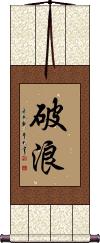
破浪 can be translated from Chinese as “braving the waves” or “bravely setting sail.”
It literally means: “break/cleave/cut [the] waves.”
破浪 is a great title to encourage yourself or someone else not to be afraid of problems or troubles.
Because of the context, this is especially good for sailors or yachtsmen and surfers too.
Note: While this can be understood in Japanese, it's not commonly used in Japan. Therefore, please consider this to be primarily a Chinese proverb.
Great Ambitions
Brave the wind and the waves
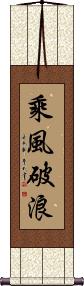
乘風破浪 is a Chinese proverb that represents having great ambitions.
The British might say “to plough through.” Another way to understand it is “surmount all difficulties and forge ahead courageously.”
This can also be translated as “braving the wind and waves,” “to brave the wind and the billows,” “to ride the wind and crest the waves,” or “to be ambitious and unafraid.”
Literally, it reads: “ride (like a chariot) [the] wind [and] break/cleave/cut [the] waves,” or “ride [the] wind [and] slash [through the] waves.”
乘風破浪 is a great proverb to encourage yourself or someone else not to be afraid of problems or troubles, and when you have a dream, just go for it.
There is an alternate version, 長風破浪, but 乘風破浪 is far more common.
The Way of the Wave
The Tao of the Waves
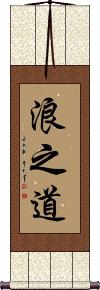
浪之道 is a great title for a surfer whose lifestyle is entwined with the surf and waves.
This can be translated a few different ways:
The Way of the Wave
The Dao of the Wave
The Tao of the Waves
Note: Dao and Tao are the same character (道), just sometimes romanized differently.
Go With The Flow
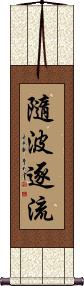
隨波逐流 is a Chinese proverb that means to drift with the waves and go with the flow.
This can be positive or negative, as it can also be used to mean following the crowd blindly.
Seafarer / Sailor
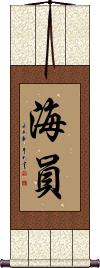
海員 is the Chinese, Japanese Kanji, and old Korean Hanja for a sailor, mariner, seafarer, or seaman.
If you sail the seas and brave the waves, this may be the title for you.
The literal meanings: 海 is “Sea” and 員 is “Person.”
Do not fear the task: Cooperation will lead to success
Do not fear strong winds waves; just be sure to row in unison
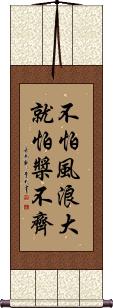
不怕风浪大就怕桨不齐 is a Chinese proverb that literally translates as: Do not fear strong winds [and] high waves; what [one should] worry about whether or not you're rowing in unison.
Figuratively, this means: However difficult the task, the key to success lies in making collective efforts.
I like to translate this as “Don't sweat the details, just get together and get it done.”
Rise and Fall / Ups and Downs
Eiko-Seisui
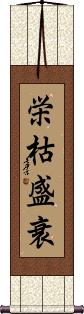
This Japanese proverb can be translated as “flourish and wither, prosper and perish,” “life is full of fortune and misfortune,” or simply “vicissitudes of life.”
栄枯盛衰 / 榮枯盛衰 is about the rise and fall of human affairs or the ups and downs of life. Prosperity comes and goes, everything is fleeting and temporary, but like waves, another swell of prosperity may come.
Here's how the Kanji break down in this proverb:
栄 = prosper; thrive; flourish; boom.
枯 = wither; die.
盛 = prosperous; flourishing; thriving; successful; energetic; vigorous; enthusiastic.
衰 = become weaker; decline; get weak; die down; subside; abate; fail.
 Notes: The original version of the first character looks like the image to the right. In modern Japan, they simplified that Kanji a bit into the version shown above. If you have a preference for which style is used for your calligraphy, please let me know when you place your order.
Apparently, with that original version of the first character, this is also used in Korean Hanja. However, I have not confirmed that
it’s
used in the same way or is widely-known in Korean.
This in-stock artwork might be what you are looking for, and ships right away...
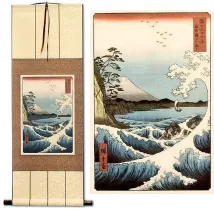
Gallery Price: $108.00
Your Price: $59.88
Not the results for waves that you were looking for?
Below are some entries from our dictionary that may match your waves search...
| Characters If shown, 2nd row is Simp. Chinese |
Pronunciation Romanization |
Simple Dictionary Definition |
波 see styles |
bō bo1 po bo ぼ |
More info & calligraphy: Wave(abbreviation) (See 波蘭・ポーランド) Poland; (personal name) Bo taraṅga. A wave, waves; to involve; translit. p, b, v; cf. 婆; 般; 鉢 etc. |
波浪 see styles |
bō làng bo1 lang4 po lang harou / haro はろう |
More info & calligraphy: Wavewaves; billows; surge; (female given name) Harou taraṅga, a wave, waves. |
破浪 see styles |
pò làng po4 lang4 p`o lang po lang |
More info & calligraphy: Brave the Waves |
隨波逐流 随波逐流 see styles |
suí bō zhú liú sui2 bo1 zhu2 liu2 sui po chu liu |
More info & calligraphy: Go With The Flow |
麥克斯韋 麦克斯韦 see styles |
mài kè sī wéi mai4 ke4 si1 wei2 mai k`o ssu wei mai ko ssu wei |
More info & calligraphy: Maxwell |
淜 see styles |
péng peng2 p`eng peng |
roar of dashing waves |
湱 see styles |
huò huo4 huo |
dashing of waves |
漰 see styles |
pēng peng1 p`eng peng |
noise of dashing waves |
澐 see styles |
yún yun2 yün |
river waves |
澴 see styles |
huán huan2 huan |
to return (of waves) |
灪 see styles |
yù yu4 yü |
(literary) (of waves) huge |
三細 三细 see styles |
sān xì san1 xi4 san hsi sansai |
The three refined, or subtle conceptions, in contrast with the 六麤 cruder or common concepts, in the Awakening of Faith 起信論. The three are 無明業相 "ignorance", or the unenlightened condition, considered as in primal action, the stirring of the perceptive faculty; 能見相 ability to perceive phenomena; perceptive faculties; 境界相 the object perceived, or the empirical world. The first is associated with the 體corpus or substance, the second and third with function, but both must have co-existence, e.g. water and waves. v. 六麤. |
二如 see styles |
èr rú er4 ru2 erh ju ninyo |
There are various definitions of the two aspects of the 眞如 bhūtatathatā. (1) (a) 不變眞如 The changeless essence or substance, e.g. the sea; (b) 隨緣眞如 its conditioned or ever-changing forms, as in the phenomenal world, e.g. the waves. (2) (a) 離言眞如 The inexpressible absolute, only mentally conceivable; (6) 依言眞如 aspects of it expressible in words, its ideal reflex. (3) (a) 空眞如 The absolute as the void, e.g. as space, the sky, a clear mirror; (b) 不空眞如 the absolute in manifestation, or phenomenal, e. g. images in the mirror: the womb of the universe in which are all potentialities. (4) (a) 在纏眞如The Buddha-nature in bonds, i.e. all beings in suffering; (b) 出纏真如the Buddha-nature set free by the manifestation of the Buddha and bodhisattvas. (5) (a) 有垢眞如The Buddha-nature defiled, as in unenlightened man, etc., e.g. the water-lily with its roots in the mud; (b) 無垢眞如 the pure Buddha-nature, purifed or bright as the full moon. (6) 安立 and 非安立眞如 similar to the first definition given above. |
以太 see styles |
yǐ tài yi3 tai4 i t`ai i tai |
(loanword) ether (hypothetical medium that transmits light waves) |
余波 see styles |
yoha(p); nagori; nagoro(ok) よは(P); なごり; なごろ(ok) |
(1) waves that remain after the wind has subsided; (2) (よは only) after-effect; aftermath |
偏振 see styles |
piān zhèn pian1 zhen4 p`ien chen pien chen |
polarization (of waves) |
光波 see styles |
guāng bō guang1 bo1 kuang po minami みなみ |
light wave light waves; (female given name) Minami |
分位 see styles |
fēn wèi fen1 wei4 fen wei bun'i |
avasthaa; defined as 時分 time and 地位 position; i. e. a state, e. g. the state of water disturbed into waves, waves being also a state of water; a dependent state. |
勇浪 see styles |
yǒng làng yong3 lang4 yung lang yōrō |
fierce waves |
咬む see styles |
kamu かむ |
(transitive verb) (1) to bite; to chew; to gnaw; (2) to crash against (e.g. of waves); to break onto (shore); (3) to engage (of cogs, zippers, etc.); to mesh; to fit together; (4) to be involved in; (5) to fumble one's words (during a play, broadcast, etc.); to falter with one's words; (6) (archaism) to strongly confute; to argue down; to rebuke; to scold harshly |
咲く see styles |
saku さく |
(v5k,vi) (1) to bloom; to flower; to blossom; to open; (v5k,vi) (2) (archaism) to rise up (of breaking waves) |
嚼む see styles |
kamu かむ |
(transitive verb) (1) to bite; to chew; to gnaw; (2) to crash against (e.g. of waves); to break onto (shore); (3) to engage (of cogs, zippers, etc.); to mesh; to fit together; (4) to be involved in; (5) to fumble one's words (during a play, broadcast, etc.); to falter with one's words; (6) (archaism) to strongly confute; to argue down; to rebuke; to scold harshly |
圓融 圆融 see styles |
yuán róng yuan2 rong2 yüan jung enyū |
accommodating; (Buddhism) completely integrated Complete combination; the absolute in the relative and vice versa; the identity of apparent contraries; perfect harmony among all differences, as in water and waves, passion and enlightenment, transmigration and nirvāṇa, or life and death, etc.; all are of the same fundamental nature, all are bhūtatathatā, and bhūtatathatā is all; waves are one with waves, and water is one with water, and water and wave are one. |
天眞 see styles |
tiān zhēn tian1 zhen1 t`ien chen tien chen tenma てんま |
(female given name) Tenma bhūtatathatā, permanent reality underlying all phenomena, pure and unchanging e. g. the sea in contrast with the waves; nature, the natural, 天然之眞理, 非人之造作者 natural reality, not of human creation. |
奔騰 奔腾 see styles |
bēn téng ben1 teng2 pen t`eng pen teng hontou / honto ほんとう |
(of waves) to surge forward; to roll on in waves; to gallop (n,vs,vi) soar (e.g. in price); jump; boom; sudden ride |
女波 see styles |
menami めなみ |
the smaller waves |
媒質 媒质 see styles |
méi zhì mei2 zhi4 mei chih baishitsu ばいしつ |
medium {physics} medium (for carrying energy waves); transmission medium |
心波 see styles |
xīn bō xin1 bo1 hsin po konoha このは |
(female given name) Konoha Mind waves, i. e. mental activity. |
心海 see styles |
xīn hǎi xin1 hai3 hsin hai motomi もとみ |
(female given name) Motomi Mind as a sea or ocean, external phenomena being the wind, and the 八識 eight forms of cognition being the waves. |
念波 see styles |
nenpa ねんぱ |
telepathy; thought waves |
Click here for more waves results from our dictionary
The following table may be helpful for those studying Chinese or Japanese...
| Title | Characters | Romaji (Romanized Japanese) | Various forms of Romanized Chinese | |
| Brave the Waves | 破浪 | ha rou / harou / ha ro | pò làng / po4 lang4 / po lang / polang | p`o lang / polang / po lang |
| Great Ambitions | 乘風破浪 乘风破浪 | chéng fēng pò làng cheng2 feng1 po4 lang4 cheng feng po lang chengfengpolang | ch`eng feng p`o lang chengfengpolang cheng feng po lang |
|
| The Way of the Wave | 浪之道 | làng zhī dào lang4 zhi1 dao4 lang zhi dao langzhidao | lang chih tao langchihtao |
|
| Go With The Flow | 隨波逐流 随波逐流 | suí bō zhú liú sui2 bo1 zhu2 liu2 sui bo zhu liu suibozhuliu | sui po chu liu suipochuliu |
|
| Seafarer Sailor | 海員 海员 | kaiin / kain kain / kain | hǎi yuán / hai3 yuan2 / hai yuan / haiyuan | hai yüan / haiyüan |
| Do not fear the task: Cooperation will lead to success | 不怕風浪大就怕槳不齊 不怕风浪大就怕桨不齐 | bù pà fēng làng dà jiù pà jiǎng bù qí bu4 pa4 feng1 lang4 da4 jiu4 pa4 jiang3 bu4 qi2 bu pa feng lang da jiu pa jiang bu qi | pu p`a feng lang ta chiu p`a chiang pu ch`i pu pa feng lang ta chiu pa chiang pu chi |
|
| Rise and Fall Ups and Downs | 栄枯盛衰 / 榮枯盛衰 荣枯盛衰 | ei ko sei sui eikoseisui | ||
| In some entries above you will see that characters have different versions above and below a line. In these cases, the characters above the line are Traditional Chinese, while the ones below are Simplified Chinese. | ||||

Successful Chinese Character and Japanese Kanji calligraphy searches within the last few hours...



