Custom Respect Chinese/Japanese Calligraphy Wall Scroll
We have many options to create artwork with Respect characters on a wall scroll or portrait.
If you want to create a cool Respect wall scroll, this is the place. Below you will find a few Asian symbols that express the idea of respect.
3. Prideful Mind / Self-Respecting Heart
4. Love and Respect / Kindness and Respect
7. Respect
8. Respect out of fear is never genuine; Reverence out of respect is never false
12. The Five Tenets of Confucius
15. Pride
Respect / Honor / Esteem
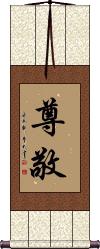
尊敬 is how to express the ideas of respect, honor, reverence, esteem, nobility, and sometimes the state of being noble, all in one word. Most of the time, this is used as “giving respect,” but depending on the context, it can suggest that you should try to be “worthy of respect.”
Although pronounced differently, the Chinese characters, Japanese Kanji, and Korean Hanja are the same across these languages. This is an indication that this word is very old and crosses many barriers and cultures in the Orient (East Asia).
Self-Respect / Self-Esteem
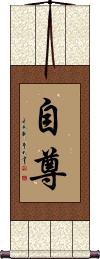
自尊 means self-respect or self-esteem in Chinese, Korean and Japanese. It can also mean “pride in oneself.”
Note: Japanese sometimes put the character for the heart after these two. However, this two-character word is universal between all three languages (which is often better since more than a third of the world's population can read this version as a native word).
Prideful Mind / Self-Respecting Heart
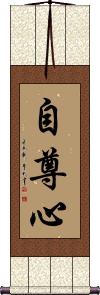
自尊心 is a Japanese and Korean word that means “pride” or “self-respect.”
The first Kanji/Hanja means oneself. The second can mean revered, valuable, precious, noble, or exalted. And the last Kanji/Hanja means heart, mind, and/or spirit.
While these characters make sense and hold the same general meaning in Chinese, this is not a normal Chinese word. This selection should only be used if your audience is Japanese or Korean.
See Also: Pride | Self-Reliance | Self-Control | Self-Discipline
Love and Respect / Kindness and Respect
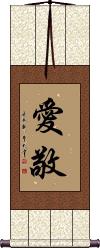
愛敬 is a Chinese, Japanese Kanji, and old Korean Hanja title that can mean “love and respect,” “kindness and respect,” “to love with reverence,” “charm,” “amiability,” “winsomeness,” “courtesy,” or “ingratiating behavior.”
Note: The wide-ranging definitions show that this word is a bit ambiguous without the context of being used in a sentence.
Love and Respect
Love each other and show mutual respect
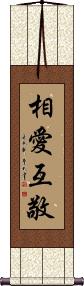
相愛互敬 is a nice way to say “Love and Respect” in Chinese.
This proverb is about the mutual exchange of love and respect within a good relationship.
The first two characters create a word that means “to love each other” or “mutual love.”
The third character means mutual, interlocking, or in some contexts, “to dovetail” (as in how joints are made in fine furniture).
The last character means “to respect,” “to venerate,” “to salute,” “reverence,” or simply “respect.”
Love and Respect
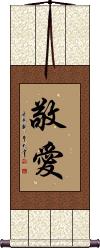
敬愛 is the short and sweet way to say “love and respect” in Chinese, Japanese Kanji, and old Korean Hanja.
Besides “respect and love,” this could be translated as “respect and affection,” “Reverence and love,” or “reverent love.”
In Japanese, this can also be the personal name Yoshinari.
Love and Respect
Love and respect each other
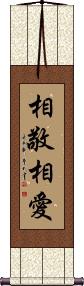
相敬相愛 is an old Chinese proverb that suggests love and respect go together and are to be exchanged between people (especially couples).
The first two characters mean “exchanging respect” or “mutual respect.”
The last two characters create a word that means “to love each other” or “mutual love.”
You'll notice that the first and third characters are the same. So you can read this literally as something like “Exchange respect, exchange love” or “Mutual respect, mutual love.” In English, we'd probably just say, “Mutual love and respect.” Grammar differs in every language - So while the literal translation might sound a bit awkward in English, this phrase is very natural in Chinese.
Mutual Respect
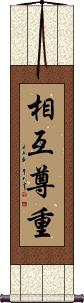
相互尊重 means mutual respect in Chinese, Japanese Kanji, and old Korean Hanja.
The first two characters are a word that means each other, mutual or reciprocal.
The last two characters are a word that means to respect, honor, value, eminent, or hold in high esteem.
Respect
Politeness, Gratitude and Propriety
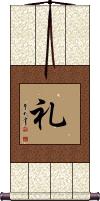
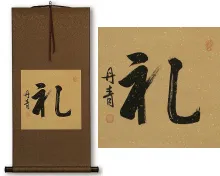
礼 is one of the five tenets of Confucius.
Beyond respect, 礼 can also be translated as propriety, good manners, politeness, rite, worship, or an expression of gratitude.
We show respect by speaking and acting with courtesy. We treat others with dignity and honor the rules of our family, school, and nation. Respect yourself, and others will respect you.
 Please note that Japanese use this simplified 礼 version of the original 禮 character for respect. 礼 also happens to be the same simplification used in mainland China. While 禮 is the traditional and original version, 礼 has been used as a shorthand version for many centuries. Click on the big 禮 character to the right if you want the Traditional Chinese and older Japanese versions.
This is also a virtue of the Samurai Warrior
See our page with just Code of the Samurai / Bushido here
See Also: Confucius
Respect out of fear is never genuine; Reverence out of respect is never false
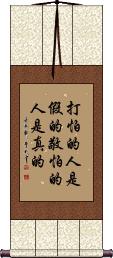
打怕的人是假的敬怕的人是真的 is a proverb that seems to be aimed at world leaders or others in power. Perhaps a suggestion to avoid the practice of “fear-mongering” opting instead for a policy of benevolence and justice.
An example: When the Bush administration told Pakistan they could either join America in the “war on terror,” or expect some bombs to be coming their way, Bush gained this kind of “less-than-genuine respect” from Pakistanis.
Leaders in places like North Korea and even Saudi Arabia reap the same bogus respect from their own citizens.
Note that calligraphers do not like to repeat the same characters in exactly the same way in the same piece of artwork. So expect the characters that are repeated to be written in different forms in the real artwork (unlike the way they are displayed to the left).
Respect, Honor, Truth
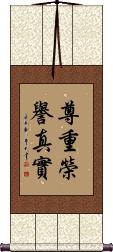
尊重, 榮譽, 真實 means “Respect, Honor, Truth” in Chinese.
This is a word list, which is not the most natural kind of composition in Chinese (usually there is a subject, object, and verb - or a single word).
Respect, Honor, Truth
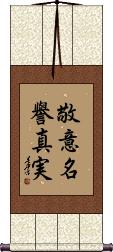
This means “Respect, Honor, Truth” in Japanese.
This is a word list, which is not the most natural kind of composition in Japanese (usually there is a subject, object, and verb - or a single word).
Respect and Loyalty
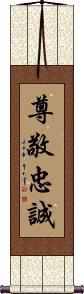
尊敬忠誠 means respect and loyalty in Chinese.
This is a word list (not a normal Chinese or Japanese phrase).
Word lists like this are not very common or natural in Chinese, so try to look for a better phrase to match your idea before you settle on this.
Love Loyalty Respect
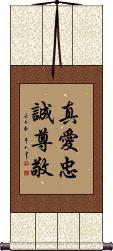
真愛忠誠尊敬 is a Chinese word list that means love, loyalty, and respect.
Love Loyalty Respect
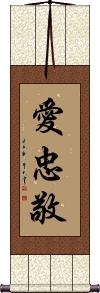
愛忠敬 is a Chinese word list that means love, loyalty, and respect.
愛忠敬 is the shortest way to express these words/ideas. Word lists are not as natural in Chinese as they are in English - phrases or proverbs are more common.
The Five Tenets of Confucius
The Five Cardinal Rules / Virtues of Confucius
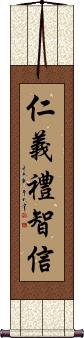
仁義禮智信 are the core of Confucius's philosophy.
Simply stated:
仁 = Benevolence / Charity
義 = Justice / Rectitude
禮 = Courtesy / Politeness / Tact
智 = Wisdom / Knowledge
信 = Fidelity / Trust / Sincerity
Many of these concepts can be found in various religious teachings. It should be clearly understood that Confucianism is not a religion but should instead be considered a moral code for a proper and civilized society.
This title is also labeled “5 Confucian virtues.”
 If you order this from the Japanese calligrapher, expect the middle Kanji to be written in a more simple form (as seen to the right). This can also be romanized as "jin gi rei satoshi shin" in Japanese. Not all Japanese will recognize this as Confucian tenets but they will know all the meanings of the characters.
See Also: Confucius Teachings | Ethics
Courtesy / Etiquette
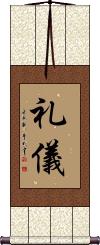
In Japanese, 礼儀 means “manners,” “courtesy,” or “etiquette.”
This also clearly means etiquette in Chinese, though the first Japanese Kanji has been “modernized” and happens to be the same as the modern Simplified Chinese version. Therefore, this word will be understood by both Japanese and Chinese people but best if your audience is mostly Japanese (Chinese people would generally prefer the ancient Traditional Chinese version).
See Also: Kindness
Courtesy / Politeness
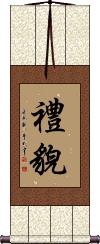
禮貌 is a Chinese and old Korean word that means courtesy or politeness.
Courtesy is being polite and having good manners. When you speak and act courteously, you give others a feeling of being valued and respected. Greet people pleasantly. Bring courtesy home. Your family needs it most of all. Courtesy helps life to go smoothly.
If you put the words "fēi cháng bù" in front of this, it is like adding "very much not." it’s a great insult in China, as nobody wants to be called "extremely discourteous" or "very much impolite."
See Also: Kindness
Pride
自尊 can mean “pride,” “self-respect,” or “self-esteem.” The first character means “oneself,” and the second can mean revered, valuable, precious, noble, exalted, honorable, or simply “pride.”
I have also seen this two-character word translated as “amour propre,” self-regard, and self-pride.
自尊 is universal between Chinese, Japanese Kanji, and Korean Hanja written languages. It may also be understood in old Vietnamese (they once used Chinese characters as well).
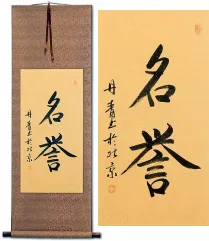
This in-stock artwork might be what you are looking for, and ships right away...
Gallery Price: $79.00
Your Price: $43.77
The following table may be helpful for those studying Chinese or Japanese...
| Title | Characters | Romaji (Romanized Japanese) | Various forms of Romanized Chinese | |
| Respect Honor Esteem | 尊敬 | sonkei | zūn jìng / zun1 jing4 / zun jing / zunjing | tsun ching / tsunching |
| Self-Respect Self-Esteem | 自尊 | jison | zì zūn / zi4 zun1 / zi zun / zizun | tzu tsun / tzutsun |
| Prideful Mind Self-Respecting Heart | 自尊心 | ji son shin jisonshin | zì zūn xīn zi4 zun1 xin1 zi zun xin zizunxin | tzu tsun hsin tzutsunhsin |
| Love and Respect Kindness and Respect | 愛敬 爱敬 | aikei / aikyou aikei / aikyo | ài jìng / ai4 jing4 / ai jing / aijing | ai ching / aiching |
| Love and Respect | 相愛互敬 相爱互敬 | xiāng ài hù jìng xiang1 ai4 hu4 jing4 xiang ai hu jing xiangaihujing | hsiang ai hu ching hsiangaihuching |
|
| Love and Respect | 敬愛 敬爱 | kei ai / keiai | jìng ài / jing4 ai4 / jing ai / jingai | ching ai / chingai |
| Love and Respect | 相敬相愛 相亲相爱 | xiāng jìng xiāng ài xiang1 jing4 xiang1 ai4 xiang jing xiang ai xiangjingxiangai | hsiang ching hsiang ai hsiangchinghsiangai |
|
| Mutual Respect | 相互尊重 | sougo sonchou sougosonchou sogo soncho | xiāng hù zūn zhòng xiang1 hu4 zun1 zhong4 xiang hu zun zhong xianghuzunzhong | hsiang hu tsun chung hsianghutsunchung |
| Respect | 禮 礼 | rei | lǐ / li3 / li | |
| Respect out of fear is never genuine; Reverence out of respect is never false | 打怕的人是假的敬怕的人是真的 | dǎ pà de rén shì jiǎ de jìng pà de rén shì zhēn de da3 pa4 de ren2 shi4 jia3 de jing4 pa4 de ren2 shi4 zhen1 de da pa de ren shi jia de jing pa de ren shi zhen de | ta p`a te jen shih chia te ching p`a te jen shih chen te ta pa te jen shih chia te ching pa te jen shih chen te |
|
| Respect, Honor, Truth | 尊重, 榮譽, 真實 尊重, 荣誉, 真实 | zūn zhòng róng yù zhēn shí zun1 zhong4 rong2 yu4 zhen1 shi2 zun zhong rong yu zhen shi zunzhongrongyuzhenshi | tsun chung jung yü chen shih tsunchungjungyüchenshih |
|
| Respect, Honor, Truth | 敬意, 名譽, 真実 敬意, 名誉, 真実 | keii meiyo shinjitsu keiimeiyoshinjitsu kei meiyo shinjitsu | ||
| Respect and Loyalty | 尊敬忠誠 尊敬忠诚 | son kei chu sei sonkeichusei | zūn jìng zhōng chéng zun1 jing4 zhong1 cheng2 zun jing zhong cheng zunjingzhongcheng | tsun ching chung ch`eng tsunchingchungcheng tsun ching chung cheng |
| Love Loyalty Respect | 真愛忠誠尊敬 | zhēn ài zhōng chéng zū jìng zhen1 ai4 zhong1 cheng2 zu1 jing4 zhen ai zhong cheng zu jing zhenaizhongchengzujing | chen ai chung ch`eng tsu ching chenaichungchengtsuching chen ai chung cheng tsu ching |
|
| Love Loyalty Respect | 愛忠敬 | ài zhōng jìng ai4 zhong1 jing4 ai zhong jing aizhongjing | ai chung ching aichungching |
|
| The Five Tenets of Confucius | 仁義禮智信 仁义礼智信 | jin gi rei tomo nobu jingireitomonobu | rén yì lǐ zhì xìn ren2 yi4 li3 zhi4 xin4 ren yi li zhi xin renyilizhixin | jen i li chih hsin jenilichihhsin |
| Courtesy Etiquette | 礼儀 / 禮儀 礼仪 | rei gi / reigi | lǐ yì / li3 yi4 / li yi / liyi | li i / lii |
| Courtesy Politeness | 禮貌 礼貌 | lǐ mào / li3 mao4 / li mao / limao | ||
| Pride | 自尊 | jison | zì zūn / zi4 zun1 / zi zun / zizun | tzu tsun / tzutsun |
| In some entries above you will see that characters have different versions above and below a line. In these cases, the characters above the line are Traditional Chinese, while the ones below are Simplified Chinese. | ||||




