You can buy a custom wall scroll with Phoenix in Chinese characters / Japanese Kanji.
Whether your name is Phoenix, or you just like the bird emerging from the fire idea, we've got something for you...
2. Phoenix
4. Dragon and Phoenix Brings Luck
5. Phoenix
6. Phoenix Rise from the Ashes
9. Emperor
10. Empress
11. King
12. Orchid Queen
13. Queen
14. Queen / Empress
15. Queen Bee
Legendary Phoenix
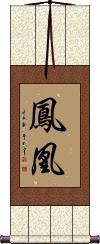
鳳凰 is the word that translates as “Legendary Phoenix” in Chinese.
This refers to the bird that, according to Chinese folklore, rose from the fiery ashes.
The phoenix and dragon are by far the most famous creatures in Chinese mythology.
Phoenix (male)
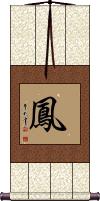
鳳 is the simplest way to write “Phoenix” in Chinese. Because the dragon is usually expressed as a single character, when you see “dragon and phoenix” written in Chinese, you'll often see this single-character version.
Please note, this is also the male element of a phoenix, so it also means “male phoenix bird.” However, some Chinese people may argue that the phoenix has a female characteristic, regardless of which character you use.
Phoenix (female)
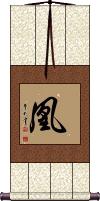
凰 is another simple way to write “Phoenix” in Chinese. 凰 is the specifically female element of a phoenix, so this is how you write “female phoenix.” 凰 is sometimes used to represent the female empress (many times in history, China was ruled by a woman, in much the same way queens came to power in Europe).
Note that the emperor is always represented as a dragon (not the male version of a phoenix).
If you see yourself as a strong woman, this might be a calligraphy scroll for you to express “woman power” or “powerful woman” in a cool way.
Dragon and Phoenix
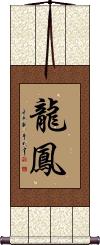
龍鳳 is the simplest way to express “Dragon and Phoenix” in Chinese and Japanese.
This title can be used to represent, “The emperor and empress,” or a metaphor for an outstanding personage.
It should be noted that this is most often used as a given name, “Ryuuhou” in Japanese. It may be read more as a name than by meaning in Japanese.
Dragon and Phoenix Brings Luck
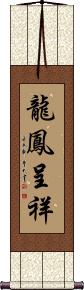
龍鳳呈祥 is often seen at weddings and other celebrations in China.
It suggests that the dragon and phoenix will bring you auspicious tidings.
The first character is a dragon.
The second is a phoenix.
The third is presents or brings.
And the last means auspicious, propitious, or luck.
Throughout China, the dragon and phoenix are symbols of good fortune. You will see these auspicious figures as decorative symbols on everything from buildings, furniture, wedding costumes, and sculptures in public parks to caskets and items used in ceremonies.
Phoenix
Transliterated Name
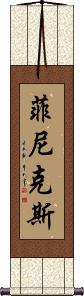
菲尼克斯 is the transliteration to Mandarin Chinese for the name Phoenix.
It sounds like Phoenix but does not mean Phoenix.
You may want to carefully consider choosing a scroll that means Phoenix instead if this is your given name.
Phoenix Rise from the Ashes
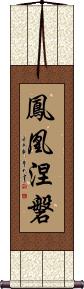
鳳凰涅磐 is a proverb that suggests “Legendary Phoenix rises from the ashes.” It means “Legendary Phoenix [reaches] Nirvana.”
There is a legend in China of a great bird reborn once every 500 years. This bird gathers all the ill will, suffering, desire, and other negative things of the world. The bird then plunges into the fire to burn away all negative things, sacrificing itself in the process (achieving Nirvana, or perhaps allowing others the opportunity to reach Nirvana).
500 years later, the phoenix is reborn from the ashes again, and the cycle repeats.
Beautiful Princess
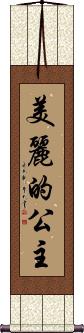
美麗的公主 is how to write beautiful princess in Chinese.
The first two characters mean feminine beauty or rather a way to say beautiful that only applies to women. The middle character is just a connecting character. The last two characters mean princess.
See Also: Queen
Dragon / Emperor Symbol
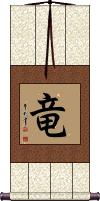
竜 is an alternate form of the dragon.
Still pronounced the same in Chinese, Japanese, and Korean.
This particular Kanji is often associated as an imperial symbol as well as representing the mythical Asian dragon. You may have seen it on the chest or flag of the emperor in old Japanese and Chinese movies.
Note: I would rate this as a non-universal alternate form. The other dragon character is by far more common, and universally understood.
Emperor
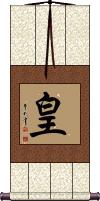
Emperor
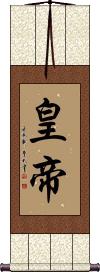
皇帝 means emperor in Chinese, Japanese, and old Korean.
From times of old, the emperors of Asia ruled under the authority of God himself. One definition of an emperor is a ruler put in power by God. This definition separates emperors from the various kings in Chinese history (although defining who is a king versus an emperor gets vague sometimes).
Occasionally, the emperor's wife was widowed, and she took the role of an empress until her death (see our entry for empress if that is what you are looking for).
Empress
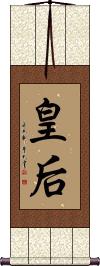
皇后 is the title of empress/emperess, the female form of the emperor.
皇后 is used in Chinese, Japanese Kanji, and old Korean Hanja.
While the emperor's reign was for life, if he died, his wife would hold his power. In this case, a woman was the ultimate ruler of the greater part of East Asia (now China) until her death and the succession of the emperor's firstborn son to lead the empire. Numerous times in various Chinese dynasties, an empress took power in this way.
The first character means emperor by itself.
The second character alone can mean “wife of an emperor or king” (the first character clarifies that we are talking about an empress and not a queen). It can also mean sovereign or last offspring, depending on context.
Note: In some books, this word is translated as queen. While only incorrect if you get technical (because an empress is theoretically a higher level than a queen), the meaning is very similar.
皇后 is sometimes used for the title of queen, but more technically, this is the wife of the emperor (a higher level than a queen).
King
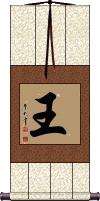
王 is wang which means king. It is not pronounced the way you think in Chinese. It is more like English speakers would want to pronounce wong. It has roughly the same vowel sound as tong, song, or long in English.
Note that this means king only, not the emperor. An emperor is higher than a king, and theoretically is chosen by God, according to ancient Chinese culture. However, the definition is often blurred at various points in Asian history.
王 can also be defined as ruler, sovereign, monarch, or magnate. It is also can refer to a game piece in the chess-like Japanese strategic game of shoji.
Note: This can also be a family name in Chinese, Korean and Vietnamese (in Vietnamese it's Vương).
See Also: Queen
Orchid Queen
Short Version
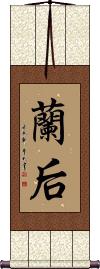
蘭后 is the short way to write “Orchid Queen” in Chinese.
This abbreviated version is open to interpretation, but it's a cool title.
Orchid Queen
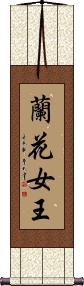
蘭花女王 is the long, clear, or verbose version of “Orchid Queen” in Chinese.
Queen
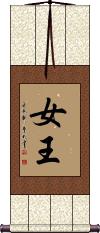
Queen / Empress
Wife of the King
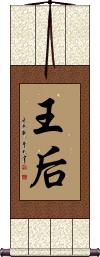
王后 is another way to write queen in Chinese, Japanese Kanji, and old Korean Hanja.
王后 is sometimes used for the title of empress.
The first character means “king,” and the second means “wife,” or a short form to say “wife of the king/emperor.” So this is literally “king's wife” or “emperor's wife.” Some will translate this as “queen consort.”
Queen Bee
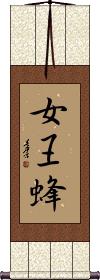
女王蜂 is the Japanese title for “Queen Bee,” as in queen of a bee hive.
Queen Bee
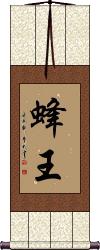
I added 蜂王 because a customer got confused about queens.
In Chinese, they do not use the same title of queen for bees as they do for humans. 蜂王 is the proper title for the queen bee of a hive.
This in-stock artwork might be what you are looking for, and ships right away...
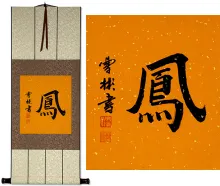
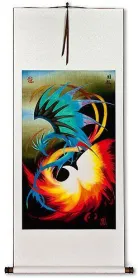
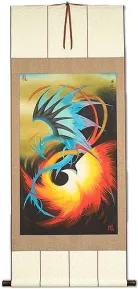
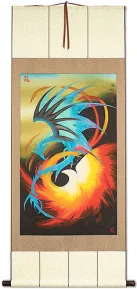
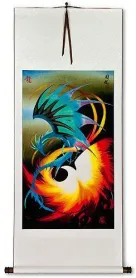

Gallery Price: $168.00
Your Price: $92.88
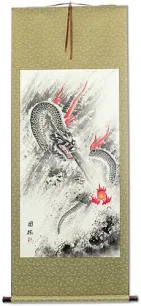
Gallery Price: $300.00
Your Price: $138.88
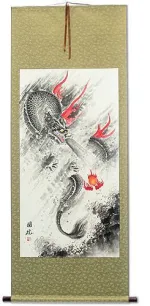
Gallery Price: $300.00
Your Price: $138.88
The following table may be helpful for those studying Chinese or Japanese...
| Title | Characters | Romaji (Romanized Japanese) | Various forms of Romanized Chinese | |
| Legendary Phoenix | 鳳凰 凤凰 | houou / ho | fèng huáng feng4 huang2 feng huang fenghuang | |
| Phoenix (male) | 鳳 凤 | ootori / otori | fèng / feng4 / feng | |
| Phoenix (female) | 凰 | ou / o | huáng / huang2 / huang | |
| Dragon and Phoenix | 龍鳳 龙凤 | ryuu hou / ryuuhou / ryu ho | lóng fèng long2 feng4 long feng longfeng | lung feng lungfeng |
| Dragon and Phoenix Brings Luck | 龍鳳呈祥 龙凤呈祥 | lóng fèng chéng xiáng long2 feng4 cheng2 xiang2 long feng cheng xiang longfengchengxiang | lung feng ch`eng hsiang lungfengchenghsiang lung feng cheng hsiang |
|
| Phoenix | 菲尼克斯 | fēi ní kè sī fei1 ni1 ke4 si1 fei ni ke si feinikesi | fei ni k`o ssu feinikossu fei ni ko ssu |
|
| Phoenix Rise from the Ashes | 鳳凰涅磐 凤凰涅磐 | fèng huáng niè pán feng4 huang2 nie4 pan2 feng huang nie pan fenghuangniepan | feng huang nieh p`an fenghuangniehpan feng huang nieh pan |
|
| Beautiful Princess | 美麗的公主 美丽的公主 | měi lì de gōng zhǔ mei3 li4 de gong1 zhu3 mei li de gong zhu meilidegongzhu | mei li te kung chu meilitekungchu |
|
| Dragon Emperor Symbol | 竜 | ryuu / tatsu ryu / tatsu | lóng / long2 / long | lung |
| Emperor | 皇 | kou / ko | huáng / huang2 / huang | |
| Emperor | 皇帝 | koutei / kotei | huáng dì / huang2 di4 / huang di / huangdi | huang ti / huangti |
| Empress | 皇后 | kou gou / kougou / ko go | huáng hòu huang2 hou4 huang hou huanghou | |
| King | 王 | ou / o | wáng / wang2 / wang | |
| Orchid Queen | 蘭后 兰后 | lán hòu / lan2 hou4 / lan hou / lanhou | ||
| Orchid Queen | 蘭花女王 兰花女王 | lán huā nǚ wáng lan2 hua1 nv3 wang2 lan hua nv wang lanhuanvwang | lan hua nü wang lanhuanüwang |
|
| Queen | 女王 | jo ou / joou / jo o | nǚ wáng / nv3 wang2 / nv wang / nvwang | nü wang / nüwang |
| Queen Empress | 王后 | ou kou / oukou / o ko | wáng hòu / wang2 hou4 / wang hou / wanghou | |
| Queen Bee | 女王蜂 | jooubachi / jobachi | ||
| Queen Bee | 蜂王 | fēng wáng feng1 wang2 feng wang fengwang | ||
| In some entries above you will see that characters have different versions above and below a line. In these cases, the characters above the line are Traditional Chinese, while the ones below are Simplified Chinese. | ||||



