Custom Martial Arts Chinese & Japanese Calligraphy Wall Scroll
We have many options to create artwork with Martial Arts characters on a wall scroll or portrait.
See our special page full of Martial Arts related words and phrases.
We also have specific pages for Karate, Aikido, Kung Fu, and Jujitsu.
If you need a different style of martial arts, just enter it in the calligraphy search box in the upper left of this page.
3. Martial Arts
7. Martial Morality / Martial Arts Ethics / Virtue
10. The Nature of Martial Arts
12. Spirit Of The Dragon Martial Arts
14. Aikido
15. Bruce Lee
17. Karate-Do
18. Kempo Karate / Law of the Fist Empty Hand
20. Shotokan Aikido
21. Aiki Budo
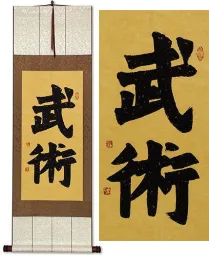
Martial Arts / Wushu
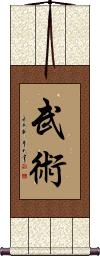
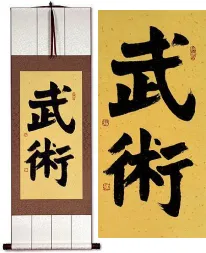
武術 is Wushu or Wu Shu, the very Chinese way to express “Martial Arts.”
Some even use this word to describe Kung Fu directly. But this is a label that fits all disciplines from Karate to Kung Fu to Taekwondo.
Note: This also means Martial Arts with the same appearance as old Korean Hanja characters and is pronounced “musul” or “musur” in Korean.
While this is best if your audience is Chinese or Korean, this also means “martial arts” in Japanese, where the popularity of this term is growing (romanized as Bujutsu or Bujitsu) in Japanese martial arts circles.
Martial Arts / Budo
Way of the Warrior
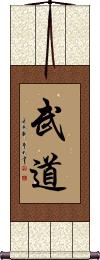
武道 is the very common Japanese way to say “Martial Arts.”
武道 is used mostly in Japanese dojos but is also understood in Chinese and Korean.
Some will use this title to mean chivalry (the conduct of a knight) or military art. The way this word is understood would depend on the context in which it is used.
The first character means “force,” “warlike,” or “essence of a warrior.”
The second character means “method,” “path,” and “the way.” It is the same character used to describe/mean the philosophy of Taoism / Daoism.
Some will also translate this as “The Way of the Warrior”; especially in the context of Korean martial arts.
Martial Arts
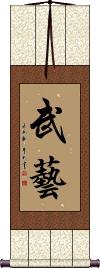
武藝 is a Korean Hanja title that means “martial arts” or “military skill.”
武藝 is also a word in Chinese but used more often in the context of Korean martial arts.
From Korean, this is romanized as either “mu ye” or “moo ye.”
If you want to order this in modern Korean Hangul, just click the Hangul characters in the pronunciation box next to the Korean flag above.
Martial Arts Master
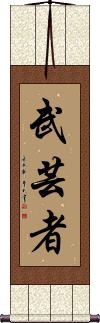
武芸者 is the Japanese Kanji title for “Martial Arts Master.” It suggests that you have reached at least the level of black belt and are probably to the level where you are ready to become an instructor.
Please consider carefully where you stand before ordering this phrase on a wall scroll. If you are not a master, this will make you look a bit foolish.
If you want to get this as a gift for your master at the dojo. Try to discreetly make sure this term is used in your school. Different schools and styles of Japanese martial arts use different terms. You may notice in the Romaji that the last two characters romanize as “geisha” which means “person skilled in arts” (what a geisha girl really is). The title here has the character for “martial,” “warrior,” and/or “military” in front of it. Therefore the literal translation is “martial art person.”
These Kanji are valid Chinese characters and Korean Hanja, but this title does not really make sense in Chinese and is not often used in Korean, though a Chinese or Korean would be able to guess the meaning by looking at the first and last characters.
Martial Arts Skills
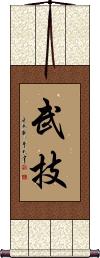
武技 can be translated as “martial arts skills,” “warrior skills,” or “military skills,” depending on usage.
In both Japanese and Chinese, rather than meaning martial arts, this speaks more to the skills that you possess in regard to martial arts. This phrase also has a light suggestion of “having the itch to show off these skills.”
Dojo / Martial Arts Studio
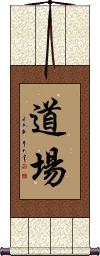
道場 is the Japanese term for a room or hall in which martial arts are taught.
道場 is often spelled “dojo” which has become a word in the English lexicon. However, the true Romaji is doujou or dōjō.
Please note: The Chinese definition of these characters is quite different. In Chinese, this is a place where Buddhist or Taoist mass is held. It could also be a place where spiritual or psychic events are performed.
Martial Morality / Martial Arts Ethics / Virtue
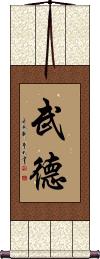
This refers to the virtue, morality, and ethics that any practitioner of martial arts should possess.
This can be used in both Chinese and Japanese in place of English terms such as “soldierly virtue,” “good conduct” (military), “warrior ethics,” and being honorable regarding any fight or competition.
In Japanese, there is a slight variation in the last character, making it 武徳 instead of 武德 in Japan. And yes, just one little horizontal stroke is omitted. If you need the Japanese version, please choose a Japanese calligrapher, or drop me a note so that I make sure you get the characters you intend.
See Also: Morality of Mind | Morality of Deed
Mixed Martial Arts / MMA
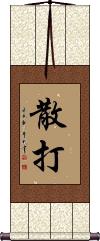
散打 is Sanda, a Chinese word for “Mixed Martial Arts” or “MMA.”
Mixed Martial Arts
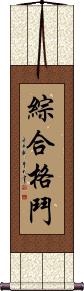
綜合格鬥 is a common Chinese title for “Mixed Martial Arts” or “MMA.”
The characters or words in this title break down this way:
綜合 zōng hé = composite, synthesized, to sum up, to integrate, and/or to synthesize.
格 gé = style, frame, or rule.
斗 dòu = fight, to battle, or to struggle.
Mixed Martial Arts
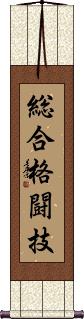
総合格闘技 is a Japanese title for mixed martial arts or MMA.
Note: Some will use other titles for this rather new word or evolving concept. This seems to be the most common right now in the Japanese language.
The Nature of Martial Arts
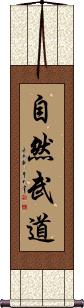
自然武道 is a means the Nature of Martial Arts.
The first two characters create a word that means nature, natural, or spontaneous.
The last two characters are often translated as martial arts.
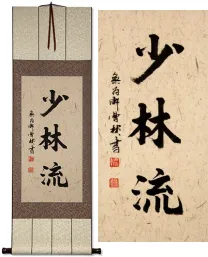
Shaolin Martial Arts
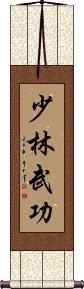
少林武功 is the title for “Shaolin Wu Gong” or “Shaolin martial arts.”
Spirit Of The Dragon Martial Arts
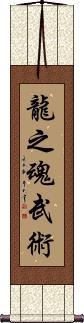
龍之魂武術 is the title Spirit Of The Dragon Martial Arts in Chinese.
This can also be translated as “Dragon Soul Martial Arts.”
Kuoshu / Martial Arts
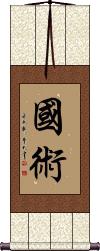
This is a way to write martial arts in Chinese.
This can be romanized as Kuoshu, Kuo Shu, Guoshu, or Guo Shu.
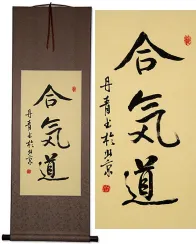
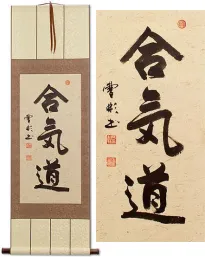
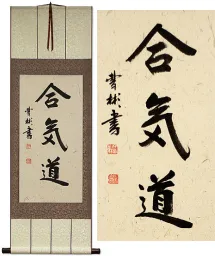
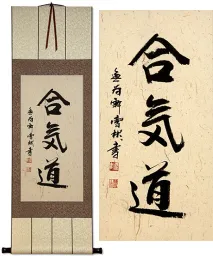
Aikido
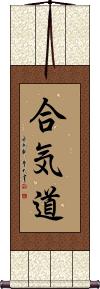
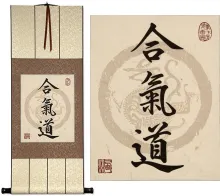
合気道 is the modern Japanese way to write Aikido.
Aikido is often referred to as the defensive martial art.
While Aikido was born in Japan, it has become a somewhat famous form of defensive tactics taught to soldiers and Marines, as well as some law enforcement officers in the West.
Looking at the characters, the first means “union” or “harmony.”
The second character means “universal energy” or “spirit.”
The third means “way” or “method.”
Please note that while the original 合氣道 characters can be pronounced in Chinese, this word is not well-known in China and is not considered part of the Chinese lexicon.
Note: It is somewhat accepted that this is the origin of Hapkido in Korea. And other than a modern simplification to the middle Kanji of this 3-Kanji word, it is written the same in Korean Hanja.
See Also: Martial Arts | Hapkido
Bruce Lee
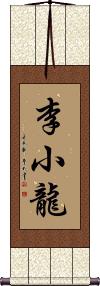
李小龍 is the real full name of Bruce Lee.
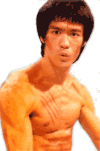 Many people have no idea that Bruce Lee had a “real” Chinese name. In Mandarin and Cantonese, he is known as “Lǐ XiǎoLóng” and “Léi SíuLùng” respectively.
He kept his family name pronunciation (Li = Lee). 李 is a common family name that also means “plum.”
His given name 小龍 (Xiao-Long), literally means “little dragon.” 李小龍 is why you often see the character for dragon associated with Bruce Lee on various posters etc.
For a pronunciation lesson, the “X” in Romanized Mandarin is pronounced like a “sh” sound but with your tongue at the bottom of your mouth. The vowel sound in “Long” is like the English “oh,” not like the “ah” sound in the English word “long.”
If you are a big Bruce Lee fan, you should know this information, and you should have this wall scroll hanging in your room or martial arts studio.
Note: Japanese use these same Chinese characters / Kanji to write Bruce Lee's real name (with different pronunciation - which is a bit like how the name “Bruce Lee” sounds in English).
See Also: Kung Fu | Martial Arts
Danketsu Karate-Do
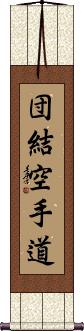
団結空手道 is the title for Danketsu Karate-Do, a dojo located in Stroudsburg, PA.
団結 (danketsu) means union, unity, or combination.
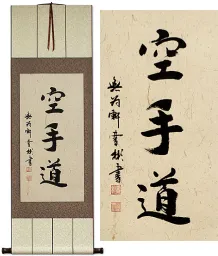
空手道 (karate-do) means “empty hand way.”
If you need you martial arts school/dojo/academy added to my database, just give me the info (actual Chinese/Japanese text if you have it).
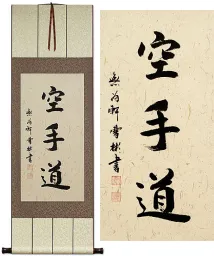
Karate-Do
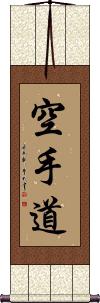
The literal meaning of 空手道 is “empty hand method” or “empty hand way.”
Credit is given that karate started in China but migrated and became refined and vastly popular in Japan.
Karate is a martial art that uses no blades or weapons other than the “natural weapons” God gave to humans (fists and feet). The last character somehow became optional, but the meaning of that character is “method” or “the way” as in Taoism / Daoism.
Karate-Do reached Korea, where it is known as 공수도 which can be romanized as “Kong Soo Do” or “Gong Su Do.”
Kempo Karate / Law of the Fist Empty Hand
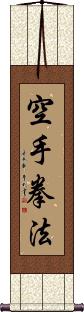
空手拳法 is the Kanji title for Kempo Karate.
The first two characters mean “karate” - technically they express “empty hand.”
The last two express “fist law” which is Romanized from Japanese as “Kenpo” or “Kempo.”
That “empty hand” translation can be understood better when you grasp the idea that karate is a martial art without weapons (other than the weapons organic to your body, such as your foot, hand, fist, etc). When you practice karate, you do so with empty hands (no weapons).
Note: There is also an antiquated way to write karate. It has the same pronunciation but a different first character which means “Tang” as in the Tang Dynasty. Some dojos use that form - let us know if you need that alternate form, and we'll add it.
Shorinji Kempo / Kenpo
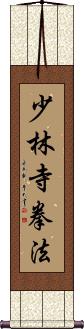
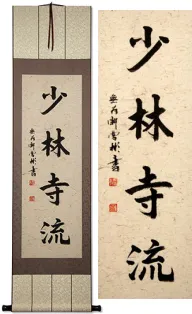
少林寺拳法 is a specific type of martial art in Japan that claims origins in the Kung Fu practiced in the original Shaolin Monastery of China.
The first three characters mean “Shaolin Monastery,” and you might notice the Japanese is pronounced in a very similar way. The reason is, many words were “borrowed” from the original Chinese when Japan did not have a written language and simply absorbed Chinese characters into their language around the 5th century. When a Japanese word did not exist, the Chinese pronunciation was often absorbed as well as the written form.
The last two characters mean “fist law” or “method of the fist.” It has long been argued as to whether the Japanese for these characters should be Romanized as “kempo” or “kenpo.” The official method should be “kenpou” but it's common to drop the “u” that comes after the “o.”
I imagine if you are looking for this title, you already know what it means, so the above is simply extra information that a student of Shorinji Kempo might want to know.
Shotokan Aikido
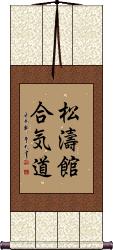
松涛館合気道 is the title for Shotokan Aikido in Japanese.
Note: Chinese and Korean pronunciations of these characters are included above, however, this title would only be understood in Chinese or Korean by someone who practices or is familiar with Shotokan Aikido. Please consider this title to be “Japanese only.”
See Also: Martial Arts | Hapkido
Aiki Budo
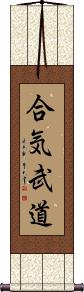
合気武道 is the title Aiki-Budo or “Aiki Martial Arts” in Japanese Kanji.
合 means “union” or “harmony.”
気/氣 means “universal energy” or “spirit.”
武 means “martial” or “military.”
道 means “way” or “method.”
合気武道 is the modern Japanese way to write this. You may also see 合氣武道, where the second character is written in the older traditional (pre-1945) form. If you want this written 合氣武道, just include a note or email with your order.
合氣武道 are all Chinese characters as well, so I included the Chinese pronunciation above. However, while it can be understood in Chinese, this is not a common term in that language and is not used in any Chinese martial arts. Also, 気 is only used in Japan - Chinese will understand 気 to be the Japanese form of 氣.
See Also: Martial Arts | Hapkido
This in-stock artwork might be what you are looking for, and ships right away...
Gallery Price: $168.00
Your Price: $92.88
Gallery Price: $168.00
Your Price: $92.88
Gallery Price: $178.00
Your Price: $98.88
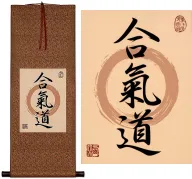
Gallery Price: $72.00
Your Price: $39.88
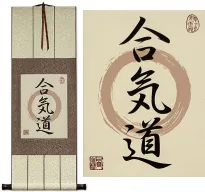
Gallery Price: $90.00
Your Price: $49.88
Gallery Price: $200.00
Your Price: $92.88
Gallery Price: $180.00
Your Price: $99.88
Gallery Price: $106.00
Your Price: $58.88
The following table may be helpful for those studying Chinese or Japanese...
| Title | Characters | Romaji (Romanized Japanese) | Various forms of Romanized Chinese | |
| Martial Arts Wushu | 武術 武术 | bujutsu | wǔ shù / wu3 shu4 / wu shu / wushu | |
| Martial Arts Budo | 武道 | bu dou / budou / bu do | wǔ dào / wu3 dao4 / wu dao / wudao | wu tao / wutao |
| Martial Arts | 武藝 武艺 | wǔ yì / wu3 yi4 / wu yi / wuyi | wu i / wui | |
| Martial Arts Master | 武芸者 | bugeisha | wǔ yún zhě wu3 yun2 zhe3 wu yun zhe wuyunzhe | wu yün che wuyünche |
| Martial Arts Skills | 武技 | bugi | wǔ jì / wu3 ji4 / wu ji / wuji | wu chi / wuchi |
| Dojo Martial Arts Studio | 道場 道场 | dou jou / doujou / do jo | dào cháng dao4 chang2 dao chang daochang | tao ch`ang taochang tao chang |
| Martial Morality Martial Arts Ethics Virtue | 武德 | bu to ku / butoku | wǔ dé / wu3 de2 / wu de / wude | wu te / wute |
| Mixed Martial Arts MMA | 散打 | sàn dǎ / san4 da3 / san da / sanda | san ta / santa | |
| Mixed Martial Arts | 綜合格鬥 综合格斗 | zōng hé gé dòu zong1 he2 ge2 dou4 zong he ge dou zonghegedou | tsung ho ko tou tsunghokotou |
|
| Mixed Martial Arts | 総合格闘技 | sougoukakutougi sogokakutogi | ||
| The Nature of Martial Arts | 自然武道 | shi zen bu do shizenbudo | zì rán wǔ dào zi4 ran2 wu3 dao4 zi ran wu dao ziranwudao | tzu jan wu tao tzujanwutao |
| Shaolin Martial Arts | 少林武功 | shǎo lín wǔ gōng shao3 lin2 wu3 gong1 shao lin wu gong shaolinwugong | shao lin wu kung shaolinwukung |
|
| Spirit Of The Dragon Martial Arts | 龍之魂武術 龙之魂武术 | lóng zhī hún wǔ shù long2 zhi1 hun2 wu3 shu4 long zhi hun wu shu longzhihunwushu | lung chih hun wu shu lungchihhunwushu |
|
| Kuoshu Martial Arts | 國術 国术 | guó shù / guo2 shu4 / guo shu / guoshu | kuo shu / kuoshu | |
| Aikido | 合氣道 合気道 | ai ki dou / aikidou / ai ki do | hé qì dào he2 qi4 dao4 he qi dao heqidao | ho ch`i tao hochitao ho chi tao |
| Bruce Lee | 李小龍 李小龙 | bu ruu su ri buruusuri bu ru su ri | lǐ xiǎo lóng li3 xiao3 long2 li xiao long lixiaolong | li hsiao lung lihsiaolung |
| Danketsu Karate-Do | 団結空手道 | dan ketsu kara te dou danketsukaratedou dan ketsu kara te do | ||
| Karate-Do | 空手道 | kara te dou karatedou kara te do | kōng shǒu dào kong1 shou3 dao4 kong shou dao kongshoudao | k`ung shou tao kungshoutao kung shou tao |
| Kempo Karate Law of the Fist Empty Hand | 空手拳法 | kara te ken pou karatekenpou kara te ken po | kōng shǒu quán fǎ kong1 shou3 quan2 fa3 kong shou quan fa kongshouquanfa | k`ung shou ch`üan fa kungshouchüanfa kung shou chüan fa |
| Shorinji Kempo Kenpo | 少林寺拳法 | shourinji kenpou shourinjikenpou shorinji kenpo | shào lín sì quán fǎ shao4 lin2 si4 quan2 fa3 shao lin si quan fa shaolinsiquanfa | shao lin ssu ch`üan fa shaolinssuchüanfa shao lin ssu chüan fa |
| Shotokan Aikido | 鬆濤館合氣道 (Old Japanese/Chinese) 松涛館合気道 (Modern Japanese) | shou tou kan ai ki dou shoutoukanaikidou sho to kan ai ki do | sōng tāo guǎn hé qì dào song1 tao1 guan3 he2 qi4 dao4 song tao guan he qi dao songtaoguanheqidao | sung t`ao kuan ho ch`i tao sungtaokuanhochitao sung tao kuan ho chi tao |
| Aiki Budo | 合氣武道 合気武道 | ai ki bu dou aikibudou ai ki bu do | hé qì wǔ dào / / | |
| In some entries above you will see that characters have different versions above and below a line. In these cases, the characters above the line are Traditional Chinese, while the ones below are Simplified Chinese. | ||||




