I am shipping orders on Thursday this week. News and More Info
Buy a Servant of God calligraphy wall scroll here!
Personalize your custom “Servant of God” project by clicking the button next to your favorite “Servant of God” title below...
妾 is the most simple way to say concubine or mistress in Chinese, Japanese Kanji, and old Korean Hanja.
Sometimes this can mean servant. Occasionally, a woman may use this title in place of “I” or “me” to say “your humble servant” in a self-deprecating way.
In Japanese, 侍 represents the warriors that attempted to hold peace when there was no Emperor in Japan.
Be cautious though, as it is an old way to express “servant” or “waiter” in Chinese and Korean. Of course, if you are a samurai, you are a servant to your Shogun-ate, Lord, or the people (which is the root meaning).
See Also: Warrior
Used in modern times for divorced couples that come back together
破鏡重圓 is about a husband and wife who were separated and reunited.
About 1500 years ago in China, there lived a beautiful princess named Le Chang. She and her husband Xu De Yan loved each other very much. But when the army of the Sui Dynasty was about to attack their kingdom, disposed of all of their worldly possessions and prepared to flee into exile.
They knew that in the chaos, they might lose track of each other, so the one possession they kept was a bronze mirror which is a symbol of unity for a husband and wife. They broke the mirror into two pieces, and each of them kept half of the mirror. They decided that if separated, they would try to meet at the fair during the 15th day of the first lunar month (which is the lantern festival). Unfortunately, the occupation was brutal, and the princess was forced to become the mistress of the new commissioner of the territory, Yang Su.
At the Lantern Festival the next year, the husband came to the fair to search for his wife. He carried with him his half of the mirror. As he walked through the fair, he saw the other half of the mirror for sale at a junk market by a servant of the commissioner. The husband recognized his wife's half of the mirror immediately, and tears rolled down his face as he was told by the servant about the bitter and loveless life that the princess had endured.
As his tears dripped onto the mirror, the husband scratched a poem into his wife's half of the mirror:
You left me with the severed mirror,
The mirror has returned, but absent are you,
As I gaze in the mirror, I seek your face,
I see the moon, but as for you, I see not a trace.
The servant brought the inscribed half of the mirror back to the princess. For many days, the princess could not stop crying when she found that her husband was alive and still loved her.
Commissioner Yang Su, becoming aware of this saga, realized that he could never obtain the princess's love. He sent for the husband and allowed them to reunite.
This proverb, 破鏡重圓, is now used to describe a couple who has been torn apart for some reason (usually divorce) but have come back together (or remarried).
It seems to be more common these days in America for divorced couples to reconcile and get married to each other again. This will be a great gift if you know someone who is about to remarry their ex.
克己奉公 is a Chinese proverb that is often used to express how one should act as a government official. Most of us wish our public officials would hold themselves to higher standards. I wish I could send this scroll, along with the meaning to every member of Congress, and the President (or if I was from the UK, all the members of Parliament, and the PM)
This can also mean: “Place Strict Standards on Oneself in Public Service.”
The story behind this ancient Chinese idiom:
Cai Zun was born in China a little over 2000 years ago. In 24 AD, he joined an uprising led by Liu Xiu, who later became the emperor of the Eastern Han Dynasty.
Later, the new emperor put Cai Zun in charge of the military court. Cai Zun exercised his power in strict accordance with military law, regardless of the offender's rank or background. He even ordered the execution of one of the emperor's close servants after the servant committed a serious crime.
Cai Zun led a simple life but put great demands on himself to do all things honorably. The emperor rewarded him for his honest character and honorable nature by promoting him to the rank of General and granting him the title of Marquis.
Whenever Cai Zun would receive an award, he would give credit to his men and share the reward with them.
Cai Zun was always praised by historians who found many examples of his selfless acts that served the public interest.
Sometime long ago in history, people began to refer to Cai Zun as “ke ji feng gong.”
See Also: Unselfish | Selflessness | Altruism
This in-stock artwork might be what you are looking for, and ships right away...
Gallery Price: $178.00
Your Price: $98.88
Gallery Price: $144.00
Your Price: $79.88
Gallery Price: $108.00
Your Price: $59.88
Gallery Price: $108.00
Your Price: $59.88
Gallery Price: $72.00
Your Price: $39.88
Gallery Price: $108.00
Your Price: $59.88
Gallery Price: $108.00
Your Price: $59.88
Discounted Blemished
Gallery Price: $29.00
Your Price: $16.00
Below are some entries from our dictionary that may match your servant of god search...
| Characters If shown, 2nd row is Simp. Chinese |
Pronunciation Romanization |
Simple Dictionary Definition |
妾 see styles |
qiè qie4 ch`ieh chieh shou / sho しょう |
More info & calligraphy: Mistress / Concubine / Servant(1) (See 妾・めかけ) mistress; kept woman; concubine; (pronoun) (2) (archaism) (humble language) (feminine speech) (See 妾・わらわ) I; me |
价 see styles |
jiè jie4 chieh |
(literary) messenger; servant |
傒 see styles |
xī xi1 hsi |
(old) native of Jiangxi 江西[Jiang1 xi1]; to wait; servant; path |
傔 see styles |
qiàn qian4 ch`ien chien |
servant |
傭 佣 see styles |
yōng yong1 yung isao いさお |
to hire; to employ; servant; hired laborer; domestic help employee; employment; (given name) Isao |
僕 仆 see styles |
pú pu2 p`u pu houyou / hoyo ほうよう |
servant (pronoun) (archaism) (humble language) I; me; (personal name) Houyou A servant. |
僮 see styles |
tóng tong2 t`ung tung |
servant boy |
儓 see styles |
tái tai2 t`ai tai |
servant |
卒 see styles |
zú zu2 tsu sosu そす |
soldier; servant; to finish; to die; finally; at last; pawn in Chinese chess (1) (hist) low-ranking soldier; (n-suf,n) (2) (abbreviation) (See 卒業・1) graduation; (n-suf,n-pref) (3) (abbreviation) (See 卒業・2) moving on (from); outgrowing (something); (4) (abbreviation) (hist) (See 卒族) low-ranking samurai (1870-1872); (5) (abbreviation) (See 卒去) death (of a noble, etc.); (given name) Sosu suddenly |
厮 see styles |
sī si1 ssu shi |
variant of 廝|厮[si1] Attendant, an attendant, servant; to serve. |
婢 see styles |
bì bi4 pi hi めのこやつこ |
slave girl; maid servant (archaism) female slave; (1) (archaism) female slave; (2) female servant; housemaid maidservant |
宿 see styles |
xiù xiu4 hsiu yado やど |
constellation (1) lodging; inn; hotel; (2) house; home; dwelling; (3) home of a servant's parents (or guarantor, etc.); (surname) Yado A halting-place; to pass the night, sojourn, stay; early, former; left over; nakṣatra, the constellations. |
廝 厮 see styles |
sī si1 ssu |
(bound form) together; each other; (bound form) male servant; (bound form) dude; so-and-so (used in 那廝|那厮[na4 si1] and 這廝|这厮[zhe4 si1]) See: 厮 |
役 see styles |
yì yi4 i mamoru まもる |
forced labor; corvée; obligatory task; military service; to use as servant; to enserf; servant (old); war; campaign; battle (1) role; assignment; responsibility; duty; function; job; service; (2) position (of responsibility); post; office; (3) part (in a play, film, etc.); role; character; (4) {mahj;cards;hanaf} scoring combination; hand; yaku; meld; (given name) Mamoru |
禿 秃 see styles |
tū tu1 t`u tu hage はげ |
bald (lacking hair or feathers); barren; bare; denuded; blunt (lacking a point); (of a piece of writing) unsatisfactory; lacking something (1) (hist) children's hairstyle of short untied hair; child with short untied hair; (2) (hist) young girl working as a servant for a high-class prostitute (Edo period); (3) (archaism) baldness; bald head; (surname) Hage Bald. |
臣 see styles |
chén chen2 ch`en chen tomi とみ |
state official or subject in dynastic China; I, your servant (used in addressing the sovereign); Kangxi radical 131 (1) (archaism) retainer; attendant; (2) (おみ only) (archaism) (See 八色の姓) Omi (hereditary title; orig. one of the two highest such titles, later demoted to sixth highest of eight); (pronoun) (3) (しん only) (humble language) (used by a servant when speaking to their master) I; me; (surname) Tomi minister |
お鍋 see styles |
onabe おなべ |
(1) (polite language) pot; (2) (archaism) typical name for a female servant in the Edo-period; (3) working at night; (4) (kana only) (slang) female with symptoms of gender identity disorder (e.g. a transvestite) |
下人 see styles |
xià rén xia4 ren2 hsia jen genin げにん |
(old) servant; (dialect) children; grandchildren low-rank person; menial |
下去 see styles |
xià qù xia4 qu4 hsia ch`ü hsia chü |
to go down; to descend; to go on; to continue; (of a servant) to withdraw |
下婢 see styles |
kahi かひ |
servant girl |
下郎 see styles |
gerou / gero げろう |
servant; valet; menial |
下部 see styles |
shimobe しもべ |
(1) lower part; substructure; (2) subordinate (office); good and faithful servant; (place-name, surname) Shimobe |
丫環 丫环 see styles |
yā huan ya1 huan5 ya huan |
servant girl; maid |
丫頭 丫头 see styles |
yā tou ya1 tou5 ya t`ou ya tou |
girl; servant girl; (used deprecatingly, but sometimes also as a term of endearment) |
丫鬟 see styles |
yā huan ya1 huan5 ya huan |
servant girl; maid |
中臈 see styles |
chuurou / churo ちゅうろう |
(1) court ladies of the middle rank serving in the inner palace (Heian period); (2) female servant for a samurai family; (3) lady-in-waiting working in the inner palace of the Edo castle (Edo period) |
主僕 主仆 see styles |
zhǔ pú zhu3 pu2 chu p`u chu pu |
master and servant |
主子 see styles |
zhǔ zi zhu3 zi5 chu tzu yukiko ゆきこ |
Master (term used by servant); Your Majesty; operator (of machine) (female given name) Yukiko |
主従 see styles |
shuujuu; shujuu / shuju; shuju しゅうじゅう; しゅじゅう |
master and servant; lord and retainer; employer and employee |
仕着 see styles |
shikise しきせ |
livery; servant's clothes provided by employers |
The following table may be helpful for those studying Chinese or Japanese...
| Title | Characters | Romaji (Romanized Japanese) | Various forms of Romanized Chinese | |
| Mistress Concubine Servant | 妾 | mekake / sobame / onname | qiè / qie4 / qie | ch`ieh / chieh |
| Samurai | 侍 | samurai | shì / shi4 / shi | shih |
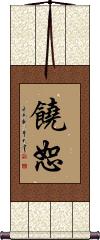
| Begging Forgiveness | 饒恕 饶恕 | ráo shù / rao2 shu4 / rao shu / raoshu | jao shu / jaoshu | |
| Broken Mirror Rejoined | 破鏡重圓 破镜重圆 | pò jìng chóng yuán po4 jing4 chong2 yuan2 po jing chong yuan pojingchongyuan | p`o ching ch`ung yüan pochingchungyüan po ching chung yüan |
|
| Work Unselfishly for the Common Good | 克己奉公 | kè jǐ fèng gōng ke4 ji3 feng4 gong1 ke ji feng gong kejifenggong | k`o chi feng kung kochifengkung ko chi feng kung |
|
| In some entries above you will see that characters have different versions above and below a line. In these cases, the characters above the line are Traditional Chinese, while the ones below are Simplified Chinese. | ||||
Successful Chinese Character and Japanese Kanji calligraphy searches within the last few hours...

All of our calligraphy wall scrolls are handmade.
When the calligrapher finishes creating your artwork, it is taken to my art mounting workshop in Beijing where a wall scroll is made by hand from a combination of silk, rice paper, and wood.
After we create your wall scroll, it takes at least two weeks for air mail delivery from Beijing to you.
Allow a few weeks for delivery. Rush service speeds it up by a week or two for $10!
When you select your calligraphy, you'll be taken to another page where you can choose various custom options.
The wall scroll that Sandy is holding in this picture is a "large size"
single-character wall scroll.
We also offer custom wall scrolls in small, medium, and an even-larger jumbo size.
Professional calligraphers are getting to be hard to find these days.
Instead of drawing characters by hand, the new generation in China merely type roman letters into their computer keyboards and pick the character that they want from a list that pops up.
There is some fear that true Chinese calligraphy may become a lost art in the coming years. Many art institutes in China are now promoting calligraphy programs in hopes of keeping this unique form
of art alive.
Even with the teachings of a top-ranked calligrapher in China, my calligraphy will never be good enough to sell. I will leave that to the experts.
The same calligrapher who gave me those lessons also attracted a crowd of thousands and a TV crew as he created characters over 6-feet high. He happens to be ranked as one of the top 100 calligraphers in all of China. He is also one of very few that would actually attempt such a feat.
Check out my lists of Japanese Kanji Calligraphy Wall Scrolls and Old Korean Hanja Calligraphy Wall Scrolls.
Some people may refer to this entry as Servant of God Kanji, Servant of God Characters, Servant of God in Mandarin Chinese, Servant of God Characters, Servant of God in Chinese Writing, Servant of God in Japanese Writing, Servant of God in Asian Writing, Servant of God Ideograms, Chinese Servant of God symbols, Servant of God Hieroglyphics, Servant of God Glyphs, Servant of God in Chinese Letters, Servant of God Hanzi, Servant of God in Japanese Kanji, Servant of God Pictograms, Servant of God in the Chinese Written-Language, or Servant of God in the Japanese Written-Language.
76 people have searched for Servant of God in Chinese or Japanese in the past year.
Servant of God was last searched for by someone else on Oct 18th, 2025