Many custom options...


And formats...



Fu in Chinese / Japanese...
Buy a Fu calligraphy wall scroll here!
Personalize your custom “Fu” project by clicking the button next to your favorite “Fu” title below...
9. Fu Lu Shou
11. Fatherly Master / Sifu / Shi Fu / Shifu
12. Kung Fu San Soo / San Shou
13. Fu Dog / Foo Dog
Lau Gar Kung Fu
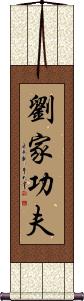
劉家功夫 are the characters for the Lau Gar Kung Fu style of martial arts.
The romanization of “Lau Gar” comes from Cantonese. “Kung Fu” is the common romanization for English from the Mandarin “Gōng Fu” or Cantonese “Gung Fu” pronunciations.
Lau gar = Lau family.
Wing Chun Kung Fu
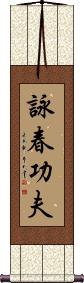
詠春功夫 is Wing Chun Kung Fu.
The first two characters literally mean “Singing Spring” (as in springtime).
The last two are “Kung Fu” (high skill).
Kung Fu / Gong Fu
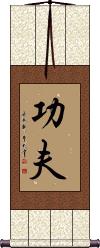
功夫 or Kung Fu is one of the most famous types of martial arts in the world - and not just because of Bruce Lee.
Some translate the meaning as “Accomplishment by Great Effort.” I think this is partially true, but directly translated, it literally means “Merit/Achievement/Accomplishment Man.” The word “fu” can sometimes mean “husband” or “porter,” but in this case, it can only mean “man.” However, few in China will think “man” when they hear the word “Gong Fu” spoken.
This term is also used for things other than martial arts. In fact, it's used to refer to a person with excellent skills in crafts that require many effort to master, such as cooking, tea ceremonies, and calligraphy.
What many people don't know is that the spelling of “Kung Fu” was actually taken from the old Wade Giles form of Romanization. Using this method, the sounds of the English “G” and “K” were both written as “K” and an apostrophe after the “K” told you it was supposed to sound like a “G.” Nobody in the west knew this rule, so most people pronounce it with a “K-sound.” And so, Gong Fu will always be Kung Fu for most westerners.
Also, just to educate you a little more, the “O” in “Gong” has a sound like the English word “oh.”
The popular Chinese dish “Kung Pao Chicken” suffers from the same problem. It should actually be “Gong Bao Chicken.”
Historical note: Many will claim that Kung Fu was invented by the monks of the Shaolin monastery. This fact is argued in both directions by scholars of Chinese history. Perhaps it is more accurate to say that the Shaolin Monks brought the original fame to Kung Fu many generations ago.
Japanese note: While most Japanese martial artists will recognize these characters, Katakana is more often used to approximate the pronunciation of “Kung Fu” with “カンフー.” Some will argue as to whether this should be considered a Japanese word at all.
See Also: Bruce Lee
Shaolin Kung Fu
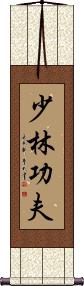
The Shaolin monks of China have been practicing the art of Kung Fu for thousands of years.
少林功夫 is the full title, “Shao Lin Kung Fu.”
San Soo Kung Fu
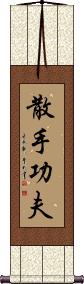
散手功夫 is San Soo Kung Fu.
Sometimes you will see this in the order 功夫散手 (Kung Fu San Soo). Either version is OK.
It's like “Kung Fu of San Soo” vs. “San Soo Kung Fu” if you put it in English terms. San Soo is the adjective either way in Chinese.
Drunken Monkey Kung Fu
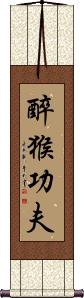
醉猴功夫 is the title for Drunken Monkey Kung Fu (Gong Fu).
The martial arts style was inspired by the novel, “Journey to the West.”
See Also: Monkey Fist
Kung Fu Panda
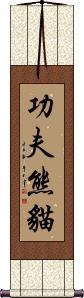
This is the title Kung Fu Panda in Chinese.
Tai Chi Wing Chun Kung Fu
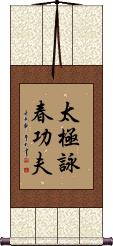
太極詠春功夫 is the title Tai Chi Wing Chun Kung Fu.
Please note that it can be romanized in a variety of ways such as:
Tai Chi Ving Tsun Kung Fu
Tai Qi Yong Chun Gong Fu
Taai Gik Wing Ceon Gung Fu
Be sure this is the right title for what you are looking for before you order.
Fu Lu Shou
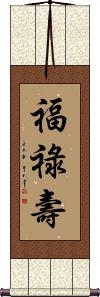
These are the short titles for Sanxing or 三星 (Three Stars).
福祿壽 are the gods of Jupiter, Ursa Major, and Sirius. Fu, Lu, and Shou represent fortune (福), presiding over the planet Jupiter, prosperity (祿), presiding over Ursa Major, and longevity (壽), presiding over Sirius.
In old Chinese folk religion, they are often represented as three old bearded wise men.
Laughing Dragon Kung Fu
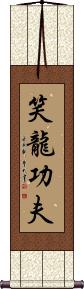
笑龍功夫 is the title for a Martial Arts studio (custom-made at by request of the owner of the studio).
Fatherly Master / Sifu / Shi Fu / Shifu
Martial Arts Teacher
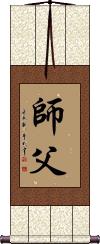
師父 means master in Chinese (occasionally used in Korean Hanja and Japanese). In the context of Martial Arts, this is the master and teacher who instructs students.
The second character by itself means father. Thus, you get the “Fatherly Master” translation. There's an old Chinese saying that goes something like, “One who is your teacher for one day is your father for life.”
Language notes: I've often seen this romanized as “sifu,” this is actually the Cantonese romanization. In Mandarin Chinese, it's “Shifu.” The pronunciation in Mandarin is actually like “sure foo” (using typical English pronunciation). There's an “R-sound” in there, which is not obvious from the romanization. Many martial arts studios incorrectly pronounce this like “she foo” (which is actually the Japanese pronunciation). In Cantonese, it sounds like “Sea foo” (almost like “seafood,” minus the “d” at the end).
師父 is kind of a weird selection for a calligraphy wall scroll; this entry is more for educational purposes. But you are welcome to buy it if it suits your circumstances.
Kung Fu San Soo / San Shou
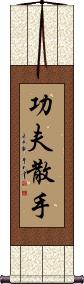
功夫散手 is a martial arts title.
Oddly, there are multiple ways two spell/romanize this in English, but in Chinese, it's written exactly the same.
Technically, the Mandarin romanizes as “gong fu san shou,” for which you'll sometimes see it written “kung fu san shou” (k'ung is an old romanization for a word that sounds like gong with a vowel sound like “oh”).
There is another martial arts style that spells this “Kung Fu San Soo.” I guess this was supposed to approximate Cantonese pronunciation for which the scholarly romanization is generally agreed to be “gung fu saan sau.”
Fu Dog / Foo Dog
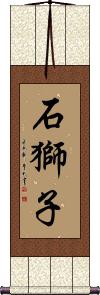
While known in the west as fu dogs or foo dogs, these are actually guardian lions.
These are the lion statues traditionally placed at the entrance of Chinese imperial palaces, imperial tombs, temples, and high-ranking officials' homes. These days, you are more likely to see them at the entrance to a fancy Chinese restaurant.
This means “stone lion(s).”
Good Luck / Good Fortune
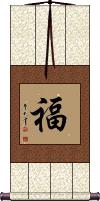
福 is pronounced “fu” in Chinese.
The character “fu” is posted by virtually all Chinese people on the doors of their homes during the Spring Festival (closely associated with the Chinese New Year).
One tradition from the Zhou Dynasty (beginning in 256 B.C.) holds that putting a fu symbol on your front door will keep the goddess of poverty away.
福 literally means good fortune, prosperity, blessed, blessedness, happiness, and fulfillment.
You'll also see this character in Vietnam (where Chinese characters were the written form until a romanization reform) where it is pronounced Phúc - a word commonly used in Vietnamese names because of its good meaning.
See Also: Serendipity / Lucky Coincidence
This in-stock artwork might be what you are looking for, and ships right away...


Not the results for fu that you were looking for?
Below are some entries from our dictionary that may match your fu search...
| Characters If shown, 2nd row is Simp. Chinese |
Pronunciation Romanization |
Simple Dictionary Definition |
佛 see styles |
fú fu2 fu hotoke ほとけ |
More info & calligraphy: Buddhism / Buddha(surname) Hotoke Buddha, from budh to "be aware of", "conceive", "observe", "wake"; also 佛陀; 浮圖; 浮陀; 浮頭; 浮塔; 勃陀; 勃馱; 沒馱; 母馱; 母陀; 部陀; 休屠. Buddha means "completely conscious, enlightened", and came to mean the enlightener. he Chinese translation is 覺 to perceive, aware, awake; and 智 gnosis, knowledge. There is an Eternal Buddha, see e.g. the Lotus Sutra, cap. 16, and multitudes of Buddhas, but the personality of a Supreme Buddha, an Ādi-Buddha, is not defined. Buddha is in and through all things, and some schools are definitely Pan-Buddhist in the pantheistic sense. In the triratna 三寳 commonly known as 三寳佛, while Śākyamuni Buddha is the first "person" of the Trinity, his Law the second, and the Order the third, all three by some are accounted as manifestations of the All-Buddha. As Śākyamuni, the title indicates him as the last of the line of Buddhas who have appeared in this world, Maitreya is to be the next. As such he is the one who has achieved enlightenment, having discovered the essential evil of existence (some say mundane existence, others all existence), and the way of deliverance from the constant round of reincarnations; this way is through the moral life into nirvana, by means of self-abnegation, the monastic life, and meditation. By this method a Buddha, or enlightened one, himself obtains Supreme Enlightenment, or Omniscience, and according to Māhāyanism leads all beings into the same enlightenment. He sees things not as they seem in their phenomenal but in their noumenal aspects, as they really are. The term is also applied to those who understand the chain of causality (twelve nidānas) and have attained enlightenment surpassing that of the arhat. Four types of the Buddha are referred to: (1) 三藏佛the Buddha of the Tripiṭaka who attained enlightenment on the bare ground under the bodhi-tree; (2) 通佛the Buddha on the deva robe under the bodhi-tree of the seven precious things; (3) 別佛the Buddha on the great precious Lotus throne under the Lotus realm bodhi-tree; and (4) 圓佛the Buddha on the throne of Space in the realm of eternal rest and glory where he is Vairocana. The Hīnayāna only admits the existence of one Buddha at a time; Mahāyāna claims the existence of many Buddhas at one and the same time, as many Buddhas as there are Buddha-universes, which are infinite in number. |
富 see styles |
fù fu4 fu yutaka ゆたか |
More info & calligraphy: Wealth / Fortune / Riches / Abundance(1) riches; wealth; fortune; (2) resources; (3) (abbreviation) lottery; (surname, given name) Yutaka Rich, wealthy, affluent, well supplied; translit. pu and ve sounds; cf. 不, 布, 補, 婆. |
福 see styles |
fú fu2 fu fukutsuru ふくつる |
More info & calligraphy: Good Luck / Good Fortunegood fortune; happiness; blessing; good luck; (surname) Fukutsuru Blessing, happiness, felicity, good fortune. |
蝠 see styles |
fú fu2 fu |
More info & calligraphy: Bat |
五福 see styles |
wǔ fú wu3 fu2 wu fu gofuku ごふく |
More info & calligraphy: The Five Fortunesfive blessings |
享福 see styles |
xiǎng fú xiang3 fu2 hsiang fu |
More info & calligraphy: Prosperous Life |
克服 see styles |
kè fú ke4 fu2 k`o fu ko fu kokufuku こくふく |
More info & calligraphy: Overcome(noun, transitive verb) conquest (of a difficulty, illness, crisis, etc.); overcoming; surmounting; bringing under control |
冥福 see styles |
míng fú ming2 fu2 ming fu meifuku めいふく |
More info & calligraphy: Happiness in the Afterlifehappiness in the next world The happiness of the dead. |
功夫 see styles |
gōng fu gong1 fu5 kung fu norio のりお |
More info & calligraphy: Kung Fu / Gong Fu(kana only) {MA} kung fu (chi: gōngfu); (male given name) Norio work |
夫人 see styles |
fū ren fu1 ren5 fu jen fujin(p); bunin(sk) ふじん(P); ぶにん(sk) |
More info & calligraphy: Fujin(n,n-suf) (1) (honorific or respectful language) wife; Mrs; Madam; (2) (archaism) wife of a nobleman; (3) (archaism) (also read ぶにん) consort (of the emperor) of the third rank (ritsuryō system) A wife; the wife of a king, i. e. a queen, devi. |
夫婦 夫妇 see styles |
fū fù fu1 fu4 fu fu fuufu / fufu ふうふ |
More info & calligraphy: Husband and Wifemarried couple; husband and wife; man and wife husband and wife |
富裕 see styles |
fù yù fu4 yu4 fu yü fuyuu / fuyu ふゆう |
More info & calligraphy: Abundance / Prosperous(noun or adjectival noun) wealth; riches; opulence; (female given name) Fuyū |
師傅 师傅 see styles |
shī fu shi1 fu5 shih fu shifu しふ |
More info & calligraphy: Master / Skilled Workerguardian and tutor of a nobleman's child |
師父 师父 see styles |
shī fu shi1 fu5 shih fu shifu しふ |
More info & calligraphy: Fatherly Master / Sifu / Shi Fu / Shifufatherly master a master |
平復 平复 see styles |
píng fù ping2 fu4 p`ing fu ping fu heifuku / hefuku へいふく |
More info & calligraphy: Restoration to Good Health(noun/participle) restoration to health recovery from illness |
幸福 see styles |
xìng fú xing4 fu2 hsing fu shiawase しあわせ |
More info & calligraphy: Happiness(noun or adjectival noun) happiness; well-being; joy; welfare; blessedness; (surname, female given name) Shiawase |
弗雷 see styles |
fú léi fu2 lei2 fu lei |
More info & calligraphy: Frey |
征服 see styles |
zhēng fú zheng1 fu2 cheng fu seifuku / sefuku せいふく |
More info & calligraphy: Conquer / Conquest(noun, transitive verb) (1) conquest; subjugation; (noun, transitive verb) (2) overcoming (a difficulty); conquering (e.g. a mountain); mastery (of a skill) to strike |
復仇 复仇 see styles |
fù chóu fu4 chou2 fu ch`ou fu chou fukkyuu; fukukyuu / fukkyu; fukukyu ふっきゅう; ふくきゅう |
More info & calligraphy: Revenge(n,vs,vi) reprisal; revenge |
復古 复古 see styles |
fù gǔ fu4 gu3 fu ku fukko ふっこ |
More info & calligraphy: Retro / Old School(n,vs,vt,vi,adj-no) revival; restoration |
復活 复活 see styles |
fù huó fu4 huo2 fu huo fukkatsu(p); fukkaatsu(sk) / fukkatsu(p); fukkatsu(sk) ふっかつ(P); ふっかーつ(sk) |
More info & calligraphy: Resurrection / Re-Birth(n,vs,vt,vi) (1) revival (of an old system, custom, fashion, etc.); restoration; return; comeback; (n,vs,vi) (2) resurrection; rebirth To live again, return to life. |
恢復 恢复 see styles |
huī fù hui1 fu4 hui fu kaifuku かいふく |
More info & calligraphy: Rehabilitation(noun/participle) (1) restoration; rehabilitation; recovery; return; replevin; improvement; (2) recovery (from an illness); recuperation; convalescence |
拉夫 see styles |
lā fū la1 fu1 la fu |
More info & calligraphy: Ruff |
父女 see styles |
fù nǚ fu4 nu:3 fu nü |
More info & calligraphy: Father and Daughter |
父愛 父爱 see styles |
fù ài fu4 ai4 fu ai |
More info & calligraphy: A Father’s Love |
祖父 see styles |
zǔ fù zu3 fu4 tsu fu sofu そふ |
More info & calligraphy: Grandfather(1) grandfather; (2) (おおじ only) (See 爺・1) old man; (3) (おおじ only) kyogen mask used for the role of an old man; (place-name) Sofu grandfather |
祝福 see styles |
zhù fú zhu4 fu2 chu fu shukufuku しゅくふく |
More info & calligraphy: Blessings and Good Wishes(noun, transitive verb) (1) celebration (of a joyous occasion); blessing; giving one's blessing; wishing (someone) good luck; (noun, transitive verb) (2) {Christn} blessing (from God) |
福克 see styles |
fú kè fu2 ke4 fu k`o fu ko |
More info & calligraphy: Fulk |
福德 see styles |
fú dé fu2 de2 fu te fukutoku |
More info & calligraphy: Fude |
福斯 see styles |
fú sī fu2 si1 fu ssu |
More info & calligraphy: Foss |
Click here for more fu results from our dictionary
The following table may be helpful for those studying Chinese or Japanese...
| Title | Characters | Romaji (Romanized Japanese) | Various forms of Romanized Chinese | |
| Lau Gar Kung Fu | 劉家功夫 刘家功夫 | liú jiā gōng fu liu2 jia1 gong1 fu liu jia gong fu liujiagongfu | liu chia kung fu liuchiakungfu |
|
| Wing Chun Kung Fu | 詠春功夫 咏春功夫 | yǒng chūn gōng fu yong3 chun1 gong1 fu yong chun gong fu yongchungongfu | yung ch`un kung fu yungchunkungfu yung chun kung fu |
|
| Kung Fu Gong Fu | 功夫 | kan fu / ku fu kanfu / kufu | gōng fu / gong1 fu / gong fu / gongfu | kung fu / kungfu |
| Shaolin Kung Fu | 少林功夫 | sho rin kan fu shorinkanfu | shǎo lín gōng fu shao3 lin2 gong1 fu shao lin gong fu shaolingongfu | shao lin kung fu shaolinkungfu |
| San Soo Kung Fu | 散手功夫 | sǎn shǒu gōng fu san3 shou3 gong1 fu san shou gong fu sanshougongfu | san shou kung fu sanshoukungfu |
|
| Drunken Monkey Kung Fu | 醉猴功夫 / 醉猴功伕 醉猴功夫 | zuì hóu gōng fu zui4 hou2 gong1 fu zui hou gong fu zuihougongfu | tsui hou kung fu tsuihoukungfu |
|
| Kung Fu Panda | 功夫熊貓 功夫熊猫 | gōng fú xióng māo gong1 fu2 xiong2 mao1 gong fu xiong mao gongfuxiongmao | kung fu hsiung mao kungfuhsiungmao |
|
| Tai Chi Wing Chun Kung Fu | 太極詠春功夫 太极咏春功夫 | tài jí yǒng chūn gōng fu tai4 ji2 yong3 chun1 gong1 fu tai ji yong chun gong fu taijiyongchungongfu | t`ai chi yung ch`un kung fu taichiyungchunkungfu tai chi yung chun kung fu |
|
| Fu Lu Shou | 福祿壽 | fú lù shòu fu2 lu4 shou4 fu lu shou fulushou | ||
| Laughing Dragon Kung Fu | 笑龍功夫 笑龙功夫 | xiào lóng gōng fu xiao4 long2 gong1 fu xiao long gong fu xiaolonggongfu | hsiao lung kung fu hsiaolungkungfu |
|
| Fatherly Master Sifu Shi Fu Shifu | 師父 师父 | shi fu / shifu | shī fù / shi1 fu4 / shi fu / shifu | shih fu / shihfu |
| Kung Fu San Soo San Shou | 功夫散手 | gōng fu sǎn shǒu gong1 fu san3 shou3 gong fu san shou gongfusanshou | kung fu san shou kungfusanshou |
|
| Fu Dog Foo Dog | 石獅子 石狮子 | shí shī zi shi2 shi1 zi5 shi shi zi shishizi | shih shih tzu shihshihtzu |
|
| Good Luck Good Fortune | 福 | fuku | fú / fu2 / fu | |
| In some entries above you will see that characters have different versions above and below a line. In these cases, the characters above the line are Traditional Chinese, while the ones below are Simplified Chinese. | ||||

Successful Chinese Character and Japanese Kanji calligraphy searches within the last few hours...



