I am shipping orders on Thursday this week. News and More Info
Buy a Four Season calligraphy wall scroll here!
Personalize your custom “Four Season” project by clicking the button next to your favorite “Four Season” title below...
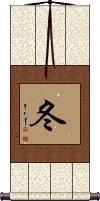
冬 is the word/character used to describe the Winter season in Chinese and Japanese.
It also means winter in Korean Hanja, though a second character is usually added in Korean.
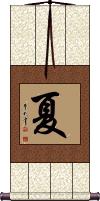
夏 is the word/character used to describe the Summer season in Chinese, Korean and Japanese.
If your name is Summer, I like this character better than transliterating a few characters together to make something that sounds like “summer.”
青龍 is a scholarly title for “Blue Dragon” or “Azure Dragon.”
You'll find this title used in ancient Chinese literature and astronomy. This dragon has dominion over the eastern sky or eastern heavens. The Azure Dragon is also noted for representing the spring season. Also seen as an auspicious omen.
Emperor Huizong of the Song Dynasty canonized the five colored dragons as “kings.” The Azure Dragon represents the most compassionate of kings.
In Japanese, this title is known with the same meaning but can also be a given name, Seiryuu or Seiryu.
Note, the first character can be written as
OR
. Same character, just two ways to write it.
Cho Wa
調和 is one of the several ways to express harmony in Chinese and Japanese.
Note: The first character means harmony but also suggests a musical meaning. It can also describe warriors marching in perfect cadence (in step) or to regulate something.
The second character carries the meaning of harmony and peace by itself.
Together, these characters create a word that can be defined as harmonious, to mediate, to reconcile, to compromise; mediation, temper, to mix, blend, blended, season, seasoning (getting the flavors of the food in balance), to placate, or be in harmonious proportion.
The meaning varies depending on the context. However, when hanging as a wall scroll, this will refer to the person (you) being balanced and in harmony while rational and under control simultaneously.
This in-stock artwork might be what you are looking for, and ships right away...
Below are some entries from our dictionary that may match your four season search...
| Characters If shown, 2nd row is Simp. Chinese |
Pronunciation Romanization |
Simple Dictionary Definition |
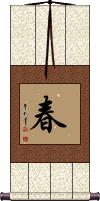
春 see styles |
chūn chun1 ch`un chun haruji はるじ |
More info & calligraphy: Spring Season(n,adv) (1) spring; springtime; (2) New Year; (3) prime (of life); height (of one's prosperity); heyday; (4) adolescence; puberty; (5) sexuality; sexual desire; (personal name) Haruji |
布施 see styles |
bù shī bu4 shi1 pu shih fuho ふほ |
More info & calligraphy: Dana: Almsgiving and Generosity(n,vs,vi) (1) {Buddh} alms-giving; charity; (n,vs,vi) (2) {Buddh} offerings (usu. money) to a priest (for reading sutras, etc.); (surname) Fuho dāna 檀那; the sixth pāramitā, almsgiving, i. e. of goods, or the doctrine, with resultant benefits now and also hereafter in the forms of reincarnation, as neglect or refusal will produce the opposite consequences. The 二種布施 two kinds of dāna are the pure, or unsullied charity, which looks for no reward here but only hereafter; and the sullied almsgiving whose object is personal benefit. The three kinds of dāna are goods, the doctrine, and courage, or fearlessness. The four kinds are pens to write the sutras, ink, the sutras themselves, and preaching. The five kinds are giving to those who have come from a distance, those who are going to a distance, the sick, the hungry, those wise in the doctrine. The seven kinds are giving to visitors, travellers, the sick, their nurses, monasteries, endowments for the sustenance of monks or nuns, and clothing and food according to season. The eight kinds are giving to those who come for aid, giving for fear (of evil), return for kindness received, anticipating gifts in return, continuing the parental example of giving, giving in hope of rebirth in a particular heaven, in hope of an honoured name, for the adornment of the heart and life. 倶舍論 18. |
調和 调和 see styles |
tiáo hé tiao2 he2 t`iao ho tiao ho chouwa / chowa ちょうわ |
More info & calligraphy: Harmony / Balance(n,vs,vi,adj-no) harmony; accord; reconciliation; agreement; (personal name) Chōwa to adjust |
レック see styles |
reggu レッグ |
More info & calligraphy: Lec |
交 see styles |
jiāo jiao1 chiao yoshimi よしみ |
to hand over; to deliver; to pay (money); to turn over; to make friends; (of lines) to intersect; variant of 跤[jiao1] (1) association; fellowship; (2) change (of season, year, etc.); (personal name) Yoshimi Interlock, intersect; crossed; mutual; friendship; to hand over, pay. |
令 see styles |
lìng ling4 ling reiji / reji れいじ |
to order; to command; an order; warrant; writ; to cause; to make something happen; virtuous; honorific title; season; government position (old); type of short song or poem (n,n-suf) (1) command; order; dictation; (prefix) (2) (See 令和) nth year in the Reiwa era (May 1, 2019-); (personal name) Reiji cause |
仲 see styles |
zhòng zhong4 chung nakamura なかむら |
second month of a season; middle; intermediate; second amongst brothers relation; relationship; (personal name) Nakamura |
俏 see styles |
qiào qiao4 ch`iao chiao |
good-looking; charming; (of goods) in great demand; (coll.) to season (food) |
候 see styles |
hòu hou4 hou kou / ko こう |
to wait; to inquire after; to watch; season; climate; (old) period of five days (auxiliary) (1) (archaism) (polite language) (auxiliary used in place of ある after で or に when forming a copula) to be; (auxiliary) (2) (archaism) (polite language) (auxiliary used in place of ます) (See 候ふ・2) to do; (surname, given name) Kō |
噴 喷 see styles |
pèn pen4 p`en pen |
(of a smell) strong; peak season (of a crop); (classifier for the ordinal number of a crop, in the context of multiple harvests) |
孟 see styles |
mèng meng4 meng mou / mo もう |
first month of a season; eldest amongst brothers (surname, given name) Mou Eldest, first; Mencius; rude. |
季 see styles |
jì ji4 chi ri り |
season; the last month of a season; fourth or youngest amongst brothers; classifier for seasonal crop yields (1) season (in nature, sports, etc.); (2) seasonal word or phrase (in haiku); (3) (See 一季・2,半季・1) year; (surname) Ri |
時 时 see styles |
shí shi2 shih tozaki とざき |
o'clock; time; when; hour; season; period (suffix noun) (1) (after noun or -masu stem of verb) (See 食事時) time for ...; time to ...; (suffix noun) (2) (See 売り時) good time to ...; opportunity to ...; (suffix noun) (3) (See 花見時) season; (surname) Tozaki Time, hour, period; constantly; as kāla, time in general, e.g. year, month, season, period; as samaya, it means kṣaṇa, momentary, passing; translit. ji. |
調 调 see styles |
tiáo tiao2 t`iao tiao mitsugu みつぐ |
to harmonize; to reconcile; to blend; to suit well; to adjust; to regulate; to season (food); to provoke; to incite (n,n-suf) (1) {music} key; (n,n-suf) (2) {music} mode (in gagaku); (suffix noun) (3) time; tempo; rhythm; (suffix noun) (4) meter (of a poem); metre; (suffix noun) (5) style; form; mood; pattern; (6) (hist) tax in kind (paid with locally produced goods; under the ritsuryō system); (male given name) Mitsugu To harmonize, blend; regulate, control; to change about, exchange; a song, tune. |
GW see styles |
jii daburyuu; jiidaburyuu(sk) / ji daburyu; jidaburyu(sk) ジー・ダブリュー; ジーダブリュー(sk) |
(See ゴールデンウィーク) Golden Week (early-May holiday season in Japan) |
お初 see styles |
ohatsu おはつ |
(1) (polite language) doing something for the first time (ever, in a season, etc.); (2) new item; first crop of the season |
一季 see styles |
kazusue かずすえ |
(n,adv) (1) one season; (n,adv) (2) (See 半季・1) one year (esp. as an Edo-period duration of employment); (given name) Kazusue |
中手 see styles |
nakante なかんて |
(1) mid-season crops; mid-season rice; mid-season vegetables; (2) (anat) metacarpus; (place-name) Nakante |
中生 see styles |
nakao なかお |
mid-season crops; mid-season rice; mid-season vegetables; (surname) Nakao |
中稲 see styles |
nakaine なかいね |
mid-season crops; mid-season rice; mid-season vegetables; (surname) Nakaine |
乾季 see styles |
kanki かんき |
(noun - becomes adjective with の) dry season |
乾期 see styles |
kanki かんき |
(noun - becomes adjective with の) dry season |
乾燥 干燥 see styles |
gān zào gan1 zao4 kan tsao kansou / kanso かんそう |
(of weather, climate, soil etc) dry; arid; (of skin, mouth etc) dry; (fig.) dull; dry; boring; (of timber etc) to dry out; to season; to cure (n,vs,vt,vi) (1) dryness; aridity; drying (e.g. clothes); dehydration; desiccation; (noun or adjectival noun) (2) (See 無味乾燥) insipidity |
今季 see styles |
konki こんき |
(n,adv) this season |
今節 see styles |
konsetsu こんせつ |
(1) nowadays; these days; (2) {sports} current section of a competition season |
令節 令节 see styles |
lìng jié ling4 jie2 ling chieh |
festive season; happy time; noble principle |
入梅 see styles |
iriume いりうめ |
(noun/participle) entering the rainy season; beginning of the rainy season; (surname) Iriume |
冬場 see styles |
fuyuba ふゆば |
wintertime; winter season |
冬季 see styles |
dōng jì dong1 ji4 tung chi fuyuki ふゆき |
winter winter season; winter; (personal name) Fuyuki |
冬月 see styles |
dōng yuè dong1 yue4 tung yüeh fuyutsuki ふゆつき |
eleventh lunar month (1) winter; winter season; (2) winter moon; (female given name) Fuyutsuki |
The following table may be helpful for those studying Chinese or Japanese...
| Title | Characters | Romaji (Romanized Japanese) | Various forms of Romanized Chinese | |
| Spring Season | 春 | haru | chūn / chun1 / chun | ch`un / chun |
| Winter Season | 冬 | fuyu | dōng / dong1 / dong | tung |
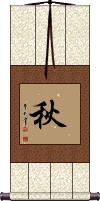
| Autumn Fall Season | 秋 | aki | qiū / qiu1 / qiu | ch`iu / chiu |
| Summer Season | 夏 | natsu | xià / xia4 / xia | hsia |
| Blue Dragon Azure Dragon | 青龍 / 靑龍 青龙 | sei ryuu / seiryuu / sei ryu | qīng lóng qing1 long2 qing long qinglong | ch`ing lung chinglung ching lung |
| Harmony Balance | 調和 调和 | chou wa / chouwa / cho wa | tiáo hé / tiao2 he2 / tiao he / tiaohe | t`iao ho / tiaoho / tiao ho |
| In some entries above you will see that characters have different versions above and below a line. In these cases, the characters above the line are Traditional Chinese, while the ones below are Simplified Chinese. | ||||
Successful Chinese Character and Japanese Kanji calligraphy searches within the last few hours...

All of our calligraphy wall scrolls are handmade.
When the calligrapher finishes creating your artwork, it is taken to my art mounting workshop in Beijing where a wall scroll is made by hand from a combination of silk, rice paper, and wood.
After we create your wall scroll, it takes at least two weeks for air mail delivery from Beijing to you.
Allow a few weeks for delivery. Rush service speeds it up by a week or two for $10!
When you select your calligraphy, you'll be taken to another page where you can choose various custom options.
The wall scroll that Sandy is holding in this picture is a "large size"
single-character wall scroll.
We also offer custom wall scrolls in small, medium, and an even-larger jumbo size.
Professional calligraphers are getting to be hard to find these days.
Instead of drawing characters by hand, the new generation in China merely type roman letters into their computer keyboards and pick the character that they want from a list that pops up.
There is some fear that true Chinese calligraphy may become a lost art in the coming years. Many art institutes in China are now promoting calligraphy programs in hopes of keeping this unique form
of art alive.
Even with the teachings of a top-ranked calligrapher in China, my calligraphy will never be good enough to sell. I will leave that to the experts.
The same calligrapher who gave me those lessons also attracted a crowd of thousands and a TV crew as he created characters over 6-feet high. He happens to be ranked as one of the top 100 calligraphers in all of China. He is also one of very few that would actually attempt such a feat.
Check out my lists of Japanese Kanji Calligraphy Wall Scrolls and Old Korean Hanja Calligraphy Wall Scrolls.
Some people may refer to this entry as Four Season Kanji, Four Season Characters, Four Season in Mandarin Chinese, Four Season Characters, Four Season in Chinese Writing, Four Season in Japanese Writing, Four Season in Asian Writing, Four Season Ideograms, Chinese Four Season symbols, Four Season Hieroglyphics, Four Season Glyphs, Four Season in Chinese Letters, Four Season Hanzi, Four Season in Japanese Kanji, Four Season Pictograms, Four Season in the Chinese Written-Language, or Four Season in the Japanese Written-Language.
104 people have searched for Four Season in Chinese or Japanese in the past year.
Four Season was last searched for by someone else on Oct 18th, 2025