Many custom options...


And formats...



First Turn of the Wheel in Chinese / Japanese...
Buy a First Turn of the Wheel calligraphy wall scroll here!
Personalize your custom “First Turn of the Wheel” project by clicking the button next to your favorite “First Turn of the Wheel” title below...
First Turn of the Dharma Wheel
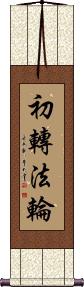
初轉法輪 is the Chinese, Japanese Kanji, and old Korean Hanja for the first turning of the wheel of the dharma.
Reincarnation / Transmigration of Souls
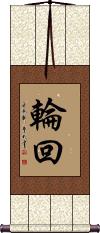
輪回 is a universal word in Japanese and Chinese that expresses the Buddhist idea of “reincarnation,” “transmigration of souls,” or “the eternal cycle of birth and death.”
In some contexts, this can also mean “karma,” and others will say it represents “samsara.”
The first character means wheel, ring, turn, circle, loop, or rotate.
The second character can be thought of as a suffix meaning “-times.” This second character can also refer to something that revolves, returns, goes back, or is a counter of the number of occurrences of some event.
Together the sum supersedes the parts, and it means reincarnation. But knowing the essence of each character may help you understand some of the meaning behind the word.
 Shown to the right is the more common way to write the second character in Japanese.
it’s
an alternate form of this character in Chinese (so neither way is technically wrong in either language). If you select a Japanese calligrapher, expect that is will look like the Kanji to the right.
Shown to the right is the more common way to write the second character in Japanese.
it’s
an alternate form of this character in Chinese (so neither way is technically wrong in either language). If you select a Japanese calligrapher, expect that is will look like the Kanji to the right.
This in-stock artwork might be what you are looking for, and ships right away...
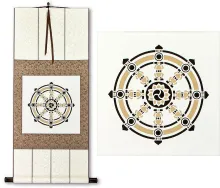
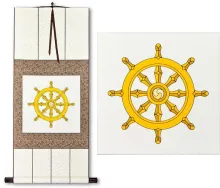
Gallery Price: $322.00
Your Price: $178.88
Not the results for first turn of the wheel that you were looking for?
Below are some entries from our dictionary that may match your first turn of the wheel search...
| Characters If shown, 2nd row is Simp. Chinese |
Pronunciation Romanization |
Simple Dictionary Definition |
五輪 五轮 see styles |
wǔ lún wu3 lun2 wu lun gorin ごりん |
(1) (See オリンピック) Olympic Games; Olympics; (2) Olympic rings; (p,s,f) Gorin The five wheels, or things that turn: I. The 五體 or five members, i. e. the knees, the elbows, and the head; when all are placed on the ground it implies the utmost respect. II. The five foundations of the world. first and lowest the wheel or circle of space; above are those of wind; of water; the diamond, or earth; on these rest the nine concentric circles and eight seas. III. The esoteric sect uses the term for the 五大 five elements, earth, water, fire, wind, and space; also for the 五解脫輪 q. v. IV. The five fingers (of a Buddha). |
切る see styles |
kiru(p); kiru(sk) きる(P); キる(sk) |
(transitive verb) (1) to cut; to cut through; to perform (surgery); (transitive verb) (2) (See 縁を切る) to sever (connections, ties); (transitive verb) (3) to turn off (e.g. the light); (transitive verb) (4) (See 電話を切る) to terminate (e.g. a conversation); to hang up (the phone); to disconnect; (transitive verb) (5) to punch (a ticket); to tear off (a stub); (transitive verb) (6) to open (something sealed); (transitive verb) (7) to start; (transitive verb) (8) to set (a limit); to do (something) in less or within a certain time; to issue (cheques, vouchers, etc.); (transitive verb) (9) (See 値切る) to reduce; to decrease; to discount; (transitive verb) (10) to shake off (water, etc.); to let drip-dry; to let drain; (transitive verb) (11) to cross; to traverse; (transitive verb) (12) to criticize sharply; (transitive verb) (13) to act decisively; to do (something noticeable); to go first; to make (certain facial expressions, in kabuki); (transitive verb) (14) (See ハンドルを切る) to turn (vehicle, steering wheel, etc.); (transitive verb) (15) to curl (a ball); to bend; to cut; (transitive verb) (16) to shuffle (cards); (transitive verb) (17) {mahj} to discard a tile; (transitive verb) (18) to dismiss; to sack; to let go; to expel; to excommunicate; (transitive verb) (19) to dig (a groove); to cut (a stencil, on a mimeograph); (transitive verb) (20) (See 切り札・1) to trump; (transitive verb) (21) {go} (sometimes キる) (See キリ・11) to cut (the connection between two groups); (transitive verb) (22) (also written as 鑽る) to start a fire (with wood-wood friction or by striking a metal against stone); (transitive verb) (23) to draw (a shape) in the air (with a sword, etc.); (suf,v5r) (24) (after the -masu stem of a verb) (See 使い切る) to do completely; to finish doing; (suf,v5r) (25) (after the -masu stem of a verb) (See 疲れ切る) to be completely ...; to be totally ...; to be terribly ...; (suf,v5r) (26) (after the -masu stem of a verb) (See 言い切る・1) to do clearly; to do decisively; to do firmly |
The following table may be helpful for those studying Chinese or Japanese...
| Title | Characters | Romaji (Romanized Japanese) | Various forms of Romanized Chinese | |
| First Turn of the Dharma Wheel | 初轉法輪 初转法轮 | sho ten bourin shotenbourin sho ten borin | chū zhuàn fǎ lún chu1 zhuan4 fa3 lun2 chu zhuan fa lun chuzhuanfalun | ch`u chuan fa lun chuchuanfalun chu chuan fa lun |
| Reincarnation Transmigration of Souls | 輪回 / 輪廻 轮回 | rin ne / rinne | lún huí / lun2 hui2 / lun hui / lunhui | |
| In some entries above you will see that characters have different versions above and below a line. In these cases, the characters above the line are Traditional Chinese, while the ones below are Simplified Chinese. | ||||

Successful Chinese Character and Japanese Kanji calligraphy searches within the last few hours...



