I am shipping orders on Thursday this week. News and More Info
Buy a Community and Together calligraphy wall scroll here!
Personalize your custom “Community and Together” project by clicking the button next to your favorite “Community and Together” title below...
1. Community
2. Sangha
4. Kaio-Ken
5. Sariputra
6. Ritsu
7. Three Treasures of Buddhism
8. No Trouble / Freedom from Problems
10. Wolf
11. Appreciation of Truth by Meditation
12. Islam
社區 is how to write community in Chinese.
社區 can mean the neighborhood you live in. It can also be used the same way we use the word community in English.
Examples: African-American community, Christian community, Asian community, etc.
If you need a special calligraphy wall scroll to describe your community, just contact me, and I’ll translate it and make it for you.
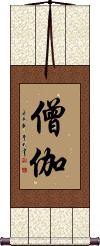
In Buddhism, 僧伽 refers to a community of monks and/or nuns (one of the “Three Jewels”). In general terms, it can simply mean “all followers of the Buddha.”
Notes: Though there are not vast numbers of Chinese Hindus, in the Hindu faith, this term means “community together.”
The original Sanskrit word is also Romanized as samgha.
The first character means “monk.” The second character means Buddha or Shakyamuni.
僧伽 is a transliteration of the original Sanskrit, but it uses two very profound Chinese characters related to Buddhism.
Some may pronounce this as “seng qie” or “seng jia” in Mandarin (two possible pronunciations for the second character). Note that “qie” sounds like “chee-ah” using typical English pronunciation. Chinese Romanization is not actually designed to match English sounds.
![]()
Note that when writing this as Kanji, Japanese will tend to write the first character in the form shown to the right. If you select our Japanese master calligrapher, please expect this special Kanji form. However, it should also be noted that this is not a common term in Japanese (except by certain sects of Buddhism or perhaps devout Buddhists in Japan).
僧 is the single-character or short form of Sangha, the Buddhist idea of community or order (of monks, nuns, or followers of the Buddha).
Alone, this character can simply mean “monk” (Just means monk in Japanese).
![]()
Note that when writing this as Kanji, Japanese will tend to write this in the form shown to the right. If you select our Japanese master calligrapher, please expect this special Kanji form.
舍利弗塔 is the name Sariputra or Śāriputra in Chinese (Mandarin).
Often written in a shorter form as 舍利弗 (shě lì fú). This name comes from the Sanskrit शारिपुत्र or Śāriputra, and from Pali as Sāriputta.
This name comes from the closest disciple of the Buddha, Śāriputra, who helped establish the legacy of the Sangha (community of monks).
While this character literally means law, regulation or rules, it's also a surname Lü in Chinese and name Ritsu in Japanese.
In more ancient times (and for some people still), this can refer to East Asian criminal code, or vinaya (rules for the monastic community). For Japanese Buddhists, this can be the Ritsu school.
In some context, this can refer to certain musical scales used in Asia.
The Triple Gem
三寶 is the title for “Three Precious Treasures of Buddhism” or “The Triple Gem.”
These three treasures are the Buddha 佛, the Dharma 法 (teachings or the law of the Buddha), and the Sangha 僧 (the community of monks or followers).
This term is used by most (perhaps not all) Buddhists in China, Japan, and South Korea (written the same in the original form but pronounced differently in each language). Non-Buddhists may just read this as “Three Treasures” without the religious context. For instance, there is also a “Three Treasures of Chinese Medicine” that is sometimes titled the same way.
In modern Japanese and Simplified Chinese, this is written 三宝 instead of 三寶.
無事 is a Zen Buddhist term meaning no problem and no trouble.
無事 is the Zen state of perfect freedom from troubles and leaving secular affairs behind.
Sometimes this is used to describe the state of satori and complete tranquility of mind.
Written as 無事に with an extra Hiragana at the end, this becomes an adverb to describe something in the condition of safety, peace, quietness, and without troubles.
無事 (Buji) can also be a given name in Japan.
This has more meaning in the Japanese Zen Buddhist community than in China or Korea, where it can mean “be free” or “nothing to do or worry about.”
大光明 is the master symbol “Daikomyo” or “Dai Ko Myo,” which is usually associated with the healing practice of Reiki.
This title can be translated as “Great Bright Light.” This symbol, as used in Reiki, alludes to “Enlightened Nature” or the radiance of a purified soul or deity.
Pronunciations in Chinese and Korean are included above but this title has no meaning except when used by a Reiki practitioner. In fact, this title is not that well known by those outside the Reiki community in Japan.
In Chinese, this would be interpreted as “Great Bright Future” (the second two characters alone create a word that means “bright future” in Chinese).
狼 is the character used to represent the elusive animal known as the wolf in both Chinese and Japanese.
If you are a fan of the wolf or the wolf means something special to you, this could make a great addition to your wall.
Do keep in mind, that much like our perception of wolves in the history of western culture, eastern cultures do not have a very positive view of wolves (save the scientific community and animal lovers). The wolf is clearly an animal that is misunderstood or feared the world over.
狼 is seldom used alone in Korean Hanja but is used in a compound word that means utter failure (as in a wolf getting into your chicken pen - or an otherwise ferocious failure). Not a good choice if your audience is Korean.
心印 is a Buddhist concept that simply stated is “appreciation of truth by meditation.”
It's a deep subject, but my understanding is that you can find truth through meditation, and once you've found the truth, you can learn to appreciate it more through further meditation. This title is not commonly used outside of the Buddhist community (your Asian friends may or may not understand it). The literal translation would be something like “the mind seal,” I've seen this term translated this way from Japanese Buddhist poetry. But apparently, the seal that is stamped deep in your mind is the truth. You just have to meditate to find it.
Soothill defines it this way: Mental impression, intuitive certainty; the mind is the Buddha-mind in all, which can seal or assure the truth; the term indicates the intuitive method of the Chan (Zen) school, which was independent of the spoken or written word.
Reference: Soothill-Hodous Dictionary of Chinese Buddhism
See Also: Zen
(phonetic version)
伊斯蘭教 both means and sounds like “Islam” in Mandarin Chinese.
The first three characters sound like the word “Islam,” and the last character means “religion” or “teaching.” It's the most general term for “Islam” in China. The highest concentration of Muslims in China is Xinjiang (the vast region in northwest China that was called The East Turkistan Republic until 1949 and is sometimes called Chinese Turkistan, Uyghuristan). Here you will find Uygurs, Kazakhs, Kyrgyz, and others that are descendants of Turkmen (possibly mixed with Persians and Arabs). Many of their ancestors were traders who traveled the silk road to buy and sell spices and silk and exchange other goods from the Orient and the Middle East.
I spent some time in Xinjiang and got to know this community. They are strong people who can endure much. They are friendly and love to have a good time. I was a stranger but was treated by villagers (near China's border with Afghanistan) as if I was a good friend.
However, I have heard that it's best not to cross them, as in this land, the law is the blade, and everything is “eye for an eye.” The Chinese government has little control in Xinjiang, with almost no police officers except in the capital of Urumqi (so it's a 60-hour roundtrip train ride to seek the aid of law enforcement in most cases).
While few seem devout, there are at least small mosques in every village. And you will never see a man or woman outside without a head covering.
It should be noted that these people are all citizens of China, but they are officially of the Caucasian race. A visit to Xinjiang will change your idea of what it means to be Chinese.
This in-stock artwork might be what you are looking for, and ships right away...
Gallery Price: $108.00
Your Price: $59.88

The following table may be helpful for those studying Chinese or Japanese...
| Title | Characters | Romaji (Romanized Japanese) | Various forms of Romanized Chinese | |
| Community | 社區 社区 | shè qū / she4 qu1 / she qu / shequ | she ch`ü / shechü / she chü | |
| Sangha | 僧伽 | sougya / sogya | sēng qié / seng1 qie2 / seng qie / sengqie | seng ch`ieh / sengchieh / seng chieh |
| Sangha Order of Monks | 僧 | sou / so | sēng / seng1 / seng | |
| Kaio-Ken | 界王拳 | kai ou ken / kaiouken / kai o ken | jiè wáng quán jie4 wang2 quan2 jie wang quan jiewangquan | chieh wang ch`üan chiehwangchüan chieh wang chüan |
| Sariputra | 舍利弗塔 | shě lì fú tǎ she3 li4 fu2 ta3 she li fu ta shelifuta | she li fu t`a shelifuta she li fu ta |
|
| Ritsu | 律 | ritsu | lǜ / lu:4 / lu: | lü |
| Three Treasures of Buddhism | 三寶 三宝 | san bou / sanbou / san bo | sān bǎo / san1 bao3 / san bao / sanbao | san pao / sanpao |
| No Trouble Freedom from Problems | 無事 无事 | buji | wú shì / wu2 shi4 / wu shi / wushi | wu shih / wushih |
| Reiki - Master Symbol | 大光明 | dai kou myou daikoumyou dai ko myo | dà guāng míng da4 guang1 ming2 da guang ming daguangming | ta kuang ming takuangming |
| Wolf | 狼 | okami | láng / lang2 / lang | |
| Appreciation of Truth by Meditation | 心印 | shin nin / shinnin | xīn yìn / xin1 yin4 / xin yin / xinyin | hsin yin / hsinyin |
| Islam | 伊斯蘭教 伊斯兰教 | yī sī lán jiào yi1 si1 lan2 jiao4 yi si lan jiao yisilanjiao | i ssu lan chiao issulanchiao |
|
| In some entries above you will see that characters have different versions above and below a line. In these cases, the characters above the line are Traditional Chinese, while the ones below are Simplified Chinese. | ||||
Successful Chinese Character and Japanese Kanji calligraphy searches within the last few hours...

All of our calligraphy wall scrolls are handmade.
When the calligrapher finishes creating your artwork, it is taken to my art mounting workshop in Beijing where a wall scroll is made by hand from a combination of silk, rice paper, and wood.
After we create your wall scroll, it takes at least two weeks for air mail delivery from Beijing to you.
Allow a few weeks for delivery. Rush service speeds it up by a week or two for $10!
When you select your calligraphy, you'll be taken to another page where you can choose various custom options.
The wall scroll that Sandy is holding in this picture is a "large size"
single-character wall scroll.
We also offer custom wall scrolls in small, medium, and an even-larger jumbo size.
Professional calligraphers are getting to be hard to find these days.
Instead of drawing characters by hand, the new generation in China merely type roman letters into their computer keyboards and pick the character that they want from a list that pops up.
There is some fear that true Chinese calligraphy may become a lost art in the coming years. Many art institutes in China are now promoting calligraphy programs in hopes of keeping this unique form
of art alive.
Even with the teachings of a top-ranked calligrapher in China, my calligraphy will never be good enough to sell. I will leave that to the experts.
The same calligrapher who gave me those lessons also attracted a crowd of thousands and a TV crew as he created characters over 6-feet high. He happens to be ranked as one of the top 100 calligraphers in all of China. He is also one of very few that would actually attempt such a feat.
Check out my lists of Japanese Kanji Calligraphy Wall Scrolls and Old Korean Hanja Calligraphy Wall Scrolls.
Some people may refer to this entry as Community and Together Kanji, Community and Together Characters, Community and Together in Mandarin Chinese, Community and Together Characters, Community and Together in Chinese Writing, Community and Together in Japanese Writing, Community and Together in Asian Writing, Community and Together Ideograms, Chinese Community and Together symbols, Community and Together Hieroglyphics, Community and Together Glyphs, Community and Together in Chinese Letters, Community and Together Hanzi, Community and Together in Japanese Kanji, Community and Together Pictograms, Community and Together in the Chinese Written-Language, or Community and Together in the Japanese Written-Language.
17 people have searched for Community and Together in Chinese or Japanese in the past year.
Community and Together was last searched for by someone else on Oct 18th, 2025