I am shipping orders on Thursday this week. News and More Info
Not what you want?
Try other similar-meaning words, fewer words, or just one word.
Buy a Tian Ti calligraphy wall scroll here!
Personalize your custom “Tian Ti” project by clicking the button next to your favorite “Tian Ti” title below...
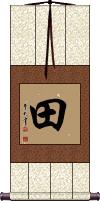
This Chinese, Korean, and Japanese character means field or farm.
Most of the time, this refers to a rice field.
However, this is very commonly used as a surname that romanizes from Mandarin as Tian, and from Cantonese and Taiwanese, it's romanized as Tien.
In Japanese, it can be the surname Yanakida, Tatsuru, or Tazaki. There are other romanizations used for Japanese surnames for this character. When just a field, it is pronounced “den” in Japanese.
天龍 can mean Heavenly Dragon (Dragon of Heaven), Sky Dragon, Holy Dragon, Celestial Dragon, or Divine Dragon.
This can be a given name in both China and Japan (天龍 is pronounced Tenryū and sometimes written 天竜 in Japanese).
In an older Buddhist context, this can refer to Brahma, Indra, and the devas, together with the nāgas. It can also refer to celestials and snake spirits.
天 means “heaven” or “sky” in Chinese, Japanese Kanji, and old Korean Hanja.
The context determines if you are talking about heaven or the sky above (often they are the same concept).
When combined with other characters, words like “today” and “tomorrow” are created. While sometimes the character for “sun” is used to mean “day,” often “sky” represents “day” in Asian languages.
Example: 今天 (this sky) = “today,” 明天 (next sky) = “tomorrow” in modern Chinese and Japanese.
In Chinese culture, regardless of which religion, it's almost always assumed that God (and any other deities) live up above the sky. The concept of God living in the sky is likely the reason heaven is associated with this character.
The equation goes something like this: God's domain is the sky, thus, the sky is heaven.
Note: As a single character, this is a little ambiguous, so you might want to choose our Kingdom of Heaven selection instead.
同性戀自豪感 or “Gay Pride” is a new idea in China. It's so new, that we may have just started the movement by translating this phrase.
If they ever do start having gay pride parades in China, my best guess is that these 6 characters will constitute the term they use to title the parade/movement.
Who knows, maybe in 10 years they will have a pride parade march straight past Tian'anmen Square on Chang An Street (the main drag in Beijing).
Secondary version of Sifu
師傅 is “sifu” as in the “master” in the context of martial arts.
But two sifu titles are floating around. This one can simply mean “skilled worker.”
Historically, this term has been used for many things, such as “The tutor of a king or emperor.” But now it's more commonly used to mean master worker or qualified worker.
Currently, within the field of skilled labor, a master (Shifu) is higher than a journeyman and is considered to be one worthy of teaching others.
Note: In the 1970s and 1980s, this term was used as a common form of polite address between people. You might say, “master, do you know where Tian'anmen Square is?” to a person on the street at that time. This usage has almost passed; however, for some reason, people still often refer to taxi cab drivers as “master” in China (though I think/hope this is fading).
In Mandarin Chinese, this is pronounced like “Sure Foo,” and in Cantonese, like “See Foo.”
The second character is the difference between this sifu and the other. In this case, the second character by itself means tutor, instructor, or teacher.
信言不美美言不信知者不博博者不知善者不多多者不善聖人無積既以為人己癒有既以予人矣已癒多故天之道利而不害聖人之道為而不爭 is the Mawangdui version of Daodejing chapter 81.
This in-stock artwork might be what you are looking for, and ships right away...
Gallery Price: $72.00
Your Price: $39.88
Below are some entries from our dictionary that may match your Tian Ti search...
| Characters If shown, 2nd row is Simp. Chinese |
Pronunciation Romanization |
Simple Dictionary Definition |
天山 see styles |
tiān shān tian1 shan1 t`ien shan tien shan tenzan てんざん |
Tian Shan, mountain range straddling the border between China and Kyrgyzstan (1) (archaism) enormous thing; (n,adv) (2) (archaism) greatly; very; (surname, given name) Tenzan; (place-name) Tenzan (Japan); Tian Shan (China) |
甜茶 see styles |
tencha; tencha てんちゃ; テンチャ |
(1) {food} tian cha; sweet tea; blackberry leaf tea; (2) (kana only) {bot} Chinese blackberry (Rubus suavissimus) |
田亮 see styles |
tián liàng tian2 liang4 t`ien liang tien liang |
Tian Liang (1979-), former male Chinese diver, Olympic medalist |
田漢 田汉 see styles |
tián hàn tian2 han4 t`ien han tien han |
Tian Han (1898-1968), author of the words of the PRC national anthem March of the Volunteer Army 義勇軍進行曲|义勇军进行曲 |
蒙恬 see styles |
méng tián meng2 tian2 meng t`ien meng tien mouten / moten もうてん |
Qin general Meng Tian (-210 BC), involved in 215 BC in fighting the Northern Xiongnu 匈奴 and building the great wall (person) Meng Tian (ca. 250-210 BCE; Chinese general) |
天峨縣 天峨县 see styles |
tiān é xiàn tian1 e2 xian4 t`ien o hsien tien o hsien |
Tian'e, a county in Hechi City 河池市[He2 chi2 Shi4], Guangxi |
テンチャ see styles |
tencha テンチャ |
(1) (food term) tian cha; sweet tea; blackberry leaf tea; (2) (bot) (kana only) Chinese blackberry (Rubus suavissimus) |
天山北路 see styles |
tenzanhokuro てんざんほくろ |
route skirting the Tian Shan Mountains to the north; region north of the Tian Shan Mountains |
天山山脈 see styles |
tenzansanmyaku てんざんさんみゃく |
(place-name) Tian Shan mountain range (Central Asia); Tengri Tagh |
田忌賽馬 田忌赛马 see styles |
tián jì sài mǎ tian2 ji4 sai4 ma3 t`ien chi sai ma tien chi sai ma |
Tian Ji races his horses (and accepts one loss in order to ensure two wins) (idiom) |
博格達山脈 博格达山脉 see styles |
bó gé dá shān mài bo2 ge2 da2 shan1 mai4 po ko ta shan mai |
Bogda Shan mountain range in the Tian Shan mountains |
セミョーノフ see styles |
semyoonofu セミョーノフ |
(personal name) Semenoff; Semenov-Tian'-Shanskii; Semyonov |
觀彌勒菩薩上生兜率天經 观弥勒菩萨上生兜率天经 see styles |
guān mí lè pú sà shàng shēng dōu shuò tiān jīng guan1 mi2 le4 pu2 sa4 shang4 sheng1 dou1 shuo4 tian1 jing1 kuan mi le p`u sa shang sheng tou shuo t`ien ching kuan mi le pu sa shang sheng tou shuo tien ching Kan Miroku bosatsu jōshō tosotsu ten kyō |
Guan Mile Busa shangsheng doushuo tian jing |
The following table may be helpful for those studying Chinese or Japanese...
| Title | Characters | Romaji (Romanized Japanese) | Various forms of Romanized Chinese | |
| Tian Tien | 田 | den | tián / tian2 / tian | t`ien / tien |
| Celestial Dragon Tian Long | 天龍 天龙 | tenryuu / tenryu | tiān lóng tian1 long2 tian long tianlong | t`ien lung tienlung tien lung |
| Heaven | 天 | ten | tiān / tian1 / tian | t`ien / tien |
| Arita | 有田 | arita / arida / uda | yǒu tián you3 tian2 you tian youtian | yu |
| Gay Pride | 同性戀自豪感 同性恋自豪感 | tóng xìng liàn zì háo gǎn tong2 xing4 lian4 zi4 hao2 gan3 tong xing lian zi hao gan tongxinglianzihaogan | t`ung hsing lien tzu hao kan tunghsinglientzuhaokan tung hsing lien tzu hao kan |
|
| Master Skilled Worker | 師傅 师傅 | shī fu / shi1 fu / shi fu / shifu | shih fu / shihfu | |
| Daodejing Tao Te Ching - Chapter 81 | 信言不美美言不信知者不博博者不知善者不多多者不善聖人無積既以為人己癒有既以予人矣已癒多故天之道利而不害聖人之道為而不爭 信言不美美言不信知者不博博者不知善者不多多者不善圣人无积既以为人己愈有既以予人矣已愈多故天之道利而不害圣人之道为而不争 | |||
| In some entries above you will see that characters have different versions above and below a line. In these cases, the characters above the line are Traditional Chinese, while the ones below are Simplified Chinese. | ||||
Successful Chinese Character and Japanese Kanji calligraphy searches within the last few hours...

All of our calligraphy wall scrolls are handmade.
When the calligrapher finishes creating your artwork, it is taken to my art mounting workshop in Beijing where a wall scroll is made by hand from a combination of silk, rice paper, and wood.
After we create your wall scroll, it takes at least two weeks for air mail delivery from Beijing to you.
Allow a few weeks for delivery. Rush service speeds it up by a week or two for $10!
When you select your calligraphy, you'll be taken to another page where you can choose various custom options.
The wall scroll that Sandy is holding in this picture is a "large size"
single-character wall scroll.
We also offer custom wall scrolls in small, medium, and an even-larger jumbo size.
Professional calligraphers are getting to be hard to find these days.
Instead of drawing characters by hand, the new generation in China merely type roman letters into their computer keyboards and pick the character that they want from a list that pops up.
There is some fear that true Chinese calligraphy may become a lost art in the coming years. Many art institutes in China are now promoting calligraphy programs in hopes of keeping this unique form
of art alive.
Even with the teachings of a top-ranked calligrapher in China, my calligraphy will never be good enough to sell. I will leave that to the experts.
The same calligrapher who gave me those lessons also attracted a crowd of thousands and a TV crew as he created characters over 6-feet high. He happens to be ranked as one of the top 100 calligraphers in all of China. He is also one of very few that would actually attempt such a feat.
Check out my lists of Japanese Kanji Calligraphy Wall Scrolls and Old Korean Hanja Calligraphy Wall Scrolls.
Some people may refer to this entry as Tian Ti Kanji, Tian Ti Characters, Tian Ti in Mandarin Chinese, Tian Ti Characters, Tian Ti in Chinese Writing, Tian Ti in Japanese Writing, Tian Ti in Asian Writing, Tian Ti Ideograms, Chinese Tian Ti symbols, Tian Ti Hieroglyphics, Tian Ti Glyphs, Tian Ti in Chinese Letters, Tian Ti Hanzi, Tian Ti in Japanese Kanji, Tian Ti Pictograms, Tian Ti in the Chinese Written-Language, or Tian Ti in the Japanese Written-Language.