Many custom options...


And formats...



Reader in Chinese / Japanese...
Buy a Reader calligraphy wall scroll here!
Personalize your custom “Reader” project by clicking the button next to your favorite “Reader” title below...
Reader

リーダー is the name Reader in Japanese Katakana.
Note: Because this title is entirely Japanese Katakana, it should be written by a Japanese calligrapher.
An Open Book Benefits Your Mind
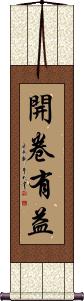
There are several ways to translate this ancient proverb. Translated literally and directly, it says, “Open roll has/yields benefit.”
To understand that, you must know a few things...
First, Chinese characters and language have deeper meanings that often are not spoken but are understood - especially with ancient texts like this. Example: It's understood that the “benefit” referred to in this proverb is to the reader's mind. Just the last character expresses that whole idea.
Second, Chinese proverbs are supposed to make you think and leave a bit of mystery to figure out.
Third, for this proverb, it should be noted that roll = book. When this proverb came about (about two thousand years ago), books were rolls of bamboo slips strung together. The first bound books like the ones we use today did not come about until about a thousand years after this proverb when they invented paper in China.
開卷有益 is a great gift for a bookworm who loves to read and increase their knowledge. Or for any friend that is or wants to be well-read.
Some other translations of this phrase:
Opening a book is profitable
The benefits of education.
Not the results for Reader that you were looking for?
Below are some entries from our dictionary that may match your Reader search...
| Characters If shown, 2nd row is Simp. Chinese |
Pronunciation Romanization |
Simple Dictionary Definition |
あんす see styles |
ansu アンス |
(expression) (1) (archaism) (semi-polite) to come; to go; (auxiliary verb) (2) (polite language) (archaism) (after -masu stem of verb) (See ます・1) expresses politeness towards the listener (or reader); (surname) Hains |
キンドル see styles |
kindoru キンドル |
More info & calligraphy: Kindle |
リーダー see styles |
riidaa / rida リーダー |
More info & calligraphy: Reader |
七僧 see styles |
qī sēng qi1 seng1 ch`i seng chi seng shichisō |
A monastery is supposed to possess the following seven monks: 咒願師 invoker; 導師 leader; 唄師 intoner, or leader of the chanting; 散花師 flower-scatterer; 梵音師 master of sacred words, or Sanskrit; 錫杖師 shaker of the rings on the metal staff, or crozier; 堂達 distributor of missals, etc. Another division is 講師 expounder; 讀師 reader; 咒願師; 三禮師 director of the three ceremonies; 唄師; 散花師; and 堂達. |
例題 例题 see styles |
lì tí li4 ti2 li t`i li ti reidai / redai れいだい |
problem or question solved for illustrative purposes in the classroom; practice question (used in preparation for an exam); sample question example; exercise (for the reader) |
凡例 see styles |
fán lì fan2 li4 fan li hanrei / hanre はんれい |
notes on the use of a book; guide to the reader (1) explanatory notes (at the start of a book); introductory remarks; usage guide (e.g. of a dictionary); (2) (See キャプション・1) legend (on maps, drawings, etc.) |
安安 see styles |
ān ān an1 an1 an an yasuyasu やすやす |
(Tw) (Internet slang) Greetings! (used when it's unknown what time the reader will see one's post, or just to be cute) (adv,adv-to) calmly; peacefully; painlessly; comfortably |
投書 投书 see styles |
tóu shū tou2 shu1 t`ou shu tou shu tousho / tosho とうしょ |
to submit a written piece (letter, article, opinion piece etc) (noun/participle) (1) letter (e.g. of complaint); letter to the editor; letter from a reader; (noun/participle) (2) (See 投稿) contribution (to a newspaper, magazine, etc.) |
文氣 文气 see styles |
wén qì wen2 qi4 wen ch`i wen chi |
the impact of a piece of writing on the reader; gentle; refined |
法師 法师 see styles |
fǎ shī fa3 shi1 fa shih houshi / hoshi ほうし |
one who has mastered the sutras (Buddhism) (1) Buddhist priest; bonze; (2) layman dressed like a priest; (suffix noun) (3) (usu. pronounced ぼうし) person; (surname, given name) Houshi A Buddhist teacher, master of the Law; five kinds are given— a custodian (of the sūtras), reader, intoner, expounder, and copier. |
看倌 see styles |
kàn guān kan4 guan1 k`an kuan kan kuan |
dear reader; dear listener |
端末 see styles |
tanmatsu たんまつ |
(1) (abbreviation) {comp} (See 端末装置) terminal; computer terminal; (2) (abbreviation) (See 携帯端末・けいたいたんまつ,通信端末・つうしんたんまつ,情報端末・じょうほうたんまつ) information access device (smartphone, tablet, book-reader, etc.); (3) end (e.g. of a roll of film) |
蛔蟲 蛔虫 see styles |
huí chóng hui2 chong2 hui ch`ung hui chung |
roundworm; ascarid; (esp.) Ascaris lumbricoides, a human parasite; (fig.) person who knows what another person is thinking; a mind reader See: 蛔虫 |
読モ see styles |
dokumo どくモ |
(abbreviation) (See 読者モデル) reader model; amateur model who appears in fashion magazines |
読手 see styles |
dokushu; yomite(sk) どくしゅ; よみて(sk) |
{cards} (See 読み手・よみて・2) reader (in competitive karuta); reciter; person who reads the cards |
読者 see styles |
dokusha どくしゃ |
reader |
讀師 读师 see styles |
dú shī du2 shi1 tu shih tokushi |
A reader to an assembly. |
讀本 读本 see styles |
dú běn du2 ben3 tu pen |
reader; an instructional book |
讀者 读者 see styles |
dú zhě du2 zhe3 tu che |
reader |
OCR see styles |
oo shii aaru; ooshiiaaru(sk) / oo shi aru; ooshiaru(sk) オー・シー・アール; オーシーアール(sk) |
(1) {comp} (See 光学式文字認識) optical character recognition; OCR; (2) {comp} (See 光学式文字読取装置) optical character reader; OCR |
リーダ see styles |
riida / rida リーダ |
(noun - becomes adjective with の) (1) leader; (2) reader; reading book; (3) reader (i.e. someone who reads); (4) (abbreviation) microreader; (5) dotted line (in printing); leaders; ellipsis mark |
副読本 see styles |
fukutokuhon; fukudokuhon ふくとくほん; ふくどくほん |
supplementary reader |
愛読者 see styles |
aidokusha あいどくしゃ |
subscriber; reader; admirer |
手相見 see styles |
tesoumi / tesomi てそうみ |
palm reading; palm reader; palmist |
投稿欄 see styles |
toukouran / tokoran とうこうらん |
reader's column; letters-to-the-editor column |
本読み see styles |
honyomi ほんよみ |
(1) script reading; scenario reading; (2) avid reader; bookworm; (3) reading a book; reading books |
読み手 see styles |
yomite よみて |
(1) reader (person); (2) person who reads the cards (in karuta games); (3) composer (of a poem) |
読取器 see styles |
yomitoriki よみとりき |
(computer terminology) (computer) reader; reading device |
読取機 see styles |
yomitoriki よみとりき |
(computer terminology) (computer) reader; reading device |
読書人 see styles |
dokushojin どくしょじん |
avid reader |
Click here for more Reader results from our dictionary
The following table may be helpful for those studying Chinese or Japanese...
| Title | Characters | Romaji (Romanized Japanese) | Various forms of Romanized Chinese | |
| Reader | リーダー | riidaa / rida | ||
| An Open Book Benefits Your Mind | 開卷有益 开卷有益 | kāi juàn yǒu yì kai1 juan4 you3 yi4 kai juan you yi kaijuanyouyi | k`ai chüan yu i kaichüanyui kai chüan yu i |
|
| In some entries above you will see that characters have different versions above and below a line. In these cases, the characters above the line are Traditional Chinese, while the ones below are Simplified Chinese. | ||||

Successful Chinese Character and Japanese Kanji calligraphy searches within the last few hours...



