Many custom options


And formats



Heard in Chinese / Japanese
Buy a Heard calligraphy wall scroll here!
Personalize your custom “Heard” project by clicking the button next to your favorite “Heard” title below.
1. Heard
4. 100 Years of Happy Marriage
5. The More We Sweat in Training, The Less We Bleed in Battle
6. Sun / Solar
7. The Whole Room Rocks With Laughter
8. Drain the pond to get all the fish
9. Taekwondo
10. Islam
Heard

赫德 is the name Heard in Chinese (Mandarin).
Heard

ハード is the name Heard in Japanese Katakana.
Note: Because this title is entirely Japanese Katakana, it should be written by a Japanese calligrapher.
Herculean Strength
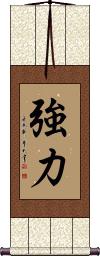
強力 means herculean strength, powerful, or strong.
I've even heard this described as “strength to carry a mountain.”
Note: This can also be the Japanese surname Gouriki (like Mr. Strong).
Om Mani Padme Hum
Oṃ maṇi padme hūṃ
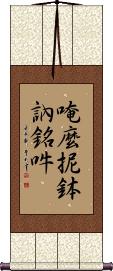
唵麼抳鉢訥銘吽 is one of the earliest and best-known mantras in the Buddhist tradition.
It can be heard in temples from Tokyo to Tibet.
This mantra is an expression of the basic attitude of compassion. It translates literally as “oṃ the jewel in the lotus hūṃ.”
There are several titles and transliterations for this mantra, including, 六字大明呪 (Great 6-syllable mantra), 六字真言 (6-syllable Sanskrit mantra of Avalokiteshvara bodhisattva), 唵嘛呢叭咪吽, 唵嘛呢叭咪哞, and 唵嘛咪叭呢哞.
Contact me if you need any of these alternates on your wall scroll.
100 Years of Happy Marriage
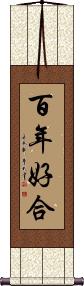
百年好合 is a wish or greeting, often heard at Chinese weddings, for a couple to have 100 good years together.
Some will translate this more naturally into English as: “May you live a long and happy life together.”
The character breakdown:
百 = 100
年 = Years
好 = Good (Happy)
合 = Together
The More We Sweat in Training, The Less We Bleed in Battle
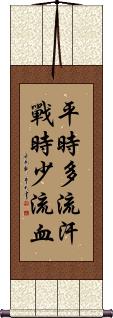
There is more than one way to translate the ancient Chinese military proverb, 平时多流汗战时少流血. Here are a few interpretations:
A drop of sweat spent in a drill is a drop of blood saved in war.
More practice will give one a better chance of success in real situations.
The more you sweat in training, the less you bleed in battle.
I heard this many times when I was a U.S. Marine but I had no idea at the time that it was actually an old Chinese proverb.
See Also: Blood Sweat and Tears
Sun / Solar
Also means Day, Sunshine, Sunlight, or Japan
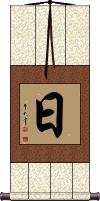
日 is the word for sun.
It also means day and can refer to the day of the month when expressing the date.
Example: October 1st would be “10 Moons, 1 Sun.”
日 is also the first Kanji for the title of Japan (in Chinese, Japanese Kanji, and Korean Hanja). Thus, this character is used as an adjective for things that are Japanese.
Ever heard of Japan being called, “The land of the rising sun”? Well, that's what the full title of Japan means.
Depending on the context, this character can mean Sunshine or Sunlight.
Note: In Japanese, this Kanji has a variety of possible pronunciations. The pronunciation changed depending on context and how this Kanji is combined with other Kanji. When used alone, this is usually “hi” (pronounced like “hee”) but sometimes it’s “nichi.” When combined, it can be “tsu,” “ni,” “ka,” and a few others.
The Whole Room Rocks With Laughter
The perfect scroll if you love humor or as a gift for the comedian in your life
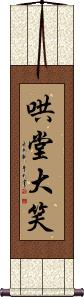
In China, 哄堂大笑 is a proverb that is used in response to a good joke or witty comment.
The story goes that Mr. Feng and Mr. He were both senior officials in the Song Dynasty (about a thousand years ago). One day, Mr. Feng walked into their shared office wearing a new pair of boots. The boots caught the eye of Mr. He who said, “New boots! - how much were they?.” Mr. Feng lifted one of the boots off the ground as if to show it off and responded, “900 coins.”
Astonished, Mr. Feng explained, “900? How can that be? - I paid 1800 coins for my boots!.” Mr. Feng then lifted his other foot off the ground and said, “This boot was also 900 coins.”
It is said that the whole room was shaking from the laughter of all that heard Mr. Feng's joke on Mr. He.
Drain the pond to get all the fish
Kill the goose that lays the golden eggs
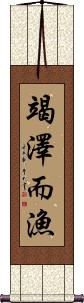
In 632 BC, Duke Wen of the Kingdom of Jin was about to lead an army against the forces of the Kingdom of Chu.
The Duke asked one of his advisers, Jiu Fan, how they could win the impending battle, as they were drastically outnumbered.
Jiu Fan said, “All is fair in war,” and suggested a plan of dishonorable tactics (cheating).
The Duke was unsure of this advice, so he asked another adviser, Yong Ji, who replied, “If you catch fish by draining the pond, you can certainly get all the fish. But there will be no fish the following year. You can cheat this one time in battle, but such tactics can only be used once, as the enemy will be wise in future encounters.”
The Duke heard the words of his wiser adviser but cheated to gain victory in the battle. However, he rewarded Yong Ji more than Jiu Fan at the victory celebration, stating that while Jiu Fan's advice gained one victory, the wise words of Yong Ji would last forever.
This Chinese idiom/proverb is still used, over 2600 years later to remind people not to burn bridges, cheat, or dishonor themselves in exchange for a short-term gain while sacrificing the future.
竭澤而漁 is very similar to the meaning of the English phrase, “Kill the goose that lays the golden eggs.”
Taekwondo
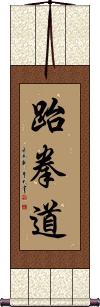
跆拳道 is one of the most widespread types of martial arts in the world as well as being an Olympic sport. Taekwondo was born in Korea with influences of Chinese and Japanese styles combined with traditional Korean combat skills. Some will define it as the “Korean art of empty-handed self-defense.”
In the simplest translation, the first character means “kick,” the second character can mean either “fist” or “punching,” and the third means “way” or “method.” Altogether, you could say this is the “Kick Punch Method.” When heard or read in various Asian languages, all will automatically think of this famous Korean martial art. It is written the same in Japanese Kanji, Chinese, and Korean Hanja characters - so the appearance of the characters is universal. However, you should note that there is another way to write this in modern Korean Hangul characters, which looks like the image to the right. 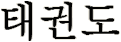
We suggest the original Korean Hanja (Chinese characters) for a wall scroll, but if you need the Hangul version, you must use master calligrapher Cao Bin: Order Taekwondo in Korean Hangul
Note: Taekwondo is sometimes Romanized as Tae-Kwondo, Tae Kwon Do, Taekwon-do, Taegwondo, Tae Gweon Do, Tai Kwon Do, Taikwondo, Taekwando, Tae Kwan Do and in Chinese Taiquandao, Tai Quan Dao, Taichuando, or Tai Chuan Tao.
Islam
(phonetic version)
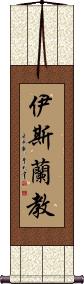
伊斯蘭教 both means and sounds like “Islam” in Mandarin Chinese.
The first three characters sound like the word “Islam,” and the last character means “religion” or “teaching.” It's the most general term for “Islam” in China. The highest concentration of Muslims in China is Xinjiang (the vast region in northwest China that was called The East Turkistan Republic until 1949 and is sometimes called Chinese Turkistan, Uyghuristan). Here you will find Uygurs, Kazakhs, Kyrgyz, and others that are descendants of Turkmen (possibly mixed with Persians and Arabs). Many of their ancestors were traders who traveled the silk road to buy and sell spices and silk and exchange other goods from the Orient and the Middle East.
I spent some time in Xinjiang and got to know this community. They are strong people who can endure much. They are friendly and love to have a good time. I was a stranger but was treated by villagers (near China's border with Afghanistan) as if I was a good friend.
However, I have heard that it's best not to cross them, as in this land, the law is the blade, and everything is “eye for an eye.” The Chinese government has little control in Xinjiang, with almost no police officers except in the capital of Urumqi (so it's a 60-hour roundtrip train ride to seek the aid of law enforcement in most cases).
While few seem devout, there are at least small mosques in every village. And you will never see a man or woman outside without a head covering.
It should be noted that these people are all citizens of China, but they are officially of the Caucasian race. A visit to Xinjiang will change your idea of what it means to be Chinese.
The following table may be helpful for those studying Chinese or Japanese:
| Title | Characters | Romaji (Romanized Japanese) | Various forms of Romanized Chinese | |
| Heard | 赫德 | hè dé / he4 de2 / he de / hede | ho te / hote | |
| Heard | ハード | haado / hado | ||
| Herculean Strength | 強力 强力 | kyou ryoku / kyouryoku / kyo ryoku | qiáng lì / qiang2 li4 / qiang li / qiangli | ch`iang li / chiangli / chiang li |
| Om Mani Padme Hum | 唵麼抳鉢訥銘吽 唵么抳钵讷铭吽 | on mani padomei un onmanipadomeiun | ǎn mó nǐ bō míng hǒu an3 mo2 ni3 bo1 ne4 ming2 hou3 an mo ni bo ne ming hou anmoniboneminghou | an mo ni po ne ming hou anmoniponeminghou |
| 100 Years of Happy Marriage | 百年好合 | bǎi nián hǎo hé bai3 nian2 hao3 he2 bai nian hao he bainianhaohe | pai nien hao ho painienhaoho |
|
| The More We Sweat in Training, The Less We Bleed in Battle | 平時多流汗戰時少流血 平时多流汗战时少流血 | píng shí duō liú hàn zhàn shí shǎo liú xuè ping2 shi2 duo1 liu2 han4 zhan4 shi2 shao3 liu2 xue4 ping shi duo liu han zhan shi shao liu xue | p`ing shih to liu shih shao liu hsüeh ping shih to liu shih shao liu hsüeh |
|
| Sun Solar | 日 | hi / nichi | rì / ri4 / ri | jih |
| The Whole Room Rocks With Laughter | 哄堂大笑 | hōng tāng dà xiào hong1 tang1 da4 xiao4 hong tang da xiao hongtangdaxiao | hung t`ang ta hsiao hungtangtahsiao hung tang ta hsiao |
|
| Drain the pond to get all the fish | 竭澤而漁 竭泽而渔 | jié zé ér yú jie2 ze2 er2 yu2 jie ze er yu jiezeeryu | chieh tse erh yü chiehtseerhyü |
|
| Taekwondo | 跆拳道 | te kon do / tekondo | tái quán dào tai2 quan2 dao4 tai quan dao taiquandao | t`ai ch`üan tao taichüantao tai chüan tao |
| Islam | 伊斯蘭教 伊斯兰教 | yī sī lán jiào yi1 si1 lan2 jiao4 yi si lan jiao yisilanjiao | i ssu lan chiao issulanchiao |
|
| In some entries above you will see that characters have different versions above and below a line. In these cases, the characters above the line are Traditional Chinese, while the ones below are Simplified Chinese. | ||||

Successful Chinese Character and Japanese Kanji calligraphy searches within the last few hours...



