Many custom options


And formats



Finger in Chinese / Japanese
Buy a Finger calligraphy wall scroll here!
Personalize your custom “Finger” project by clicking the button next to your favorite “Finger” title below.
Finger

芬格 is the name Finger in Chinese (Mandarin).
Finger

フィンガー is the name Finger in Japanese Katakana.
Note: Because this title is entirely Japanese Katakana, it should be written by a Japanese calligrapher.
Shiatsu-Do
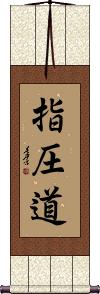
指圧道 is the title for Shiastu-Do, the Japanese way of finger pressure.
Shitsu-Do is about applying special finger pressure to points on the body thought to be connected to pathways called “meridians.” Shiatsu is a healthful way to get your 気 or 氣 (ki energy) flowing properly.
Note: This title can also be written in the older 指壓道 form (just the middle character has an ancient/traditional form used before WWII).
You might even see 指压道 which uses the Simplified Chinese form of the second character.
The Red String
Thread of Lover's Destiny / Fate
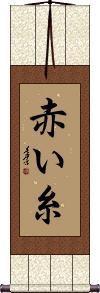
This literally translates as “the red string” or “the red thread” in Japanese, but the real meaning is much deeper...
In Japanese culture, it's believed that fate, destiny, or karma joins lovers by an unseen string, tied around one little finger of each. 赤い糸 is how soul mates find and are drawn to each other.
The Japanese concept of the red thread of fate, by most estimations, comes from Chinese folklore, where it's known as 姻緣紅線. The only difference is that in China, the celestial red thread is tied around the ankles of the lovers (versus what is usually represented as the pinky finger in Japan).
These search terms might be related to Finger:
Daimyo / Great Name
Feel at Ease Anywhere / the World is My Home
Make Guests Feel at Home
Proud of One’s Name
Sorry / Feel Apologetic / Regret
You Are Only as Old as You Feel
Not the results for Finger that you were looking for?
Below are some entries from our dictionary that may match your Finger search:
| Characters If shown, 2nd row is Simp. Chinese |
Pronunciation Romanization |
Simple Dictionary Definition |
シル see styles |
jiru ジル |
More info & calligraphy: Sill |
赤い糸 see styles |
akaiito / akaito あかいいと |
More info & calligraphy: The Red String |
フィンガー see styles |
fingaa / finga フィンガー |
More info & calligraphy: Finger |
印 see styles |
yìn yin4 yin in いん |
to print; to mark; to engrave; a seal; a print; a stamp; a mark; a trace; image (1) stamp; seal; chop; (2) seal impression; seal; sealing; stamp; mark; print; (3) {Buddh} mudra (symbolic hand gesture); (4) ninja hand sign; (5) (abbreviation) (See 印度・インド) India; (surname) In mudrā; seal, sign, symbol, emblem, proof, assurance, approve; also 印契; 契印; 印相. Manual signs indicative of various ideas, e. g. each finger represents one of the five primary elements, earth, water, fire, air, and space, beginning with the little finger; the left hand represents 定 stillness, or meditation, the right hand 慧 discernment or wisdom; they have also many other indications. Also, the various symbols of the Buddhas and Bodhisattvas, e. g. the thunderbolt; cf. 因.; (度) The five Indias, or five regions of India, idem 五天竺 q. v. |
咫 see styles |
zhǐ zhi3 chih ata あた |
8 in. length unit of Zhou dynasty (n,n-suf,ctr) (archaism) distance between outstretched thumb and middle finger (approx. 18 cm) |
弓 see styles |
gōng gong1 kung yumi ゆみ |
a bow (weapon); CL:張|张[zhang1]; to bend; to arch (one's back etc) (1) (ゆ is usu. a prefix) bow (weapon); (2) (ゆみ only) archery; (3) (ゆみ only) bow (for a violin, etc.); (surname, female given name) Yumi Dhanus. A bow; a bow's length, i. e. the 4, 000th part of a yojana. Seven grains of wheat 麥 make 1 finger-joint 指節; 24 finger-joints make 1 elbow or cubit 肘; 4 cubits make 1 bow; or 1 foot 5 inches make 1 elbow or cubit: 4 cubits make 1 bow; 300 bows make 1 li; but the measures are variously given. |
戒 see styles |
jiè jie4 chieh kai; ingoto(ok) かい; いんごと(ok) |
to guard against; to exhort; to admonish or warn; to give up or stop doing something; Buddhist monastic discipline; ring (for a finger) (1) (かい only) {Buddh} admonition; commandment; (2) sila (precept) śīla, 尸羅. Precept, command, prohibition, discipline, rule; morality. It is applied to the five, eight, ten, 250, and other commandments. The five are: (1) not to kill; (2 ) not to steal; (3) not to commit adultery; (4) not to speak falsely; (5) not to drink wine. These are the commands for lay disciples; those who observe them will be reborn in the human realm. The Sarvāstivādins did not sanction the observance of a limited selection from them as did the 成實宗 Satyasiddhi school. Each of the five precepts has five guardian spirits, in all twenty-five, 五戒二十五神. The eight for lay disciples are the above five together with Nos. 7, 8, and 9 of the following; the ten commands for the ordained, monks and nuns, are the above five with the following: (6) not to use adornments of flowers, nor perfumes; (7) not to perform as an actor, juggler, acrobat, or go to watch and hear them; (8) not to sit on elevated, broad, and large divans (or beds); (9) not to eat except in regulation hours; (10) not to possess money, gold or silver, or precious things. The 具足戒full commands for a monk number 250, those for a nun are 348, commonly called 500. Śīla is also the first of the 五分法身, i.e. a condition above all moral error. The Sutra of Brahma's Net has the following after the first five: (6) not to speak of the sins of those in orders; (7) not to vaunt self and depreciate others; (8) not to be avaricious; (9) not to be angry; (10) not to slander the triratna. |
指 see styles |
zhǐ zhi3 chih sashizaki さしざき |
finger; to point at or to; to indicate or refer to; to depend on; to count on; (of hair) to stand on end finger; toe; digit; (surname) Sashizaki Finger, toe; to point, indicate. |
摁 see styles |
èn en4 en |
to press (with one's finger or hand) |
摳 抠 see styles |
kōu kou1 k`ou kou |
to dig; to pick; to scratch (with a finger or something pointed); to carve; to cut; to study meticulously; stingy; miserly; to lift up (esp. the hem of a robe) |
撳 揿 see styles |
qìn qin4 ch`in chin |
to press (with one's hand or finger) |
鎦 镏 see styles |
liù liu4 liu |
(bound form) finger ring; Taiwan pr. [liu2] |
一指 see styles |
isshi いっし |
one finger |
中指 see styles |
zhōng zhǐ zhong1 zhi3 chung chih nakasashi なかさし |
middle finger (1) middle finger; long finger; second finger; tall finger; (2) middle toe; third toe; (surname) Nakasashi |
二指 see styles |
èr zhǐ er4 zhi3 erh chih |
index finger |
五逆 see styles |
wǔ nì wu3 ni4 wu ni gogyaku ごぎゃく |
(1) {Buddh} five cardinal sins (killing one's father, killing one's mother, killing an arhat, shedding the blood of a Buddha, causing a schism within the sangha); (2) (hist) crime of killing one's master, father, grandfather, mother, or grandmother pañcānantarya; 五無間業 The five rebellious acts or deadly sins, parricide, matricide, killing an arhat, shedding the blood of a Buddha, destroying the harmony of the sangha, or fraternity. The above definition is common both to Hīnayāna and Mahāyāna. The lightest of these sins is the first; the heaviest the last. II. Another group is: (1) sacrilege, such as destroying temples, burning sutras, stealing a Buddha's or a monk's things, inducing others to do so, or taking pleasure therein; (2) slander, or abuse of the teaching of śrāvaka s, pratyekabuddhas, or bodhisattvas; (3) ill-treatment or killing of a monk; (4) any one of the five deadly sins given above; (5) denial of the karma consequences of ill deeds, acting or teaching others accordingly, and unceasing evil life. III. There are also five deadly sins, each of which is equal to each of the first set of five: (1) violation of a mother, or a fully ordained nun; (2) killing a bodhisattva in a sangha; (5) destroying a Buddha's stūpa. IV. The five unpardonable sin of Devadatta who (1) destroyed the harmony of the community; (2) injured Śākyamuni with a stone, shedding his blood; (3) induced the king to let loose a rutting elephant to trample down Śākyamuni; (4) killed a nun; (5) put poison on his finger-nails and saluted Śākyamuni intending to destroy him thereby. |
划拳 see styles |
huá quán hua2 quan2 hua ch`üan hua chüan |
finger-guessing game |
刹那 see styles |
chàn à chan4 a4 ch`an a chan a setsuna せつな |
(n-adv,n-t) moment (san: ksana); instant; juncture; (female given name) Setsuna kṣaṇa. An indefinite space of time, a moment, an instant; the shortest measure of time, as kalpa is the longest; it is defined as 一念 a thought; but according to another definition 60 kṣaṇa equal one finger-snap, 90 a thought 念, 4,500 a minute; there are other definitions. In each kṣaṇa 900 persons are born and die. |
勘所 see styles |
kandokoro かんどころ |
(1) finger board (of a musical instrument); (2) vital point |
地大 see styles |
dì dà di4 da4 ti ta chihiro ちひろ |
(personal name) Chihiro Earth as one of the 四大 four elements, 地 earth, 水大 water, 火大 fire, and 風大 air (i. e. air in motion, wind); to these 空大 space (Skt. ākāśa) is added to make the 五大 five elements; 識 vijñāna, perception to make the six elements; and 見 darśana, views, concepts, or reasonings to make the seven elements. The esoteric sect use the five fingers, beginning with the little finger, to symbolize the five elements. |
坐享 see styles |
zuò xiǎng zuo4 xiang3 tso hsiang |
to enjoy (the benefit of something) without lifting a finger; to sit back and enjoy (favorable circumstances) |
子指 see styles |
koyubi こゆび |
(1) little finger; pinky; (2) little toe |
小指 see styles |
xiǎo zhǐ xiao3 zhi3 hsiao chih kozasu こざす |
little finger (1) little finger; pinky; fourth (occ. fifth) finger; (2) little toe; (surname) Kozasu |
弾指 see styles |
danshi; tanji(ok); danji(ok); tanshi(ok) だんし; たんじ(ok); だんじ(ok); たんし(ok) |
(1) {Buddh} snapping the fingers (esp. by striking the side of the middle finger with the thumb; to indicate consent, joy, a warning, etc.); (2) {Buddh} moment; instant; (noun, transitive verb) (3) (archaism) criticism; shunning; rejection |
戒子 see styles |
jiè zi jie4 zi5 chieh tzu |
(finger) ring |
戒指 see styles |
jiè zhi jie4 zhi5 chieh chih |
(finger) ring |
手印 see styles |
shǒu yìn shou3 yin4 shou yin shuin |
handprint; fingerprint; thumbprint mūdra, mystic positions of the hand; signet-rings, seals; finger-prints. |
手垢 see styles |
teaka てあか |
finger marks; dirty marks |
手指 see styles |
shǒu zhǐ shou3 zhi3 shou chih teyubi; shushi てゆび; しゅし |
finger; CL:個|个[ge4],隻|只[zhi1] (1) finger; (2) hands and fingers; hands hands and fingers |
拇戰 拇战 see styles |
mǔ zhàn mu3 zhan4 mu chan |
finger-guessing game |
Click here for more Finger results from our dictionary
The following table may be helpful for those studying Chinese or Japanese:
| Title | Characters | Romaji (Romanized Japanese) | Various forms of Romanized Chinese | |
| Finger | 芬格 | fēn gé / fen1 ge2 / fen ge / fenge | fen ko / fenko | |
| Finger | フィンガー | fingaa / finga | ||
| Shiatsu-Do | 指圧道 | shiatsudou / shiatsudo | ||
| The Red String | 赤い糸 | akai ito / akaiito | ||

Successful Chinese Character and Japanese Kanji calligraphy searches within the last few hours...



