Many custom options...


And formats...



Bridges in Chinese / Japanese...
Buy a Bridges calligraphy wall scroll here!
Personalize your custom “Bridges” project by clicking the button next to your favorite “Bridges” title below...
Bridges

ブリッジス is the name Bridges in Japanese Katakana.
Note: Because this title is entirely Japanese Katakana, it should be written by a Japanese calligrapher.
Drain the pond to get all the fish
Kill the goose that lays the golden eggs
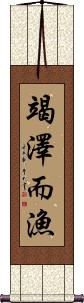
In 632 BC, Duke Wen of the Kingdom of Jin was about to lead an army against the forces of the Kingdom of Chu.
The Duke asked one of his advisers, Jiu Fan, how they could win the impending battle, as they were drastically outnumbered.
Jiu Fan said, “All is fair in war,” and suggested a plan of dishonorable tactics (cheating).
The Duke was unsure of this advice, so he asked another adviser, Yong Ji, who replied, “If you catch fish by draining the pond, you can certainly get all the fish. But there will be no fish the following year. You can cheat this one time in battle, but such tactics can only be used once, as the enemy will be wise in future encounters.”
The Duke heard the words of his wiser adviser but cheated to gain victory in the battle. However, he rewarded Yong Ji more than Jiu Fan at the victory celebration, stating that while Jiu Fan's advice gained one victory, the wise words of Yong Ji would last forever.
This Chinese idiom/proverb is still used, over 2600 years later to remind people not to burn bridges, cheat, or dishonor themselves in exchange for a short-term gain while sacrificing the future.
竭澤而漁 is very similar to the meaning of the English phrase, “Kill the goose that lays the golden eggs.”
Not the results for Bridges that you were looking for?
Below are some entries from our dictionary that may match your Bridges search...
| Characters If shown, 2nd row is Simp. Chinese |
Pronunciation Romanization |
Simple Dictionary Definition |
座 see styles |
zuò zuo4 tso za ざ |
seat; base; stand; (bound form) constellation; (archaic) suffix used in a respectful form of address (e.g. 師座|师座[shi1 zuo4]); classifier for large immovable objects such as buildings, mountains, bridges etc (1) seat; place; (2) position; status; (3) gathering; party; company; atmosphere (of a gathering); (4) stand; pedestal; platform; (5) (hist) trade guild; (suffix) (6) attaches to the names of constellations; (suffix) (7) attaches to the names of theatres, cinemas and theatrical troupes; (suf,ctr) (8) (See 里神楽) counter for theatres, deities, Buddhist images, tall mountains, and satokagura songs; (surname) Za āsana. A seat; throne; classifier of buildings, etc. |
八百八橋 see styles |
happyakuyabashi はっぴゃくやばし |
the large number of bridges over canals and rivers in Naniwa (present-day Osaka) |
八福生處 八福生处 see styles |
bā fú shēng chù ba1 fu2 sheng1 chu4 pa fu sheng ch`u pa fu sheng chu hachifuku shōsho |
The eight happy conditions in which he may be reborn who keeps the five commands and the ten good ways and bestows alms: (1) rich and honourable among men; (2) in the heavens of the four deva kings; (3) the Indra heavens; (4) Suyāma heavens; (5) Tuṣita heaven; (6) 化樂nirmāṇarati heaven, i.e. the fifth devaloka; (7) 他化 Paranirmita-vaśavartin, i.e. the sixth devaloka heaven; (8) the brahma-heavens. 八福田 The eight fields for cultivating blessedness: Buddhas; arhats (or saints); preaching monks (upādhyāya); teachers (ācārya); friars; father; mother; the sick. Buddhas, arhats, and friars (or monks in general) are termed 敬田 reverence-fields; the sick are 悲田 compassion-fields; the rest are 恩田grace- or gratitude- fields. Another group is: to make roads and wells; canals and bridges; repair dangerous roads; be dutiful to parents; support monks; tend the sick; save from disaster or distress; provide for a quinquennial assembly. Another: serving the Three Precious Ones, i.e. the Buddha; the Law; the Order; parents; the monks as teachers; the poor; the sick; animals. |
無路可退 无路可退 see styles |
wú lù kě tuì wu2 lu4 ke3 tui4 wu lu k`o t`ui wu lu ko tui |
without a retreat route; caught in a dead end; having burned one's bridges |
立體交叉 立体交叉 see styles |
lì tǐ jiāo chā li4 ti3 jiao1 cha1 li t`i chiao ch`a li ti chiao cha |
three-dimensional road junction (i.e. involving flyover bridges or underpass tunnels); overpass |
背水の陣 see styles |
haisuinojin はいすいのじん |
(expression) (idiom) fighting with one's back to the wall; having burnt one's bridges; last stand; from strategy of general Han Xin in the Battle of Jingxing |
ブリッジェス see styles |
burijjezu ブリッジェズ |
(personal name) Bridges |
ライトアップ see styles |
raitoapu ライトアップ |
illumination of bridges, buildings, trees, etc. at night (wasei: light up); (architectural) floodlighting |
ライト・アップ |
raito apu ライト・アップ |
illumination of bridges, buildings, trees, etc. at night (wasei: light up); (architectural) floodlighting |
マディソン郡の橋 see styles |
madisongunnohashi マディソンぐんのはし |
(work) The Bridges of Madison County (1992 novel by Robert James Waller, 1995 film); (wk) The Bridges of Madison County (1992 novel by Robert James Waller, 1995 film) |
Variations: |
haisuinojin はいすいのじん |
(exp,n) (idiom) fighting with one's back to the wall; having burnt one's bridges; last stand; last-ditch effort |
The following table may be helpful for those studying Chinese or Japanese...
| Title | Characters | Romaji (Romanized Japanese) | Various forms of Romanized Chinese | |
| Bridges | ブリッジス | burijjisu | ||
| Drain the pond to get all the fish | 竭澤而漁 竭泽而渔 | jié zé ér yú jie2 ze2 er2 yu2 jie ze er yu jiezeeryu | chieh tse erh yü chiehtseerhyü |
|
| In some entries above you will see that characters have different versions above and below a line. In these cases, the characters above the line are Traditional Chinese, while the ones below are Simplified Chinese. | ||||

Successful Chinese Character and Japanese Kanji calligraphy searches within the last few hours...



