Many custom options...


And formats...



迷 in Chinese / Japanese...
Buy an 迷 calligraphy wall scroll here!
Personalize your custom “迷” project by clicking the button next to your favorite “迷” title below...
Lost / Dazed and Confused
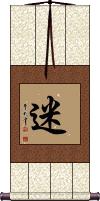
迷 is one of those characters that can mean a lot of different things depending on context. When written alone, as a single character on a wall scroll, it opens up the possibilities and allows you to decide what it means to you.
The key definition is “to be lost.” This could be physically or mentally lost. It can be someone lost in their thoughts, lost in an ocean, or just confused about where they are. The reason for the confused state may be due to internal or external reasons.
Here are some entries from various Asian dictionaries...
Chinese: lost, confused, bewilder, crazy about, fan, enthusiast, mystery.
Japanese: lost, astray, perplexed, in doubt, err, illusion.
Korean: lost, bewildered, fascinated, deluded.
Lost Love
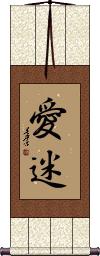
荷花 is a Japanese title that can mean straying from love, falling out of love, or losing love.
Maze

迷宮 is the name Maze in Chinese (Mandarin).
Mini

迷你 is the name Mini in Chinese (Mandarin).
Gemini
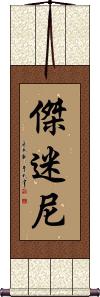
傑迷尼 is the most common transliteration to Mandarin Chinese for the name Gemini.
This sounds like “Gemini” but does not have the meaning “Gemini” (twin constellation).
Mizong-Yi
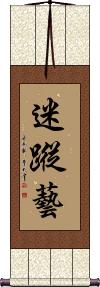
迷蹤藝 is the Chinese martial arts known as Mizong-Yi or Mizongyi, based on deception and mobility.
If you directly translate 迷蹤藝, you get something like “Lost Track Skill,” “Lost in the Art,” or “Mysterious Footwork Technique.”
Daodejing / Tao Te Ching - Chapter 27
The Mastery of Effortless Skill

Chapter 27 of the Daodejing reveals a profound truth about mastery: the highest skill leaves no trace, requires no force, and appears almost invisible.
善行無轍跡,
善言無瑕謫,
善數不用籌策,
善閉無關鍵而不可開,
善結無繩約而不可解。
是以聖人常善救人,
故無棄人;
常善救物,
故無棄物。
是謂襲明。
故善人者,不善人之師;
不善人者,善人之資。
不貴其師,不愛其資,
雖智大迷,
是謂要妙。
The sage moves through life with such natural harmony that nothing seems imposed; doors need no locks, knots require no rope, and actions leave no mark behind.
This is the essence of wúwéi (effortless action), where true ability arises from deep alignment with the Tao rather than deliberate effort.
At its heart, this chapter teaches compassion without exception. The sage “abandons no one and nothing,” recognizing value in all people and all things. Even those who seem flawed or unrefined are not rejected, but understood as part of a greater whole with each person both a student and a teacher in the unfolding of life.
Laozi reminds us that wisdom is not about perfection or control, but about subtle awareness. The truly skilled individual does not rely on tools, rules, or rigid structures; instead, they embody an intuitive understanding that makes their actions naturally complete.
In this way, excellence becomes quiet, effortless, and beyond imitation.
This teaching also reflects a deeper philosophical insight: Opposites are interdependent. The “good” person learns from the “not good,” and the “not good” provides the material for growth. To reject either is to misunderstand the balance of existence itself.
As calligraphy, Daodejing Chapter 27 serves as a reminder to cultivate inner mastery rather than outward display. It is a meditation on refinement, humility, and the quiet power of skill perfected through harmony with the natural order.
Note: The Chinese text used here is based on the early Mawangdui silk manuscript tradition (2nd century BCE). The Guodian manuscripts do NOT preserve Chapter 27 in full form.
Not the results for 迷 that you were looking for?
Below are some entries from our dictionary that may match your 迷 search...
| Characters If shown, 2nd row is Simp. Chinese |
Pronunciation Romanization |
Simple Dictionary Definition |
迷 see styles |
mí mi2 mi mei |
More info & calligraphy: Lost / Dazed and Confusedmāyā; delude, deceive, confuse, mislead; delusion, illusion, etc. |
愛迷 see styles |
aimei / aime あいめい |
More info & calligraphy: Lost Love |
迷你 see styles |
mí nǐ mi2 ni3 mi ni |
More info & calligraphy: Mini |
迷宮 迷宫 see styles |
mí gōng mi2 gong1 mi kung meikyuu / mekyu めいきゅう |
More info & calligraphy: Maze(1) labyrinth; maze; (2) (See 迷宮入り) mystery; (3) {vidg} dungeon |
三迷 see styles |
sān mí san1 mi2 san mi sanmei |
Sama, 等, equal, like, same as. |
不迷 see styles |
bù mí bu4 mi2 pu mi fumei |
not confused |
低迷 see styles |
dī mí di1 mi2 ti mi teimei / teme ていめい |
blurred (landscape etc); low (spirits); in a slump (economy) (n,vs,vi) (1) hanging low (of clouds); (n,vs,vi) (2) remaining low (of sales, stock prices, etc.); remaining sluggish (of the economy, market, etc.); hovering (around a low level); floundering; slump; depression |
入迷 see styles |
rù mí ru4 mi2 ju mi |
to be fascinated; to be enchanted |
八迷 see styles |
bā mí ba1 mi2 pa mi hachimei |
The eight misleading terms, which form the basis of the logic of the 中論, i.e. 生 birth, 滅 death, 去 past, 來 future, 一 identity, 異 difference, 斷 annihilation, 常 perpetuity (or eternity). The 三論宗 regards these as unreal; v. 八不中道. |
北迷 see styles |
hokumei / hokume ほくめい |
(given name) Hokumei |
哈迷 see styles |
hā mí ha1 mi2 ha mi |
Harry Potter fan (slang) |
四迷 see styles |
sì mí si4 mi2 ssu mi shimei / shime しめい |
(given name) Shimei idem 四執. |
執迷 执迷 see styles |
zhí mí zhi2 mi2 chih mi |
to be obsessive; to persist obstinately |
大迷 see styles |
dà mí da4 mi2 ta mi daimei |
greatly confused |
失迷 see styles |
shī mí shi1 mi2 shih mi |
to lose one's way; to get lost (on the road etc) |
嵯迷 see styles |
samei / same さめい |
(given name) Samei |
影迷 see styles |
yǐng mí ying3 mi2 ying mi |
film enthusiast; movie fan; CL:個|个[ge4] |
悽迷 凄迷 see styles |
qī mí qi1 mi2 ch`i mi chi mi |
pained and bewildered |
惑迷 see styles |
huò mí huo4 mi2 huo mi wakumei |
to delude |
愚迷 see styles |
yú mí yu2 mi2 yü mi gumei |
deluded |
所迷 see styles |
suǒ mí suo3 mi2 so mi shomei |
that which is misconstrued |
昏迷 see styles |
hūn mí hun1 mi2 hun mi konmei / konme こんめい |
to lose consciousness; to be in a coma; stupor; coma; stunned; disoriented (n,vs,adj-no) stupefaction; stupor; unconsciousness; confusion delusion |
有迷 see styles |
yǒu mí you3 mi2 yu mi umei |
to have delusion |
樂迷 乐迷 see styles |
yuè mí yue4 mi2 yüeh mi |
music fan |
歌迷 see styles |
gē mí ge1 mi2 ko mi |
fan of a singer |
沉迷 see styles |
chén mí chen2 mi2 ch`en mi chen mi |
to be engrossed; to be absorbed with; to lose oneself in; to be addicted to |
淒迷 凄迷 see styles |
qī mí qi1 mi2 ch`i mi chi mi |
dreary and fuzzy (sight) |
混迷 see styles |
konmei / konme こんめい |
(n,vs,vi) turmoil; chaos; confusion |
獸迷 兽迷 see styles |
shòu mí shou4 mi2 shou mi |
furry (fan of anthropomorphic animal characters) |
球迷 see styles |
qiú mí qiu2 mi2 ch`iu mi chiu mi |
fan (ball sports); CL:個|个[ge4] |
Click here for more 迷 results from our dictionary
The following table may be helpful for those studying Chinese or Japanese...
| Title | Characters | Romaji (Romanized Japanese) | Various forms of Romanized Chinese | |
| Lost Dazed and Confused | 迷 | mei | mí / mi2 / mi | |
| Lost Love | 愛迷 | ai mei / aimei | ||
| Maze | 迷宮 迷宫 | mí gōng / mi2 gong1 / mi gong / migong | mi kung / mikung | |
| Mini | 迷你 | mí nǐ / mi2 ni3 / mi ni / mini | ||
| Gemini | 傑迷尼 杰迷尼 | jié mǐ ní jie2 mi2 ni1 jie mi ni jiemini | chieh mi ni chiehmini |
|
| Mizong-Yi | 迷蹤藝 迷踪艺 | mí zōng yì mi2 zong1 yi4 mi zong yi mizongyi | mi tsung i mitsungi |
|
| Daodejing Tao Te Ching - Chapter 27 | 善行無轍跡善言無瑕謫善數不用籌策善閉無關鍵而不可開善結無繩約而不可解是以聖人常善救人故無棄人常善救物故無棄物是謂襲明故善人者不善人之師不善人者善人之資不貴其師不愛其資雖智大迷是謂要妙 善行无辙迹善言无瑕谪善数不用筹策善闭无关键而不可开善结无绳约而不可解是以圣人常善救人故无弃人常善救物故无弃物是谓袭明故善人者不善人之师不善人者善人之资不贵其师不爱其资虽智大迷是谓要妙 | shàn xíng wú zhé jì shàn yán wú xiá zhé shàn shù bù yòng chóu cè shàn bì wú guān jiàn ér bù kě kāi shàn jié wú shéng yuē ér bù kě jiě shì yǐ shèng rén cháng shàn jiù rén gù wú qì rén cháng shàn jiù wù gù wú qì wù shì wèi xí míng gù shàn rén zhě bù shàn rén zhī shī bù shàn rén zhě shàn rén zhī zī bù guì qí shī bù ài qí zī suī zhì dà mí shì wèi yào miào shan4 xing2 wu2 zhe2 ji4 shan4 yan2 wu2 xia2 zhe2 shan4 shu4 bu4 yong4 chou2 ce4 shan4 bi4 wu2 guan1 jian4 er2 bu4 ke3 kai1 shan4 jie2 wu2 sheng2 yue1 er2 bu4 ke3 jie3 shi4 yi3 sheng4 ren2 chang2 shan4 jiu4 ren2 gu4 wu2 qi4 ren2 chang2 shan4 jiu4 wu4 gu4 wu2 qi4 wu4 shi4 wei4 xi2 ming2 gu4 shan4 ren2 zhe3 bu4 shan4 ren2 zhi1 shi1 bu4 shan4 ren2 zhe3 shan4 ren2 zhi1 zi1 bu4 gui4 qi2 shi1 bu4 ai4 qi2 zi1 sui1 zhi4 da4 mi2 shi4 wei4 yao4 miao4 shan xing wu zhe ji shan yan wu xia zhe shan shu bu yong chou ce shan bi wu guan jian er bu ke kai shan jie wu sheng yue er bu ke jie shi yi sheng ren chang shan jiu ren gu wu qi ren chang shan jiu wu gu wu qi wu shi wei xi ming gu shan ren zhe bu shan ren zhi shi bu shan ren zhe shan ren zhi zi bu gui qi shi bu ai qi zi sui zhi da mi shi wei yao miao | shan hsing wu che chi shan yen wu hsia che shan shu pu yung ch`ou ts`e shan pi wu kuan chien erh pu k`o k`ai shan chieh wu sheng yüeh erh pu k`o chieh shih i sheng jen ch`ang shan chiu jen ku wu ch`i jen ch`ang shan chiu wu ku wu ch`i wu shih wei hsi ming ku shan jen che pu shan jen chih shih pu shan jen che shan jen chih tzu pu kuei ch`i shih pu ai ch`i tzu sui chih ta mi shih wei yao miao shan hsing wu che chi shan yen wu hsia che shan shu pu yung chou tse shan pi wu kuan chien erh pu ko kai shan chieh wu sheng yüeh erh pu ko chieh shih i sheng jen chang shan chiu jen ku wu chi jen chang shan chiu wu ku wu chi wu shih wei hsi ming ku shan jen che pu shan jen chih shih pu shan jen che shan jen chih tzu pu kuei chi shih pu ai chi tzu sui chih ta mi shih wei yao miao |
|
| In some entries above you will see that characters have different versions above and below a line. In these cases, the characters above the line are Traditional Chinese, while the ones below are Simplified Chinese. | ||||

Successful Chinese Character and Japanese Kanji calligraphy searches within the last few hours...



